Japan IoT in Aerospace Market Size & Growth Rate
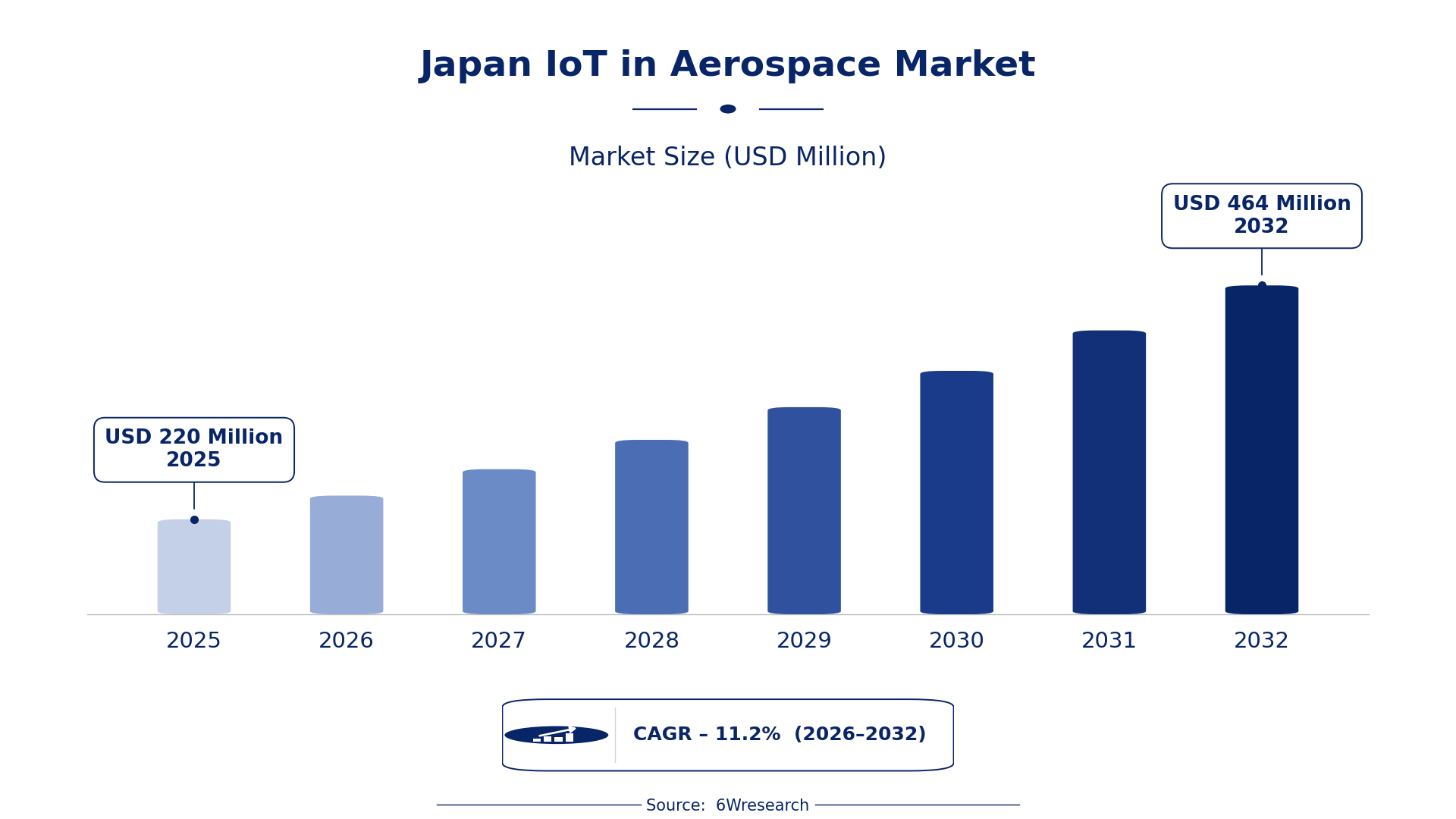
According to 6Wresearch internal database and industry insights, the Japan IoT in Aerospace Market was valued at USD 220 Million in 2025 and is projected to reach USD 464 Million by 2032, growing at a CAGR of approximately 11.2% during 2026–2032.
Japan IoT in Aerospace Market Highlights
| Report Metric | Details |
| Report Name | Japan IoT in Aerospace Market (2026-2032) |
| Market Size 2025 | USD 220 Million |
| Market Size 2032 | USD 464 Million |
| Absolute Growth 2025–2032 | USD 244 Million |
| CAGR 2026–2032 | 11.2% |
| Peak Annual Growth | 18.1% in 2026 |
| Forecast Period | 2026–2032 |
| Historical Data | 2022–2025 |
| Base Year | 2025 |
| Leading Application Type, 2025 | Predictive Maintenance (43% share) |
| Leading Sensor Type, 2025 | Vibration/Temp Sensors (53% share) |
| Leading Platform, 2025 | Commercial Aircraft (35% share) |
| Leading Use Case, 2025 | Engine Health Monitoring (43% share) |
| Leading End User, 2025 | Airlines (43% share) |
| Fastest-Growing Application Type | Cabin Monitoring (14.3% CAGR) |
| Fastest-Growing Sensor Type | Environmental Sensors (16.3% CAGR) |
| Fastest-Growing Platform | Business Jets (15.0% CAGR) |
| Fastest-Growing Use Case | Passenger Comfort (14.6% CAGR) |
| Fastest-Growing End User | Luxury Jet Owners (13.8% CAGR) |
| Growing Sector | Aerospace |
| Key End Users | Airlines, Defense Forces, Drone OEMs, Luxury Jet Owners |
Japan IoT in Aerospace Market Year-wise Growth Rate and Key Drivers (2022–2032)
This graph illustrates the annual growth rates of the market from 2022 to 2032, highlighting a steady upward trajectory and projected market expansion over the forecast period.
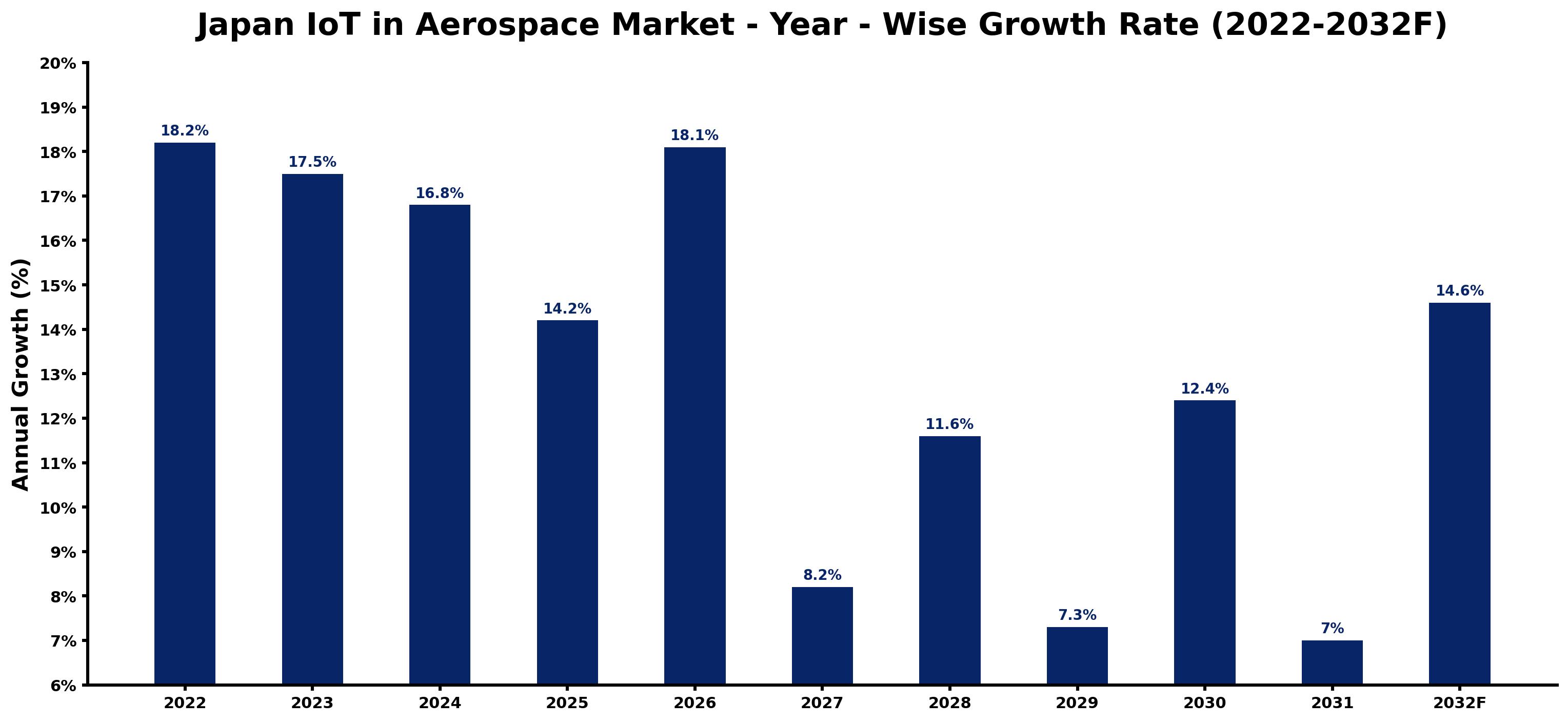
Annual growth estimates for each year appear below with the principal reason behind them, explaining the shifts that set the pace of the market.
| Year | Estimated Annual Growth (%) | Market Rationale |
| 2022 | 18.2 | The market experienced strong demand from airlines and defense sectors, driving growth. |
| 2023 | 17.5 | Growth slowed due to market saturation in certain technology segments, yet demand remained positive. |
| 2024 | 16.8 | Market expansion continued as airlines focused on improving operational efficiency through IoT. |
| 2025 | 14.2 | Investment in predictive maintenance solutions by airlines contributed to sustained growth. |
| 2026 | 18.1 | Growth is expected to accelerate as new technologies and applications gain traction in aerospace. |
| 2027 | 8.2 | A slowdown is projected as the market adjusts to previous rapid growth rates and demand stabilises. |
| 2028 | 11.6 | Increased interest in environmental sensors is expected to boost growth as airlines seek efficiency. |
| 2029 | 7.3 | Growth is anticipated to slow as market maturity sets in, with demand stabilising across segments. |
| 2030 | 12.4 | Technological advancements in IoT applications are projected to drive renewed growth. |
| 2031 | 7.0 | A slowdown in growth reflects market adjustments to technological integration and saturation. |
| 2032 | 14.6 | Growth is expected to rise as the focus on reducing emissions drives IoT adoption. |
Note: Market size estimations and growth projections presented in this report are based on 6Wresearch's proprietary forecasting methodology, utilizing the latest available industry data, government publications, and primary research inputs.
Japan IoT in Aerospace Market Synopsis
IoT in Aerospace integrates advanced technology within the Japan IoT in Aerospace Market, focusing on operational efficiency, safety, and maintenance processes. The aerospace sector, valued at approximately 2 trillion JPY, shows strong demand from airlines and defence forces, with over 30,000 registered aircraft driving the need for IoT solutions. Factors behind this growth include substantial investments in predictive maintenance solutions and the government's commitment to reducing aircraft emissions by 30% by 2030, promoting IoT technologies across various applications.
Market Dynamics Impact Analysis (2026–2032)
| Factor | Type | Impact | Primary Segment Affected |
| Increased investment in predictive maintenance solutions | Driver | High | Predictive Maintenance |
| Growing demand for environmental sensors to enhance safety | Driver | High | Environmental Sensors |
| Rising interest in smart airports drives demand for IoT integration | Opportunity | High | Commercial Aircraft |
| Emerging drone technology creates new IoT applications | Opportunity | Medium | Drones |
| High costs associated with IoT technology adoption | Restraint | High | Cabin Monitoring |
| Limited skilled workforce in IoT technology implementation | Restraint | Medium | Component Tracking |
| Regulatory challenges in drone operations hinder growth | Challenge | High | Drones |
| Competition from international suppliers affects local producers | Challenge | Medium | Military Aircraft |
Evaluation of Drivers in Japan IoT in Aerospace Market (2026–2032)
The factors lifting demand, and the evidence behind each, are summarised below.
| Drivers | Primary Segment Affected | Why It Matters (Evidence) |
| Investment in predictive maintenance solutions | Predictive Maintenance | Airlines are increasingly adopting these solutions to improve safety and reduce downtime, with 1 billion JPY allocated for technology upgrades. |
| Growing demand for environmental sensors | Environmental Sensors | Airlines are focusing on improving cabin safety and comfort, resulting in increased purchases of these sensors for monitoring, with a projected increase of 30% by 2030. |
| Expansion of smart airport initiatives | Commercial Aircraft | The Japanese government aims to promote smart airports by 2025, driving demand for IoT technologies in operational efficiency, with 500 million JPY allocated for upgrades. |
| Rising adoption of drones in various applications | Drones | The number of drone registrations in Japan has surpassed 200,000, indicating a growing market for IoT integration across various applications. |
| Focus on improving passenger comfort | Passenger Comfort | Airlines are investing in IoT technologies to elevate the travel experience, leading to increased demand for related solutions, with a projected growth of 15% by 2025. |
Spending rises because airlines are increasingly investing in predictive maintenance solutions to improve safety and reduce downtime. Approximately 1 billion JPY has been allocated for advanced aerospace technologies, driving demand for IoT applications. The push for smart airports by 2025 further fuels growth, as the Tokyo Metropolitan area, with over 20 airports, seeks efficiency improvements. The growing number of drone registrations creates new opportunities for IoT integration across various applications. This trend aligns with the aim to reduce aircraft emissions by 30% by 2030, promoting the adoption of IoT technologies.
Evaluation of Restraints in Japan IoT in Aerospace Market
The main factors holding the market back are set out below.
| Market Restraint | Primary Segment Affected | Why It Matters (Evidence) |
| High costs associated with IoT technology adoption | Cabin Monitoring | The investment required for IoT implementation can deter airlines from upgrading their systems. |
| Limited skilled workforce in IoT technology implementation | Component Tracking | A shortage of qualified personnel in Japan hampers the effective deployment of IoT solutions in aerospace. |
| Regulatory challenges in drone operations | Drones | Strict regulations set by the Japan Civil Aviation Bureau can delay the integration of IoT technologies in drone applications. |
| Competition from international suppliers | Military Aircraft | Local producers face challenges from established international suppliers, affecting market share and pricing strategies. |
| Market saturation in certain technology segments | Predictive Maintenance | As the market matures, growth rates may slow due to reduced demand for existing solutions. |
Japan IoT in Aerospace Market Challenges
Buyers in the aerospace sector face challenges integrating advanced IoT technologies due to high development costs, which can exceed 500 million JPY for sophisticated systems. Limited availability of tailored IoT solutions delays operational efficiency improvements for airlines, potentially affecting safety measures. High costs of implementing these technologies can postpone upgrades for producers, leading to increased operational risks. Skills gaps in the workforce hinder effective IoT system implementation, resulting in training costs rising by an estimated 20% for companies needing to upskill employees in this evolving field.
Trends in the Japan IoT in Aerospace Market
Below are the shifts with the largest effect on the Japan IoT in Aerospace Market.
- Shift towards Smart Airports in Tokyo: Tokyo is leading the shift towards smart airports, with the government promoting IoT integration by 2025. This initiative aims to improve operational efficiency and passenger experience, with a projected investment of 500 million JPY.
- Emerging Demand for Environmental Sensors: The Japan Aerospace Exploration Agency (JAXA) is advocating for the adoption of environmental sensors in aerospace applications. This trend is gaining traction as airlines aim to improve safety, with an expected increase in sensor usage by 30% by 2030.
- Growth in Drone Registrations: The number of drone registrations in Japan has surpassed 200,000, indicating a rapidly growing market for IoT applications. This trend reflects the increasing interest in drone technology across various sectors, including logistics and surveillance.
- Focus on Passenger Comfort Improvements: Airlines are prioritising passenger comfort through IoT technologies, with investments in cabin monitoring solutions. This trend is expected to grow as airlines seek to improve the travel experience, with a projected increase in demand by 15% by 2025.
Investment Opportunities in the Japan IoT in Aerospace Market
Where to invest in the Japan IoT in Aerospace Market: the main openings are set out below.
- Timing for Smart Airport Investments: With the government's push for smart airports by 2025, there is an opportunity for suppliers to invest in IoT technologies. Airlines in Japan are looking to improve operational efficiency, with a projected investment of 500 million JPY.
- Growing Demand from Airlines: Airlines are increasingly seeking advanced IoT solutions for predictive maintenance, creating an opportunity for technology providers. The projected growth in air travel demand supports this trend, with passenger numbers reaching 100 million in 2022.
- Gap in Environmental Sensor Adoption: There is a notable gap in the adoption of environmental sensors within the aerospace sector, presenting an opportunity for suppliers. The Japanese government aims to reduce aircraft emissions by 30% by 2030, driving demand for these technologies.
- Expansion of Drone Applications: The rapidly growing drone market in Japan offers opportunities for IoT integration across various applications. With over 200,000 registered drones, suppliers can enter this market by collaborating with drone OEMs.
Government Initiatives in the Japan IoT in Aerospace Market
The Semiconductor and Digital Industry Strategy, established by METI in June 2021, focuses on securing domestic semiconductor manufacturing, which is essential for IoT technology in aerospace. This measure ensures that producers have access to the necessary components for developing advanced IoT solutions, strengthening Japan's aerospace capabilities with an expected growth of 10% in the workforce by 2025.
A subsidy program for IoT technology adoption in aerospace has been launched, allocating 1 billion JPY for advanced aerospace technologies in 2023. The Ministry of Defense oversees this initiative, supporting the integration of IoT solutions to improve operational efficiency and safety in the aerospace sector.
Future Insight of the Japan IoT in Aerospace Market
By 2032, advancements in IoT technology will transform operational practices in aerospace. The Japanese government's subsidy program for IoT adoption will encourage producers to invest in smart technologies, improving overall efficiency. New standards for drone operations will facilitate urban air mobility, creating opportunities for diverse applications. The aerospace workforce is projected to grow by 10% by 2025, ensuring a steady supply of skilled professionals to support the implementation of advanced systems.
Market Segmentation Analysis
Japan IoT in Aerospace Market report covers a detailed analysis of the following market segments:
By Application Type – Predictive Maintenance Leads, Cabin Monitoring Expected to Grow Fastest
According to Saurav Kr Singh, Senior Research Analyst at 6Wresearch, Predictive Maintenance accounted for 43% of the market by application type in 2025. Predictive maintenance holds the largest share as it is vital for minimising aircraft downtime, appealing to airlines that focus on operational efficiency. For instance, airlines in Japan are increasingly investing in predictive maintenance solutions to enhance safety and reliability. Cabin Monitoring is projected to grow fastest, at a CAGR of 14.3% during 2026–2032. Cabin monitoring is growing rapidly as airlines prioritise improving passenger experience and safety. The Japanese government's initiative for smart airports, targeting IoT integration by 2025, significantly fuels this trend. Suppliers should concentrate on developing advanced cabin monitoring solutions to satisfy the increasing demand from airlines.
By Sensor Type – Vibration/Temp Sensors Lead, Environmental Sensors Expected to Grow Fastest
Vibration/Temp Sensors held 53% of the Japan IoT in Aerospace Market by sensor type in 2025. Vibration and temperature sensors dominate the market due to their critical role in monitoring engine and structural health, essential for safety in aviation. Their widespread application in commercial aircraft ensures a robust installed base in Japan's aerospace sector. The quickest growth will come from Environmental Sensors, forecast to expand at a CAGR of 16.3% between 2026 and 2032. Environmental sensors are expanding quickly as they ensure safety and comfort within the cabin, aligning with the growing focus on passenger experience. The rise in air travel demand in Japan is a key factor driving this segment forward. Buyers will gain from investing in environmental sensors to improve passenger comfort and safety.
By Platform – Commercial Aircraft Leads, Business Jets Expected to Grow Fastest
With 35% of platform revenue in 2025, Commercial Aircraft was the largest category. Commercial aircraft represent the largest segment as they are the primary users of IoT technologies aimed at enhancing operational efficiency. With over 30,000 registered aircraft in Japan, this platform is crucial for the integration of IoT solutions. Over 2026–2032, Business Jets are expected to post the fastest growth, at a CAGR of 15.0%. Business jets are experiencing the fastest growth due to an increasing adoption of IoT for luxury and comfort enhancements. The expanding market for private air travel in Japan is propelling this trend. Suppliers should target business jet owners with customised IoT solutions that elevate luxury and comfort.
By Use Case – Engine Health Monitoring Leads, Passenger Comfort Expected to Grow Fastest
The largest use case category in 2025 was Engine Health Monitoring, at 43% of revenue. Engine health monitoring is the leading use case as it is critical for ensuring engine reliability and performance, a top priority for airlines. This emphasis is underscored by substantial investments made by airlines in predictive maintenance technologies. Passenger Comfort is set to record the highest CAGR in this split, 14.6% over 2026–2032. Passenger comfort is the fastest-growing use case as airlines seek to enhance the travel experience for their customers. The increasing air travel demand in Japan drives this focus on passenger-centric solutions. Airlines should prioritise investments in passenger comfort technologies to meet changing customer expectations.
By End User – Airlines Lead, Luxury Jet Owners Expected to Grow Fastest
In 2025, Airlines led the end user split with a 43% share. Airlines are the largest end users of IoT in aerospace, employing these technologies for operational improvements and safety enhancements. The significant air travel demand in Japan compels airlines to adopt IoT solutions aggressively. Luxury Jet Owners are projected to grow fastest, at a CAGR of 13.8% during 2026–2032. Luxury jet owners are witnessing rapid growth in interest for high-tech solutions that elevate their flying experience. This trend is bolstered by rising wealth and demand for personalised air travel in Japan. Suppliers should cater to the luxury jet market with advanced IoT solutions tailored to high-end customer needs.
Key Attractiveness of the Report
- 10 Years of Market Numbers
- Historical Data Starting from 2022 to 2025
- Base Year 2025
- Forecast Data until 2032
- Key Performance Indicators Impacting the Market
- Major Upcoming Developments and Projects
Key Highlights of the Report:
- Japan IoT in Aerospace Market Outlook
- Market Size of Japan IoT in Aerospace Market, 2025
- Forecast of Japan IoT in Aerospace Market, 2032
- Historical Data and Forecast of Japan IoT in Aerospace Revenues & Volume for the Period 2022-2032F
- Japan IoT in Aerospace Market Trend Evolution
- Japan IoT in Aerospace Market Drivers and Challenges
- Japan IoT in Aerospace Price Trends
- Japan IoT in Aerospace Porter's Five Forces
- Japan IoT in Aerospace Industry Life Cycle
- Historical Data and Forecast of Japan IoT in Aerospace Market Revenues & Volume By Application Type for the Period 2022-2032F
- Historical Data and Forecast of Japan IoT in Aerospace Market Revenues & Volume By Predictive Maintenance for the Period 2022-2032F
- Historical Data and Forecast of Japan IoT in Aerospace Market Revenues & Volume By Cabin Monitoring for the Period 2022-2032F
- Historical Data and Forecast of Japan IoT in Aerospace Market Revenues & Volume By Component Tracking for the Period 2022-2032F
- Historical Data and Forecast of Japan IoT in Aerospace Market Revenues & Volume By Flight Path Optimization for the Period 2022-2032F
- Historical Data and Forecast of Japan IoT in Aerospace Market Revenues & Volume By Sensor Type for the Period 2022-2032F
- Historical Data and Forecast of Japan IoT in Aerospace Market Revenues & Volume By Vibration/Temp Sensors for the Period 2022-2032F
- Historical Data and Forecast of Japan IoT in Aerospace Market Revenues & Volume By Environmental Sensors for the Period 2022-2032F
- Historical Data and Forecast of Japan IoT in Aerospace Market Revenues & Volume By RFID Tags for the Period 2022-2032F
- Historical Data and Forecast of Japan IoT in Aerospace Market Revenues & Volume By GNSS/Barometric Sensors for the Period 2022-2032F
- Historical Data and Forecast of Japan IoT in Aerospace Market Revenues & Volume By Platform for the Period 2022-2032F
- Historical Data and Forecast of Japan IoT in Aerospace Market Revenues & Volume By Commercial Aircraft for the Period 2022-2032F
- Historical Data and Forecast of Japan IoT in Aerospace Market Revenues & Volume By Business Jets for the Period 2022-2032F
- Historical Data and Forecast of Japan IoT in Aerospace Market Revenues & Volume By Military Aircraft for the Period 2022-2032F
- Historical Data and Forecast of Japan IoT in Aerospace Market Revenues & Volume By Drones for the Period 2022-2032F
- Historical Data and Forecast of Japan IoT in Aerospace Market Revenues & Volume By Use Case for the Period 2022-2032F
- Historical Data and Forecast of Japan IoT in Aerospace Market Revenues & Volume By Engine Health Monitoring for the Period 2022-2032F
- Historical Data and Forecast of Japan IoT in Aerospace Market Revenues & Volume By Passenger Comfort for the Period 2022-2032F
- Historical Data and Forecast of Japan IoT in Aerospace Market Revenues & Volume By Parts Lifecycle Tracking for the Period 2022-2032F
- Historical Data and Forecast of Japan IoT in Aerospace Market Revenues & Volume By Navigation Efficiency for the Period 2022-2032F
- Historical Data and Forecast of Japan IoT in Aerospace Market Revenues & Volume By End User for the Period 2022-2032F
- Historical Data and Forecast of Japan IoT in Aerospace Market Revenues & Volume By Airlines for the Period 2022-2032F
- Historical Data and Forecast of Japan IoT in Aerospace Market Revenues & Volume By Luxury Jet Owners for the Period 2022-2032F
- Historical Data and Forecast of Japan IoT in Aerospace Market Revenues & Volume By Defense Forces for the Period 2022-2032F
- Historical Data and Forecast of Japan IoT in Aerospace Market Revenues & Volume By Drone OEMs for the Period 2022-2032F
- Japan IoT in Aerospace Import Export Trade Statistics
- Market Opportunity Assessment By Application Type
- Market Opportunity Assessment By Sensor Type
- Market Opportunity Assessment By Platform
- Market Opportunity Assessment By Use Case
- Market Opportunity Assessment By End User
- Japan IoT in Aerospace Top Companies Market Share
- Japan IoT in Aerospace Competitive Benchmarking By Technical and Operational Parameters
- Japan IoT in Aerospace Company Profiles
- Japan IoT in Aerospace Key Strategic Recommendations
Market Covered
The study includes the following segmentation.
By Application Type
- Predictive Maintenance
- Cabin Monitoring
- Component Tracking
- Flight Path Optimization
By Sensor Type
- Vibration/Temp Sensors
- Environmental Sensors
- RFID Tags
- GNSS/Barometric Sensors
By Platform
- Commercial Aircraft
- Business Jets
- Military Aircraft
- Drones
By Use Case
- Engine Health Monitoring
- Passenger Comfort
- Parts Lifecycle Tracking
- Navigation Efficiency
By End User
- Airlines
- Luxury Jet Owners
- Defense Forces
- Drone OEMs































