Japan IoT in Asset Monitoring Market Size & Growth Rate
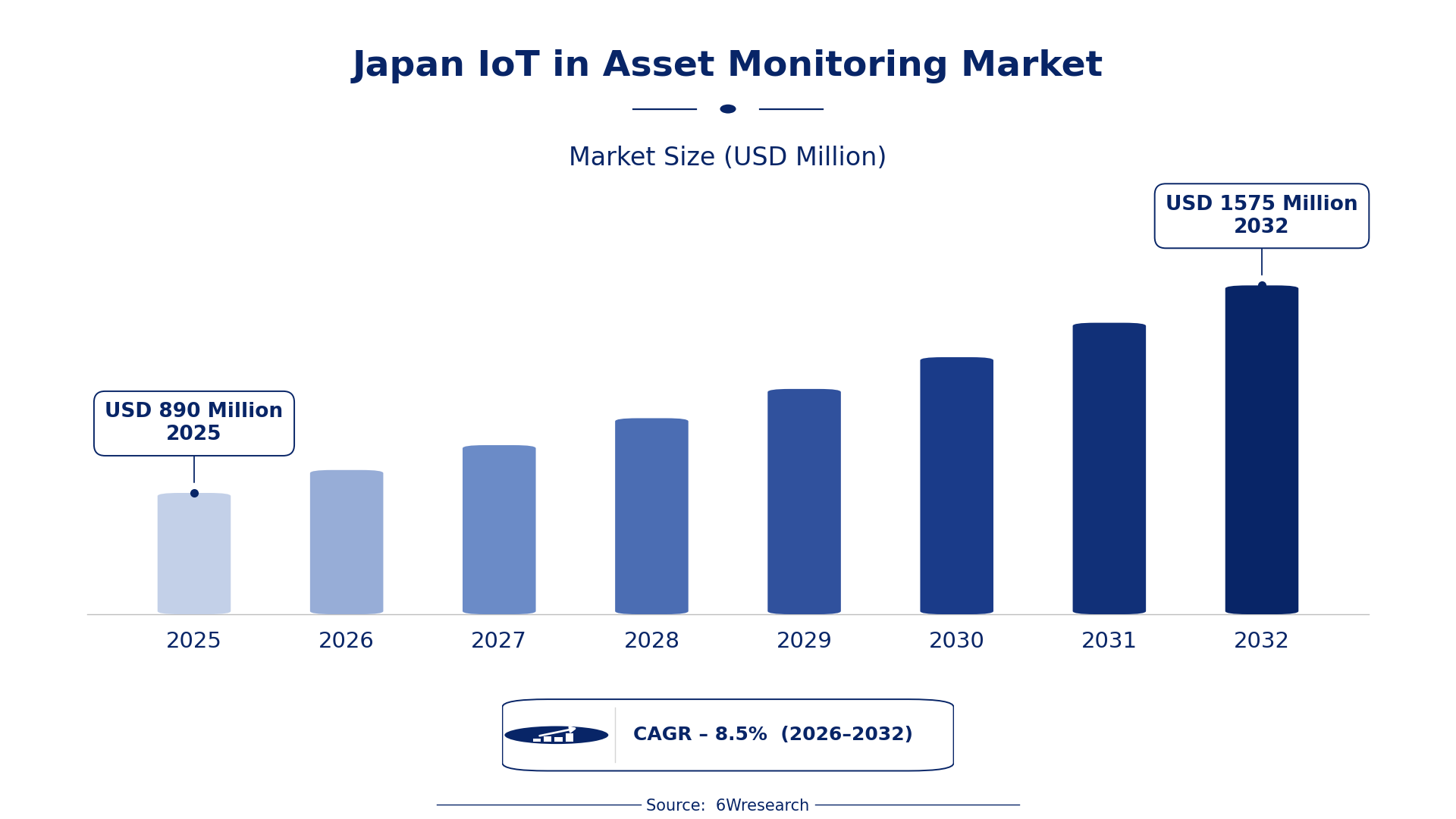
According to 6Wresearch internal database and industry insights, the Japan IoT in Asset Monitoring Market was valued at USD 890 Million in 2025 and is projected to reach USD 1,575 Million by 2032, growing at a CAGR of approximately 8.5% during 2026–2032.
Japan IoT in Asset Monitoring Market Highlights
| Report Metric | Details |
| Report Name | Japan IoT in Asset Monitoring Market (2026-2032) |
| Market Size 2025 | USD 890 Million |
| Market Size 2032 | USD 1,575 Million |
| Absolute Growth 2025–2032 | USD 685 Million |
| CAGR 2026–2032 | 8.5% |
| Peak Annual Growth | 10.3% in 2026 |
| Forecast Period | 2026–2032 |
| Historical Data | 2022–2025 |
| Base Year | 2025 |
| Leading Monitoring Type, 2025 | Vibration Analysis (34% share) |
| Leading Communication Protocol, 2025 | LTE-M/5G (45% share) |
| Leading Sensor Type, 2025 | Accelerometers (38% share) |
| Leading Asset Tracked, 2025 | Motors/Rotors (51% share) |
| Leading End User, 2025 | Manufacturing Plants (36% share) |
| Fastest-Growing Monitoring Type | Thermal Monitoring (11.4% CAGR) |
| Fastest-Growing Communication Protocol | LPWAN (10.9% CAGR) |
| Fastest-Growing Sensor Type | IR Sensors (12.0% CAGR) |
| Fastest-Growing Asset Tracked | Transformers (10.7% CAGR) |
| Fastest-Growing End User | Power Utilities (10.4% CAGR) |
| Growing Sector | Manufacturing |
| Key End Users | Manufacturing Plants, Power Utilities, Logistic Firms, Energy Companies |
Japan IoT in Asset Monitoring Market Year-wise Growth Rate and Key Drivers (2022–2032)
This graph illustrates the annual growth rates of the market from 2022 to 2032, highlighting a steady upward trajectory and projected market expansion over the forecast period.
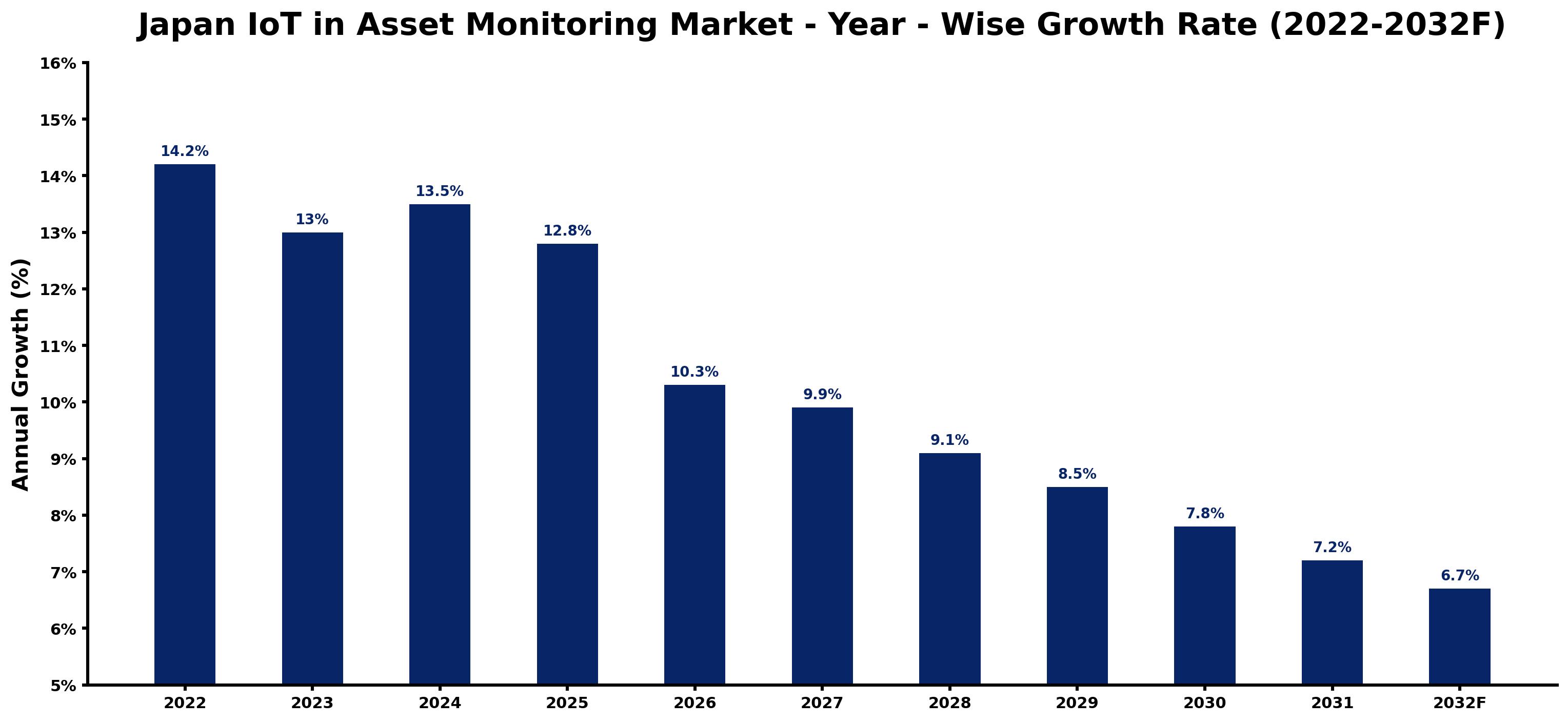
Below, each year's estimated growth is shown next to the factor that most influenced it.
| Year | Estimated Annual Growth (%) | Market Rationale |
| 2022 | 14.2 | The market showed strong demand due to increased IoT adoption in manufacturing. |
| 2023 | 13.0 | Growth slowed as initial enthusiasm for IoT technology began to normalise. |
| 2024 | 13.5 | An uptick in investment in predictive maintenance boosted growth rates. |
| 2025 | 12.8 | Investment in IoT solutions continued but at a slower pace than before. |
| 2026 | 10.3 | Demand is expected to stabilise as the market adjusts to previous high growth levels. |
| 2027 | 9.9 | The market is projected to maintain steady growth driven by ongoing technological advancements. |
| 2028 | 9.1 | Growth is expected to continue slowing as market saturation begins to take effect. |
| 2029 | 8.5 | The market will experience a further slowdown as competition intensifies. |
| 2030 | 7.8 | Growth rates are projected to decrease as companies focus on optimising existing solutions. |
| 2031 | 7.2 | The market is expected to show signs of stabilisation as demand for new solutions slows. |
| 2032 | 6.7 | Growth will continue to slow as the market matures and competition increases. |
Note: Market size estimations and growth projections presented in this report are based on 6Wresearch's proprietary forecasting methodology, utilizing the latest available industry data, government publications, and primary research inputs.
Japan IoT in Asset Monitoring Market Synopsis
IoT in Asset Monitoring integrates advanced technology to oversee and manage physical assets in real-time, utilising sensors and communication protocols for data collection and analysis. In Japan, the manufacturing sector, employing over 8 million workers, heavily relies on this technology for predictive maintenance and operational efficiency. The Japan IoT in Asset Monitoring Market is expanding due to rising investments in IoT solutions, driven by initiatives like the 2023 program from the Ministry of Economy, Trade and Industry to promote IoT adoption in manufacturing and the establishment of the Japan IoT Acceleration Consortium, which encourages innovation in this sector.
Market Dynamics Impact Analysis (2026–2032)
| Factor | Type | Impact | Primary Segment Affected |
| Growing adoption of IoT technology in manufacturing | Driver | High | Vibration Analysis |
| Increasing demand for predictive maintenance solutions | Driver | High | Thermal Monitoring |
| Need for enhanced operational efficiency in logistics | Opportunity | Medium | Location Tracking |
| Rising investments in renewable energy monitoring | Opportunity | Medium | Transformers |
| High initial costs of IoT implementation | Restraint | High | Pressure Monitoring |
| Limited awareness among smaller firms about IoT benefits | Restraint | Medium | Motors/Rotors |
| Challenges in integrating legacy systems with IoT solutions | Challenge | High | Fleet Vehicles |
| Shortage of skilled workforce for IoT deployment | Challenge | Medium | Power Utilities |
Evaluation of Drivers in Japan IoT in Asset Monitoring Market (2026–2032)
Key forces behind demand, with the segment each one moves most, are listed below.
| Drivers | Primary Segment Affected | Why It Matters (Evidence) |
| Increased investment in predictive maintenance technologies | Vibration Analysis | Japan's manufacturing sector employs over 8 million workers, leading to increased investment. |
| Growing focus on operational efficiency | Thermal Monitoring | The average age of manufacturing equipment exceeds 10 years, prompting necessary upgrades. |
| Expansion of IoT devices in logistics | Location Tracking | Japan aims to increase IoT adoption in logistics by 30% by 2025. |
| Rising demand for renewable energy solutions | Transformers | Energy companies are integrating IoT for improved grid management, reflecting market needs. |
| Implementation of quality management standards | Pressure Monitoring | The JIS Q 9001 standard drives quality improvements in manufacturing processes. |
Buyers are adding capacity as Japan's manufacturing sector employs over 8 million workers, prompting substantial investment in predictive maintenance technologies. The average age of manufacturing equipment exceeds 10 years, leading firms to upgrade for improved operational efficiency. With a target to boost IoT adoption in logistics by 30% by 2025, companies are investing in location tracking solutions. Energy firms are integrating IoT for better grid management, reflecting a shift towards renewable energy solutions. The adoption of quality management standards like JIS Q 9001 drives demand for pressure monitoring technologies, ensuring compliance and efficiency.
Evaluation of Restraints in Japan IoT in Asset Monitoring Market
These restraints slow adoption and weigh on supplier margins.
| Market Restraint | Primary Segment Affected | Why It Matters (Evidence) |
| High initial costs of IoT implementation | Pressure Monitoring | Many firms struggle with upfront costs, limiting their ability to adopt new technologies. |
| Limited awareness among smaller firms about IoT benefits | Motors/Rotors | Smaller manufacturers often lack knowledge of IoT advantages, hindering growth. |
| Integration challenges with legacy systems | Fleet Vehicles | Older systems complicate the deployment of new IoT solutions, delaying benefits. |
| Shortage of skilled workforce for IoT deployment | Power Utilities | The lack of trained personnel slows the implementation of IoT technologies. |
| Data security concerns regarding IoT devices | Transformers | Firms are hesitant to adopt IoT due to fears of potential data breaches. |
Japan IoT in Asset Monitoring Market Challenges
In Japan, the manufacturing sector struggles with outdated equipment, as the average age of machinery exceeds 10 years, leading to inefficiencies in asset monitoring. This situation raises operational costs for buyers, who may face delays in implementing IoT solutions. A shortage of skilled professionals in IoT technology hampers suppliers, resulting in project completion delays of up to six months. High integration costs deter smaller manufacturers from adopting IoT systems, causing them to miss out on potential operational efficiencies that could improve their market competitiveness.
Trends in the Japan IoT in Asset Monitoring Market
The shifts below are changing how Japan IoT in Asset Monitoring Market products are bought and supplied.
- Initiative Driving Predictive Maintenance: The 2023 initiative by the Ministry of Economy, Trade and Industry is promoting predictive maintenance in manufacturing. This trend is projected to see the total number of IoT devices reach 1 billion by 2025.
- Investment in Renewable Energy Monitoring: Japan's energy sector is heavily investing in IoT for grid management, particularly for renewable energy integration. In 2023, substantial funding was allocated to improve monitoring capabilities, reflecting a commitment to sustainability.
- Growth of LPWAN Technology: LPWAN technology is gaining traction in asset monitoring, especially for low-power devices. With a projected CAGR of 10.9%, this shift enables broader IoT applications across various sectors.
- Collaboration in IoT Innovation: The establishment of the Japan IoT Acceleration Consortium in 2023 is enhancing collaboration in IoT innovation. This initiative aims to improve the development of IoT solutions across industries.
Investment Opportunities in the Japan IoT in Asset Monitoring Market
Below are the investment opportunities with the strongest case in the Japan IoT in Asset Monitoring Market.
- Supply of IoT Sensors for Predictive Maintenance: Manufacturing plants are seeking advanced IoT sensors for predictive maintenance. With over 8 million workers in the sector, the demand for these solutions is projected to rise significantly.
- Focus on Renewable Energy Monitoring Solutions: Energy companies are prioritising IoT solutions for grid management. With Japan's commitment to renewable energy, there is a growing need for effective monitoring tools.
- Development of IoT Solutions for Logistics: Logistic firms are looking for IoT solutions to enhance supply chain management. With a target to increase IoT adoption by 30% by 2025, this sector presents a promising opportunity.
- Partnerships for IoT Implementation: Manufacturing plants are seeking local partners to implement IoT solutions. Collaborating with technology providers can facilitate smoother integration and faster deployment.
Government Initiatives in the Japan IoT in Asset Monitoring Market
The Semiconductor and Digital Industry Strategy, launched in June 2021, outlines measures to secure domestic semiconductor manufacturing, which impacts IoT producers by ensuring a stable supply chain. This strategy aims to strengthen Japan's position in the global semiconductor market, essential for IoT technologies.
The Economic Security Promotion Act, overseen by the Ministry of Economy, Trade and Industry, supports supply-chain resilience for critical products, including IoT devices. This act facilitates funding for projects that improve domestic production of essential technologies, benefiting both producers and buyers in the IoT sector.
Future Insight of the Japan IoT in Asset Monitoring Market
By 2032, a significant shift will occur in Japan's IoT in asset monitoring, driven by government initiatives and industry collaboration. The Japan IoT Acceleration Consortium will promote innovation and integration across sectors. As the total number of IoT devices is projected to reach 1 billion by 2025, suppliers will need to create more efficient solutions for predictive maintenance. Buyers will benefit from enhanced asset tracking capabilities, leading to improved operational efficiency and productivity in the manufacturing and energy sectors.
Market Segmentation Analysis
Japan IoT in Asset Monitoring Market report covers a detailed analysis of the following market segments:
By Monitoring Type – Vibration Analysis Leads, Thermal Monitoring Expected to Grow Fastest
According to Saurav Kr Singh, Senior Research Analyst at 6Wresearch, in 2025, Vibration Analysis led the monitoring type split with a 34% share. Vibration Analysis holds the largest share due to its critical role in predictive maintenance, preventing equipment failure in various sectors. For instance, the manufacturing sector employs over 8 million workers who rely on this technology to maintain operational efficiency. The quickest growth will come from Thermal Monitoring, forecast to expand at a CAGR of 11.4% between 2026 and 2032. Thermal Monitoring is experiencing rapid growth as industries increasingly focus on the safety of temperature-sensitive equipment. The rising demand for efficient energy management in sectors like power utilities is driving this trend. Suppliers should prioritise developing advanced thermal monitoring solutions to meet the growing needs of various industries.
By Communication Protocol – LTE-M/5G Leads, LPWAN Expected to Grow Fastest
The largest communication protocol category in 2025 was LTE-M/5G, at 45% of revenue. LTE-M/5G holds the largest share due to its provision of high-speed connectivity essential for real-time data transmission. This is particularly vital in urban areas like Tokyo, where the demand for efficient IoT applications is increasing. Over 2026–2032, LPWAN is expected to post the fastest growth, at a CAGR of 10.9%. LPWAN is experiencing rapid growth as it enables long-range communication for low-power devices, which is essential for expanding IoT networks. The push for increased connectivity across Japan is driving this segment's expansion. Suppliers should focus on developing LPWAN solutions to meet the growing demand for efficient IoT connectivity.
By Sensor Type – Accelerometers Lead, IR Sensors Expected to Grow Fastest
With 38% of sensor type revenue in 2025, Accelerometers was the largest category. Accelerometers dominate the market due to their importance in measuring vibrations in rotating machinery, essential for predictive maintenance in manufacturing. This is particularly relevant given the average age of manufacturing equipment in Japan, which exceeds 10 years. IR Sensors are set to record the highest CAGR in this split, 12.0% over 2026–2032. IR Sensors are seeing the fastest growth as they are increasingly used for non-contact temperature measurement, vital for industries that require precise thermal management. The push for efficient monitoring solutions is driving this trend. Suppliers must focus on advancing IR sensor technology to cater to the increasing demand for non-contact monitoring solutions.
By Asset Tracked – Motors/Rotors Lead, Transformers Expected to Grow Fastest
Motors/Rotors took 51% of asset tracked revenue in 2025, more than any other category. Motors/Rotors hold the largest share due to their essential role in ensuring performance and maintenance, particularly in the manufacturing sector. With over 8 million workers in this field, the demand for effective monitoring solutions is substantial. Transformers are projected to grow fastest, at a CAGR of 10.7% during 2026–2032. Transformers are experiencing rapid growth, primarily driven by the increasing need for monitoring electrical performance and safety in power utilities. The push for renewable energy integration is further propelling this segment's expansion. Suppliers should focus on developing advanced monitoring solutions for transformers to meet the rising demand for safety and efficiency.
By End User – Manufacturing Plants Lead, Power Utilities Expected to Grow Fastest
Manufacturing Plants accounted for 36% of the market by end user in 2025. Manufacturing Plants represent the largest end user, utilising IoT technology to enhance operational efficiency and maintenance, which are critical for productivity. The significant workforce in this sector underscores the necessity for robust monitoring solutions. The quickest growth will come from Power Utilities, forecast to expand at a CAGR of 10.4% between 2026 and 2032. Power Utilities are the fastest-growing end user, driven by the imperative to monitor critical infrastructure for reliable energy distribution. Continuous investments in grid management and renewable energy initiatives are crucial to this segment's growth. Suppliers must tailor their offerings to meet the specific monitoring needs of power utilities to capitalise on this growth trend.
Key Attractiveness of the Report
- 10 Years of Market Numbers
- Historical Data Starting from 2022 to 2025
- Base Year 2025
- Forecast Data until 2032
- Key Performance Indicators Impacting the Market
- Major Upcoming Developments and Projects
Key Highlights of the Report:
- Japan IoT in Asset Monitoring Market Outlook
- Market Size of Japan IoT in Asset Monitoring Market, 2025
- Forecast of Japan IoT in Asset Monitoring Market, 2032
- Historical Data and Forecast of Japan IoT in Asset Monitoring Revenues & Volume for the Period 2022-2032F
- Japan IoT in Asset Monitoring Market Trend Evolution
- Japan IoT in Asset Monitoring Market Drivers and Challenges
- Japan IoT in Asset Monitoring Price Trends
- Japan IoT in Asset Monitoring Porter's Five Forces
- Japan IoT in Asset Monitoring Industry Life Cycle
- Historical Data and Forecast of Japan IoT in Asset Monitoring Market Revenues & Volume By Monitoring Type for the Period 2022-2032F
- Historical Data and Forecast of Japan IoT in Asset Monitoring Market Revenues & Volume By Vibration Analysis for the Period 2022-2032F
- Historical Data and Forecast of Japan IoT in Asset Monitoring Market Revenues & Volume By Thermal Monitoring for the Period 2022-2032F
- Historical Data and Forecast of Japan IoT in Asset Monitoring Market Revenues & Volume By Location Tracking for the Period 2022-2032F
- Historical Data and Forecast of Japan IoT in Asset Monitoring Market Revenues & Volume By Pressure Monitoring for the Period 2022-2032F
- Historical Data and Forecast of Japan IoT in Asset Monitoring Market Revenues & Volume By Communication Protocol for the Period 2022-2032F
- Historical Data and Forecast of Japan IoT in Asset Monitoring Market Revenues & Volume By LTE-M/5G for the Period 2022-2032F
- Historical Data and Forecast of Japan IoT in Asset Monitoring Market Revenues & Volume By LPWAN for the Period 2022-2032F
- Historical Data and Forecast of Japan IoT in Asset Monitoring Market Revenues & Volume By GPS + Cellular for the Period 2022-2032F
- Historical Data and Forecast of Japan IoT in Asset Monitoring Market Revenues & Volume By Zigbee for the Period 2022-2032F
- Historical Data and Forecast of Japan IoT in Asset Monitoring Market Revenues & Volume By Sensor Type for the Period 2022-2032F
- Historical Data and Forecast of Japan IoT in Asset Monitoring Market Revenues & Volume By Accelerometers for the Period 2022-2032F
- Historical Data and Forecast of Japan IoT in Asset Monitoring Market Revenues & Volume By IR Sensors for the Period 2022-2032F
- Historical Data and Forecast of Japan IoT in Asset Monitoring Market Revenues & Volume By Motion Sensors for the Period 2022-2032F
- Historical Data and Forecast of Japan IoT in Asset Monitoring Market Revenues & Volume By Pressure Sensors for the Period 2022-2032F
- Historical Data and Forecast of Japan IoT in Asset Monitoring Market Revenues & Volume By Asset Tracked for the Period 2022-2032F
- Historical Data and Forecast of Japan IoT in Asset Monitoring Market Revenues & Volume By Motors/Rotors for the Period 2022-2032F
- Historical Data and Forecast of Japan IoT in Asset Monitoring Market Revenues & Volume By Transformers for the Period 2022-2032F
- Historical Data and Forecast of Japan IoT in Asset Monitoring Market Revenues & Volume By Fleet Vehicles for the Period 2022-2032F
- Historical Data and Forecast of Japan IoT in Asset Monitoring Market Revenues & Volume By Oil Equipment for the Period 2022-2032F
- Historical Data and Forecast of Japan IoT in Asset Monitoring Market Revenues & Volume By End User for the Period 2022-2032F
- Historical Data and Forecast of Japan IoT in Asset Monitoring Market Revenues & Volume By Manufacturing Plants for the Period 2022-2032F
- Historical Data and Forecast of Japan IoT in Asset Monitoring Market Revenues & Volume By Power Utilities for the Period 2022-2032F
- Historical Data and Forecast of Japan IoT in Asset Monitoring Market Revenues & Volume By Logistic Firms for the Period 2022-2032F
- Historical Data and Forecast of Japan IoT in Asset Monitoring Market Revenues & Volume By Energy Companies for the Period 2022-2032F
- Japan IoT in Asset Monitoring Import Export Trade Statistics
- Market Opportunity Assessment By Monitoring Type
- Market Opportunity Assessment By Communication Protocol
- Market Opportunity Assessment By Sensor Type
- Market Opportunity Assessment By Asset Tracked
- Market Opportunity Assessment By End User
- Japan IoT in Asset Monitoring Top Companies Market Share
- Japan IoT in Asset Monitoring Competitive Benchmarking By Technical and Operational Parameters
- Japan IoT in Asset Monitoring Company Profiles
- Japan IoT in Asset Monitoring Key Strategic Recommendations
Market Covered
The report covers the following segments.
By Monitoring Type
- Vibration Analysis
- Thermal Monitoring
- Location Tracking
- Pressure Monitoring
By Communication Protocol
- LTE-M/5G
- LPWAN
- GPS + Cellular
- Zigbee
By Sensor Type
- Accelerometers
- IR Sensors
- Motion Sensors
- Pressure Sensors
By Asset Tracked
- Motors/Rotors
- Transformers
- Fleet Vehicles
- Oil Equipment
By End User
- Manufacturing Plants
- Power Utilities
- Logistic Firms
- Energy Companies































