Japan IoT in Packaging Market Size & Growth Rate
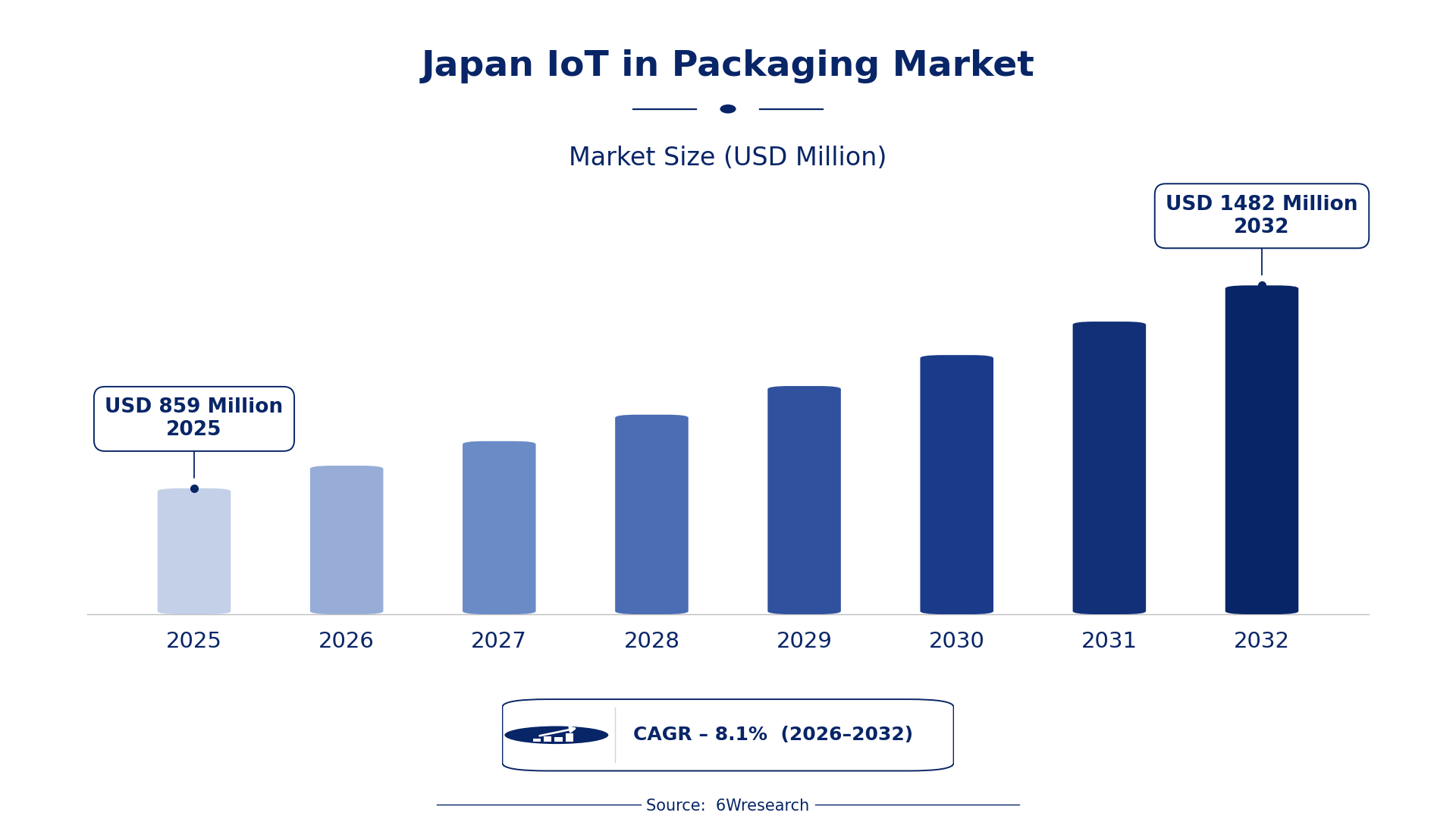
According to 6Wresearch internal database and industry insights, the Japan IoT in Packaging Market was valued at USD 859 Million in 2025 and is projected to reach USD 1,482 Million by 2032, growing at a CAGR of approximately 8.1% during 2026–2032.
Japan IoT in Packaging Market Highlights
| Report Metric | Details |
| Report Name | Japan IoT in Packaging Market (2026-2032) |
| Market Size 2025 | USD 859 Million |
| Market Size 2032 | USD 1,482 Million |
| Absolute Growth 2025–2032 | USD 623 Million |
| CAGR 2026–2032 | 8.1% |
| Peak Annual Growth | 8.8% in 2028 |
| Forecast Period | 2026–2032 |
| Historical Data | 2022–2025 |
| Base Year | 2025 |
| Leading Packaging Type, 2025 | Smart Labels (48% share) |
| Leading IoT Feature, 2025 | RFID (45% share) |
| Leading Sensor Type, 2025 | Thermistors (38% share) |
| Leading Application Area, 2025 | Food Safety (42% share) |
| Leading End User, 2025 | FMCG Companies (46% share) |
| Fastest-Growing Packaging Type | Connected Packaging (11.5% CAGR) |
| Fastest-Growing IoT Feature | QR/NFC (11.1% CAGR) |
| Fastest-Growing Application Area | Logistics Visibility (9.6% CAGR) |
| Fastest-Growing End User | E-commerce Retailers (10.7% CAGR) |
| Growing Sector | FMCG Companies |
| Key End Users | FMCG Companies, E-commerce Retailers, Retailers |
Japan IoT in Packaging Market Year-wise Growth Rate and Key Drivers (2022–2032)
This graph illustrates the annual growth rates of the market from 2022 to 2032, highlighting a steady upward trajectory and projected market expansion over the forecast period.
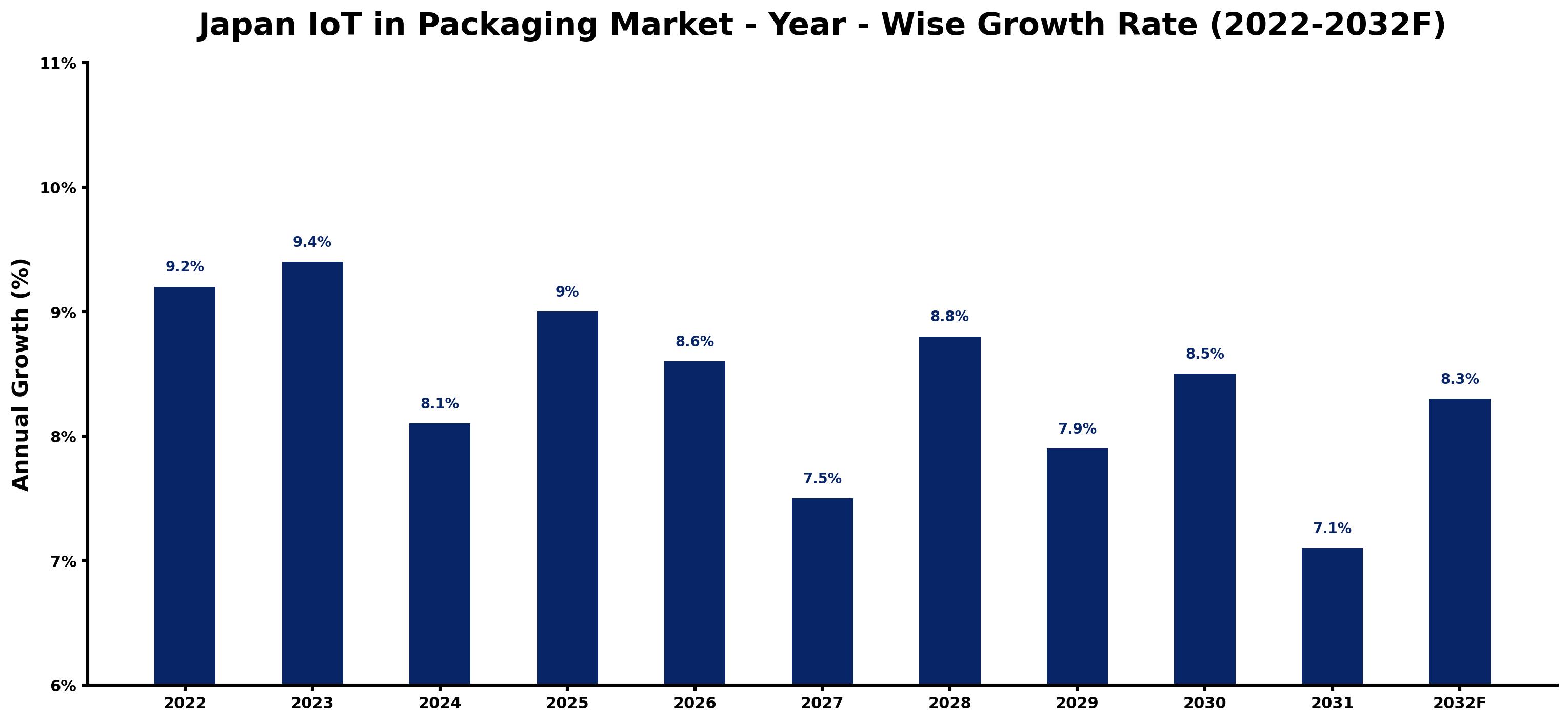
The table below sets out the estimated growth rate for each year and the main factor behind it.
| Year | Estimated Annual Growth (%) | Market Rationale |
| 2022 | 9.2 | The market exhibited strong demand from FMCG companies adopting IoT solutions. |
| 2023 | 9.4 | The adoption rate among e-commerce retailers increased, driving market growth. |
| 2024 | 8.1 | Growth slowed as some sectors adjusted to new technologies in packaging. |
| 2025 | 9.0 | Increased investment in smart labels led to faster growth this year. |
| 2026 | 8.6 | A slowdown is expected as competition intensifies among providers. |
| 2027 | 7.5 | Growth will continue to slow as companies consolidate their IoT strategies. |
| 2028 | 8.8 | A surge in connected packaging demand will spur faster growth this year. |
| 2029 | 7.9 | Growth is projected to slow again as market saturation begins to set in. |
| 2030 | 8.5 | Increased focus on logistics visibility will lead to a rebound in growth. |
| 2031 | 7.1 | The market will slow as economic factors influence spending on IoT. |
| 2032 | 8.3 | A renewed interest in food safety technologies is expected to drive growth higher. |
Note: Market size estimations and growth projections presented in this report are based on 6Wresearch's proprietary forecasting methodology, utilizing the latest available industry data, government publications, and primary research inputs.
Japan IoT in Packaging Market Synopsis
IoT in Packaging integrates Internet of Things technology into packaging solutions, improving functionality and interactivity. The Japan IoT in Packaging Market is valued at over 1 trillion JPY, driven by demand from FMCG companies and e-commerce retailers, where 60% of FMCG companies adopted IoT solutions in 2022. The rising adoption of smart labels and connected packaging technologies is propelling this growth, supported by government initiatives that promote IoT technology in manufacturing.
Market Dynamics Impact Analysis (2026–2032)
| Factor | Type | Impact | Primary Segment Affected |
| Growing adoption of smart labels for tracking and information sharing | Driver | High | Smart Labels |
| Increased focus on food safety compliance | Driver | High | Food Safety |
| Rising demand for logistics visibility solutions | Opportunity | Medium | Logistics Visibility |
| Expansion of e-commerce retailing requiring advanced packaging solutions | Opportunity | High | Connected Packaging |
| Regulatory compliance costs for packaging materials | Restraint | High | Condition-Aware Boxes |
| Limited awareness among small manufacturers about IoT benefits | Restraint | Medium | Trackable Packaging |
| Supply chain disruptions affecting IoT technology deployment | Challenge | High | Connected Packaging |
| High initial investment costs for IoT integration | Challenge | Medium | Smart Labels |
Evaluation of Drivers in Japan IoT in Packaging Market (2026–2032)
These are the developments adding the most demand over the forecast period.
| Drivers | Primary Segment Affected | Why It Matters (Evidence) |
| Increased adoption of smart labels by e-commerce retailers | Smart Labels | Over 80% of e-commerce retailers use smart labels for tracking, driving demand. |
| Growing emphasis on food safety regulations | Food Safety | Food safety regulations mandate temperature monitoring in packaging, increasing IoT adoption. |
| Rising demand for logistics visibility solutions | Logistics Visibility | The logistics visibility segment is projected to expand significantly by 2026, driven by e-commerce growth. |
| Increased investment in connected packaging technologies | Connected Packaging | Connected packaging is expected to grow by 15% annually through 2025, enhancing consumer engagement. |
| Technological advancements in sensor integration | Trackable Packaging | RFID technology is used in over 40% of logistics operations in Japan, facilitating tracking. |
In 2022, 60% of FMCG companies adopted IoT solutions, enhancing their operational efficiency. The logistics visibility segment is expected to expand significantly by 2026, driven by increased investments in tracking technologies. E-commerce retailers are increasingly utilising smart labels, with over 80% adopting these technologies for improved inventory management. Advancements in sensor integration are facilitating the growth of trackable packaging solutions as IoT technologies gain traction in logistics operations.
Evaluation of Restraints in Japan IoT in Packaging Market
Below are the constraints most often cited by buyers and suppliers, with the segment each affects.
| Market Restraint | Primary Segment Affected | Why It Matters (Evidence) |
| High compliance costs associated with food safety regulations | Condition-Aware Boxes | Food safety regulations require rigorous testing and certification of packaging materials, increasing costs for manufacturers. |
| Limited awareness among small manufacturers about IoT benefits | Trackable Packaging | Many small manufacturers lack knowledge of IoT's advantages, hindering adoption and limiting market growth. |
| Supply chain disruptions affecting IoT technology deployment | Connected Packaging | Recent global supply chain issues have delayed the integration of IoT technology in packaging, affecting availability. |
| High initial investment costs for IoT integration | Smart Labels | The costs associated with implementing IoT solutions can be prohibitive, especially for smaller companies. |
| Resistance to change from traditional packaging methods | Trackable Packaging | Some companies are hesitant to shift from conventional practices to IoT, limiting innovation. |
Japan IoT in Packaging Market Challenges
High costs of IoT integration hinder many buyers from adopting smart packaging solutions, limiting their competitive edge. In Japan, the average investment for IoT-enabled packaging can exceed 10 million JPY, making it prohibitive for smaller firms. Buyers face delays in achieving supply chain visibility due to reliance on traditional packaging methods, which can inflate logistics costs by 20%. Suppliers struggle with rapid technological changes, leading to inconsistent standards that complicate product development and can extend time-to-market by 30%. Supply chain disruptions further impact the availability of essential components, delaying production for manufacturers.
Trends in the Japan IoT in Packaging Market
Below are the shifts with the largest effect on the Japan IoT in Packaging Market.
- Shift towards Enhanced Food Safety Monitoring: Food safety monitoring has become a priority for packaging solutions. The Food Safety Commission's new guidelines in 2023 emphasise temperature monitoring, driving demand for condition-aware boxes, which are essential for compliance.
- Transition from Traditional to Smart Labels: The adoption of smart labels has surged, with over 80% of e-commerce retailers now using them for tracking. This shift enhances supply chain transparency and customer engagement, reflecting a growing trend in the packaging industry.
- Connected Packaging Gaining Traction: Connected packaging is on the rise, expected to grow by 15% annually through 2025. This trend is driven by consumer demand for improved product traceability and engagement, particularly in the FMCG sector.
- Emergence of Logistics Visibility Solutions: Logistics visibility solutions are becoming increasingly important, with a projected expansion by 2026. This shift is driven by the need for better tracking and management of goods in transit, particularly in e-commerce.
Investment Opportunities in the Japan IoT in Packaging Market
Below are the investment opportunities with the strongest case in the Japan IoT in Packaging Market.
- Growing Demand for Logistics Visibility: With the logistics visibility segment projected to expand significantly by 2026, there is an opportunity to invest in advanced tracking technologies. E-commerce retailers are particularly keen on such solutions, making it a promising market for suppliers.
- Increased Focus on Food Safety Compliance: The emphasis on food safety regulations creates a pressing need for condition-aware packaging solutions. Companies in the food sector can benefit from investing in technologies that ensure compliance with the latest guidelines.
- Expansion of E-commerce Retailing: The rise of e-commerce is driving demand for smart labels and connected packaging. Suppliers can enter this market by partnering with e-commerce platforms to provide tailored solutions.
- Investment in Smart Label Technologies: As over 80% of e-commerce retailers adopt smart labels, there is a significant opportunity for investment. Collaborating with logistics companies can enhance tracking capabilities and improve supply chain efficiency.
Government Initiatives in the Japan IoT in Packaging Market
The Ministry of Economy, Trade and Industry's 2023 programme promotes IoT adoption in manufacturing, building on the Food Sanitation Act amendments from 2018. These amendments established a system ensuring compliance with safety standards and producer accountability in food packaging materials.
The Food Safety Commission oversees the implementation of new guidelines for packaging materials, ensuring compliance with health regulations. The Ministry of Health, Labour and Welfare also plays a role in approving food safety measures, focusing on improving packaging standards and ensuring consumer safety.
Future Insight of the Japan IoT in Packaging Market
E-commerce retailers will increasingly adopt advanced IoT technologies by 2032, driven by government initiatives that promote innovation. The Tokyo region will see a surge in smart packaging advancements, influenced by a 2 billion JPY investment in technology development. By 2025, logistics visibility solutions are projected to expand, enhancing operational efficiency for suppliers. Consumer engagement through smart labels will likely rise, with rates expected to exceed 30%, offering benefits for both buyers and suppliers in the transforming market.
Market Segmentation Analysis
Japan IoT in Packaging Market report covers a detailed analysis of the following market segments:
By Packaging Type – Smart Labels Lead, Connected Packaging Expected to Grow Fastest
According to Saurav Kr Singh, Senior Research Analyst at 6Wresearch, Smart Labels held 48% of the Japan IoT in Packaging Market by packaging type in 2025. Smart labels dominate the market as they are widely adopted by FMCG companies, with 60% implementing IoT solutions for tracking and information sharing. Their effectiveness in urban areas like Tokyo, which accounts for a significant portion of packaging production, reinforces their leading position. Connected Packaging is projected to grow fastest, at a CAGR of 11.5% during 2026–2032. Connected packaging is anticipated to grow swiftly due to its ability to enhance consumer interaction, with a projected annual growth rate of 15% through 2025. The rising consumer engagement with QR codes, achieving a 30% interaction rate, is a key factor driving this growth. Suppliers must focus on developing connected packaging solutions to meet the increasing consumer demand for interactivity.
By IoT Feature – RFID Leads, QR/NFC Expected to Grow Fastest
RFID accounted for 45% of the market by iot feature in 2025. RFID technology leads the market, being used in over 40% of logistics operations in Japan, which allows for efficient inventory tracking and management. Its established presence in supply chains makes it a preferred choice for manufacturers seeking reliable solutions. QR/NFC is set to record the highest CAGR in this split, 11.1% over 2026–2032. QR and NFC technologies are rapidly gaining traction, enhancing consumer engagement and information access, which are crucial in today's market. The growing integration of these features is expected to significantly boost their adoption in the near future. Buyers should consider incorporating QR and NFC features into their packaging to improve customer interaction and streamline information access.
By Sensor Type – Thermistors Lead and Record the Fastest Growth
In 2025, Thermistors led the sensor type split with a 38% share. Thermistors are the leading sensor type due to their critical role in temperature monitoring applications, especially in food safety where compliance with health regulations is paramount. Their reliability in maintaining product quality solidifies their market position. Its lead should widen, with a projected CAGR of 11.9% during 2026–2032, the highest in this split. Thermistors are also the fastest-growing segment as their importance in temperature-sensitive packaging continues to rise. This dual role not only reinforces their market dominance but also attracts ongoing investment in their technology. Suppliers must focus on advancing thermistor technology to meet the increasing demand for temperature-sensitive packaging solutions.
By Application Area – Food Safety Leads, Logistics Visibility Expected to Grow Fastest
Food Safety took 42% of application area revenue in 2025, more than any other category. Food safety is the foremost application area, driven by strict health regulations that require effective monitoring of packaging conditions. This critical compliance necessity keeps food safety as a top priority for manufacturers in the sector. Over 2026–2032, Logistics Visibility is expected to post the fastest growth, at a CAGR of 9.6%. Logistics visibility is projected to experience substantial growth as companies aim to improve their supply chain management capabilities. The increasing complexity of logistics operations necessitates enhanced tracking and transparency, driving demand for advanced solutions. Suppliers should focus on developing solutions that improve logistics visibility to meet the changing needs of the supply chain.
By End User – FMCG Companies Lead, E-commerce Retailers Expected to Grow Fastest
The largest end user category in 2025 was FMCG Companies, at 46% of revenue. FMCG companies are the largest end user segment for IoT in packaging solutions, heavily relying on these technologies for operational efficiency and consumer engagement. Their significant market share ensures a steady demand for advanced packaging solutions. E-commerce Retailers are projected to grow fastest, at a CAGR of 10.7% during 2026–2032. E-commerce retailers represent the fastest-growing segment, driven by the need for effective tracking and delivery solutions in the expanding online marketplace. Their growth reflects the increasing reliance on technology to meet consumer expectations. Suppliers should tailor their offerings to address the specific requirements of e-commerce retailers to capitalise on this growth opportunity.
Key Attractiveness of the Report
- 10 Years of Market Numbers
- Historical Data Starting from 2022 to 2025
- Base Year 2025
- Forecast Data until 2032
- Key Performance Indicators Impacting the Market
- Major Upcoming Developments and Projects
Key Highlights of the Report:
- Japan IoT in Packaging Market Outlook
- Market Size of Japan IoT in Packaging Market, 2025
- Forecast of Japan IoT in Packaging Market, 2032
- Historical Data and Forecast of Japan IoT in Packaging Revenues & Volume for the Period 2022-2032F
- Japan IoT in Packaging Market Trend Evolution
- Japan IoT in Packaging Market Drivers and Challenges
- Japan IoT in Packaging Price Trends
- Japan IoT in Packaging Porter's Five Forces
- Japan IoT in Packaging Industry Life Cycle
- Historical Data and Forecast of Japan IoT in Packaging Market Revenues & Volume By Packaging Type for the Period 2022-2032F
- Historical Data and Forecast of Japan IoT in Packaging Market Revenues & Volume By Smart Labels for the Period 2022-2032F
- Historical Data and Forecast of Japan IoT in Packaging Market Revenues & Volume By Connected Packaging for the Period 2022-2032F
- Historical Data and Forecast of Japan IoT in Packaging Market Revenues & Volume By Trackable Packaging for the Period 2022-2032F
- Historical Data and Forecast of Japan IoT in Packaging Market Revenues & Volume By Condition-Aware Boxes for the Period 2022-2032F
- Historical Data and Forecast of Japan IoT in Packaging Market Revenues & Volume By IoT Feature for the Period 2022-2032F
- Historical Data and Forecast of Japan IoT in Packaging Market Revenues & Volume By Temp Logging for the Period 2022-2032F
- Historical Data and Forecast of Japan IoT in Packaging Market Revenues & Volume By QR/NFC for the Period 2022-2032F
- Historical Data and Forecast of Japan IoT in Packaging Market Revenues & Volume By RFID for the Period 2022-2032F
- Historical Data and Forecast of Japan IoT in Packaging Market Revenues & Volume By Shock + Temp Sensors for the Period 2022-2032F
- Historical Data and Forecast of Japan IoT in Packaging Market Revenues & Volume By Sensor Type for the Period 2022-2032F
- Historical Data and Forecast of Japan IoT in Packaging Market Revenues & Volume By Thermistors for the Period 2022-2032F
- Historical Data and Forecast of Japan IoT in Packaging Market Revenues & Volume By Proximity Sensors for the Period 2022-2032F
- Historical Data and Forecast of Japan IoT in Packaging Market Revenues & Volume By Location Tags for the Period 2022-2032F
- Historical Data and Forecast of Japan IoT in Packaging Market Revenues & Volume By Accelerometers for the Period 2022-2032F
- Historical Data and Forecast of Japan IoT in Packaging Market Revenues & Volume By Application Area for the Period 2022-2032F
- Historical Data and Forecast of Japan IoT in Packaging Market Revenues & Volume By Food Safety for the Period 2022-2032F
- Historical Data and Forecast of Japan IoT in Packaging Market Revenues & Volume By Brand Engagement for the Period 2022-2032F
- Historical Data and Forecast of Japan IoT in Packaging Market Revenues & Volume By Logistics Visibility for the Period 2022-2032F
- Historical Data and Forecast of Japan IoT in Packaging Market Revenues & Volume By Electronics Packaging for the Period 2022-2032F
- Historical Data and Forecast of Japan IoT in Packaging Market Revenues & Volume By End User for the Period 2022-2032F
- Historical Data and Forecast of Japan IoT in Packaging Market Revenues & Volume By FMCG Companies for the Period 2022-2032F
- Historical Data and Forecast of Japan IoT in Packaging Market Revenues & Volume By Retailers for the Period 2022-2032F
- Historical Data and Forecast of Japan IoT in Packaging Market Revenues & Volume By E-commerce Retailers for the Period 2022-2032F
- Historical Data and Forecast of Japan IoT in Packaging Market Revenues & Volume By Appliance OEMs for the Period 2022-2032F
- Japan IoT in Packaging Import Export Trade Statistics
- Market Opportunity Assessment By Packaging Type
- Market Opportunity Assessment By IoT Feature
- Market Opportunity Assessment By Sensor Type
- Market Opportunity Assessment By Application Area
- Market Opportunity Assessment By End User
- Japan IoT in Packaging Top Companies Market Share
- Japan IoT in Packaging Competitive Benchmarking By Technical and Operational Parameters
- Japan IoT in Packaging Company Profiles
- Japan IoT in Packaging Key Strategic Recommendations
Market Covered
Coverage by segment is as follows.
By Packaging Type
- Smart Labels
- Connected Packaging
- Trackable Packaging
- Condition-Aware Boxes
By IoT Feature
- Temp Logging
- QR/NFC
- RFID
- Shock + Temp Sensors
By Sensor Type
- Thermistors
- Proximity Sensors
- Location Tags
- Accelerometers
By Application Area
- Food Safety
- Brand Engagement
- Logistics Visibility
- Electronics Packaging
By End User
- FMCG Companies
- Retailers
- E-commerce Retailers
- Appliance OEMs































