Japan IoT in Poultry Farming Market Size & Growth Rate
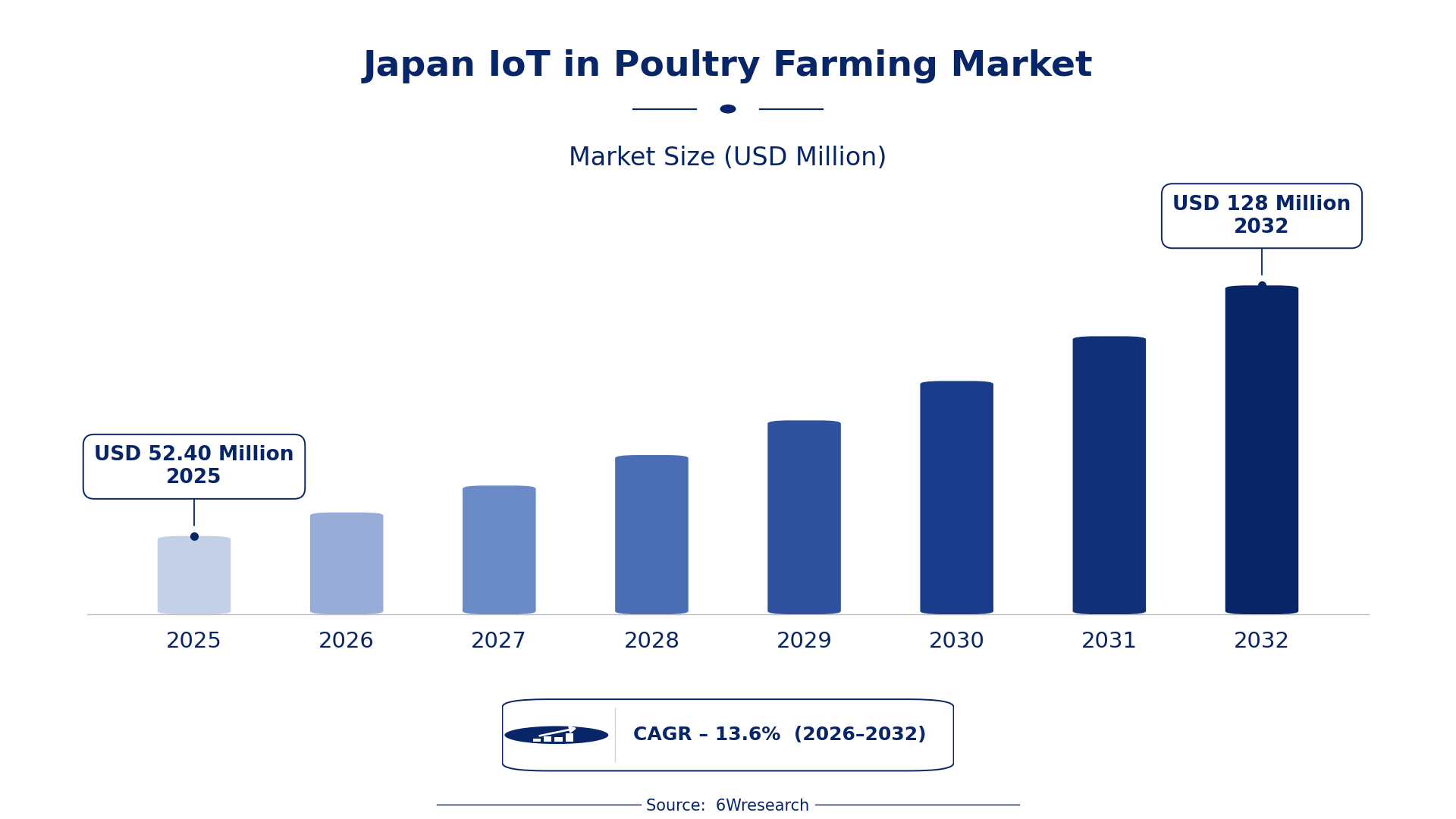
According to 6Wresearch internal database and industry insights, the Japan IoT in Poultry Farming Market was valued at USD 52.40 Million in 2025 and is projected to reach USD 128 Million by 2032, growing at a CAGR of approximately 13.6% during 2026–2032.
Japan IoT in Poultry Farming Market Highlights
| Report Metric | Details |
| Report Name | Japan IoT in Poultry Farming Market (2026-2032) |
| Market Size 2025 | USD 52.40 Million |
| Market Size 2032 | USD 128 Million |
| Absolute Growth 2025–2032 | USD 75.60 Million |
| CAGR 2026–2032 | 13.6% |
| Peak Annual Growth | 15.0% in 2026 |
| Forecast Period | 2026–2032 |
| Historical Data | 2022–2025 |
| Base Year | 2025 |
| Leading Application Area, 2025 | Health Tracking (44% share) |
| Leading Sensor Type, 2025 | Temp + Humidity Sensors (45% share) |
| Leading Communication Type, 2025 | Zigbee/Wi-Fi (37% share) |
| Leading Deployment Type, 2025 | Cloud-Based (51% share) |
| Leading End User, 2025 | Poultry Farmers (43% share) |
| Fastest-Growing Application Area | Feed Monitoring (15.5% CAGR) |
| Fastest-Growing Sensor Type | Weight Sensors (19.2% CAGR) |
| Fastest-Growing Communication Type | Cellular IoT (19.1% CAGR) |
| Fastest-Growing End User | Large Farms (16.7% CAGR) |
| Growing Sector | Poultry Farming |
| Key End Users | Poultry Farmers, Large Farms, Hatcheries, Livestock Managers |
Japan IoT in Poultry Farming Market Year-wise Growth Rate and Key Drivers (2022–2032)
This graph illustrates the annual growth rates of the market from 2022 to 2032, highlighting a steady upward trajectory and projected market expansion over the forecast period.
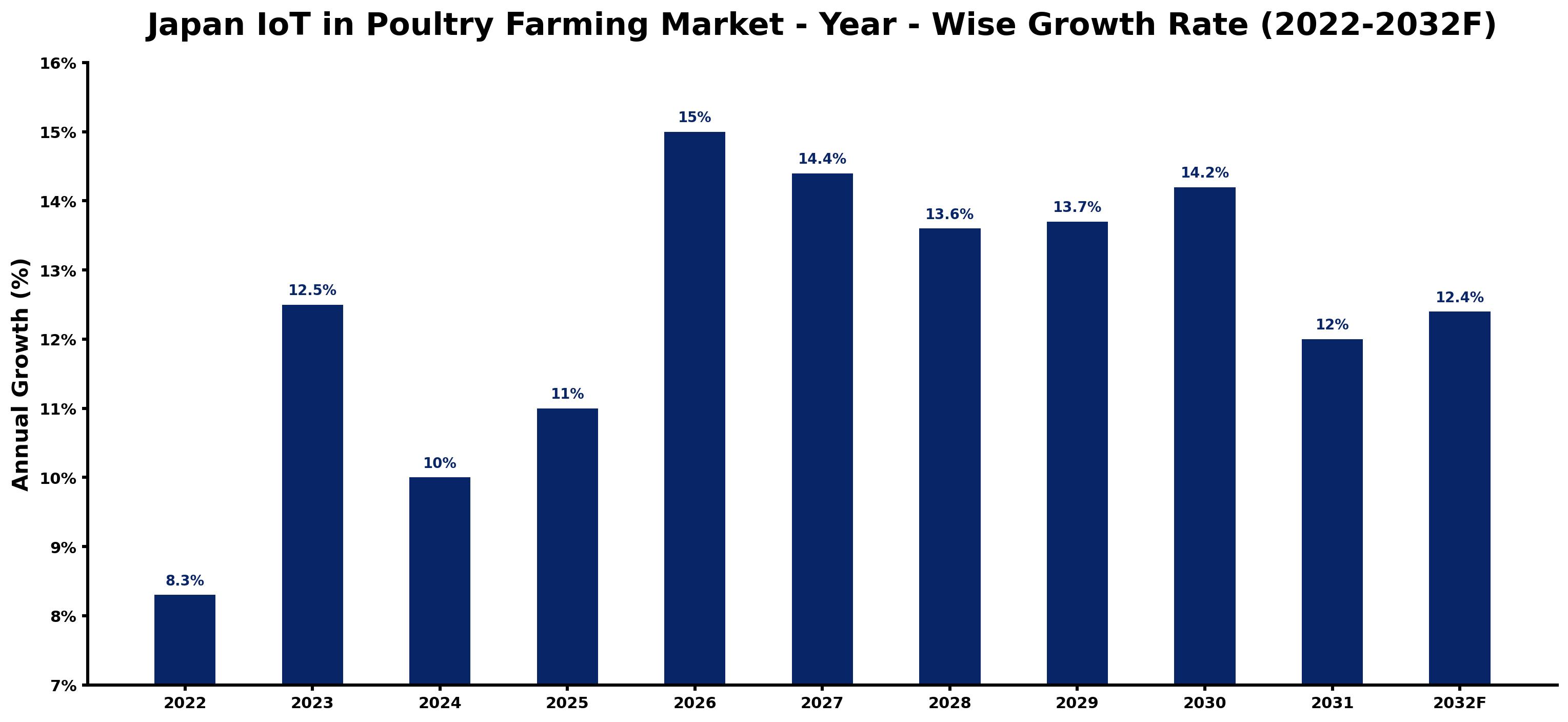
Year by year, the estimates below pair each growth rate with the development that shaped it.
| Year | Estimated Annual Growth (%) | Market Rationale |
| 2022 | 8.3 | The poultry farming population was approximately 1.2 million, driving initial demand for IoT solutions. |
| 2023 | 12.5 | The digital agriculture initiative launched in 2023 spurred technology adoption among farmers, enhancing productivity. |
| 2024 | 10.0 | Growth slowed as farmers adjusted to integrating IoT technologies into their operations and practices. |
| 2025 | 11.0 | Increased investment in agricultural IoT technologies led to a rise in market activity and adoption rates. |
| 2026 | 15.0 | The peak growth year is expected to be driven by a surge in cloud-based monitoring systems across farms. |
| 2027 | 14.4 | A slight slowdown will occur as the market matures and competition intensifies among IoT providers. |
| 2028 | 13.6 | Growth is projected to continue slowing as IoT adoption reaches saturation in certain regions of Japan. |
| 2029 | 13.7 | Demand is expected to accelerate again due to rising interest in health tracking systems among producers. |
| 2030 | 14.2 | Investment in IoT technologies will remain strong, supporting steady market growth and innovation. |
| 2031 | 12.0 | A slowdown is projected as the market stabilises after rapid expansion and initial adoption phases. |
| 2032 | 12.4 | The market will grow again as poultry farmers seek to modernise operations and improve efficiency. |
Note: Market size estimations and growth projections presented in this report are based on 6Wresearch's proprietary forecasting methodology, utilizing the latest available industry data, government publications, and primary research inputs.
Japan IoT in Poultry Farming Market Synopsis
IoT in poultry farming integrates technology to monitor and manage operations, utilising various sensors and communication technologies to improve productivity, ensure animal welfare, and optimise resource management. The Japan IoT in Poultry Farming Market is expanding due to rising domestic poultry production, with notable investment in digital agriculture initiatives. The average egg production per hen is about 300 eggs annually, while cloud-based monitoring systems are adopted in 70% of large farms, driving further demand from domestic poultry farmers and large farms.
Market Dynamics Impact Analysis (2026–2032)
| Factor | Type | Impact | Primary Segment Affected |
| Rising domestic poultry production drives demand for IoT solutions. | Driver | High | Environmental Control |
| Investment in digital agriculture initiatives supports IoT adoption. | Driver | High | Health Tracking |
| Increasing interest in health tracking systems presents opportunities. | Opportunity | High | Health Tracking |
| The average age of poultry farmers indicates a need for modernization. | Opportunity | Medium | Poultry Farmers |
| High initial costs of IoT systems may deter adoption. | Restraint | High | Feed Monitoring |
| Limited awareness of IoT benefits restricts market growth. | Restraint | Medium | Health Tracking |
| Compliance with JIS Z 9901 standards can be challenging for producers. | Challenge | High | IoT-Integrated Systems |
| Capacity constraints in local manufacturing affect supply. | Challenge | Medium | Cloud-Based |
Evaluation of Drivers in Japan IoT in Poultry Farming Market (2026–2032)
The table below links each growth driver to the segment it affects and the evidence for it.
| Drivers | Primary Segment Affected | Why It Matters (Evidence) |
| Rising domestic poultry production increases demand for monitoring solutions. | Environmental Control | Japan's poultry production reached 1.5 million tons in 2022, prompting farmers to seek IoT solutions. |
| Investment in digital agriculture initiatives drives technology adoption. | Health Tracking | The Ministry of Agriculture, Forestry and Fisheries launched a digital agriculture initiative in 2023, encouraging farmers to integrate IoT. |
| Cloud-based monitoring systems improve operational efficiency. | Cloud-Based | Adoption of cloud-based systems is seen in 70% of large farms, enabling remote monitoring and data analysis. |
| Health tracking systems ensure poultry well-being and productivity. | Health Tracking | Health tracking systems are utilized in 60% of hatcheries, driving demand for IoT solutions. |
| The average age of poultry farmers indicates a shift towards modern practices. | Poultry Farmers | With an average age of 58 years, farmers are increasingly looking to modernize their operations. |
A wider customer base explains much of the growth, as rising domestic poultry production reached 1.5 million tons in 2022, prompting farmers to seek monitoring solutions. Cloud-based monitoring systems are now adopted in 70% of large farms, enabling remote access and data analysis. Health tracking systems are increasingly used in hatcheries, ensuring poultry well-being and productivity. The average age of poultry farmers is 58 years, leading to a strong demand for modernised farming practices and solutions.
Evaluation of Restraints in Japan IoT in Poultry Farming Market
The main factors holding the market back are set out below.
| Market Restraint | Primary Segment Affected | Why It Matters (Evidence) |
| High initial costs of IoT systems deter adoption among smaller farms. | Feed Monitoring | Smaller poultry farms may struggle to afford the upfront investment required for IoT systems, limiting their operational efficiency. |
| Limited awareness of IoT benefits restricts market growth. | Health Tracking | Many farmers remain unaware of the advantages that IoT can provide in monitoring health metrics, hindering adoption rates. |
| Producers face challenges in navigating complex certification processes. | IoT-Integrated Systems | Compliance with JIS Z 9901 standards requires significant resources and expertise, complicating technology integration for producers. |
| Capacity constraints in local manufacturing affect supply of IoT devices. | Cloud-Based | Limited local manufacturing capabilities can lead to delays in the availability of IoT solutions, impacting farmers' operations. |
| Resistance to change among traditional farmers hampers adoption rates. | Environmental Control | Some farmers prefer established methods and are hesitant to adopt new technologies, slowing market growth. |
Japan IoT in Poultry Farming Market Challenges
Outdated farming practices hinder productivity as the average age of poultry farmers is 58 years, which limits the willingness to adopt new technologies. Buyers struggle with a skills gap, as younger generations show little interest in poultry farming, leaving farms without knowledgeable workers familiar with IoT systems. Regulatory standards like JIS Z 9901 complicate technology integration, resulting in delays that increase operational costs for producers. High investment costs for IoT technologies, projected at 200 million USD by 2025, discourage smaller farms from modernising their operations, restricting overall industry advancement.
Trends in the Japan IoT in Poultry Farming Market
Below are the shifts with the largest effect on the Japan IoT in Poultry Farming Market.
- Shift towards Cloud-Based Monitoring Systems: The Tokyo region is experiencing a shift towards cloud-based monitoring systems, with 70% of large farms adopting this technology. This trend allows for improved data analysis and remote management of poultry operations, boosting overall productivity.
- Transition from Traditional to IoT-Integrated Farming: The digital agriculture initiative launched in 2023 is driving a transition from traditional farming methods to IoT-integrated practices. This shift aims to modernise poultry farming and improve productivity across Japan, benefiting farmers in various regions.
- Emergence of Health Tracking Systems: Health tracking systems are becoming increasingly important in hatcheries, with 60% already using IoT solutions. This trend indicates a growing focus on animal welfare and productivity in poultry farming, improving operational efficiency.
- Poultry Farmers Prioritising Modernisation: Poultry farmers are prioritising modernisation, driven by an average age of 58 years among producers. This demographic shift is pushing for the adoption of IoT technologies to improve operational efficiency and productivity.
Investment Opportunities in the Japan IoT in Poultry Farming Market
The openings below show where demand in the Japan IoT in Poultry Farming Market is visible and how suppliers can enter.
- Partner with Local Farmers for IoT Solutions: Establishing partnerships can facilitate the supply of IoT solutions, particularly in regions like Tokyo, which accounts for 30% of poultry farms. This presents an opportunity to tap into a growing market and improve local operations.
- Supply Cloud-Based Monitoring Systems: There is an opportunity to supply cloud-based monitoring systems, with 51% market share projected for 2025. Engaging large farms can lead to substantial contracts and long-term relationships, driving further growth in the sector.
- Invest in Health Tracking Technologies: Investing in health tracking technologies is important as 60% of hatcheries are already utilising these systems. Targeting hatcheries can yield high returns in the growing market for IoT solutions in poultry farming.
- Focus on Feed Monitoring Solutions: With increasing demand for feed efficiency tracking, supplying effective feed monitoring solutions can capture the attention of poultry farmers. Engaging local cooperatives can improve market entry and adoption rates.
Government Initiatives in the Japan IoT in Poultry Farming Market
The Economic Security Promotion Act, enacted in 2022, supports supply-chain resilience for critical products, impacting the availability of IoT devices for poultry farming. This measure encourages local production and investment, benefiting farmers by ensuring access to necessary technologies. The Green Growth Strategy Through Achieving Carbon Neutrality in 2050 identifies growth sectors, including agriculture, promoting sustainable practices and technological advancements in poultry farming.
The Ministry of Agriculture, Forestry and Fisheries funds various projects to promote digital agriculture, including IoT integration in poultry farming. This agency approves initiatives that improve productivity and sustainability, benefiting farmers across Japan by facilitating access to modern technologies and practices.
Future Insight of the Japan IoT in Poultry Farming Market
A digital agriculture initiative is set to modernise poultry farming practices through enhanced technology integration. By 2025, the government aims for a 50% increase in IoT adoption, which will improve operational efficiency and animal welfare. Cloud-based monitoring systems are expected to be used in 80% of large farms by 2032, boosting data accessibility and decision-making. Health tracking systems will become standard in 70% of hatcheries, promoting better health management and productivity across the sector.
Market Segmentation Analysis
Japan IoT in Poultry Farming Market report covers a detailed analysis of the following market segments:
By Application Area – Health Tracking Leads, Feed Monitoring Expected to Grow Fastest
According to Saurav Kr Singh, Senior Research Analyst at 6Wresearch, the largest application area category in 2025 was Health Tracking, at 44% of revenue. Health tracking holds the largest share as it is essential for monitoring the well-being of poultry, ensuring optimal health and productivity. For instance, health tracking systems are used in 60% of hatcheries across Japan, highlighting its widespread adoption. Feed Monitoring is set to record the highest CAGR in this split, 15.5% over 2026–2032. The rapid growth of feed monitoring is propelled by its critical role in tracking feed efficiency and consumption, which is vital for maximising production. The increasing focus on optimising resource management in poultry farming further fuels this demand. Suppliers should prioritise developing advanced feed monitoring solutions to capitalise on this growing trend.
By Sensor Type – Temp + Humidity Sensors Lead, Weight Sensors Expected to Grow Fastest
With 45% of sensor type revenue in 2025, Temp + Humidity Sensors was the largest category. Temp and humidity sensors dominate the market as they are crucial for maintaining optimal environmental conditions essential for poultry health and productivity. Their widespread application across various farms underscores their importance in effectively managing poultry operations. Over 2026–2032, Weight Sensors are expected to post the fastest growth, at a CAGR of 19.2%. Weight sensors are experiencing rapid growth due to their direct role in monitoring poultry growth and health, which farmers are increasingly prioritising. The heightened awareness of the benefits of precise weight tracking is propelling this segment's expansion. Buyers should consider investing in weight sensors to enhance operational efficiency and improve animal welfare.
By Communication Type – Zigbee/Wi-Fi Leads, Cellular IoT Expected to Grow Fastest
Zigbee/Wi-Fi held 37% of the Japan IoT in Poultry Farming Market by communication type in 2025. Zigbee and Wi-Fi technologies lead the market as they are extensively utilised for connecting devices on farms, facilitating efficient data transfer. Their established presence in the industry solidifies their dominant position in communication solutions. The quickest growth will come from Cellular IoT, forecast to expand at a CAGR of 19.1% between 2026 and 2032. Cellular IoT is the fastest-growing communication type, as it meets the demand for reliable connectivity for remote monitoring of poultry operations. The increasing need for immediate data access is driving the growth of this segment. Suppliers must focus on improving cellular IoT solutions to meet the rising demand for remote monitoring capabilities.
By Deployment Type – Cloud-Based Leads and Records the Fastest Growth
In 2025, Cloud-Based led the deployment type split with a 51% share. Cloud-based deployment is preferred because it enables remote access and comprehensive data analysis, both of which are vital for modern poultry farming. Its ability to integrate various data sources enhances decision-making processes for farmers. The same category is also set to grow fastest, at a CAGR of 14.7% during 2026–2032. Cloud-based solutions are also the fastest-growing deployment type, as their scalability and flexibility cater to the evolving needs of poultry operations. The increasing adoption of digital agriculture initiatives is further accelerating this trend. Buyers should embrace cloud-based solutions to improve operational efficiency and data management.
By End User – Poultry Farmers Lead, Large Farms Expected to Grow Fastest
Poultry Farmers accounted for 43% of the market by end user in 2025. Poultry farmers represent the largest user group of IoT solutions, as they directly benefit from enhanced productivity and resource management. Their significant presence in the market highlights the critical role of IoT technology in their farming practices. Large Farms are set to record the highest CAGR in this split, 16.7% over 2026–2032. Large farms are the fastest-growing end user segment, primarily due to their operational scale that necessitates advanced monitoring solutions. The ongoing trend towards larger farming operations is driving this segment's growth. Suppliers should tailor their offerings to address the specific needs of large farms to capture this expanding market segment.
Key Attractiveness of the Report
- 10 Years of Market Numbers
- Historical Data Starting from 2022 to 2025
- Base Year 2025
- Forecast Data until 2032
- Key Performance Indicators Impacting the Market
- Major Upcoming Developments and Projects
Key Highlights of the Report:
- Japan IoT in Poultry Farming Market Outlook
- Market Size of Japan IoT in Poultry Farming Market, 2025
- Forecast of Japan IoT in Poultry Farming Market, 2032
- Historical Data and Forecast of Japan IoT in Poultry Farming Revenues & Volume for the Period 2022-2032F
- Japan IoT in Poultry Farming Market Trend Evolution
- Japan IoT in Poultry Farming Market Drivers and Challenges
- Japan IoT in Poultry Farming Price Trends
- Japan IoT in Poultry Farming Porter's Five Forces
- Japan IoT in Poultry Farming Industry Life Cycle
- Historical Data and Forecast of Japan IoT in Poultry Farming Market Revenues & Volume By Application Area for the Period 2022-2032F
- Historical Data and Forecast of Japan IoT in Poultry Farming Market Revenues & Volume By Environmental Control for the Period 2022-2032F
- Historical Data and Forecast of Japan IoT in Poultry Farming Market Revenues & Volume By Feed Monitoring for the Period 2022-2032F
- Historical Data and Forecast of Japan IoT in Poultry Farming Market Revenues & Volume By Health Tracking for the Period 2022-2032F
- Historical Data and Forecast of Japan IoT in Poultry Farming Market Revenues & Volume By Egg Production Monitoring for the Period 2022-2032F
- Historical Data and Forecast of Japan IoT in Poultry Farming Market Revenues & Volume By Sensor Type for the Period 2022-2032F
- Historical Data and Forecast of Japan IoT in Poultry Farming Market Revenues & Volume By Temp + Humidity Sensors for the Period 2022-2032F
- Historical Data and Forecast of Japan IoT in Poultry Farming Market Revenues & Volume By Weight Sensors for the Period 2022-2032F
- Historical Data and Forecast of Japan IoT in Poultry Farming Market Revenues & Volume By Motion + Vitals Sensors for the Period 2022-2032F
- Historical Data and Forecast of Japan IoT in Poultry Farming Market Revenues & Volume By Optical Sensors for the Period 2022-2032F
- Historical Data and Forecast of Japan IoT in Poultry Farming Market Revenues & Volume By Communication Type for the Period 2022-2032F
- Historical Data and Forecast of Japan IoT in Poultry Farming Market Revenues & Volume By Zigbee/Wi-Fi for the Period 2022-2032F
- Historical Data and Forecast of Japan IoT in Poultry Farming Market Revenues & Volume By Cellular IoT for the Period 2022-2032F
- Historical Data and Forecast of Japan IoT in Poultry Farming Market Revenues & Volume By Bluetooth Low Energy for the Period 2022-2032F
- Historical Data and Forecast of Japan IoT in Poultry Farming Market Revenues & Volume By LPWAN for the Period 2022-2032F
- Historical Data and Forecast of Japan IoT in Poultry Farming Market Revenues & Volume By Deployment Type for the Period 2022-2032F
- Historical Data and Forecast of Japan IoT in Poultry Farming Market Revenues & Volume By In-Premise for the Period 2022-2032F
- Historical Data and Forecast of Japan IoT in Poultry Farming Market Revenues & Volume By Cloud-Based for the Period 2022-2032F
- Historical Data and Forecast of Japan IoT in Poultry Farming Market Revenues & Volume By Wearable Devices for the Period 2022-2032F
- Historical Data and Forecast of Japan IoT in Poultry Farming Market Revenues & Volume By IoT-Integrated Systems for the Period 2022-2032F
- Historical Data and Forecast of Japan IoT in Poultry Farming Market Revenues & Volume By End User for the Period 2022-2032F
- Historical Data and Forecast of Japan IoT in Poultry Farming Market Revenues & Volume By Poultry Farmers for the Period 2022-2032F
- Historical Data and Forecast of Japan IoT in Poultry Farming Market Revenues & Volume By Large Farms for the Period 2022-2032F
- Historical Data and Forecast of Japan IoT in Poultry Farming Market Revenues & Volume By Livestock Managers for the Period 2022-2032F
- Historical Data and Forecast of Japan IoT in Poultry Farming Market Revenues & Volume By Hatcheries for the Period 2022-2032F
- Japan IoT in Poultry Farming Import Export Trade Statistics
- Market Opportunity Assessment By Application Area
- Market Opportunity Assessment By Sensor Type
- Market Opportunity Assessment By Communication Type
- Market Opportunity Assessment By Deployment Type
- Market Opportunity Assessment By End User
- Japan IoT in Poultry Farming Top Companies Market Share
- Japan IoT in Poultry Farming Competitive Benchmarking By Technical and Operational Parameters
- Japan IoT in Poultry Farming Company Profiles
- Japan IoT in Poultry Farming Key Strategic Recommendations
Market Covered
Segments analysed in this report are listed below.
By Application Area
- Environmental Control
- Feed Monitoring
- Health Tracking
- Egg Production Monitoring
By Sensor Type
- Temp + Humidity Sensors
- Weight Sensors
- Motion + Vitals Sensors
- Optical Sensors
By Communication Type
- Zigbee/Wi-Fi
- Cellular IoT
- Bluetooth Low Energy
- LPWAN
By Deployment Type
- In-Premise
- Cloud-Based
- Wearable Devices
- IoT-Integrated Systems
By End User
- Poultry Farmers
- Large Farms
- Livestock Managers
- Hatcheries































