Japan IoT in Precision Farming Market Size & Growth Rate
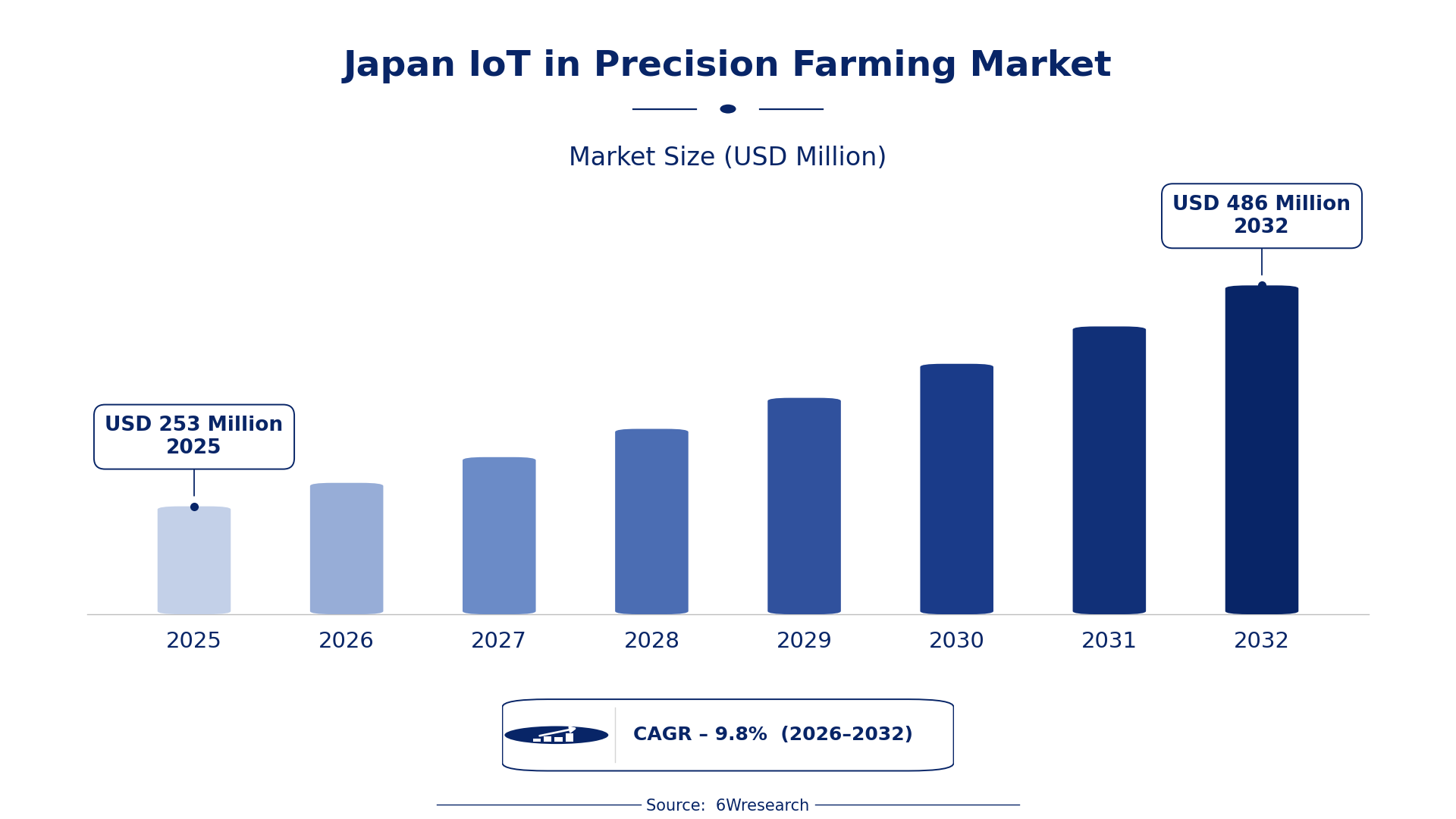
According to 6Wresearch internal database and industry insights, the Japan IoT in Precision Farming Market was valued at USD 253 Million in 2025 and is projected to reach USD 486 Million by 2032, growing at a CAGR of approximately 9.8% during 2026–2032.
Japan IoT in Precision Farming Market Highlights
| Report Metric | Details |
| Report Name | Japan IoT in Precision Farming Market (2026-2032) |
| Market Size 2025 | USD 253 Million |
| Market Size 2032 | USD 486 Million |
| Absolute Growth 2025–2032 | USD 233 Million |
| CAGR 2026–2032 | 9.8% |
| Peak Annual Growth | 10.7% in 2028 |
| Forecast Period | 2026–2032 |
| Historical Data | 2022–2025 |
| Base Year | 2025 |
| Leading Equipment Type, 2025 | Tractors & Combines (43% share) |
| Leading IoT Feature, 2025 | GPS-Based Auto Steer (40% share) |
| Leading Sensor Technology, 2025 | GNSS + Inertial (32% share) |
| Leading Data Integration, 2025 | Cloud + AI Analytics (40% share) |
| Leading End User, 2025 | Smart Farms (45% share) |
| Fastest-Growing Equipment Type | Drones & UAVs (13.9% CAGR) |
| Fastest-Growing IoT Feature | Smart Water Control (13.2% CAGR) |
| Fastest-Growing Sensor Technology | Soil Moisture + pH (14.1% CAGR) |
| Fastest-Growing End User | AgriTech Startups (12.6% CAGR) |
| Growing Sector | AgriTech Startups |
| Key End Users | Smart Farms, AgriTech Startups, Farming Co-operatives |
Japan IoT in Precision Farming Market Year-wise Growth Rate and Key Drivers (2022–2032)
This graph illustrates the annual growth rates of the market from 2022 to 2032, highlighting a steady upward trajectory and projected market expansion over the forecast period.
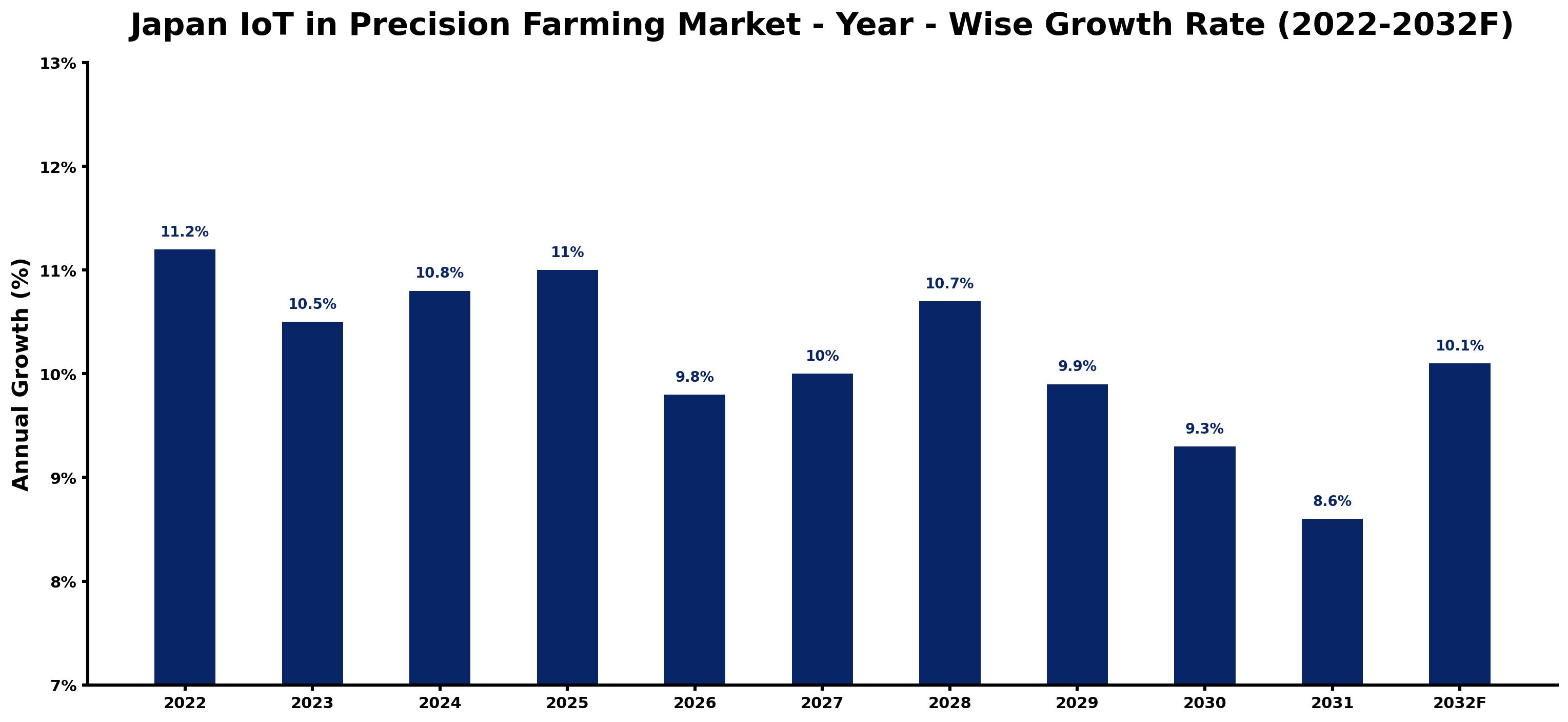
Below, each year's estimated growth is shown next to the factor that most influenced it.
| Year | Estimated Annual Growth (%) | Market Rationale |
| 2022 | 11.2 | The market experienced strong growth due to increased adoption of precision farming techniques. |
| 2023 | 10.5 | Growth slowed as the market adjusted to previous high levels of investment and innovation. |
| 2024 | 10.8 | Demand increased again, driven by advancements in IoT technology and agricultural practices. |
| 2025 | 11.0 | Growth continued as more farmers sought to modernise operations and improve yields. |
| 2026 | 9.8 | The market growth slowed as saturation began to affect new technology adoption rates. |
| 2027 | 10.0 | Demand picked up as farmers increasingly recognised the benefits of IoT solutions. |
| 2028 | 10.7 | Growth accelerated again, supported by new investments in agricultural technology. |
| 2029 | 9.9 | The pace of growth slowed as market maturity began to take hold. |
| 2030 | 9.3 | Demand growth continued to decelerate as the market stabilised. |
| 2031 | 8.6 | A further slowdown occurred as the market reached a more mature phase. |
| 2032 | 10.1 | Growth resumed as innovative solutions captured the interest of new buyer groups. |
Note: Market size estimations and growth projections presented in this report are based on 6Wresearch's proprietary forecasting methodology, utilizing the latest available industry data, government publications, and primary research inputs.
Japan IoT in Precision Farming Market Synopsis
IoT in Precision Farming integrates advanced technologies to improve agricultural productivity and efficiency. This includes sensors, devices, and data analytics platforms that monitor crop conditions and resource management. The market is expanding due to rising demand from domestic users and agri-tech startups, alongside government initiatives promoting smart agriculture. With over 1.2 million hectares of farmland employing precision farming techniques, the sector is poised for continued growth, particularly as Japan targets a 30% increase in IoT adoption by 2025.
Market Dynamics Impact Analysis (2026–2032)
| Factor | Type | Impact | Primary Segment Affected |
| Increased adoption of precision farming technologies | Driver | High | Tractors & Combines |
| Government funding for agricultural technology development | Driver | High | Irrigation Systems |
| Growing interest in smart farming solutions | Opportunity | High | AgriTech Startups |
| Rising demand for sustainable farming practices | Opportunity | High | Smart Farms |
| High average age of farmers necessitating automation | Restraint | Medium | Soil Samplers |
| Limited awareness of IoT benefits among traditional farmers | Restraint | Medium | Drones & UAVs |
| Challenges in integrating new technologies into existing practices | Challenge | High | GPS-Based Auto Steer |
| Competition among agri-tech startups for market share | Challenge | Medium | Data Logging |
Evaluation of Drivers in Japan IoT in Precision Farming Market (2026–2032)
Below are the drivers that matter most for revenue growth, with supporting evidence.
| Drivers | Primary Segment Affected | Why It Matters (Evidence) |
| Rising investment in precision agriculture | Tractors & Combines | Japan's agricultural sector contributed ¥8 trillion in 2021, driving demand for advanced machinery. |
| Government initiatives promoting smart agriculture | Irrigation Systems | The Ministry of Agriculture, Forestry and Fisheries has promoted smart agriculture since 2020, increasing technology adoption. |
| Increased focus on sustainability in farming | Drones & UAVs | The average age of farmers in Japan is 66 years, affecting their willingness to adopt new technologies. |
| Growing number of smart farms | Soil Samplers | As of 2022, there are approximately 500 smart farms in Japan, increasing demand for precision tools. |
| Technological advancements in IoT solutions | GPS-Based Auto Steer | The Japanese government aims to boost IoT adoption in agriculture by 30% by 2025. |
Buyers are increasing capacity as the agricultural sector contributed ¥8 trillion to the economy in 2021, driving demand for advanced machinery. The adoption of drones for aerial monitoring is becoming more prevalent, as farmers recognise the advantages of improved crop health. The goal to increase IoT adoption by 30% by 2025 is prompting further investments in this sector.
Evaluation of Restraints in Japan IoT in Precision Farming Market
The following restraints limit how fast demand can grow.
| Market Restraint | Primary Segment Affected | Why It Matters (Evidence) |
| High average age of farmers limits technology adoption | Soil Samplers | The average age of farmers in Japan is 66 years, affecting their willingness to adopt new technologies. |
| Limited awareness of IoT benefits among traditional farmers | Drones & UAVs | Many traditional farmers are unaware of the advantages IoT can bring to their operations. |
| Integration challenges with existing farming practices | GPS-Based Auto Steer | Farmers face difficulties in adapting new technologies to their established methods, risking yield losses. |
| High initial investment costs for precision farming tools | Irrigation Systems | The cost of implementing advanced technologies can be a barrier for smaller farms, often exceeding ¥5 million. |
| Intense competition among agri-tech startups for market share | Data Logging | Numerous startups are vying for attention, making it challenging for any single entity to dominate the market. |
Japan IoT in Precision Farming Market Challenges
Over 1.2 million hectares of farmland in Japan face supply chain issues, as many farmers struggle to access IoT technologies due to implementation costs exceeding ¥5 million per farm, delaying efficiency for buyers. Intense competition from numerous agri-tech startups pressures suppliers to lower prices, which can reduce profit margins by up to 15%. Buyers encounter integration difficulties with new technologies, risking yield losses of up to 20% during the transition period. Skills shortages among the ageing farmer population, with an average age of 66 years, hinder the effective adoption of advanced solutions, complicating operations for producers.
Trends in the Japan IoT in Precision Farming Market
The trends below show where the Japan IoT in Precision Farming Market is heading.
- Shift from Traditional to Smart Farming: Japan is transitioning from traditional farming methods to smart farming solutions, particularly in the Tokyo region. In 2023, the government allocated ¥10 billion for agricultural technology development, highlighting the increasing focus on innovation.
- Transition to Automated Irrigation Systems: Automated irrigation systems are becoming more prevalent in Japan, especially among smart farms. As of 2022, soil moisture sensors are widely used in rice cultivation, improving water management efficiency.
- Emergence of AgriTech Startups: The Tokyo region is establishing itself as a hub for AgriTech startups focusing on IoT solutions. With over 500 smart farms in Japan, these startups are driving innovation in precision farming technologies.
- Growing Adoption of Drones in Agriculture: Drones are increasingly being used for aerial monitoring and crop health assessment across Japan. This trend is supported by government initiatives promoting smart agriculture since 2020.
Investment Opportunities in the Japan IoT in Precision Farming Market
Several openings in the Japan IoT in Precision Farming Market merit attention from investors.
- Investment in Smart Water Control Systems: With a projected increase in IoT adoption by 30% by 2025, there is an opportunity for investment in smart water control systems, particularly among smart farms in regions like Hokkaido.
- Expansion of Soil Moisture Sensor Technology: As rice cultivation continues to dominate, investment in soil moisture sensor technology is essential. The Tokyo region is a key area for this technology, with local partnerships facilitating entry.
- Development of Data Logging Solutions: The demand for data logging solutions is increasing as farmers seek to optimise yields. Collaborating with agri-tech startups in urban areas can provide an effective entry strategy.
- Growth in Drone Technology Applications: The growing usage of drones in agriculture presents opportunities for suppliers. Engaging with farming cooperatives in rural regions can help establish a foothold in this market.
Government Initiatives in the Japan IoT in Precision Farming Market
The Economic Security Promotion Act (2022) supports supply-chain resilience for critical products, benefiting producers and buyers in the precision farming sector. This measure encourages investment in advanced technologies, ensuring that farmers can access the necessary tools for modernisation and efficiency improvements.
In 2023, Japan allocated ¥10 billion for agricultural technology development, administered by the Ministry of Agriculture, Forestry and Fisheries. This funding aims to support the integration of IoT solutions in farming, improving productivity and sustainability.
Future Insight of the Japan IoT in Precision Farming Market
Farmers will increasingly adopt IoT technologies by 2032, driven by government initiatives that aim to boost adoption rates by 30% by 2025. The introduction of the JIS Z 8401 standard will streamline technology integration, enhancing operational efficiency. A programme supporting AI integration in farming will further modernise practices, enabling farmers to optimise resource management. With the agricultural sector contributing ¥8 trillion to the economy, advancements in technology will create new opportunities for both buyers and suppliers, promoting a more efficient agricultural environment.
Market Segmentation Analysis
Japan IoT in Precision Farming Market report covers a detailed analysis of the following market segments:
By Equipment Type – Tractors & Combines Lead, Drones & UAVs Expected to Grow Fastest
According to Saurav Kr Singh, Senior Research Analyst at 6Wresearch, Tractors & Combines held 43% of the Japan IoT in Precision Farming Market by equipment type in 2025. Tractors and combines are essential for mechanised farming operations, particularly in rice cultivation across Japan's 1.2 million hectares of farmland. Their widespread use reflects the demand for high-tech solutions to improve productivity and address labour shortages. Drones & UAVs are set to record the highest CAGR in this split, 13.9% over 2026–2032. Drones and UAVs are increasingly utilised for aerial monitoring and crop health assessment, as farmers seek to enhance efficiency. The rise of smart farms adopting these technologies is propelling this segment's rapid growth. Suppliers should prioritise the development of drone technologies to align with the increasing demand from modern agricultural practices.
By IoT Feature – GPS-Based Auto Steer Leads, Smart Water Control Expected to Grow Fastest
With 40% of iot feature revenue in 2025, GPS-Based Auto Steer was the largest category. GPS-based auto steer significantly improves precision in field operations, reducing the need for manual labour. Its effectiveness in enhancing operational efficiency has led to widespread adoption among farmers seeking to modernise their practices. Smart Water Control is projected to grow fastest, at a CAGR of 13.2% during 2026–2032. Smart water control automates irrigation processes, optimising water usage and addressing challenges related to water scarcity. The growing focus on sustainable agricultural practices is accelerating the uptake of this technology. Buyers should invest in smart water control systems to maximise resource efficiency and support sustainable farming initiatives.
By Sensor Technology – GNSS + Inertial Leads, Soil Moisture + pH Expected to Grow Fastest
GNSS + Inertial took 32% of sensor technology revenue in 2025, more than any other category. GNSS and inertial sensors provide accurate positioning for farming equipment, which is crucial for effective precision farming. Their integration into farming practices is vital for optimising field operations and improving overall yield outcomes. Over 2026–2032, Soil Moisture + pH is expected to post the fastest growth, at a CAGR of 14.1%. Soil moisture and pH sensors are essential for assessing soil health and irrigation needs, leading to their rapid adoption among farmers. The increasing emphasis on sustainable farming practices is driving demand for these sensors. Suppliers must focus on developing advanced soil sensors to meet the growing emphasis on soil health management in agriculture.
By Data Integration – Cloud + AI Analytics Leads and Records the Fastest Growth
In 2025, Cloud + AI Analytics led the data integration split with a 40% share. Cloud and AI analytics support data analysis for precision farming, enabling farmers to make informed decisions based on real-time information. This technology is becoming integral to modern farming operations, enhancing productivity and efficiency. The same category is also set to grow fastest, at a CAGR of 13.4% during 2026–2032. The combination of cloud and AI analytics is not only leading the segment but also experiencing rapid growth as farms increasingly rely on data-driven insights for operational efficiency. This dual role reinforces its market position. Buyers should leverage cloud and AI analytics to enhance decision-making and operational efficiency in their farming practices.
By End User – Smart Farms Lead, AgriTech Startups Expected to Grow Fastest
Smart Farms accounted for 45% of the market by end user in 2025. Smart farms represent the modern approach to agriculture, utilising IoT technologies to boost productivity and efficiency. With around 500 smart farms in Japan, this segment is leading the market due to its innovative practices and technologies. AgriTech Startups are set to record the highest CAGR in this split, 12.6% over 2026–2032. AgriTech startups are propelling the rapid growth of IoT solutions in farming, as they focus on creating advanced technologies to address agricultural challenges. Their innovation and agility are key factors in this segment's expansion. Suppliers should collaborate with AgriTech startups to remain competitive and meet the evolving needs of modern agriculture.
Key Attractiveness of the Report
- 10 Years of Market Numbers
- Historical Data Starting from 2022 to 2025
- Base Year 2025
- Forecast Data until 2032
- Key Performance Indicators Impacting the Market
- Major Upcoming Developments and Projects
Key Highlights of the Report:
- Japan IoT in Precision Farming Market Outlook
- Market Size of Japan IoT in Precision Farming Market, 2025
- Forecast of Japan IoT in Precision Farming Market, 2032
- Historical Data and Forecast of Japan IoT in Precision Farming Revenues & Volume for the Period 2022-2032F
- Japan IoT in Precision Farming Market Trend Evolution
- Japan IoT in Precision Farming Market Drivers and Challenges
- Japan IoT in Precision Farming Price Trends
- Japan IoT in Precision Farming Porter's Five Forces
- Japan IoT in Precision Farming Industry Life Cycle
- Historical Data and Forecast of Japan IoT in Precision Farming Market Revenues & Volume By Equipment Type for the Period 2022-2032F
- Historical Data and Forecast of Japan IoT in Precision Farming Market Revenues & Volume By Tractors & Combines for the Period 2022-2032F
- Historical Data and Forecast of Japan IoT in Precision Farming Market Revenues & Volume By Irrigation Systems for the Period 2022-2032F
- Historical Data and Forecast of Japan IoT in Precision Farming Market Revenues & Volume By Drones & UAVs for the Period 2022-2032F
- Historical Data and Forecast of Japan IoT in Precision Farming Market Revenues & Volume By Soil Samplers for the Period 2022-2032F
- Historical Data and Forecast of Japan IoT in Precision Farming Market Revenues & Volume By IoT Feature for the Period 2022-2032F
- Historical Data and Forecast of Japan IoT in Precision Farming Market Revenues & Volume By GPS-Based Auto Steer for the Period 2022-2032F
- Historical Data and Forecast of Japan IoT in Precision Farming Market Revenues & Volume By Smart Water Control for the Period 2022-2032F
- Historical Data and Forecast of Japan IoT in Precision Farming Market Revenues & Volume By Crop Mapping for the Period 2022-2032F
- Historical Data and Forecast of Japan IoT in Precision Farming Market Revenues & Volume By Data Logging for the Period 2022-2032F
- Historical Data and Forecast of Japan IoT in Precision Farming Market Revenues & Volume By Sensor Technology for the Period 2022-2032F
- Historical Data and Forecast of Japan IoT in Precision Farming Market Revenues & Volume By GNSS + Inertial for the Period 2022-2032F
- Historical Data and Forecast of Japan IoT in Precision Farming Market Revenues & Volume By Soil Moisture + pH for the Period 2022-2032F
- Historical Data and Forecast of Japan IoT in Precision Farming Market Revenues & Volume By Multispectral Cameras for the Period 2022-2032F
- Historical Data and Forecast of Japan IoT in Precision Farming Market Revenues & Volume By Electrochemical Sensors for the Period 2022-2032F
- Historical Data and Forecast of Japan IoT in Precision Farming Market Revenues & Volume By Data Integration for the Period 2022-2032F
- Historical Data and Forecast of Japan IoT in Precision Farming Market Revenues & Volume By Cloud + AI Analytics for the Period 2022-2032F
- Historical Data and Forecast of Japan IoT in Precision Farming Market Revenues & Volume By IoT Platform for the Period 2022-2032F
- Historical Data and Forecast of Japan IoT in Precision Farming Market Revenues & Volume By Edge Computing for the Period 2022-2032F
- Historical Data and Forecast of Japan IoT in Precision Farming Market Revenues & Volume By Central Dashboards for the Period 2022-2032F
- Historical Data and Forecast of Japan IoT in Precision Farming Market Revenues & Volume By End User for the Period 2022-2032F
- Historical Data and Forecast of Japan IoT in Precision Farming Market Revenues & Volume By Smart Farms for the Period 2022-2032F
- Historical Data and Forecast of Japan IoT in Precision Farming Market Revenues & Volume By AgriTech Startups for the Period 2022-2032F
- Historical Data and Forecast of Japan IoT in Precision Farming Market Revenues & Volume By Large Agri Holdings for the Period 2022-2032F
- Historical Data and Forecast of Japan IoT in Precision Farming Market Revenues & Volume By Farming Co-operatives for the Period 2022-2032F
- Japan IoT in Precision Farming Import Export Trade Statistics
- Market Opportunity Assessment By Equipment Type
- Market Opportunity Assessment By IoT Feature
- Market Opportunity Assessment By Sensor Technology
- Market Opportunity Assessment By Data Integration
- Market Opportunity Assessment By End User
- Japan IoT in Precision Farming Top Companies Market Share
- Japan IoT in Precision Farming Competitive Benchmarking By Technical and Operational Parameters
- Japan IoT in Precision Farming Company Profiles
- Japan IoT in Precision Farming Key Strategic Recommendations
Market Covered
Coverage by segment is as follows.
By Equipment Type
- Tractors & Combines
- Irrigation Systems
- Drones & UAVs
- Soil Samplers
By IoT Feature
- GPS-Based Auto Steer
- Smart Water Control
- Crop Mapping
- Data Logging
By Sensor Technology
- GNSS + Inertial
- Soil Moisture + pH
- Multispectral Cameras
- Electrochemical Sensors
By Data Integration
- Cloud + AI Analytics
- IoT Platform
- Edge Computing
- Central Dashboards
By End User
- Smart Farms
- AgriTech Startups
- Large Agri Holdings
- Farming Co-operatives































