Japan IoT Protocol Market Size & Growth Rate
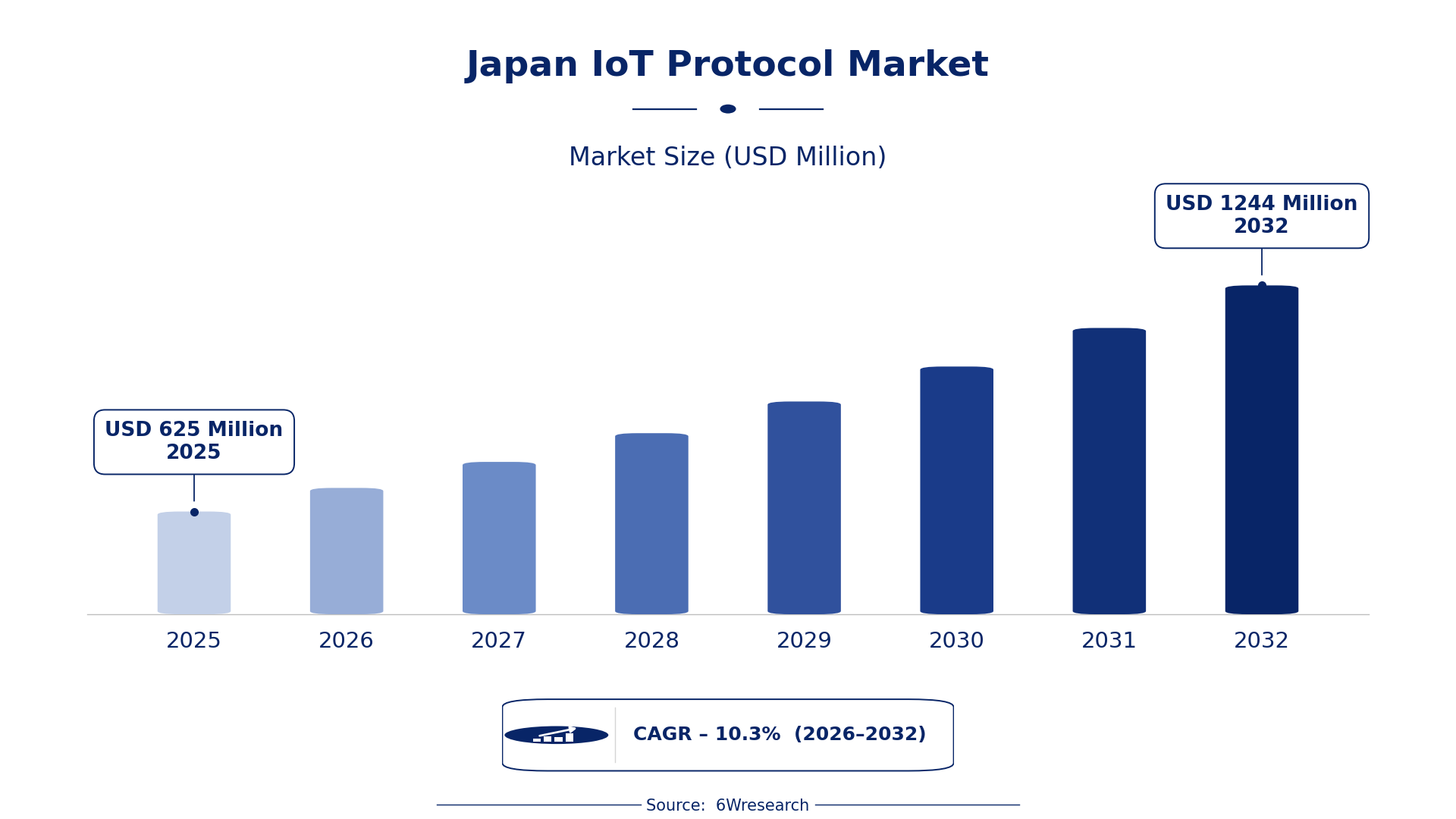
According to 6Wresearch internal database and industry insights, the Japan IoT Protocol Market was valued at USD 625 Million in 2025 and is projected to reach USD 1,244 Million by 2032, growing at a CAGR of approximately 10.3% during 2026–2032.
Japan IoT Protocol Market Highlights
| Report Metric | Details |
| Report Name | Japan IoT Protocol Market (2026-2032) |
| Market Size 2025 | USD 625 Million |
| Market Size 2032 | USD 1,244 Million |
| Absolute Growth 2025–2032 | USD 619 Million |
| CAGR 2026–2032 | 10.3% |
| Peak Annual Growth | 11.7% in 2026 |
| Forecast Period | 2026–2032 |
| Historical Data | 2022–2025 |
| Base Year | 2025 |
| Leading Protocol Type, 2025 | MQTT (44% share) |
| Leading Communication Mode, 2025 | Publish-Subscribe (52% share) |
| Leading Application Area, 2025 | Smart Homes (43% share) |
| Leading Bandwidth Level, 2025 | Low (53% share) |
| Leading End User, 2025 | IoT Developers (42% share) |
| Fastest-Growing Protocol Type | CoAP (14.1% CAGR) |
| Fastest-Growing Communication Mode | Request-Response (13.1% CAGR) |
| Fastest-Growing Application Area | Industrial IoT (12.6% CAGR) |
| Fastest-Growing Bandwidth Level | Very Low (13.4% CAGR) |
| Fastest-Growing End User | Manufacturing Firms (13.2% CAGR) |
| Growing Sector | Industrial IoT |
| Key End Users | Smart Homes, Industrial IoT, Home Automation, Agriculture Monitoring |
Japan IoT Protocol Market Year-wise Growth Rate and Key Drivers (2022–2032)
This graph illustrates the annual growth rates of the market from 2022 to 2032, highlighting a steady upward trajectory and projected market expansion over the forecast period.
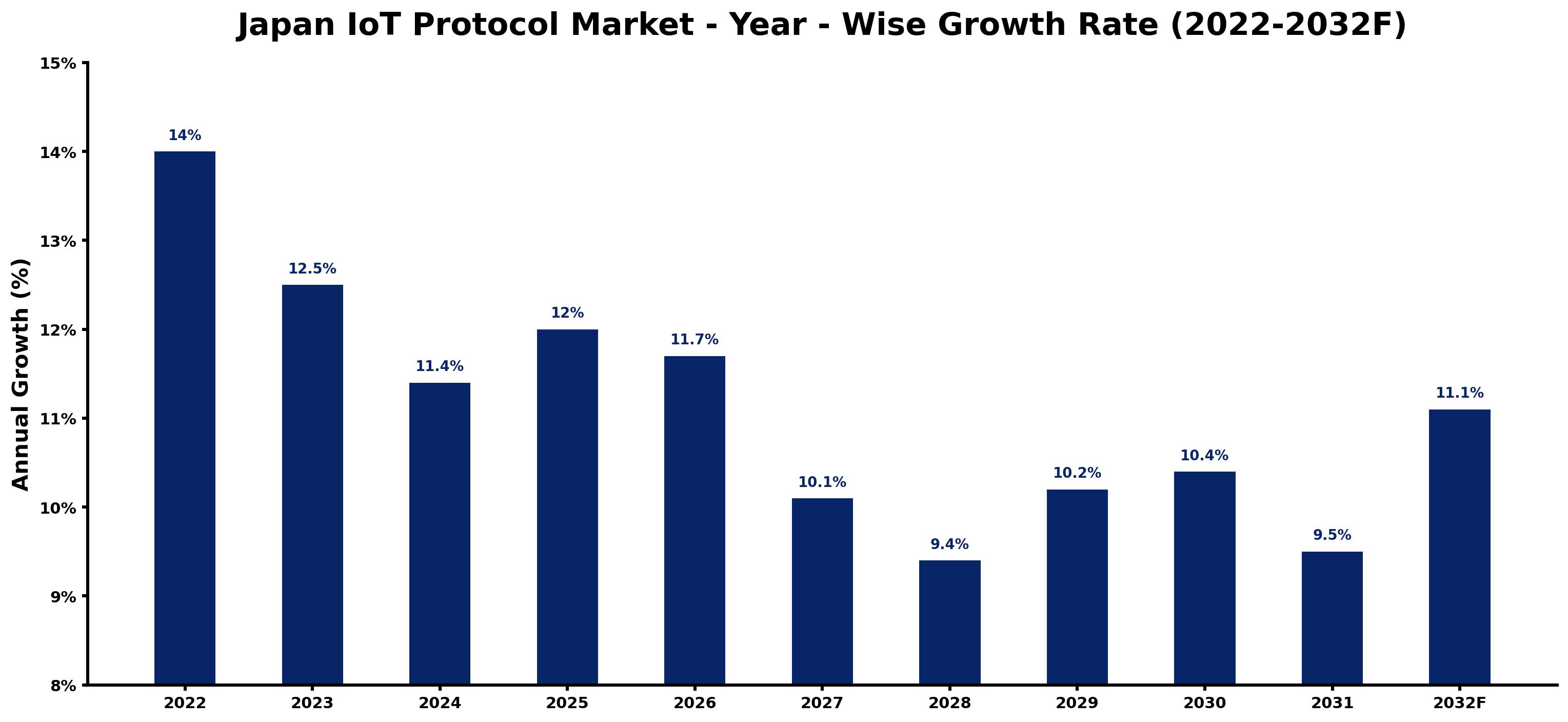
For each year, the table pairs the estimated growth rate with the leading influence on demand, showing how the drivers changed across the period.
| Year | Estimated Annual Growth (%) | Market Rationale |
| 2022 | 14.0 | The market experienced strong growth due to heightened IoT adoption across various sectors. |
| 2023 | 12.5 | Growth slowed as the market adjusted to increased competition and evolving technology standards. |
| 2024 | 11.4 | A slight slowdown occurred as companies focused on optimising existing IoT solutions. |
| 2025 | 12.0 | Demand accelerated again as smart home installations surged, increasing connectivity needs. |
| 2026 | 11.7 | Growth is likely to moderate as the market stabilises following its peak in 2022. |
| 2027 | 10.1 | A continued slowdown is projected as market saturation occurs in some IoT application areas. |
| 2028 | 9.4 | The market is expected to grow slower as companies consolidate their IoT investments. |
| 2029 | 10.2 | Growth is anticipated to pick up as new industrial IoT applications emerge, driving demand. |
| 2030 | 10.4 | An increase in demand is likely as more sectors embrace IoT for efficiency. |
| 2031 | 9.5 | Growth is projected to slow again as the market matures and competition intensifies. |
| 2032 | 11.1 | A resurgence in demand is expected as new technologies improve IoT capabilities. |
Note: Market size estimations and growth projections presented in this report are based on 6Wresearch's proprietary forecasting methodology, utilizing the latest available industry data, government publications, and primary research inputs.
Japan IoT Protocol Market Synopsis
IoT Protocols are communication standards that enable connections and data exchange among devices over the internet. In Japan, the IoT industry is thriving, with strong demand from manufacturing and technology sectors. The Japan IoT Protocol Market is projected to reach 1 trillion yen by 2025, driven by the increasing adoption of smart devices and initiatives such as the 'Connected Industries' programme, which promotes IoT integration across various sectors. The growing number of IoT devices, expected to exceed 1 billion by 2025, further fuels this demand.
Market Dynamics Impact Analysis (2026–2032)
| Factor | Type | Impact | Primary Segment Affected |
| Growing demand for smart home solutions | Driver | High | Smart Homes |
| Expansion of industrial automation | Driver | High | Industrial IoT |
| Increased investment in IoT infrastructure | Opportunity | High | Manufacturing Firms |
| Rising demand for agricultural innovations | Opportunity | High | AgriTech Companies |
| Concerns over data security and privacy | Restraint | High | IoT Developers |
| Limited interoperability between devices | Restraint | Medium | Consumer OEMs |
| High costs of IoT implementation | Challenge | High | Manufacturing Firms |
| Shortage of skilled IoT professionals | Challenge | Medium | IoT Developers |
Evaluation of Drivers in Japan IoT Protocol Market (2026–2032)
Key forces behind demand, with the segment each one moves most, are listed below.
| Drivers | Primary Segment Affected | Why It Matters (Evidence) |
| Increased consumer interest in smart home devices | Smart Homes | This interest drives demand for IoT protocols, with smart homes projected to reach 10 million installations by 2025. |
| Growing automation in manufacturing processes | Industrial IoT | Manufacturing firms are adopting IoT protocols to improve efficiency, with industrial applications dominating the market. |
| Government initiatives promoting IoT adoption | AgriTech Companies | The 'Smart Agriculture Promotion Project' aims to boost productivity, encouraging investment in IoT solutions. |
| Rising global demand for connected devices | Consumer OEMs | The increasing number of IoT devices is expected to exceed 1 billion by 2025, boosting protocol adoption. |
| Technological advancements in IoT infrastructure | IoT Developers | New protocols and standards improve device connectivity, driving innovation in IoT applications. |
Behind the steady rise in orders is a surge in consumer interest for smart home devices, with projections indicating 10 million installations by 2025. Industrial automation is also driving demand, as manufacturing firms increasingly adopt IoT protocols to improve efficiency. The number of IoT devices is expected to exceed 1 billion by 2025, reflecting a growing need for connectivity solutions. Advancements in IoT infrastructure are enabling developers to create more sophisticated applications, thereby increasing overall market demand.
Evaluation of Restraints in Japan IoT Protocol Market
The table below lists the restraints and the evidence behind each.
| Market Restraint | Primary Segment Affected | Why It Matters (Evidence) |
| Concerns regarding data security and privacy | IoT Developers | These concerns can deter companies from fully implementing IoT solutions, impacting adoption rates. |
| Limited interoperability between various IoT devices | Consumer OEMs | This limitation affects integration of devices, slowing market growth. |
| High costs associated with IoT implementation | Manufacturing Firms | The initial investment required for IoT infrastructure can be a barrier for many manufacturers. |
| Shortage of skilled professionals in the IoT sector | IoT Developers | This shortage can delay project timelines and hinder the development of new solutions. |
| Regulatory compliance challenges | AgriTech Companies | Navigating complex regulations can slow down the adoption of IoT technologies in agriculture. |
Japan IoT Protocol Market Challenges
Buyers in the IoT market face technology integration challenges, as many devices lack compatibility with existing systems, resulting in deployment delays of up to six months. Suppliers encounter regulatory complexities, particularly with standards like JIS X 5070, leading to compliance costs that can consume approximately 15% of project budgets. Increased competition from new entrants disrupts pricing strategies, forcing established suppliers to adapt or risk losing market share. Skills shortages hinder IoT development, with around 30% of positions unfilled, delaying projects for producers who struggle to find qualified talent.
Trends in the Japan IoT Protocol Market
The trends below show where the Japan IoT Protocol Market is heading.
- Shift from Traditional to Smart Homes: Since 2021, Japan has experienced a shift towards smart homes, driven by the increasing adoption of IoT devices. The number of smart homes is projected to reach 10 million by 2025, indicating a growing demand for IoT protocols.
- Transition to Industrial IoT Solutions: The 'Connected Industries' initiative, launched in 2020, promotes the integration of IoT in manufacturing. This push is likely to improve productivity and efficiency across various sectors, resulting in increased investment in IoT protocols.
- Emergence of New IoT Standards: With the introduction of JIS X 5070, interoperability among IoT devices is improving. This standard is crucial for enhancing device communication and is likely to boost market growth as companies seek compliance.
- Growing Focus on Agricultural IoT: The 'Smart Agriculture Promotion Project', initiated in 2021, aims to improve agricultural productivity through IoT solutions. This initiative is likely to drive substantial investment in IoT protocols within the agricultural sector.
Investment Opportunities in the Japan IoT Protocol Market
The opportunities below stand out in the Japan IoT Protocol Market for new entrants and existing suppliers.
- Tokyo as a Hub for IoT Development: Tokyo is rapidly becoming a centre for IoT innovation, with investments projected to exceed 200 billion yen by 2025. Companies can enter the market by partnering with local tech firms to develop IoT solutions.
- Manufacturing Firms Seeking IoT Integration: With industrial IoT applications expected to dominate the market, manufacturing firms are looking for advanced IoT protocols. Collaborating with local developers can facilitate access to this growing market.
- Investment in Smart Home Technologies: The smart home market is projected to grow, with a potential market size of 1 trillion yen by 2025. Suppliers can capitalise by providing IoT protocols tailored for smart devices.
- AgriTech Companies Adopting IoT Solutions: AgriTech companies are increasingly investing in IoT technologies to improve productivity, with a projected growth of 12% by 2025. Entering this sector requires partnerships with local agricultural firms.
Government Initiatives in the Japan IoT Protocol Market
The New Robot Strategy, established in 2015, aims to expand the use of robots and IoT in manufacturing, services, and agriculture. This initiative encourages companies to adopt IoT protocols, improving productivity and efficiency across sectors. The strategy targets a notable increase in robot utilisation, supporting Japan's technological advancement. The AI Promotion Act, set to be implemented in 2025, establishes a national framework for AI research and development, which will further enhance IoT integration in various sectors.
The Digital Agency is responsible for overseeing digital transformation initiatives, including IoT adoption. It funds projects that support IoT integration across various sectors, aiming to boost Japan's competitiveness in the global market. The agency's support is essential for companies looking to implement IoT solutions effectively.
Future Insight of the Japan IoT Protocol Market
By 2032, buyers will benefit from enhanced device communication as interoperability standards gain traction, streamlining integration processes. The 'Smart Agriculture Promotion Project' will drive productivity improvements, enabling farmers to optimise resource use. The 'Connected Industries' initiative will facilitate broader IoT integration across various sectors, fostering collaboration. With the number of smart homes projected to reach 10 million by 2025, suppliers must innovate to address the evolving needs of consumers.
Market Segmentation Analysis
Japan IoT Protocol Market report covers a detailed analysis of the following market segments:
By Protocol Type – MQTT Leads, CoAP Expected to Grow Fastest
According to Saurav Kr Singh, Senior Research Analyst at 6Wresearch, with 44% of protocol type revenue in 2025, MQTT was the largest category. MQTT holds the largest share as it is extensively utilised for lightweight messaging across various IoT applications, particularly in smart home environments. Its adoption in key urban areas like Tokyo highlights its critical role in the expanding smart solutions market. CoAP is set to record the highest CAGR in this split, 14.1% over 2026–2032. CoAP is experiencing rapid growth due to its design for constrained devices, making it particularly effective for low-power IoT applications. The expected increase in IoT devices in Japan, projected to exceed 1 billion by 2025, significantly fuels this growth. This suggests that suppliers should focus on enhancing MQTT and CoAP capabilities to meet the rising demand for IoT communication standards.
By Communication Mode – Publish-Subscribe Leads, Request-Response Expected to Grow Fastest
In 2025, Publish-Subscribe led the communication mode split with a 52% share. The Publish-Subscribe model leads the market as it efficiently supports real-time data distribution in IoT systems, particularly in urban areas like Osaka. This method is essential for applications requiring timely updates, such as smart city initiatives. Request-Response is projected to grow fastest, at a CAGR of 13.1% during 2026–2032. Request-Response is the fastest-growing mode due to its standard use for querying data in various IoT environments. As industries increasingly rely on data-driven decisions, the demand for this communication method is expected to rise. Buyers should consider integrating both communication modes to optimise their IoT systems for different use cases.
By Application Area – Smart Homes Lead, Industrial IoT Expected to Grow Fastest
Smart Homes held 43% of the Japan IoT Protocol Market by application area in 2025. Smart Homes dominate the market as they are rapidly adopting IoT devices, with projections indicating growth to 10 million smart homes by 2025. This trend is particularly strong in urban centres where technology adoption is higher. The quickest growth will come from Industrial IoT, forecast to expand at a CAGR of 12.6% between 2026 and 2032. Industrial IoT is the fastest-growing area, driven by the need for automation and efficiency in manufacturing processes. The focus on smart factories aligns with Japan's industrial strategy, propelling this segment forward. Suppliers should prioritise solutions tailored for both smart homes and industrial applications to capture emerging opportunities.
By Bandwidth Level – Low Leads, Very Low Expected to Grow Fastest
Low took 53% of bandwidth level revenue in 2025, more than any other category. Low bandwidth is the leading segment as it is suitable for basic IoT applications that require minimal data transmission, making it widely applicable across various sectors. This is particularly relevant in urban environments where connectivity is essential. Over 2026–2032, Very Low is expected to post the fastest growth, at a CAGR of 13.4%. Very Low bandwidth is growing rapidly, as it is ideal for ultra-low-power devices in IoT ecosystems. The increasing number of constrained devices is driving this segment's expansion, reflecting a shift towards energy-efficient solutions. Buyers should evaluate their bandwidth requirements carefully to ensure compatibility with their IoT devices.
By End User – IoT Developers Lead, Manufacturing Firms Expected to Grow Fastest
The largest end user category in 2025 was IoT Developers, at 42% of revenue. IoT Developers represent the largest user group, as they are the primary creators of applications utilising IoT protocols. Their presence is particularly strong in technology hubs like Tokyo, where innovation thrives. Manufacturing Firms are set to record the highest CAGR in this split, 13.2% over 2026–2032. Manufacturing Firms are the fastest-growing end users, increasingly adopting IoT protocols for smart factory solutions. This trend is driven by the need for improved automation and operational efficiency in the manufacturing sector. Suppliers must tailor their offerings to meet the specific needs of both IoT developers and manufacturing firms.
Key Attractiveness of the Report
- 10 Years of Market Numbers
- Historical Data Starting from 2022 to 2025
- Base Year 2025
- Forecast Data until 2032
- Key Performance Indicators Impacting the Market
- Major Upcoming Developments and Projects
Key Highlights of the Report:
- Japan IoT Protocol Market Outlook
- Market Size of Japan IoT Protocol Market, 2025
- Forecast of Japan IoT Protocol Market, 2032
- Historical Data and Forecast of Japan IoT Protocol Revenues & Volume for the Period 2022-2032F
- Japan IoT Protocol Market Trend Evolution
- Japan IoT Protocol Market Drivers and Challenges
- Japan IoT Protocol Price Trends
- Japan IoT Protocol Porter's Five Forces
- Japan IoT Protocol Industry Life Cycle
- Historical Data and Forecast of Japan IoT Protocol Market Revenues & Volume By Protocol Type for the Period 2022-2032F
- Historical Data and Forecast of Japan IoT Protocol Market Revenues & Volume By MQTT for the Period 2022-2032F
- Historical Data and Forecast of Japan IoT Protocol Market Revenues & Volume By CoAP for the Period 2022-2032F
- Historical Data and Forecast of Japan IoT Protocol Market Revenues & Volume By Zigbee Protocol for the Period 2022-2032F
- Historical Data and Forecast of Japan IoT Protocol Market Revenues & Volume By LoRaWAN for the Period 2022-2032F
- Historical Data and Forecast of Japan IoT Protocol Market Revenues & Volume By Communication Mode for the Period 2022-2032F
- Historical Data and Forecast of Japan IoT Protocol Market Revenues & Volume By Publish-Subscribe for the Period 2022-2032F
- Historical Data and Forecast of Japan IoT Protocol Market Revenues & Volume By Request-Response for the Period 2022-2032F
- Historical Data and Forecast of Japan IoT Protocol Market Revenues & Volume By Mesh Network for the Period 2022-2032F
- Historical Data and Forecast of Japan IoT Protocol Market Revenues & Volume By Star Topology for the Period 2022-2032F
- Historical Data and Forecast of Japan IoT Protocol Market Revenues & Volume By Application Area for the Period 2022-2032F
- Historical Data and Forecast of Japan IoT Protocol Market Revenues & Volume By Smart Homes for the Period 2022-2032F
- Historical Data and Forecast of Japan IoT Protocol Market Revenues & Volume By Industrial IoT for the Period 2022-2032F
- Historical Data and Forecast of Japan IoT Protocol Market Revenues & Volume By Home Automation for the Period 2022-2032F
- Historical Data and Forecast of Japan IoT Protocol Market Revenues & Volume By Agriculture Monitoring for the Period 2022-2032F
- Historical Data and Forecast of Japan IoT Protocol Market Revenues & Volume By Bandwidth Level for the Period 2022-2032F
- Historical Data and Forecast of Japan IoT Protocol Market Revenues & Volume By Low for the Period 2022-2032F
- Historical Data and Forecast of Japan IoT Protocol Market Revenues & Volume By Very Low for the Period 2022-2032F
- Historical Data and Forecast of Japan IoT Protocol Market Revenues & Volume By Moderate for the Period 2022-2032F
- Historical Data and Forecast of Japan IoT Protocol Market Revenues & Volume By Low Power for the Period 2022-2032F
- Historical Data and Forecast of Japan IoT Protocol Market Revenues & Volume By End User for the Period 2022-2032F
- Historical Data and Forecast of Japan IoT Protocol Market Revenues & Volume By IoT Developers for the Period 2022-2032F
- Historical Data and Forecast of Japan IoT Protocol Market Revenues & Volume By Manufacturing Firms for the Period 2022-2032F
- Historical Data and Forecast of Japan IoT Protocol Market Revenues & Volume By Consumer OEMs for the Period 2022-2032F
- Historical Data and Forecast of Japan IoT Protocol Market Revenues & Volume By AgriTech Companies for the Period 2022-2032F
- Japan IoT Protocol Import Export Trade Statistics
- Market Opportunity Assessment By Protocol Type
- Market Opportunity Assessment By Communication Mode
- Market Opportunity Assessment By Application Area
- Market Opportunity Assessment By Bandwidth Level
- Market Opportunity Assessment By End User
- Japan IoT Protocol Top Companies Market Share
- Japan IoT Protocol Competitive Benchmarking By Technical and Operational Parameters
- Japan IoT Protocol Company Profiles
- Japan IoT Protocol Key Strategic Recommendations
Market Covered
The following segment groups are covered in the report.
By Protocol Type
- MQTT
- CoAP
- Zigbee Protocol
- LoRaWAN
By Communication Mode
- Publish-Subscribe
- Request-Response
- Mesh Network
- Star Topology
By Application Area
- Smart Homes
- Industrial IoT
- Home Automation
- Agriculture Monitoring
By Bandwidth Level
- Low
- Very Low
- Moderate
- Low Power
By End User
- IoT Developers
- Manufacturing Firms
- Consumer OEMs
- AgriTech Companies































