Japan Juicer Market Size & Growth Rate
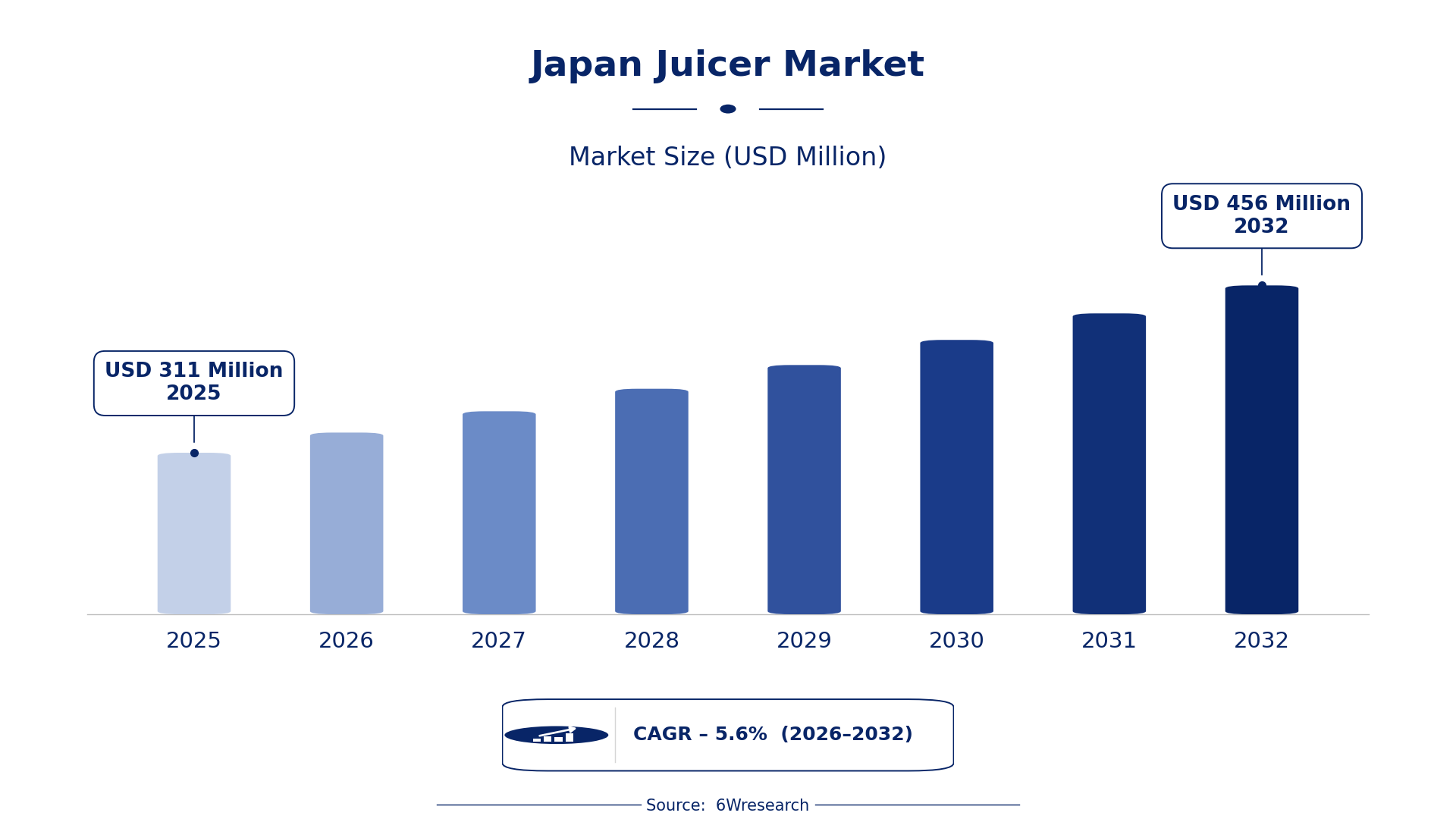
According to 6Wresearch internal database and industry insights, the Japan Juicer Market was valued at USD 311 Million in 2025 and is projected to reach USD 456 Million by 2032, growing at a CAGR of approximately 5.6% during 2026–2032.
Japan Juicer Market Highlights
| Report Metric | Details |
| Report Name | Japan Juicer Market (2026-2032) |
| Market Size 2025 | USD 311 Million |
| Market Size 2032 | USD 456 Million |
| Absolute Growth 2025–2032 | USD 145 Million |
| CAGR 2026–2032 | 5.6% |
| Peak Annual Growth | 6.5% in 2029 |
| Forecast Period | 2026–2032 |
| Historical Data | 2022–2025 |
| Base Year | 2025 |
| Leading End- User, 2025 | Commercial (67% share) |
| Leading Application, 2025 | Household (44% share) |
| Leading Type, 2025 | Traditional Juice Extractor (59% share) |
| Leading Distribution Channel, 2025 | Store Based (56% share) |
| Leading Product Type, 2025 | Manual Juicers (63% share) |
| Fastest-Growing End- User | Residential (7.0% CAGR) |
| Fastest-Growing Application | Food Services (7.5% CAGR) |
| Fastest-Growing Type | Slow Juicer (7.8% CAGR) |
| Fastest-Growing Distribution Channel | Non-Store Based (6.8% CAGR) |
| Fastest-Growing Product Type | Electric Juicers (7.9% CAGR) |
| Growing Sector | Residential juicer sector |
| Key End Users | Households, cafes, restaurants, health food stores |
Japan Juicer Market Year-wise Growth Rate and Key Drivers (2022–2032)
This graph illustrates the annual growth rates of the market from 2022 to 2032, highlighting a steady upward trajectory and projected market expansion over the forecast period.
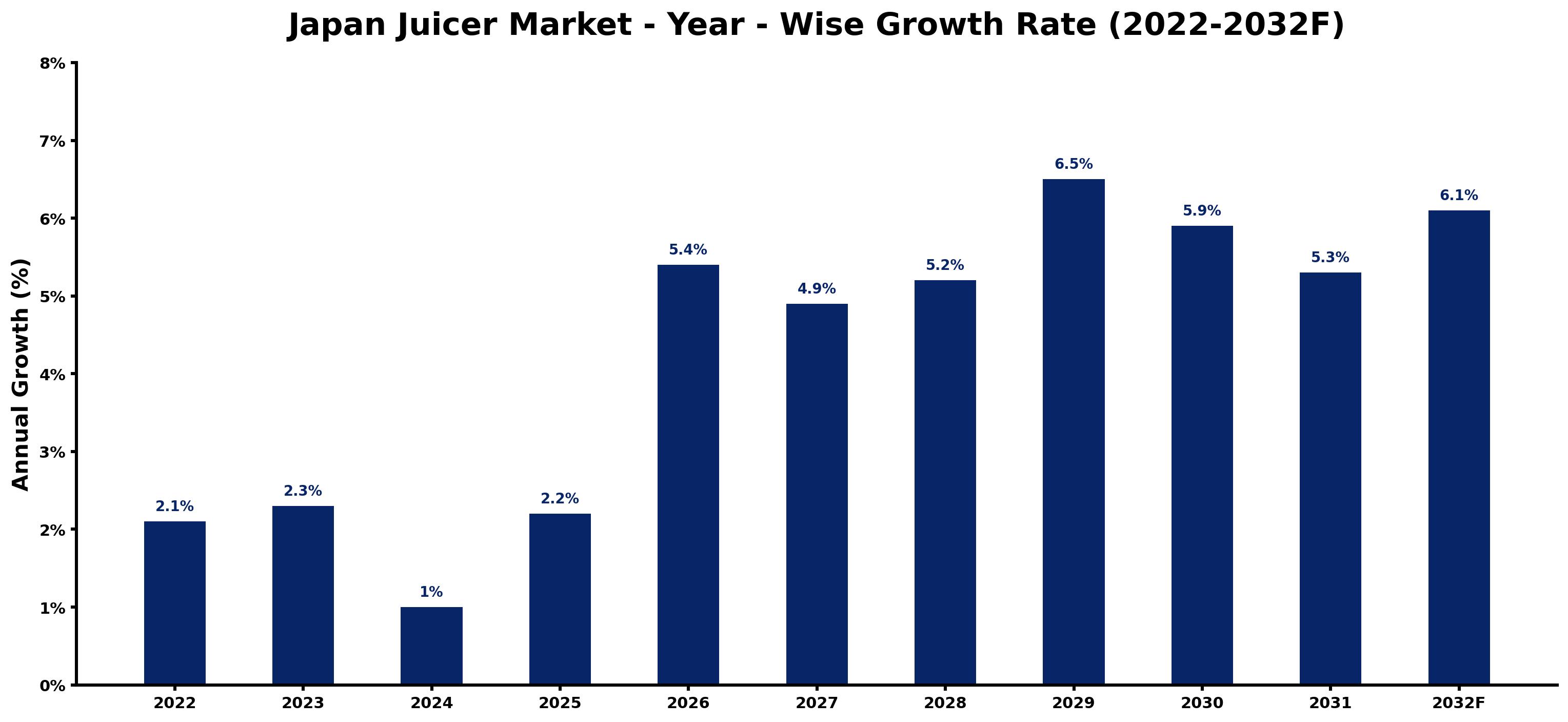
The yearly estimates that follow link every growth rate to its principal driver, so readers can see why the pace changed in each period.
| Year | Estimated Annual Growth (%) | Market Rationale |
| 2022 | 2.1 | The market experienced steady growth due to rising health awareness among consumers. |
| 2023 | 2.3 | Demand increased as health food trends gained traction in urban areas like Tokyo. |
| 2024 | 1.0 | Growth slowed as consumers became more selective with their purchases. |
| 2025 | 2.2 | A renewed interest in home cooking spurred juicer sales across households. |
| 2026 | 5.4 | Health initiatives are expected to promote fresh juice consumption, boosting the market. |
| 2027 | 4.9 | Growth is projected to slow slightly as competition intensifies among various juicer types. |
| 2028 | 5.2 | Demand is anticipated to accelerate again with a focus on health-conscious products. |
| 2029 | 6.5 | Innovations in juicer technology and design will drive peak growth. |
| 2030 | 5.9 | Growth is expected to decelerate as the market begins to stabilise after rapid expansion. |
| 2031 | 5.3 | A slight slowdown is projected as consumers adjust to market saturation. |
| 2032 | 6.1 | Growth will pick up again as eco-friendly juicer options gain popularity. |
Note: Market size estimations and growth projections presented in this report are based on 6Wresearch's proprietary forecasting methodology, utilizing the latest available industry data, government publications, and primary research inputs.
Japan Juicer Market Synopsis
Juicers are vital devices for extracting juice from fruits and vegetables, primarily constructed from metal and plastic components. According to the Japan Juicer Market, strong demand is emerging from health-conscious consumers and food service establishments, with Tokyo serving as a major hub for juicer sales. Rising health awareness and government initiatives promoting healthy eating are driving investments in juicer technology and design, shaping market growth.
Market Dynamics Impact Analysis (2026–2032)
| Factor | Type | Impact | Primary Segment Affected |
| Health-conscious consumers are driving demand for fresh juice preparation in homes and cafes. | Driver | High | Residential |
| The rise of health food stores and cafes in urban areas is expanding the market. | Driver | High | Commercial |
| The growing trend towards home cooking presents opportunities for suppliers to introduce new products. | Opportunity | High | Household |
| The increasing popularity of slow juicers provides a chance for innovation in product offerings. | Opportunity | Medium | Slow Juicer |
| Consumer preferences are shifting towards high-quality, durable juicers, affecting purchasing decisions. | Restraint | Medium | Electric Juicers |
| Price sensitivity among consumers may limit the growth of premium juicer segments. | Restraint | Medium | Manual Juicers |
| Competition from alternative health products may divert consumer spending away from juicers. | Challenge | High | Food Services |
| Supply chain disruptions can delay product availability, impacting sales and customer satisfaction. | Challenge | Medium | Commercial |
Evaluation of Drivers in Japan Juicer Market (2026–2032)
Demand rests on the following drivers, each shown with the segment it touches most.
| Drivers | Primary Segment Affected | Why It Matters (Evidence) |
| Rising health consciousness among consumers. | Residential | This trend has led to increased purchases of juicers for home use, with the health food market projected to reach ¥1 trillion by 2025. |
| Growth of health food stores and cafes. | Commercial | The number of specialty health food stores in Japan surpassed 1,000 in 2023, driving demand for juicers. |
| Increased focus on nutrition education. | Food Services | Health initiatives allocated ¥500 million in 2023 to promote fresh juice consumption in cafes and restaurants. |
| Popularity of slow juicers due to health benefits. | Slow Juicer | Sales of slow juicers reported a 15% increase in 2023, attracting health-conscious consumers. |
| The trend towards home cooking and fresh juices. | Household | Various lifestyle platforms are promoting home juicing, influencing consumer purchases. |
The growth of health food stores, exceeding 1,000 in 2023, has boosted demand for juicers in commercial settings. The rising popularity of slow juicers, with a 15% sales increase in 2023, reflects a shift towards healthier options. Various lifestyle platforms are encouraging home cooking, resulting in higher juicer purchases among households.
Evaluation of Restraints in Japan Juicer Market
The table below lists the restraints and the evidence behind each.
| Market Restraint | Primary Segment Affected | Why It Matters (Evidence) |
| Shifting consumer preferences towards high-quality products. | Electric Juicers | Consumers are increasingly opting for durable juicers, impacting sales of lower-quality models. |
| Price sensitivity affecting premium juicer segments. | Manual Juicers | Many consumers hesitate to invest in higher-priced juicers, limiting market growth. |
| Competition from alternative health products. | Food Services | Health-conscious consumers may choose smoothies or other beverages over fresh juice, affecting demand. |
| Supply chain disruptions impacting product availability. | Commercial | Delays in supply can result in lost sales opportunities for cafes and restaurants. |
| Market saturation affecting growth rates. | Household | As more households own juicers, the growth potential diminishes, resulting in slower sales increases. |
Japan Juicer Market Challenges
Limited domestic manufacturing capabilities create supply chain disruptions for producers, as reliance on imported components can extend lead times by up to three months. A shortage of skilled technicians in the juicer manufacturing sector hampers production efficiency, raising operational costs for producers. Regulatory standards complicate compliance for manufacturers, leading to potential fines and additional testing costs that burden suppliers. Rising raw material costs are pushing up prices, impacting buyers who now face electric juicer prices averaging ¥20,000, making it challenging for households to invest in quality appliances.
Trends in the Japan Juicer Market
Buyers and suppliers in the Japan Juicer Market are adjusting to the following trends.
- Shift towards Eco-Friendly Juicers: In 2023, the Japanese market saw a rise in eco-friendly juicer options, aligning with sustainability trends. This shift is clear as consumers increasingly prefer products that minimise environmental impact, with notable sales increases in such models.
- Transition from Manual to Electric Juicers: Electric juicers are gaining popularity, accounting for approximately 70% of the market share in Japan. This trend reflects consumer demand for convenience and efficiency in juice preparation, prompting suppliers to innovate.
- Emergence of Health-Focused Juicing Programs: The Tokyo Metropolitan Government launched a health initiative in 2023 promoting fresh juice consumption. This program encourages cafes and restaurants to offer fresh juice options, boosting demand for juicers in the food service sector.
- Growing Interest in Slow Juicers: Sales of slow juicers have increased by 15% in 2023, driven by consumer awareness of health benefits. This trend is reshaping the market as more buyers seek out these models for their nutritional advantages.
Investment Opportunities in the Japan Juicer Market
Investors looking at the Japan Juicer Market should consider the following areas.
- Partnering with Health Food Stores: Now is an ideal time to invest in partnerships with health food stores, which are expanding rapidly. With over 1,000 stores in Japan, suppliers can tap into this growing market by offering appealing juicer models.
- Expanding into Food Service Establishments: The food service sector is experiencing a rise in demand for fresh juice, driven by health initiatives. Suppliers can enter this market by collaborating with cafes and restaurants to provide tailored juicing solutions.
- Investing in Eco-Friendly Juicer Production: With the growing interest in sustainability, there is an opportunity to invest in eco-friendly juicer production. This aligns with consumer preferences and can attract environmentally conscious buyers.
- Enhancing Online Sales Channels: As online sales are growing, suppliers should focus on improving their e-commerce presence. With non-store based channels projected to grow at 6.8%, this is a strategic entry point for reaching more consumers.
Government Initiatives in the Japan Juicer Market
The Food Sanitation Act amendment introduced in 2018 requires food businesses to adopt HACCP-based hygiene management, ensuring safety standards for juicer production. This law mandates that juicers meet stringent health regulations, benefiting consumers by providing safer products. In 2023, the Ministry of Health, Labour and Welfare oversees health promotion programs that allocate funds for nutrition education, directly benefiting buyers by increasing awareness of healthy eating.
The Electrical Appliance and Material Safety Act regulates the safety of electrical appliances sold in Japan, ensuring that juicers meet safety standards. The Ministry of Economy, Trade and Industry oversees compliance, which helps maintain high safety levels for consumers.
Future Insight of the Japan Juicer Market
By 2032, advancements in juicing technology will transform consumer experiences, driven by a growing emphasis on health and convenience. The government's health initiative will continue to promote fresh juice consumption, prompting suppliers to diversify their product lines. Eco-friendly juicer options will become more prevalent, catering to environmentally conscious consumers. The health food market is projected to expand significantly, with expectations of reaching ¥1 trillion by 2025, encouraging suppliers to strengthen their distribution networks and improve product availability.
Market Segmentation Analysis
Japan Juicer Market report covers a detailed analysis of the following market segments:
By End- User – Commercial Leads, Residential Expected to Grow Fastest
According to Vasudha, AM at 6Wresearch, in 2025, Commercial led the end- user split with a 67% share. The commercial segment leads the market as restaurants and cafes require juicers for fresh juice preparation, particularly in urban areas like Tokyo. This segment benefits from a robust installed base driven by the rising number of health food establishments catering to health-conscious consumers. Over 2026–2032, Residential is expected to post the fastest growth, at a CAGR of 7.0%. The residential segment is growing quickly as households adopt health-focused lifestyles, resulting in a notable increase in personal juicer purchases. This trend is further supported by government health initiatives that encourage fresh juice consumption at home. Suppliers should target both commercial and residential sectors to take advantage of the expanding juicer market.
By Application – Household Leads, Food Services Expected to Grow Fastest
The largest application category in 2025 was Household, at 44% of revenue. Household applications dominate the market as juicers are commonly used in homes for daily juice consumption, driven by health-conscious consumers. The average household size of 2.3 people in Japan influences this trend, encouraging families to invest in juicers. Food Services are projected to grow fastest, at a CAGR of 7.5% during 2026–2032. Food services are the fastest-growing application, as cafes and juice bars increasingly incorporate fresh juices into their offerings, reflecting a shift towards healthier menu options. This growth is further propelled by the rising health food market projected to reach ¥1 trillion by 2025. Suppliers should prioritise product features that cater to both household and food service applications to maximise market reach.
By Type – Traditional Juice Extractor Leads, Slow Juicer Expected to Grow Fastest
Traditional Juice Extractor took 59% of type revenue in 2025, more than any other category. Traditional juice extractors maintain the largest share despite a decline in popularity, as they are still used for specific recipes and smaller quantities. Their established presence in the market allows them to retain a loyal customer base. The quickest growth will come from Slow Juicer, forecast to expand at a CAGR of 7.8% between 2026 and 2032. Slow juicers are rapidly gaining traction due to their health benefits, appealing to consumers looking for nutrient-rich juice options. The 15% increase in sales reported in 2023 indicates a strong shift towards this type of juicer. Manufacturers should consider expanding their slow juicer offerings to capitalise on this growing consumer preference.
By Distribution Channel – Store Based Leads, Non-Store Based Expected to Grow Fastest
With 56% of distribution channel revenue in 2025, Store Based was the largest category. Store-based distribution channels dominate the market as they serve as the primary purchasing method, providing consumers immediate access to juicers. The presence of physical stores, especially in urban centres, significantly impacts consumer purchasing behaviour. Non-Store Based is set to record the highest CAGR in this split, 6.8% over 2026–2032. Non-store-based channels are growing rapidly, particularly online sales, as consumers increasingly prefer the convenience of e-commerce for juicer purchases. This shift reflects changing shopping behaviours towards digital platforms. Suppliers must improve their online sales strategies to effectively address the rising demand for non-store-based purchasing options.
By Product Type – Manual Juicers Lead, Electric Juicers Expected to Grow Fastest
Manual Juicers held 63% of the Japan Juicer Market by product type in 2025. Manual juicers hold the largest market share as they are often chosen for specific recipes and small quantities, appealing to niche consumer segments. Their simplicity and affordability make them a popular choice among certain demographics. Over 2026–2032, Electric Juicers are expected to post the fastest growth, at a CAGR of 7.9%. Electric juicers are experiencing the fastest growth due to their convenience and efficiency, making them the preferred option for busy households. The average price range of electric juicers aligns well with consumer expectations for quality and usability. Manufacturers should focus on developing advanced features in electric juicers to meet the increasing consumer demand.
Key Attractiveness of the Report
- 10 Years of Market Numbers
- Historical Data Starting from 2022 to 2025
- Base Year 2025
- Forecast Data until 2032
- Key Performance Indicators Impacting the Market
- Major Upcoming Developments and Projects
Key Highlights of the Report:
- Japan Juicer Market Outlook
- Market Size of Japan Juicer Market, 2025
- Forecast of Japan Juicer Market, 2032
- Historical Data and Forecast of Japan Juicer Revenues & Volume for the Period 2022-2032
- Japan Juicer Market Trend Evolution
- Japan Juicer Market Drivers and Challenges
- Japan Juicer Price Trends
- Japan Juicer Porter's Five Forces
- Japan Juicer Industry Life Cycle
- Historical Data and Forecast of Japan Juicer Market Revenues & Volume By End- User for the Period 2022-2032
- Historical Data and Forecast of Japan Juicer Market Revenues & Volume By Commercial for the Period 2022-2032
- Historical Data and Forecast of Japan Juicer Market Revenues & Volume By Residential for the Period 2022-2032
- Historical Data and Forecast of Japan Juicer Market Revenues & Volume By Application for the Period 2022-2032
- Historical Data and Forecast of Japan Juicer Market Revenues & Volume By Household for the Period 2022-2032
- Historical Data and Forecast of Japan Juicer Market Revenues & Volume By Food Services for the Period 2022-2032
- Historical Data and Forecast of Japan Juicer Market Revenues & Volume By Public Services for the Period 2022-2032
- Historical Data and Forecast of Japan Juicer Market Revenues & Volume By Shop for the Period 2022-2032
- Historical Data and Forecast of Japan Juicer Market Revenues & Volume By Others for the Period 2022-2032
- Historical Data and Forecast of Japan Juicer Market Revenues & Volume By Type for the Period 2022-2032
- Historical Data and Forecast of Japan Juicer Market Revenues & Volume By Traditional Juice Extractor for the Period 2022-2032
- Historical Data and Forecast of Japan Juicer Market Revenues & Volume By Slow Juicer for the Period 2022-2032
- Historical Data and Forecast of Japan Juicer Market Revenues & Volume By Distribution Channel for the Period 2022-2032
- Historical Data and Forecast of Japan Juicer Market Revenues & Volume By Store Based for the Period 2022-2032
- Historical Data and Forecast of Japan Juicer Market Revenues & Volume By Non-Store Based for the Period 2022-2032
- Historical Data and Forecast of Japan Juicer Market Revenues & Volume By Product Type for the Period 2022-2032
- Historical Data and Forecast of Japan Juicer Market Revenues & Volume By Manual Juicers for the Period 2022-2032
- Historical Data and Forecast of Japan Juicer Market Revenues & Volume By Electric Juicers for the Period 2022-2032
- Japan Juicer Import Export Trade Statistics
- Market Opportunity Assessment By End- User
- Market Opportunity Assessment By Application
- Market Opportunity Assessment By Type
- Market Opportunity Assessment By Distribution Channel
- Market Opportunity Assessment By Product Type
- Japan Juicer Top Companies Market Share
- Japan Juicer Competitive Benchmarking By Technical and Operational Parameters
- Japan Juicer Company Profiles
- Japan Juicer Key Strategic Recommendations
Market Covered
The report covers the following segments.
By End- User
- Commercial
- Residential
By Application
- Household
- Food Services
- Public Services
- Shop
- Others
By Type
- Traditional Juice Extractor
- Slow Juicer
By Distribution Channel
- Store Based
- Non-Store Based
By Product Type
- Manual Juicers
- Electric Juicers































