Japan Luxury Residential Real Estate Market Size & Growth Rate
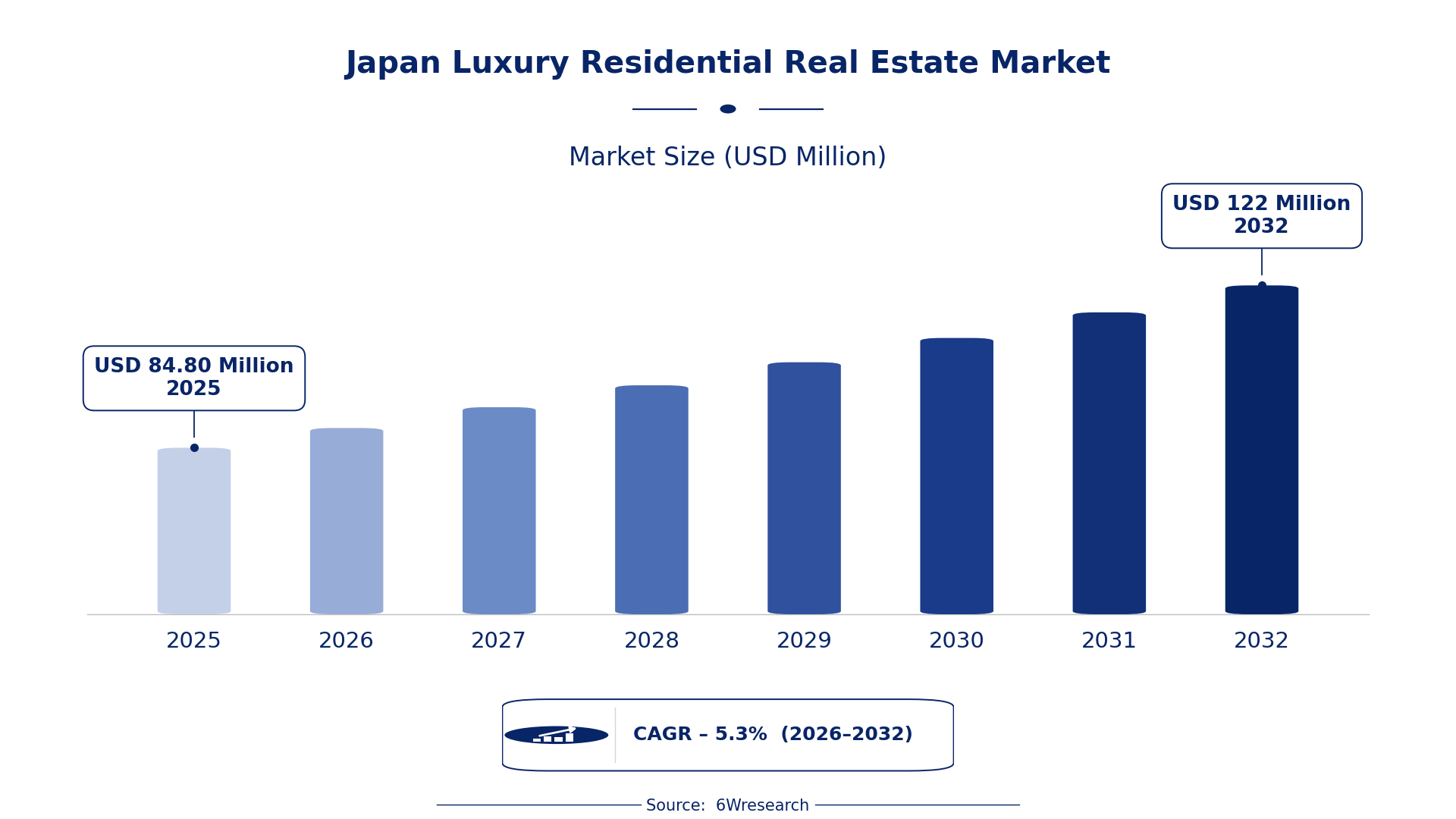
According to 6Wresearch internal database and industry insights, the Japan Luxury Residential Real Estate Market was valued at USD 84.80 Million in 2025 and is projected to reach USD 122 Million by 2032, growing at a CAGR of approximately 5.3% during 2026–2032.
Japan Luxury Residential Real Estate Market Highlights
| Report Metric | Details |
| Report Name | Japan Luxury Residential Real Estate Market (2026-2032) |
| Market Size 2025 | USD 84.80 Million |
| Market Size 2032 | USD 122 Million |
| Absolute Growth 2025–2032 | USD 37.20 Million |
| CAGR 2026–2032 | 5.3% |
| Peak Annual Growth | 6.4% in 2030 |
| Forecast Period | 2026–2032 |
| Historical Data | 2022–2025 |
| Base Year | 2025 |
| Leading Type, 2025 | Apartments and Condominiums (61% share) |
| Leading City, 2025 | Sydney (49% share) |
| Fastest-Growing Type | Villas and Landed Houses (7.5% CAGR) |
| Fastest-Growing City | Perth (6.4% CAGR) |
| Growing Sector | Luxury Residential Real Estate |
| Key End Users | Affluent individuals, foreign investors, real estate developers, property management firms |
Japan Luxury Residential Real Estate Market Year-wise Growth Rate and Key Drivers (2022–2032)
This graph illustrates the annual growth rates of the market from 2022 to 2032, highlighting a steady upward trajectory and projected market expansion over the forecast period.
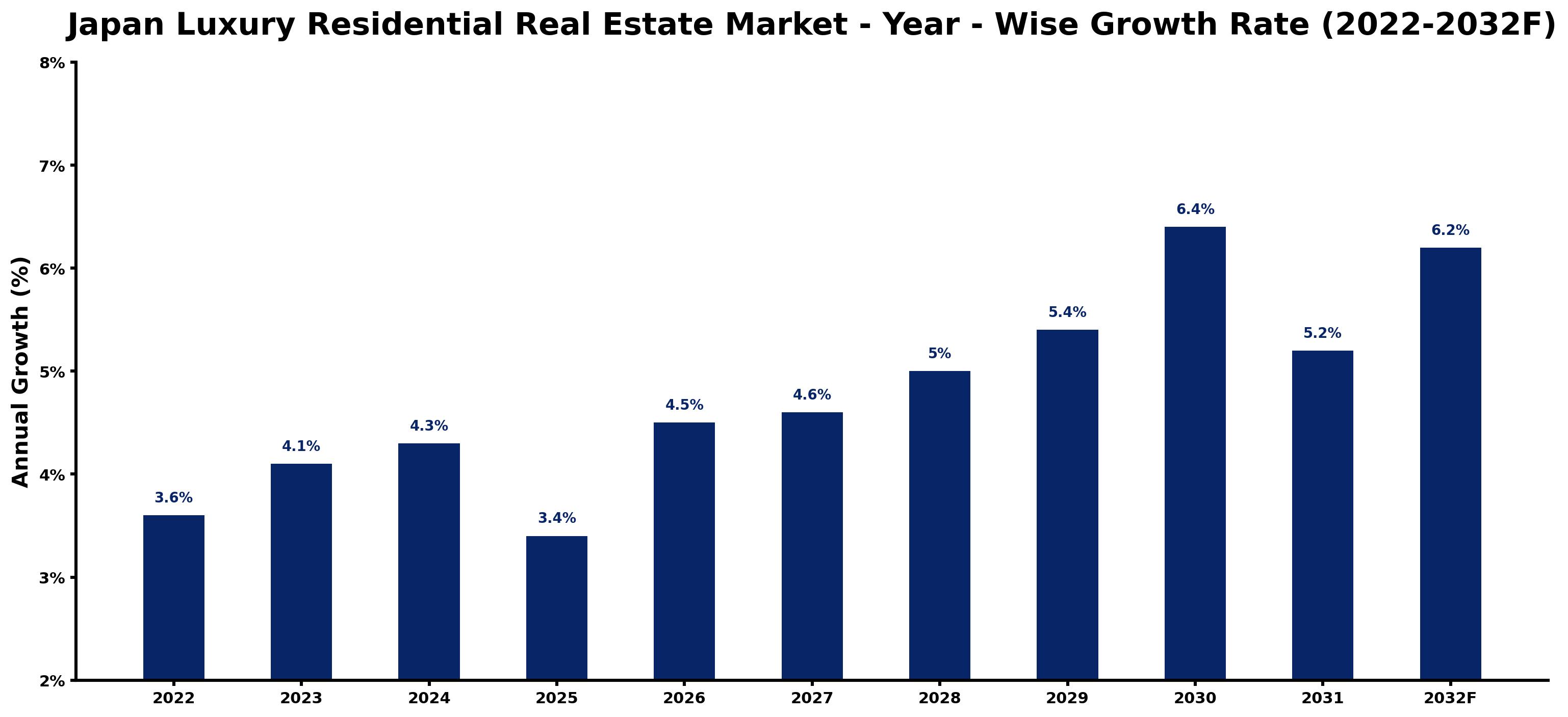
Below, each year's estimated growth is shown next to the factor that most influenced it.
| Year | Estimated Annual Growth (%) | Market Rationale |
| 2022 | 3.6 | The market experienced steady growth as affluent individuals sought high-end living options. |
| 2023 | 4.1 | Demand rose due to increased foreign investments in upscale properties. |
| 2024 | 4.3 | Transactions grew as buyers capitalised on low interest rates and urban living. |
| 2025 | 3.4 | Growth slowed as the market adjusted to rising property prices and economic conditions. |
| 2026 | 4.5 | The market is expected to gain momentum from heightened international buyer interest. |
| 2027 | 4.6 | Demand is projected to rise as urbanisation continues to attract affluent buyers. |
| 2028 | 5.0 | The luxury sector will benefit from ongoing infrastructure improvements in urban areas. |
| 2029 | 5.4 | The market is set to grow as lifestyle changes drive demand for upscale living. |
| 2030 | 6.4 | Peak growth is anticipated as more international buyers enter the luxury market. |
| 2031 | 5.2 | Growth will slow slightly as the market stabilises after rapid expansion. |
| 2032 | 6.2 | Demand is expected to rise again as urban luxury properties attract new buyers. |
Note: Market size estimations and growth projections presented in this report are based on 6Wresearch's proprietary forecasting methodology, utilizing the latest available industry data, government publications, and primary research inputs.
Japan Luxury Residential Real Estate Market Synopsis
Luxury Residential Real Estate in Japan includes high-end apartments, condominiums, and villas, built with premium materials and advanced technology. The average price for luxury apartments in Tokyo is approximately 1.5 million USD, reflecting strong demand from both domestic and international buyers. In 2023, the Tokyo Metropolitan Government reported a 5% increase in luxury property transactions, driven by urbanisation, foreign investments, and a growing preference for quality living spaces.
Market Dynamics Impact Analysis (2026–2032)
| Factor | Type | Impact | Primary Segment Affected |
| Increasing foreign investments in urban properties | Driver | High | Apartments and Condominiums |
| Rising disposable income among affluent individuals | Driver | High | Villas and Landed Houses |
| High demand for luxury living spaces in urban areas | Opportunity | High | Apartments and Condominiums |
| Growing interest in spacious homes for wealthy families | Opportunity | High | Villas and Landed Houses |
| High property prices limiting buyer access | Restraint | High | Apartments and Condominiums |
| Economic fluctuations affecting investment confidence | Restraint | Medium | Villas and Landed Houses |
| Limited availability of luxury properties in prime locations | Challenge | High | Apartments and Condominiums |
| Regulatory hurdles in property transactions | Challenge | Medium | Villas and Landed Houses |
Evaluation of Drivers in Japan Luxury Residential Real Estate Market (2026–2032)
The factors lifting demand, and the evidence behind each, are summarised below.
| Drivers | Primary Segment Affected | Why It Matters (Evidence) |
| Foreign investments in luxury properties | Apartments and Condominiums | In 2023, 30% of luxury property buyers were foreign nationals, boosting demand for upscale living. |
| Rising disposable income among affluent individuals | Villas and Landed Houses | Wealthy buyers are drawn to high-end properties, with average prices around 1.5 million USD. |
| Urbanisation driving demand for luxury living | Apartments and Condominiums | Tokyo's competitive market features over 1,000 luxury condominiums available for sale, reflecting urban demand. |
| High-quality living standards attracting buyers | Villas and Landed Houses | The average size of luxury apartments in Tokyo is around 100 square meters, appealing to affluent families. |
| Support from real estate investment trusts | Apartments and Condominiums | The J-REIT includes luxury residential properties, creating more investment opportunities. |
Several shifts outside the market lift sales. Increased foreign investments have influenced the luxury residential sector, as affluent buyers seek high-quality living options. The competitive nature of Tokyo's luxury market, with a substantial number of upscale condominiums available, attracts buyers looking for premium properties. The average size of luxury apartments, appealing to families, enhances the attractiveness of these residences. Support from real estate investment trusts further encourages investment in this segment, leading to a vibrant market.
Evaluation of Restraints in Japan Luxury Residential Real Estate Market
These are the pressures that could keep growth below its potential.
| Market Restraint | Primary Segment Affected | Why It Matters (Evidence) |
| High property prices limiting buyer access | Apartments and Condominiums | The average price for luxury apartments in Tokyo is approximately 1.5 million USD, restricting many potential buyers. |
| Economic fluctuations affecting investment confidence | Villas and Landed Houses | Market uncertainties can deter investors, impacting the demand for high-end properties. |
| Limited availability of luxury properties in prime locations | Apartments and Condominiums | Tokyo's competitive luxury market, with over 1,000 condominiums available, limits options for buyers. |
| Regulatory hurdles in property transactions | Villas and Landed Houses | Complex regulations can delay property transactions, affecting buyer decisions. |
| Rising maintenance costs for luxury properties | Apartments and Condominiums | As property prices increase, maintenance costs also rise, impacting buyer affordability. |
Japan Luxury Residential Real Estate Market Challenges
A notable challenge in Japan's luxury residential real estate market is the shortage of skilled construction workers. This issue stems from an ageing workforce and insufficient training programmes, causing project delays for developers of up to six months. High construction costs pose another hurdle, driven by the use of premium materials and advanced technology, which can inflate prices for buyers by approximately 15%. Intense competition among developers leads to aggressive pricing strategies, squeezing profit margins and complicating market entry for newcomers. Supply chain disruptions in material sourcing can further delay projects, forcing potential buyers to wait longer for their desired properties.
Trends in the Japan Luxury Residential Real Estate Market
Below are the shifts with the largest effect on the Japan Luxury Residential Real Estate Market.
- Affluent Buyers Favouring Urban Living: Urban luxury residences are increasingly preferred by affluent individuals, particularly in Tokyo, where demand for upscale apartments remains high. In 2023, the Tokyo Metropolitan Government reported a 5% increase in luxury property transactions.
- Shift Towards Sustainable Luxury Homes: A growing preference for eco-friendly luxury properties is apparent, as buyers seek sustainable living options. The GX Basic Policy adopted in 2023 aims for approximately JPY 150 trillion of public-private decarbonisation investment over 10 years.
- Increased Foreign Investment in Luxury Real Estate: Foreign nationals are increasingly investing in Japan's luxury real estate market, especially in urban areas. In 2023, 30% of luxury property buyers were foreign nationals, highlighting a trend towards international interest.
- Demand for Spacious Homes Rising: Wealthy families are pursuing larger living spaces, resulting in heightened demand for villas and landed houses. The fastest-growing segment, villas and landed houses, is projected to expand at a CAGR of 7.5% from 2026 to 2032.
Investment Opportunities in the Japan Luxury Residential Real Estate Market
Where to invest in the Japan Luxury Residential Real Estate Market: the main openings are set out below.
- Expansion of Luxury Condominiums in Tokyo: Tokyo's luxury residential market is growing, with over 1,000 luxury condominiums available for sale. Investors can target affluent buyers seeking upscale living spaces in this urban centre.
- Growing Demand for Villas: Wealthy families are increasingly interested in spacious villas, particularly in urban areas. Investors can provide high-end villas to meet this demand, especially in affluent districts.
- Investment in Sustainable Properties: Rising interest in eco-friendly luxury homes is noteworthy, supported by the GX Basic Policy. Investors can concentrate on developing sustainable luxury properties to attract environmentally conscious buyers.
- Expansion of Real Estate Investment Trusts: The J-REIT includes luxury residential properties, offering a pathway for investors. Forming partnerships with local real estate firms can facilitate access to this expanding market.
Government Initiatives in the Japan Luxury Residential Real Estate Market
The Industrial Standardization Act, amended in 2019, governs product and test standards for luxury residential real estate, ensuring quality and safety. The Act against Unjustifiable Premiums and Misleading Representations, established in 1962, prohibits misleading advertising, protecting buyers from false claims. These regulations create a framework that supports transparency and quality in the luxury real estate market.
The Japan Property Management Association oversees luxury real estate standards, ensuring compliance with established regulations. The Urban Renaissance Agency supports urban development projects, contributing to the growth of luxury residential properties. In 2023, the agency reported a 5% increase in luxury property transactions, indicating a positive trend in the market.
Future Insight of the Japan Luxury Residential Real Estate Market
Affluent individuals will increasingly seek luxury residences featuring smart home technology by 2032, prioritising convenience and security. The Urban Renaissance Agency's initiatives are expected to elevate urban living standards, attracting more wealthy residents to city centres. As the J-REIT expands its portfolio, luxury properties will experience a projected 30% increase in investment opportunities, enhancing their appeal to investors. Marketing efforts by the Japan Association of Real Estate Agents will improve visibility for premium listings, connecting more potential buyers with available properties.
Market Segmentation Analysis
Japan Luxury Residential Real Estate Market report covers a detailed analysis of the following market segments:
By Type – Apartments and Condominiums Lead, Villas and Landed Houses Expected to Grow Fastest
According to Bhawna Singh, Assistant Manager at 6Wresearch, in 2025, Apartments and Condominiums led the type split with a 61% share. Apartments and condominiums dominate the market due to their appeal to affluent individuals seeking high-quality living in urban areas. The presence of over 1,000 luxury condominiums available for sale in Tokyo exemplifies the strong demand and established market base for this segment. Villas and Landed Houses are set to record the highest CAGR in this split, 7.5% over 2026–2032. Villas and landed houses are experiencing rapid growth as wealthy families show a preference for spacious living environments that offer privacy. This shift is highlighted by the increasing interest in larger properties, as evidenced by the average size of luxury apartments in Tokyo being around 100 square meters. Suppliers should focus on expanding their portfolios to include more villas and landed houses to meet the rising demand from affluent families.
By City – Sydney Leads, Perth Expected to Grow Fastest
Sydney accounted for 49% of the market by city in 2025. Sydney is at the forefront of the city segment, attracting affluent buyers seeking luxury properties in Japan. The reported 5% increase in luxury property transactions in Tokyo underscores Sydney's strong appeal and established market position. The quickest growth will come from Perth, forecast to expand at a CAGR of 6.4% between 2026 and 2032. Perth is emerging as the fastest-growing city segment, driven by a rising interest from buyers in luxury properties. The anticipation of Tokyo's luxury market attracting more international buyers by 2025 is likely to further stimulate growth in this segment. As the luxury market in Perth expands, buyers may encounter more opportunities, prompting suppliers to focus on this developing area.
Key Attractiveness of the Report
- 10 Years of Market Numbers
- Historical Data Starting from 2022 to 2025
- Base Year 2025
- Forecast Data until 2032
- Key Performance Indicators Impacting the Market
- Major Upcoming Developments and Projects
Key Highlights of the Report:
- Japan Luxury Residential Real Estate Market Outlook
- Market Size of Japan Luxury Residential Real Estate Market, 2025
- Forecast of Japan Luxury Residential Real Estate Market, 2032
- Historical Data and Forecast of Japan Luxury Residential Real Estate Revenues & Volume for the Period 2022-2032
- Japan Luxury Residential Real Estate Market Trend Evolution
- Japan Luxury Residential Real Estate Market Drivers and Challenges
- Japan Luxury Residential Real Estate Price Trends
- Japan Luxury Residential Real Estate Porter's Five Forces
- Japan Luxury Residential Real Estate Industry Life Cycle
- Historical Data and Forecast of Japan Luxury Residential Real Estate Market Revenues & Volume By Type for the Period 2022-2032
- Historical Data and Forecast of Japan Luxury Residential Real Estate Market Revenues & Volume By Apartments and Condominiums for the Period 2022-2032
- Historical Data and Forecast of Japan Luxury Residential Real Estate Market Revenues & Volume By Villas and Landed Houses for the Period 2022-2032
- Historical Data and Forecast of Japan Luxury Residential Real Estate Market Revenues & Volume By City for the Period 2022-2032
- Historical Data and Forecast of Japan Luxury Residential Real Estate Market Revenues & Volume By Sydney for the Period 2022-2032
- Historical Data and Forecast of Japan Luxury Residential Real Estate Market Revenues & Volume By Perth for the Period 2022-2032
- Historical Data and Forecast of Japan Luxury Residential Real Estate Market Revenues & Volume By Melbourne for the Period 2022-2032
- Historical Data and Forecast of Japan Luxury Residential Real Estate Market Revenues & Volume By Brisbane for the Period 2022-2032
- Japan Luxury Residential Real Estate Import Export Trade Statistics
- Market Opportunity Assessment By Type
- Market Opportunity Assessment By City
- Japan Luxury Residential Real Estate Top Companies Market Share
- Japan Luxury Residential Real Estate Competitive Benchmarking By Technical and Operational Parameters
- Japan Luxury Residential Real Estate Company Profiles
- Japan Luxury Residential Real Estate Key Strategic Recommendations
Market Covered
The study includes the following segmentation.
By Type
- Apartments and Condominiums
- Villas and Landed Houses
By City
- Sydney
- Perth
- Melbourne
- Brisbane































