Japan Packaged Substation Market Size & Growth Rate
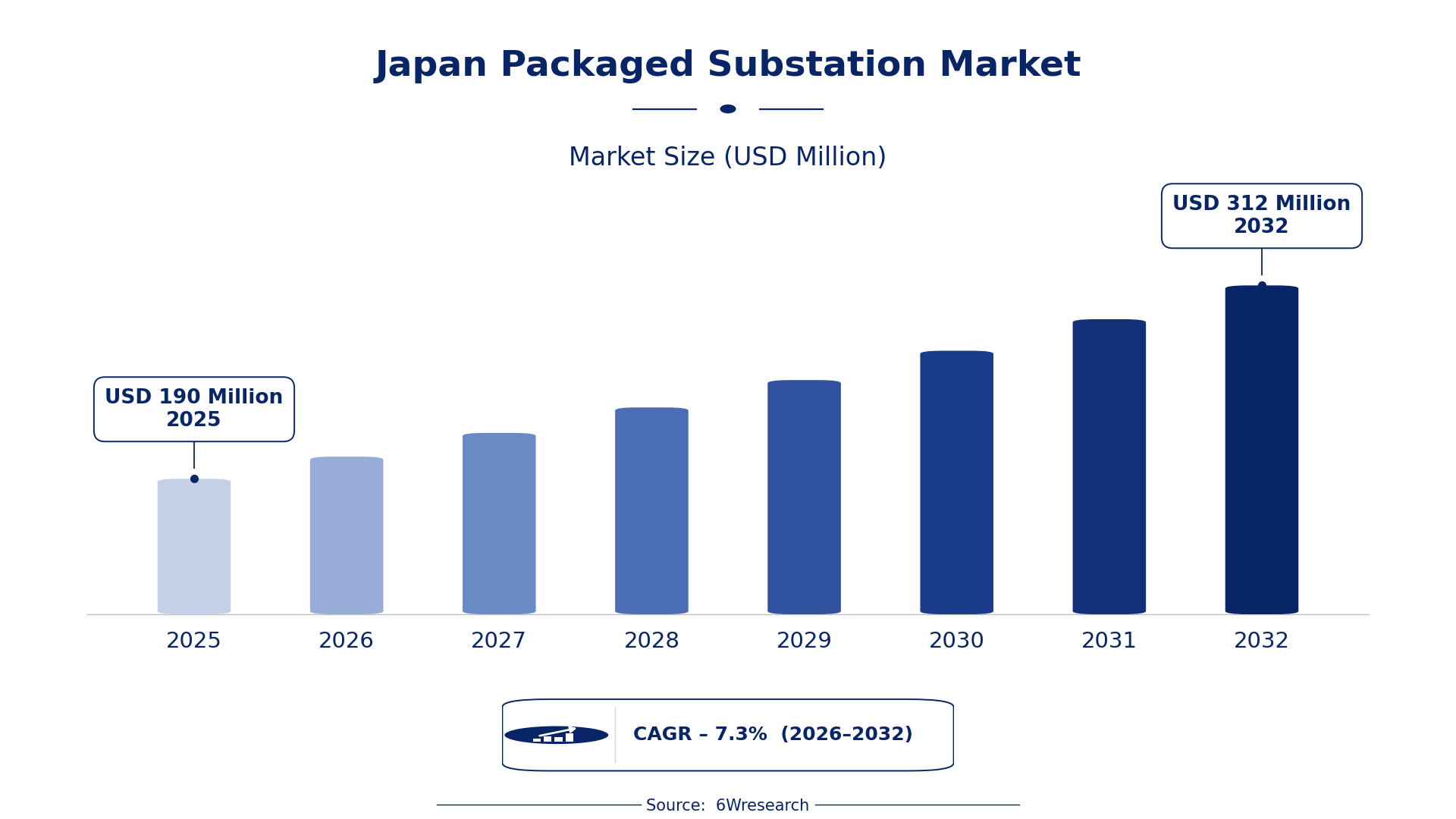
According to 6Wresearch internal database and industry insights, the Japan Packaged Substation Market was valued at USD 190 Million in 2025 and is projected to reach USD 312 Million by 2032, growing at a CAGR of approximately 7.3% during 2026–2032.
Japan Packaged Substation Market Highlights
| Report Metric | Details |
| Report Name | Japan Packaged Substation Market (2026-2032) |
| Market Size 2025 | USD 190 Million |
| Market Size 2032 | USD 312 Million |
| Absolute Growth 2025–2032 | USD 122 Million |
| CAGR 2026–2032 | 7.3% |
| Peak Annual Growth | 8.6% in 2026 |
| Forecast Period | 2026–2032 |
| Historical Data | 2022–2025 |
| Base Year | 2025 |
| Leading voltage Split, 2025 | below 36kV (62% share) |
| Leading Application, 2025 | Power Utilities & Generation (48% share) |
| Fastest-Growing voltage Split | above 36kV to 150kV (8.8% CAGR) |
| Fastest-Growing Application | Infrastructure (10.0% CAGR) |
| Growing Sector | Infrastructure |
| Key End Users | Power utilities, industrial facilities, infrastructure developers |
Japan Packaged Substation Market Year-wise Growth Rate and Key Drivers (2022–2032)
This graph illustrates the annual growth rates of the market from 2022 to 2032, highlighting a steady upward trajectory and projected market expansion over the forecast period.
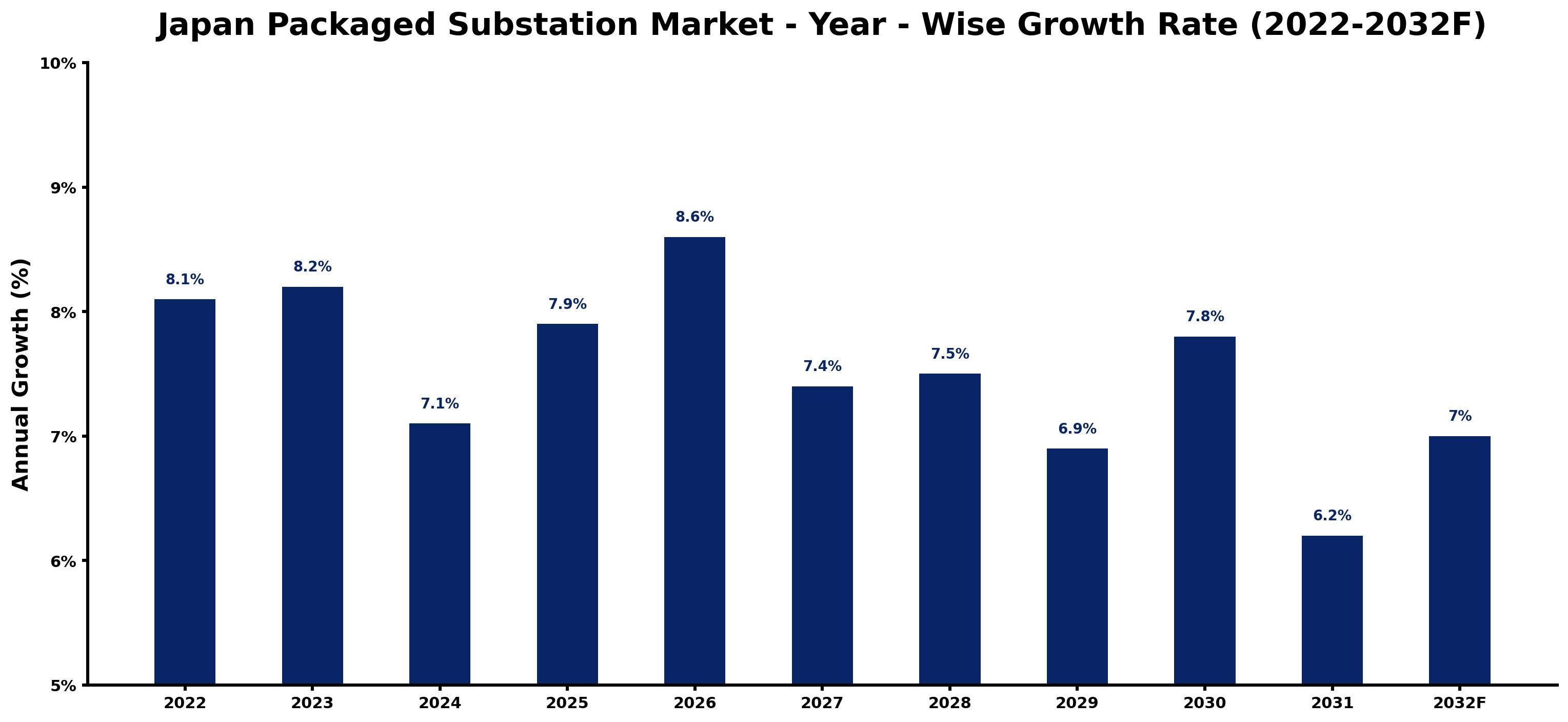
The table below sets out the estimated growth rate for each year and the main factor behind it.
| Year | Estimated Annual Growth (%) | Market Rationale |
| 2022 | 8.1 | The market experienced steady growth due to ongoing infrastructure projects and stable utility demand. |
| 2023 | 8.2 | Growth accelerated as packaged substations gained traction in urban areas like Tokyo and Osaka. |
| 2024 | 7.1 | A slowdown occurred as the market adjusted to previous high growth rates while still expanding. |
| 2025 | 7.9 | Demand increased again as investments in energy efficiency and grid modernization continued. |
| 2026 | 8.6 | The market is expected to peak with orders driven by the Smart Grid initiative and renewable energy projects. |
| 2027 | 7.4 | Growth is projected to slow as the market stabilises after the peak, but demand remains strong. |
| 2028 | 7.5 | A slight uptick in growth is anticipated as new infrastructure projects are initiated across Japan. |
| 2029 | 6.9 | The market will see a slowdown again as the focus shifts to optimising existing resources. |
| 2030 | 7.8 | Growth is expected to rise again as energy consumption patterns shift towards more efficient technologies. |
| 2031 | 6.2 | A slowdown is projected as the market matures, with stable demand from key sectors. |
| 2032 | 7.0 | Growth will pick up as new projects and technologies are adopted, revitalising the market. |
Note: Market size estimations and growth projections presented in this report are based on 6Wresearch's proprietary forecasting methodology, utilizing the latest available industry data, government publications, and primary research inputs.
Japan Packaged Substation Market Synopsis
Packaged substations are compact electrical assemblies designed for voltage transformation and distribution, serving industrial facilities, infrastructure projects, and utility companies. The Japan Packaged Substation Market is growing due to ongoing infrastructure development and a stable utility sector. Growth stems from investments in energy efficiency and Smart Grid initiatives, supported by over 1,000 operational units and a total installed capacity exceeding 200 GW.
Market Dynamics Impact Analysis (2026–2032)
| Factor | Type | Impact | Primary Segment Affected |
| Growing demand for energy-efficient solutions | Driver | High | Power Utilities & Generation |
| Increased infrastructure projects requiring reliable power supply | Driver | High | Infrastructure |
| Expansion of renewable energy initiatives | Opportunity | High | Power Utilities & Generation |
| Investment in Smart Grid technology | Opportunity | High | Infrastructure |
| High initial costs of packaged substations | Restraint | Medium | Industrial |
| Limited awareness of benefits among smaller utilities | Restraint | Medium | Power Utilities & Generation |
| Competition from alternative energy solutions | Challenge | High | Infrastructure |
| Supply chain disruptions affecting component availability | Challenge | Medium | Industrial |
Evaluation of Drivers in Japan Packaged Substation Market (2026–2032)
The following drivers explain most of the expected growth.
| Drivers | Primary Segment Affected | Why It Matters (Evidence) |
| Increased energy consumption in urban areas | Power Utilities & Generation | Japan's energy consumption was approximately 900 TWh in 2022, driving demand for efficient substations. |
| Government support for renewable energy integration | Infrastructure | In 2023, the government allocated ¥10 billion for renewable energy projects, boosting substation demand. |
| Technological advancements in substation design | Industrial | The Japanese Electrical Manufacturers' Association promotes innovation, improving product reliability and efficiency. |
| Focus on energy efficiency standards | Power Utilities & Generation | The Ministry of Economy, Trade and Industry promotes energy efficiency standards, increasing substation adoption. |
| Growth of the Smart Grid initiative | Infrastructure | Packaged substations support the Smart Grid initiative, improving grid reliability and efficiency. |
Orders keep climbing as energy consumption in urban areas rises, with Japan's consumption reaching approximately 900 TWh in 2022. Support for renewable energy integration, highlighted by a ¥10 billion allocation in 2023, drives demand for packaged substations. Innovations in substation design improve product reliability, leading to increased orders from utilities.
Evaluation of Restraints in Japan Packaged Substation Market
The following restraints limit how fast demand can grow.
| Market Restraint | Primary Segment Affected | Why It Matters (Evidence) |
| High initial costs of packaged substations | Industrial | The average investment for a packaged substation can be substantial, limiting adoption among smaller industries. |
| Limited awareness of benefits among smaller utilities | Power Utilities & Generation | Many smaller utilities lack knowledge about the efficiency gains from packaged substations, hindering market growth. |
| Regulatory hurdles for new installations | Infrastructure | Compliance with energy efficiency standards can delay project timelines for new substations. |
| Supply chain disruptions affecting component availability | Industrial | Global supply chain issues have led to delays in obtaining critical components for substations. |
| Competition from alternative energy solutions | Infrastructure | Emerging technologies in energy generation may divert investment away from traditional substation infrastructure. |
Japan Packaged Substation Market Challenges
In Japan, over 1,000 packaged substations face a critical skills shortage, with fewer technicians entering the workforce, which delays essential maintenance and raises operational risks for utility companies. Production costs are increasing due to stringent energy efficiency standards, inflating prices for buyers and making projects less viable. Limited adoption of advanced technology hinders innovation, causing suppliers to lag behind global competitors, which reduces their market share. Intense competition among local manufacturers drives down prices, squeezing margins and forcing producers to compromise on quality, ultimately affecting the reliability of substations for end users.
Trends in the Japan Packaged Substation Market
The shifts below are changing how Japan Packaged Substation Market products are bought and supplied.
- Integration of Smart Grid Technology: The Smart Grid initiative is transforming energy distribution in Japan, with over 1,000 operational packaged substations facilitating this transition. This integration boosts efficiency and reliability in energy management.
- Shift towards Renewable Energy Integration: Japan is increasingly prioritising renewable energy, with government funding of ¥10 billion in 2023 for integration projects. This shift requires more packaged substations to manage variable energy sources.
- Adoption of Energy Efficiency Standards: The Ministry of Economy, Trade and Industry's promotion of energy efficiency standards is driving upgrades in substation technology. This initiative is expected to improve operational efficiency across the sector.
- Expansion of Infrastructure Projects: Infrastructure development is accelerating in regions like Tokyo and Osaka, where demand for reliable power supply is critical. This trend will likely drive further investment in packaged substations.
Investment Opportunities in the Japan Packaged Substation Market
Where to invest in the Japan Packaged Substation Market: the main openings are set out below.
- Supply of Packaged Substations for Renewable Projects: With the government allocating ¥10 billion for renewable energy integration, there is an opportunity to supply packaged substations. Power utilities are actively seeking reliable solutions.
- Investment in Smart Grid Infrastructure: The ongoing Smart Grid initiative presents a gap in infrastructure that needs addressing. Infrastructure developers in urban areas are looking for local partners to enhance their projects.
- Expansion into Emerging Markets: As Japan's energy consumption patterns evolve, there is a growing need for efficient power solutions. Industrial sectors are increasingly interested in upgrading their substations to meet new demands.
- Upgrade of Existing Substation Technology: The average lifespan of a packaged substation is around 25 years, indicating a need for upgrades. Utilities are seeking modern solutions to replace outdated systems.
Government Initiatives in the Japan Packaged Substation Market
The Food Sanitation Act amendment of 2018 introduced a positive list system for synthetic resins, affecting the materials used in electrical components. This law, fully applied by June 2021, ensures safety and compliance in the production of packaged substations, influencing manufacturers to adhere to stricter standards.
In 2023, the Ministry of Economy, Trade and Industry funded renewable energy integration projects, allocating ¥10 billion to support this initiative. The agency oversees the implementation of energy efficiency standards, ensuring that substations meet modern requirements.
Future Insight of the Japan Packaged Substation Market
The investment pipeline for renewable energy integration will create substantial demand for packaged substations by 2032. The Smart Grid initiative will drive technological advancements, enabling suppliers to offer more efficient solutions. Energy management standards like ISO 50001 will gain traction, prompting buyers to adopt higher efficiency levels. As Japan's energy consumption reaches approximately 900 TWh, the market will shift towards modernised infrastructure that supports sustainable practices.
Market Segmentation Analysis
Japan Packaged Substation Market report covers a detailed analysis of the following market segments:
By voltage Split – below 36kV Leads, above 36kV to 150kV Expected to Grow Fastest
According to Sumit Sagar, AM at 6Wresearch, the largest voltage split category in 2025 was below 36kV, at 62% of revenue. The below 36kV segment dominates the market due to its extensive use in residential and commercial applications, particularly in urban centres like Tokyo. The existing infrastructure supports a large installed base, ensuring continued demand from local users. The quickest growth will come from above 36kV to 150kV, forecast to expand at a CAGR of 8.8% between 2026 and 2032. The above 36kV to 150kV segment is growing rapidly as industrial and utility sectors increasingly require higher voltage solutions for large-scale operations. This growth is further propelled by government initiatives, including the allocation of ¥10 billion for renewable energy integration projects. This trend indicates that suppliers should prioritise their strategies towards the higher voltage segment to align with market demands.
By Application – Power Utilities & Generation Leads, Infrastructure Expected to Grow Fastest
Power Utilities & Generation held 48% of the Japan Packaged Substation Market by application in 2025. Power Utilities & Generation dominates the market as these substations are essential for effective voltage transformation and distribution across Japan's extensive utility network. The segment's strength is reinforced by the substantial operational capacity of over 200 GW in the country. Over 2026–2032, Infrastructure is expected to post the fastest growth, at a CAGR of 10.0%. Infrastructure is the fastest-growing application as ongoing development projects necessitate reliable power supply solutions, particularly in urban areas. The government's commitment to infrastructure upgrades is a key factor, with substantial funding allocated for these initiatives. Buyers in the infrastructure sector should prioritise partnerships with suppliers who can deliver reliable packaged substations.
Key Attractiveness of the Report
- 10 Years of Market Numbers
- Historical Data Starting from 2022 to 2025
- Base Year 2025
- Forecast Data until 2032
- Key Performance Indicators Impacting the Market
- Major Upcoming Developments and Projects
Key Highlights of the Report:
- Japan Packaged Substation Market Outlook
- Market Size of Japan Packaged Substation Market, 2025
- Forecast of Japan Packaged Substation Market, 2032
- Historical Data and Forecast of Japan Packaged Substation Revenues & Volume for the Period 2022-2032
- Japan Packaged Substation Market Trend Evolution
- Japan Packaged Substation Market Drivers and Challenges
- Japan Packaged Substation Price Trends
- Japan Packaged Substation Porter's Five Forces
- Japan Packaged Substation Industry Life Cycle
- Historical Data and Forecast of Japan Packaged Substation Market Revenues & Volume By voltage Split for the Period 2022-2032
- Historical Data and Forecast of Japan Packaged Substation Market Revenues & Volume By below 36kV for the Period 2022-2032
- Historical Data and Forecast of Japan Packaged Substation Market Revenues & Volume By above 36kV to 150kV for the Period 2022-2032
- Historical Data and Forecast of Japan Packaged Substation Market Revenues & Volume By Application for the Period 2022-2032
- Historical Data and Forecast of Japan Packaged Substation Market Revenues & Volume By Industrial for the Period 2022-2032
- Historical Data and Forecast of Japan Packaged Substation Market Revenues & Volume By Infrastructure for the Period 2022-2032
- Historical Data and Forecast of Japan Packaged Substation Market Revenues & Volume By Power Utilities & Generation for the Period 2022-2032
- Japan Packaged Substation Import Export Trade Statistics
- Market Opportunity Assessment By voltage Split
- Market Opportunity Assessment By Application
- Japan Packaged Substation Top Companies Market Share
- Japan Packaged Substation Competitive Benchmarking By Technical and Operational Parameters
- Japan Packaged Substation Company Profiles
- Japan Packaged Substation Key Strategic Recommendations
Market Covered
The report covers the following segments.
By voltage Split
- below 36kV
- above 36kV to 150kV
By Application
- Industrial
- Infrastructure
- Power Utilities & Generation































