Japan Product-Based Sales Training Market Size & Growth Rate
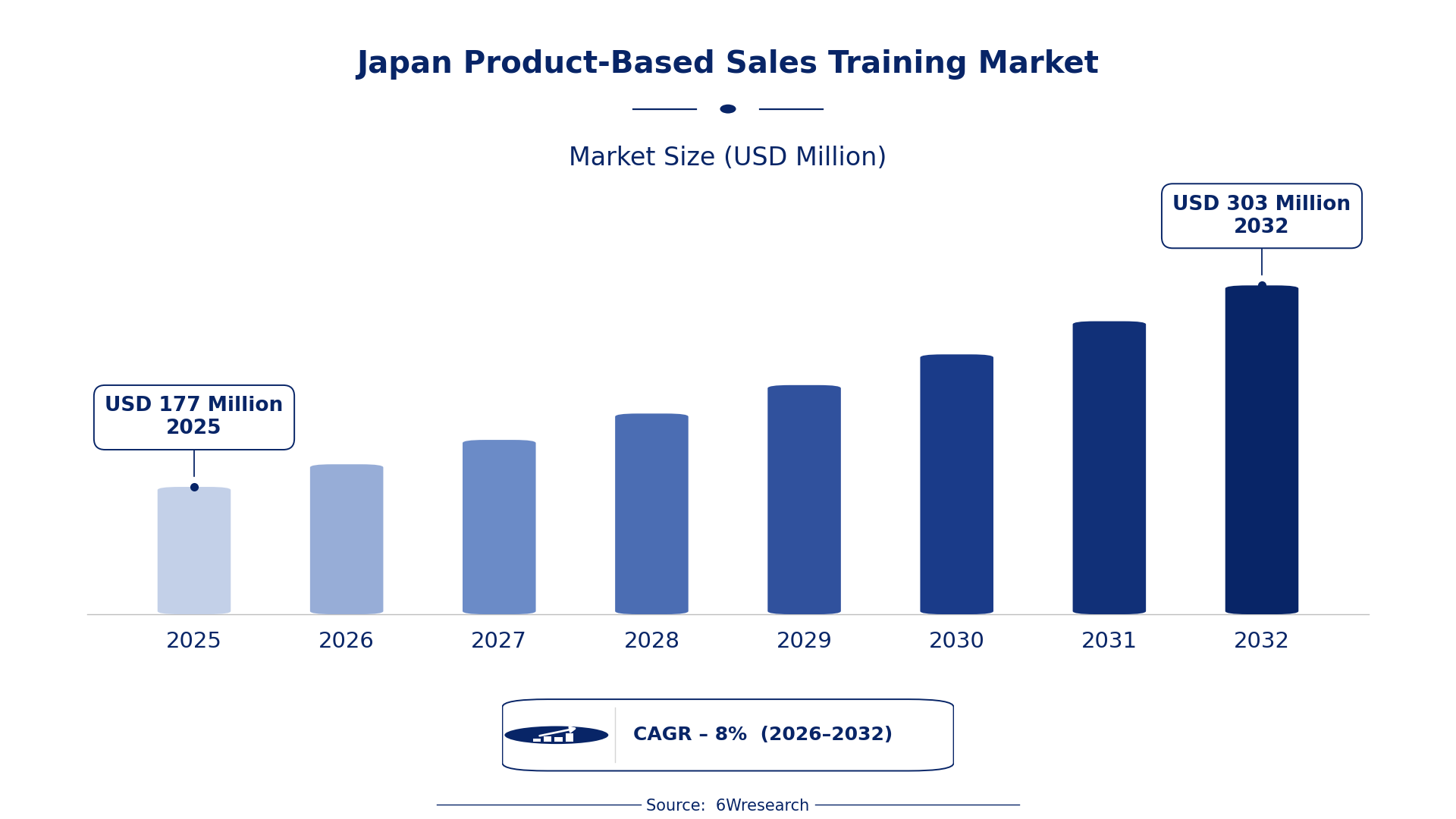
According to 6Wresearch internal database and industry insights, the Japan Product-Based Sales Training Market was valued at USD 177 Million in 2025 and is projected to reach USD 303 Million by 2032, growing at a CAGR of approximately 8% during 2026–2032.
Japan Product-Based Sales Training Market Highlights
| Report Metric | Details |
| Report Name | Japan Product-Based Sales Training Market (2026-2032) |
| Market Size 2025 | USD 177 Million |
| Market Size 2032 | USD 303 Million |
| Absolute Growth 2025–2032 | USD 126 Million |
| CAGR 2026–2032 | 8% |
| Peak Annual Growth | 8.5% in 2026 |
| Forecast Period | 2026–2032 |
| Historical Data | 2022–2025 |
| Base Year | 2025 |
| Leading Product Type, 2025 | In-Person Training (43% share) |
| Leading Training Method, 2025 | Workshops & Seminars (39% share) |
| Leading Application Area, 2025 | Sales Skills (43% share) |
| Leading Distribution Channel, 2025 | Direct Sales (44% share) |
| Leading End User, 2025 | Corporates (53% share) |
| Fastest-Growing Product Type | Online Training Modules (11.5% CAGR) |
| Fastest-Growing Training Method | eLearning Platforms (11.1% CAGR) |
| Fastest-Growing Application Area | Customer Interaction (9.5% CAGR) |
| Fastest-Growing Distribution Channel | Training Providers (10.2% CAGR) |
| Fastest-Growing End User | SMEs & Enterprises (10.3% CAGR) |
| Growing Sector | Sales Training |
| Key End Users | Corporates, SMEs & Enterprises, Retail Teams |
Japan Product-Based Sales Training Market Year-wise Growth Rate and Key Drivers (2022–2032)
This graph illustrates the annual growth rates of the market from 2022 to 2032, highlighting a steady upward trajectory and projected market expansion over the forecast period.
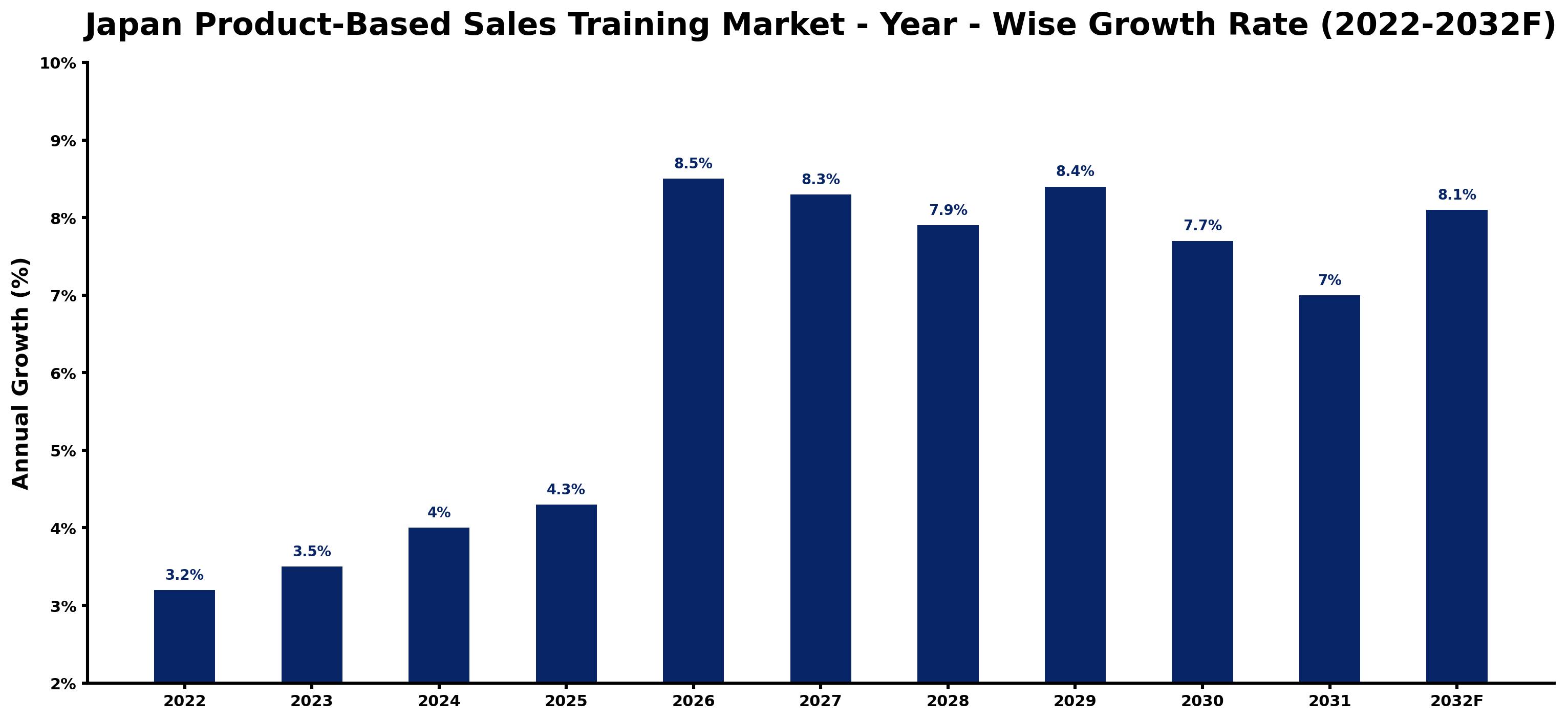
Annual growth estimates for each year appear below with the principal reason behind them, explaining the shifts that set the pace of the market.
| Year | Estimated Annual Growth (%) | Market Rationale |
| 2022 | 3.2 | The market exhibited steady growth, driven by increasing corporate training initiatives. |
| 2023 | 3.5 | Demand accelerated as more businesses recognised the value of sales training. |
| 2024 | 4.0 | The rise in corporate training workshops contributed to heightened market activity. |
| 2025 | 4.3 | Workshops and seminars gained traction, enhancing overall sales capabilities. |
| 2026 | 8.5 | The introduction of new training methods is expected to spur significant market growth. |
| 2027 | 8.3 | Growth is projected to slow slightly as the market adjusts to evolving training formats. |
| 2028 | 7.9 | A further slowdown is expected as companies stabilise their training budgets. |
| 2029 | 8.4 | Demand is expected to surge again due to renewed interest in customer interaction training. |
| 2030 | 7.7 | Growth is projected to moderate as the market matures and competition intensifies. |
| 2031 | 7.0 | The market will continue to grow, supported by ongoing corporate training investments. |
| 2032 | 8.1 | Increased focus on digital training methods is expected to boost market performance. |
Note: Market size estimations and growth projections presented in this report are based on 6Wresearch's proprietary forecasting methodology, utilizing the latest available industry data, government publications, and primary research inputs.
Japan Product-Based Sales Training Market Synopsis
Product-Based Sales Training includes structured programmes designed to improve sales skills and customer interaction through various formats, such as in-person sessions and online modules. The Japan Product-Based Sales Training Market is growing due to increased demand from corporates and SMEs, alongside a rise in diverse training methodologies. The Tokyo region represents 40% of the market, and the sector is set to expand as more organisations invest in enhancing sales performance and customer engagement.
Market Dynamics Impact Analysis (2026–2032)
| Factor | Type | Impact | Primary Segment Affected |
| Rising corporate training budgets | Driver | High | Corporates |
| Growing adoption of eLearning platforms | Driver | High | Online Training Modules |
| Increasing demand for customer interaction skills | Opportunity | High | Customer Interaction |
| Expansion of training providers in urban areas | Opportunity | Medium | Training Providers |
| Limited awareness of training benefits among SMEs | Restraint | Medium | SMEs & Enterprises |
| High competition among training providers | Restraint | Medium | Training Providers |
| Talent shortages in skilled trainers | Challenge | High | In-Person Training |
| Resistance to adopting new training technologies | Challenge | Medium | Online Training Modules |
Evaluation of Drivers in Japan Product-Based Sales Training Market (2026–2032)
Below are the drivers that matter most for revenue growth, with supporting evidence.
| Drivers | Primary Segment Affected | Why It Matters (Evidence) |
| Increased corporate training budgets | Corporates | The average training budget per corporation is approximately ¥1 million annually, leading to more effective training programs. |
| Adoption of eLearning platforms | Online Training Modules | eLearning platforms have seen a 30% increase in user registrations in 2023, prompting companies to invest in flexible training solutions. |
| Demand for simulation-based training | Simulation-Based Training | Utilised by 25% of large corporations, this method supports skill development through realistic practice scenarios. |
| Growth in hybrid training programs | Hybrid Training Programs | With 50% of companies adopting hybrid formats by 2023, this approach combines the benefits of in-person and online training. |
| Focus on improving customer interaction skills | Customer Interaction | Sales skills training is mandated for all new employees in major retail chains, driving demand for effective training solutions. |
Behind the steady rise in orders is the increasing corporate training budgets, with the average training budget per corporation estimated at approximately ¥1 million annually. The adoption of eLearning platforms has surged, as evidenced by a 30% increase in user registrations in 2023, prompting companies to invest in flexible training solutions. Demand for simulation-based training is on the rise, with 25% of large corporations employing this method for realistic practice scenarios. The emphasis on improving customer interaction skills is apparent, as sales skills training becomes mandatory for new employees in major retail chains, driving demand for effective training solutions.
Evaluation of Restraints in Japan Product-Based Sales Training Market
The key brakes on demand, and where they bite hardest, are shown below.
| Market Restraint | Primary Segment Affected | Why It Matters (Evidence) |
| Limited number of workshops available for training | Workshops & Seminars | Only 5,000 workshops were conducted in 2023, restricting timely access for buyers. |
| High operational costs due to regulatory compliance | Training Providers | Compliance with ISO 9001 standards increases costs, limiting program options for buyers. |
| High costs of in-person training sessions | In-Person Training | Average session costs ¥1 million annually, restricting producers from offering diverse programs. |
| Skills shortages in the workforce | Sales Skills | The average age of participants is 35 years, indicating a need for younger talent. |
| Limited flexibility in training formats | Hybrid Training Programs | Some companies may hesitate to adopt hybrid formats due to logistical challenges. |
Japan Product-Based Sales Training Market Challenges
High costs associated with in-person training sessions limit producers' ability to offer diverse programmes, with the average session costing ¥1 million annually. Buyers experience delays in acquiring necessary sales skills due to the limited number of workshops, as only 5,000 were conducted in 2023, which hampers timely training access. Regulatory demands impose additional burdens on training providers, as compliance with ISO 9001 standards increases operational costs, potentially reducing programme options for buyers. Skills shortages persist since the average age of participants is 35 years, indicating a pressing need for younger talent to improve sales effectiveness.
Trends in the Japan Product-Based Sales Training Market
The shifts below are changing how Japan Product-Based Sales Training Market products are bought and supplied.
- Shift towards Hybrid Training Programs: Corporates are increasingly adopting hybrid training programmes that combine in-person and online sessions. By 2023, 50% of companies have implemented this approach, reflecting a growing preference for flexibility in training delivery.
- Rise of eLearning Platforms: Since 2023, eLearning platforms have gained traction, with user registrations increasing by 30%. This trend indicates a shift towards more accessible and flexible training options for employees.
- Focus on Customer Interaction Skills: The growing emphasis on customer interaction skills has led to a surge in training programmes aimed at improving these capabilities. Sales skills training is now mandated for all new employees in major retail chains, highlighting this trend.
- Increased Use of Simulation-Based Training: Simulation-based training is becoming more prevalent, with 25% of large corporations utilising this method for skill development. This trend reflects the demand for realistic practice in controlled environments.
Investment Opportunities in the Japan Product-Based Sales Training Market
Investors looking at the Japan Product-Based Sales Training Market should consider the following areas.
- Partnerships with Training Providers: Training providers can expand their offerings by partnering with corporates seeking to improve sales capabilities. With over 1,200 registered training providers in Japan, collaboration can lead to increased market reach.
- Investment in eLearning Platforms: Corporates are increasingly looking for flexible training solutions, making eLearning platforms a prime area for investment. The growing demand for online training modules presents opportunities for suppliers.
- Development of Simulation-Based Training Programs: There is a rising need for realistic training experiences, creating opportunities for suppliers to develop simulation-based training programmes. This method is already utilised by 25% of large corporations.
- Expansion into Urban Areas: Training providers should focus on expanding their services in urban regions, where demand for sales training is high. The Tokyo region accounts for 40% of the market, indicating a promising opportunity.
Government Initiatives in the Japan Product-Based Sales Training Market
The Industrial Standardization Act, established in 1949 and amended in 2019, governs the standards for training quality assurance in Japan. This law ensures that training providers comply with JIS Z 9901 standards, establishing credibility for training programmes and protecting consumers' interests.
The Digital Agency, established in September 2021, leads the government's digital transformation efforts. It supports the development and approval of digital training methodologies, helping training providers to modernise their offerings and meet the evolving needs of corporates.
Future Insight of the Japan Product-Based Sales Training Market
By 2032, suppliers will see a significant shift towards online training, projected to serve 60% of the corporate training market by 2025, enhancing accessibility for buyers. The Ministry of Economy, Trade and Industry's programme to support SMEs will increase participation in sales training, resulting in a more competent workforce. Demand for simulation-based training, which is currently utilised by 25% of large corporations, will expand, providing more hands-on skill development opportunities. The Japan Sales Training Association's initiatives will promote adherence to best practices, ensuring improved quality across training offerings.
Market Segmentation Analysis
Japan Product-Based Sales Training Market report covers a detailed analysis of the following market segments:
By Product Type – In-Person Training Leads, Online Training Modules Expected to Grow Fastest
According to Vasu Joshi, Associate Consultant at 6Wresearch, In-Person Training took 43% of product type revenue in 2025, more than any other category. In-Person Training holds the largest share as it provides hands-on experience and immediate feedback, which are vital for mastering sales techniques. The average duration of these sessions is three days, allowing participants to engage deeply with the material and practice skills effectively. Over 2026–2032, Online Training Modules are expected to post the fastest growth, at a CAGR of 11.5%. Online Training Modules are witnessing rapid growth due to their flexibility and accessibility, catering to the busy schedules of professionals. The 30% increase in user registrations for eLearning platforms in 2023 illustrates the rising preference for this format. Suppliers should prioritise the development of online training solutions to meet the increasing demand for accessible learning options.
By Training Method – Workshops & Seminars Lead, eLearning Platforms Expected to Grow Fastest
The largest training method category in 2025 was Workshops & Seminars, at 39% of revenue. Workshops & Seminars dominate the market as they facilitate interactive learning and networking opportunities, essential for participant engagement. With 5,000 corporate training workshops conducted in 2023, this method proves highly effective for knowledge transfer. eLearning Platforms are set to record the highest CAGR in this split, 11.1% over 2026–2032. eLearning Platforms are the fastest-growing segment, allowing for self-paced learning and broad reach, appealing to a diverse audience. The shift towards online formats is evidenced by the increasing registrations and adoption rates. Providers must invest in eLearning technologies to capture the expanding market of self-directed learners.
By Application Area – Sales Skills Lead, Customer Interaction Expected to Grow Fastest
In 2025, Sales Skills led the application area split with a 43% share. Sales Skills training dominates the market as it is fundamental for effective selling techniques, essential in a competitive landscape. Major retail chains mandate this training for all new employees, highlighting its critical role in workforce development. Customer Interaction is projected to grow fastest, at a CAGR of 9.5% during 2026–2032. Customer Interaction is expanding quickly as it is crucial for building relationships and successfully closing sales, reflecting a shift towards more personalised customer engagement. This growing emphasis on relationship-building is propelling the segment's rapid growth. Training providers should focus on developing programmes that enhance customer interaction skills to align with market trends.
By Distribution Channel – Direct Sales Leads, Training Providers Expected to Grow Fastest
Direct Sales held 44% of the Japan Product-Based Sales Training Market by distribution channel in 2025. Direct Sales is the leading channel, facilitating immediate engagement with customers which is essential for effective training delivery. This method allows for personalised service and instant feedback, enhancing the overall learning experience. The quickest growth will come from Training Providers, forecast to expand at a CAGR of 10.2% between 2026 and 2032. Training Providers are the fastest-growing channel, playing a critical role in delivering training programmes and resources effectively. Their increasing recognition in the market underscores the importance of their contributions to training accessibility. Suppliers should strengthen collaborations with training providers to broaden their market reach and service capabilities.
By End User – Corporates Lead, SMEs & Enterprises Expected to Grow Fastest
With 53% of end user revenue in 2025, Corporates was the largest category. Corporates represent the largest user group for training programmes, focusing on employee development to boost overall performance. With an average training budget of approximately ¥1 million annually, corporates are heavily investing in skill enhancement initiatives. Over 2026–2032, SMEs & Enterprises are expected to post the fastest growth, at a CAGR of 10.3%. SMEs & Enterprises are experiencing the fastest growth as they strive to improve sales capabilities to remain competitive. The government's initiatives to support SMEs in sales training further fuel this upward trend. Training providers should create customised solutions for SMEs to effectively tap into this expanding market segment.
Key Attractiveness of the Report
- 10 Years of Market Numbers
- Historical Data Starting from 2022 to 2025
- Base Year 2025
- Forecast Data until 2032
- Key Performance Indicators Impacting the Market
- Major Upcoming Developments and Projects
Key Highlights of the Report:
- Japan Product-Based Sales Training Market Outlook
- Market Size of Japan Product-Based Sales Training Market, 2025
- Forecast of Japan Product-Based Sales Training Market, 2032
- Historical Data and Forecast of Japan Product-Based Sales Training Market Revenues & Volume for the Period 2022-2032F
- Japan Product-Based Sales Training Market Trend Evolution
- Japan Product-Based Sales Training Market Drivers and Challenges
- Japan Product-Based Sales Training Market Price Trends
- Japan Product-Based Sales Training Market Porter's Five Forces
- Japan Product-Based Sales Training Market Industry Life Cycle
- Historical Data and Forecast of Japan Product-Based Sales Training Market Revenues & Volume By Product Type for the Period 2022-2032F
- Historical Data and Forecast of Japan Product-Based Sales Training Market Revenues & Volume By In-Person Training for the Period 2022-2032F
- Historical Data and Forecast of Japan Product-Based Sales Training Market Revenues & Volume By Online Training Modules for the Period 2022-2032F
- Historical Data and Forecast of Japan Product-Based Sales Training Market Revenues & Volume By Simulation-Based Training for the Period 2022-2032F
- Historical Data and Forecast of Japan Product-Based Sales Training Market Revenues & Volume By Hybrid Training Programs for the Period 2022-2032F
- Historical Data and Forecast of Japan Product-Based Sales Training Market Revenues & Volume By Training Method for the Period 2022-2032F
- Historical Data and Forecast of Japan Product-Based Sales Training Market Revenues & Volume By Workshops & Seminars for the Period 2022-2032F
- Historical Data and Forecast of Japan Product-Based Sales Training Market Revenues & Volume By eLearning Platforms for the Period 2022-2032F
- Historical Data and Forecast of Japan Product-Based Sales Training Market Revenues & Volume By Virtual Simulations for the Period 2022-2032F
- Historical Data and Forecast of Japan Product-Based Sales Training Market Revenues & Volume By Mixed Methods for the Period 2022-2032F
- Historical Data and Forecast of Japan Product-Based Sales Training Market Revenues & Volume By Application Area for the Period 2022-2032F
- Historical Data and Forecast of Japan Product-Based Sales Training Market Revenues & Volume By Sales Skills for the Period 2022-2032F
- Historical Data and Forecast of Japan Product-Based Sales Training Market Revenues & Volume By Product Knowledge for the Period 2022-2032F
- Historical Data and Forecast of Japan Product-Based Sales Training Market Revenues & Volume By Customer Interaction for the Period 2022-2032F
- Historical Data and Forecast of Japan Product-Based Sales Training Market Revenues & Volume By Sales & Marketing for the Period 2022-2032F
- Historical Data and Forecast of Japan Product-Based Sales Training Market Revenues & Volume By Distribution Channel for the Period 2022-2032F
- Historical Data and Forecast of Japan Product-Based Sales Training Market Revenues & Volume By Direct Sales for the Period 2022-2032F
- Historical Data and Forecast of Japan Product-Based Sales Training Market Revenues & Volume By SaaS Platforms for the Period 2022-2032F
- Historical Data and Forecast of Japan Product-Based Sales Training Market Revenues & Volume By Online Platforms for the Period 2022-2032F
- Historical Data and Forecast of Japan Product-Based Sales Training Market Revenues & Volume By Training Providers for the Period 2022-2032F
- Historical Data and Forecast of Japan Product-Based Sales Training Market Revenues & Volume By End User for the Period 2022-2032F
- Historical Data and Forecast of Japan Product-Based Sales Training Market Revenues & Volume By Corporates for the Period 2022-2032F
- Historical Data and Forecast of Japan Product-Based Sales Training Market Revenues & Volume By SMEs & Enterprises for the Period 2022-2032F
- Historical Data and Forecast of Japan Product-Based Sales Training Market Revenues & Volume By Retail Teams for the Period 2022-2032F
- Historical Data and Forecast of Japan Product-Based Sales Training Market Revenues & Volume By Business Organizations for the Period 2022-2032F
- Japan Product-Based Sales Training Market Import Export Trade Statistics
- Market Opportunity Assessment By Product Type
- Market Opportunity Assessment By Training Method
- Market Opportunity Assessment By Application Area
- Market Opportunity Assessment By Distribution Channel
- Market Opportunity Assessment By End User
- Japan Product-Based Sales Training Market Top Companies Market Share
- Japan Product-Based Sales Training Market Competitive Benchmarking By Technical and Operational Parameters
- Japan Product-Based Sales Training Market Company Profiles
- Japan Product-Based Sales Training Market Key Strategic Recommendations
Market Covered
The following segment groups are covered in the report.
By Product Type
- In-Person Training
- Online Training Modules
- Simulation-Based Training
- Hybrid Training Programs
By Training Method
- Workshops & Seminars
- eLearning Platforms
- Virtual Simulations
- Mixed Methods
By Application Area
- Sales Skills
- Product Knowledge
- Customer Interaction
- Sales & Marketing
By Distribution Channel
- Direct Sales
- SaaS Platforms
- Online Platforms
- Training Providers
By End User
- Corporates
- SMEs & Enterprises
- Retail Teams
- Business Organizations































