Japan SaaS-Based CRM Software Market Size & Growth Rate
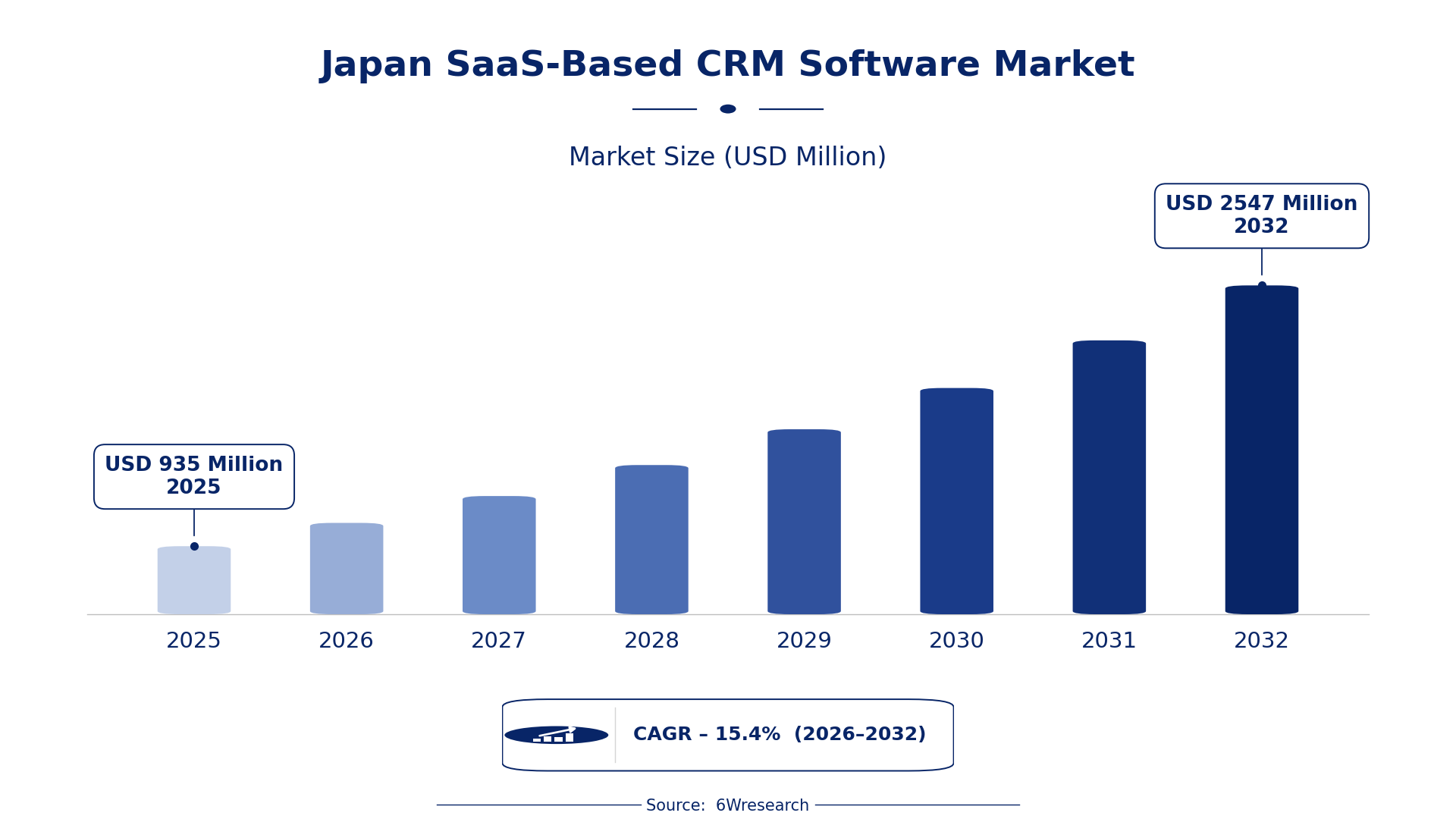
According to 6Wresearch internal database and industry insights, the Japan SaaS-Based CRM Software Market was valued at USD 935 Million in 2025 and is projected to reach USD 2,547 Million by 2032, growing at a CAGR of approximately 15.4% during 2026–2032.
Japan SaaS-Based CRM Software Market Highlights
| Report Metric | Details |
| Report Name | Japan SaaS-Based CRM Software Market (2026-2032) |
| Market Size 2025 | USD 935 Million |
| Market Size 2032 | USD 2,547 Million |
| Absolute Growth 2025–2032 | USD 1,612 Million |
| CAGR 2026–2032 | 15.4% |
| Peak Annual Growth | 17.2% in 2032 |
| Forecast Period | 2026–2032 |
| Historical Data | 2022–2025 |
| Base Year | 2025 |
| Leading Deployment Model, 2025 | Cloud-based (34% share) |
| Leading Solution Type, 2025 | Operational CRM (43% share) |
| Leading End User, 2025 | Enterprises (46% share) |
| Leading Application, 2025 | Customer Service (50% share) |
| Fastest-Growing Deployment Model | Hybrid (22.5% CAGR) |
| Fastest-Growing Solution Type | Analytical CRM (21.4% CAGR) |
| Fastest-Growing End User | SMEs (19.7% CAGR) |
| Fastest-Growing Application | Marketing Automation (21.3% CAGR) |
| Growing Sector | customer service |
| Key End Users | enterprises, SMEs, retailers, service providers |
Japan SaaS-Based CRM Software Market Year-wise Growth Rate and Key Drivers (2022–2032)
This graph illustrates the annual growth rates of the market from 2022 to 2032, highlighting a steady upward trajectory and projected market expansion over the forecast period.
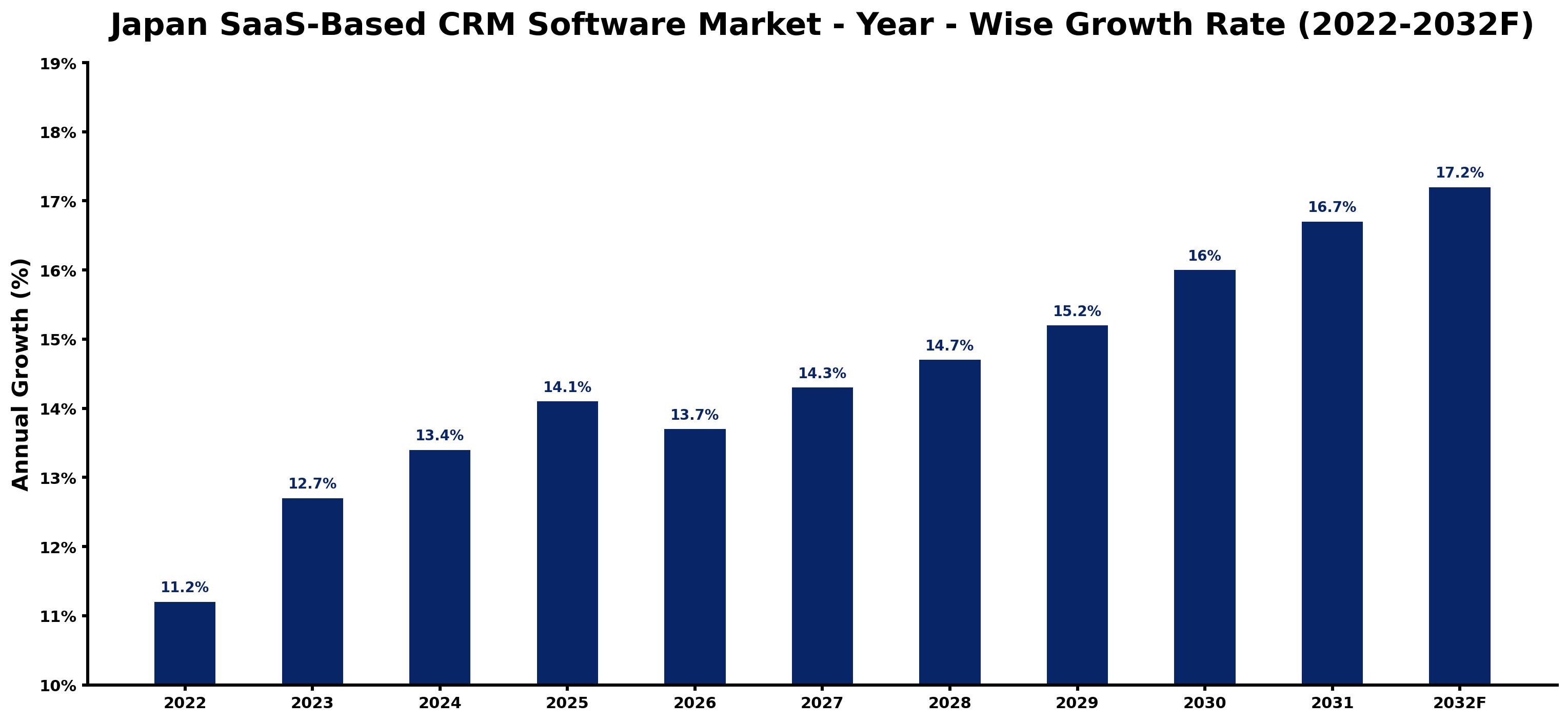
Each row of the following table gives one year's estimated growth and the event or demand shift that explains it.
| Year | Estimated Annual Growth (%) | Market Rationale |
| 2022 | 11.2 | The market was characterised by increasing adoption of digital tools among enterprises. |
| 2023 | 12.7 | Demand accelerated as more SMEs recognised the benefits of CRM solutions. |
| 2024 | 13.4 | The growth trend continued with heightened competition among software providers. |
| 2025 | 14.1 | Enterprises sought effective CRM solutions, boosting market performance. |
| 2026 | 13.7 | Growth slowed slightly as the market began to stabilise after rapid expansion. |
| 2027 | 14.3 | Demand picked up again as businesses focused on enhancing customer engagement. |
| 2028 | 14.7 | The market saw consistent growth driven by technological advancements in CRM. |
| 2029 | 15.2 | Increased integration of marketing automation tools spurred further demand. |
| 2030 | 16.0 | A surge in user adoption was noted as more enterprises embraced cloud solutions. |
| 2031 | 16.7 | The market expanded as businesses prioritised data-driven decision-making capabilities. |
| 2032 | 17.2 | Demand peaked as companies invested heavily in advanced CRM functionalities. |
Note: Market size estimations and growth projections presented in this report are based on 6Wresearch's proprietary forecasting methodology, utilizing the latest available industry data, government publications, and primary research inputs.
Japan SaaS-Based CRM Software Market Synopsis
SaaS-Based CRM Software is a cloud-based solution that enables businesses to manage customer relationships through data analysis and automation. More than 70% of enterprises in Japan utilise some form of CRM software, driven by the need to improve customer service and streamline sales processes. The Japan SaaS-Based CRM Software Market is expanding quickly, supported by a 15% increase in SMEs adopting CRM solutions and a government initiative aimed at digital transformation for SMEs, which has allocated 5 billion yen for digital innovation in 2024.
Market Dynamics Impact Analysis (2026–2032)
| Factor | Type | Impact | Primary Segment Affected |
| Growing adoption of cloud-based solutions | Driver | High | Cloud-based |
| Increased focus on customer engagement | Driver | High | Customer Service |
| Rising demand for data-driven decision-making | Opportunity | High | Analytical CRM |
| Investment in marketing automation integration | Opportunity | High | Marketing Automation |
| Limited awareness among SMEs about CRM benefits | Restraint | Medium | SMEs |
| High competition among software providers | Restraint | Medium | Operational CRM |
| Challenges in data security and privacy compliance | Challenge | High | Cloud-based |
| Resistance to change from traditional systems | Challenge | Medium | On-premises |
Evaluation of Drivers in Japan SaaS-Based CRM Software Market (2026–2032)
The following drivers explain most of the expected growth.
| Drivers | Primary Segment Affected | Why It Matters (Evidence) |
| Increased digital transformation initiatives among SMEs | SMEs | The Ministry of Economy, Trade and Industry's digital transformation initiative for SMEs has led to a 15% rise in CRM adoption. |
| Growing emphasis on customer experience management | Customer Service | Over 70% of enterprises are investing in CRM solutions to enhance customer interactions and satisfaction. |
| Rising demand for analytics-driven insights | Analytical CRM | The adoption rate of marketing automation tools, currently at 30%, is driving demand for analytical capabilities. |
| Cloud adoption for flexibility and cost-effectiveness | Cloud-based | The shift towards cloud solutions is evident as 34% of the market share is held by cloud-based deployments. |
| Integration of CRM with other business tools | Operational CRM | The average number of users per enterprise CRM system is around 50, indicating widespread use across various functions. |
Over 70% of enterprises are investing in CRM solutions to improve customer interactions, reflecting a growing emphasis on customer experience management. The adoption rate of marketing automation tools, currently at 30%, is driving demand for analytical capabilities. The shift towards cloud solutions is clear as 34% of the market share is held by cloud-based deployments, enabling flexibility and cost-effectiveness. The average number of users per enterprise CRM system is around 50, indicating widespread use across various functions.
Evaluation of Restraints in Japan SaaS-Based CRM Software Market
These are the pressures that could keep growth below its potential.
| Market Restraint | Primary Segment Affected | Why It Matters (Evidence) |
| Limited awareness among SMEs about CRM benefits | SMEs | Many SMEs are unaware of how CRM solutions can optimise customer interactions, hindering adoption. |
| High competition among software providers | Operational CRM | Intense competition can lead to pricing pressures, affecting profitability for providers. |
| Challenges in data security and privacy compliance | Cloud-based | Concerns regarding data security may deter businesses from adopting cloud-based CRM solutions. |
| Resistance to change from traditional systems | On-premises | Some enterprises prefer existing systems, delaying CRM adoption and integration. |
| Complexity in integrating with existing IT infrastructure | Hybrid | Hybrid solutions may face integration challenges, limiting their adoption among enterprises. |
Japan SaaS-Based CRM Software Market Challenges
Rising operational costs impact buyers as Japan's minimum wage reaches JPY 1,055 per hour, increasing expenses for CRM providers. This leads to higher subscription fees for small businesses, forcing them to divert funds from other critical areas. A skills gap exists among developers, who often lack the necessary expertise in CRM data handling, resulting in delays in software updates and inadequate support for users. Technology adoption remains slow, with only 30% of firms integrating marketing automation tools, which hampers efficiency and customer engagement in major markets like Tokyo and Osaka.
Trends in the Japan SaaS-Based CRM Software Market
Buyers and suppliers in the Japan SaaS-Based CRM Software Market are adjusting to the following trends.
- Shift from On-premises to Cloud Solutions: The trend is moving towards cloud-based CRM solutions, with 34% market share in 2025, as enterprises seek flexibility and scalability.
- Increased Integration of Marketing Automation: The integration of marketing automation tools into CRM systems is growing, with a 30% adoption rate, improving targeted marketing efforts.
- Focus on Data Analytics in CRM: The demand for analytical CRM is rising, with a CAGR of 21.4%, as businesses prioritise data-driven decision-making capabilities.
- Emergence of AI in CRM Solutions: The AI Promotion Act of 2025 is promoting AI integration in CRM, improving customer interactions and service efficiency.
Investment Opportunities in the Japan SaaS-Based CRM Software Market
Several openings in the Japan SaaS-Based CRM Software Market merit attention from investors.
- Partnerships with Local SMEs: Now is the time for software providers to partner with local SMEs, as the number of SMEs adopting CRM solutions increased by 15% last year.
- Investing in Cloud-Based Solutions: With 34% of the market share held by cloud-based solutions, investing in this area presents a strong opportunity for growth.
- Focus on Customer Service Applications: Customer service applications account for 40% of the CRM market, creating a demand for effective solutions in this segment.
- Expansion into Tokyo and Osaka: Targeting the main industrial regions, such as Tokyo and Osaka, provides a strategic entry point for CRM software providers.
Government Initiatives in the Japan SaaS-Based CRM Software Market
The Act against Unjustifiable Premiums and Misleading Representations, established in 1962, prohibits misleading advertising, ensuring that CRM software providers maintain transparency in their offerings. The Digital Agency, established in September 2021, leads government digital transformation efforts and sets common system standards, directly impacting CRM software deployment.
The Digital Agency's guidelines help enterprises understand and implement CRM solutions effectively. This agency provides support for businesses, ensuring they can utilise CRM software to improve customer interactions and service delivery.
Future Insight of the Japan SaaS-Based CRM Software Market
The launch of digital transformation initiatives will drive CRM software evolution by 2032, allowing for better integration of advanced technologies. The Japanese government's investment of 5 billion yen will facilitate the development of more sophisticated solutions, improving user experience. As ISO 9001 certification becomes increasingly sought after among developers, buyers can expect enhanced quality and reliability in offerings. With a notable rise in CRM adoption, the market will likely experience increased competition and innovation, leading to improved features and support for users.
Market Segmentation Analysis
Japan SaaS-Based CRM Software Market report covers a detailed analysis of the following market segments:
By Deployment Model – Cloud-based Leads, Hybrid Expected to Grow Fastest
According to Bhawna Singh, Assistant Manager at 6Wresearch, with 34% of deployment model revenue in 2025, Cloud-based was the largest category. The cloud-based segment leads due to its flexibility and cost-effectiveness, making it the preferred choice for numerous businesses. For instance, Tokyo and Osaka are prominent regions where cloud-based CRM solutions are widely adopted, reflecting their significant market presence. The quickest growth will come from Hybrid, forecast to expand at a CAGR of 22.5% between 2026 and 2032. The hybrid model is gaining traction as companies seek to combine the benefits of cloud solutions with on-premises control, particularly among larger firms. This trend is underscored by the increasing interest in diverse deployment options, as evidenced by the 15% rise in SMEs adopting CRM solutions. Suppliers should focus on enhancing hybrid solutions to capture the evolving preferences of businesses.
By Solution Type – Operational CRM Leads, Analytical CRM Expected to Grow Fastest
Operational CRM accounted for 43% of the market by solution type in 2025. Operational CRM holds the largest share as it is essential for effectively managing customer interactions, which is critical for enterprises. The reliance on operational CRM for streamlining customer engagement processes highlights its importance in the market. Analytical CRM is projected to grow fastest, at a CAGR of 21.4% during 2026–2032. Analytical CRM is experiencing rapid growth as businesses increasingly recognise the value of data-driven decision making. The integration of marketing automation tools into CRM systems is further fuelling this trend, with a notable adoption rate among enterprises. Buyers should prioritise analytical capabilities in CRM solutions to leverage data for strategic advantages.
By End User – Enterprises Lead, SMEs Expected to Grow Fastest
In 2025, Enterprises led the end user split with a 46% share. Enterprises represent the largest segment, as they seek comprehensive solutions to manage extensive customer interactions across multiple channels. Their significant investment in CRM systems underscores the demand for robust customer relationship management. SMEs are set to record the highest CAGR in this split, 19.7% over 2026–2032. SMEs are the fastest-growing segment, driven by their need to adopt digital tools for improved customer engagement. The Japanese government's digital transformation initiative for SMEs highlights the support for this rapid adoption. Suppliers should tailor offerings to meet the specific needs of SMEs to capitalise on this growth opportunity.
By Application – Customer Service Leads, Marketing Automation Expected to Grow Fastest
The largest application category in 2025 was Customer Service, at 50% of revenue. Customer service applications dominate the market as they are fundamental for improving support processes, which are crucial for customer retention. This segment's substantial contribution to the CRM software market illustrates its critical role in enhancing customer satisfaction. Over 2026–2032, Marketing Automation is expected to post the fastest growth, at a CAGR of 21.3%. Marketing automation is the fastest-growing application, as businesses increasingly seek targeted marketing efforts to enhance customer engagement. The growing integration of these tools into CRM systems is becoming essential for effective marketing strategies. Suppliers must enhance marketing automation features in their CRM solutions to meet rising demand.
Key Attractiveness of the Report
- 10 Years of Market Numbers
- Historical Data Starting from 2022 to 2025
- Base Year 2025
- Forecast Data until 2032
- Key Performance Indicators Impacting the Market
- Major Upcoming Developments and Projects
Key Highlights of the Report:
- Japan SaaS-Based CRM Software Market Outlook
- Market Size of Japan SaaS-Based CRM Software Market,2025
- Forecast of Japan SaaS-Based CRM Software Market, 2032
- Historical Data and Forecast of Japan SaaS-Based CRM Software Revenues & Volume for the Period 2022-2032
- Japan SaaS-Based CRM Software Market Trend Evolution
- Japan SaaS-Based CRM Software Market Drivers and Challenges
- Japan SaaS-Based CRM Software Price Trends
- Japan SaaS-Based CRM Software Porter's Five Forces
- Japan SaaS-Based CRM Software Industry Life Cycle
- Historical Data and Forecast of Japan SaaS-Based CRM Software Market Revenues & Volume By Deployment Model for the Period 2022-2032
- Historical Data and Forecast of Japan SaaS-Based CRM Software Market Revenues & Volume By Cloud-based for the Period 2022-2032
- Historical Data and Forecast of Japan SaaS-Based CRM Software Market Revenues & Volume By On-premises for the Period 2022-2032
- Historical Data and Forecast of Japan SaaS-Based CRM Software Market Revenues & Volume By Hybrid for the Period 2022-2032
- Historical Data and Forecast of Japan SaaS-Based CRM Software Market Revenues & Volume By Others for the Period 2022-2032
- Historical Data and Forecast of Japan SaaS-Based CRM Software Market Revenues & Volume By Solution Type for the Period 2022-2032
- Historical Data and Forecast of Japan SaaS-Based CRM Software Market Revenues & Volume By Operational CRM for the Period 2022-2032
- Historical Data and Forecast of Japan SaaS-Based CRM Software Market Revenues & Volume By Analytical CRM for the Period 2022-2032
- Historical Data and Forecast of Japan SaaS-Based CRM Software Market Revenues & Volume By Collaborative CRM for the Period 2022-2032
- Historical Data and Forecast of Japan SaaS-Based CRM Software Market Revenues & Volume By Others for the Period 2022-2032
- Historical Data and Forecast of Japan SaaS-Based CRM Software Market Revenues & Volume By End User for the Period 2022-2032
- Historical Data and Forecast of Japan SaaS-Based CRM Software Market Revenues & Volume By Enterprises for the Period 2022-2032
- Historical Data and Forecast of Japan SaaS-Based CRM Software Market Revenues & Volume By SMEs for the Period 2022-2032
- Historical Data and Forecast of Japan SaaS-Based CRM Software Market Revenues & Volume By Retailers for the Period 2022-2032
- Historical Data and Forecast of Japan SaaS-Based CRM Software Market Revenues & Volume By Others for the Period 2022-2032
- Historical Data and Forecast of Japan SaaS-Based CRM Software Market Revenues & Volume By Application for the Period 2022-2032
- Historical Data and Forecast of Japan SaaS-Based CRM Software Market Revenues & Volume By Customer Service for the Period 2022-2032
- Historical Data and Forecast of Japan SaaS-Based CRM Software Market Revenues & Volume By Marketing Automation for the Period 2022-2032
- Historical Data and Forecast of Japan SaaS-Based CRM Software Market Revenues & Volume By Sales Management for the Period 2022-2032
- Historical Data and Forecast of Japan SaaS-Based CRM Software Market Revenues & Volume By Others for the Period 2022-2032
- Japan SaaS-Based CRM Software Import Export Trade Statistics
- Market Opportunity Assessment By Deployment Model
- Market Opportunity Assessment By Solution Type
- Market Opportunity Assessment By End User
- Market Opportunity Assessment By Application
- Japan SaaS-Based CRM Software Top Companies Market Share
- Japan SaaS-Based CRM Software Competitive Benchmarking By Technical and Operational Parameters
- Japan SaaS-Based CRM Software Company Profiles
- Japan SaaS-Based CRM Software Key Strategic Recommendations
Market Covered
The report covers the following segments.
By Deployment Model
- Cloud-based
- On-premises
- Hybrid
- Others
By Solution Type
- Operational CRM
- Analytical CRM
- Collaborative CRM
- Others
By End User
- Enterprises
- SMEs
- Retailers
- Others
By Application
- Customer Service
- Marketing Automation
- Sales Management
- Others































