Japan Skiing and Snowboarding Market Size & Growth Rate
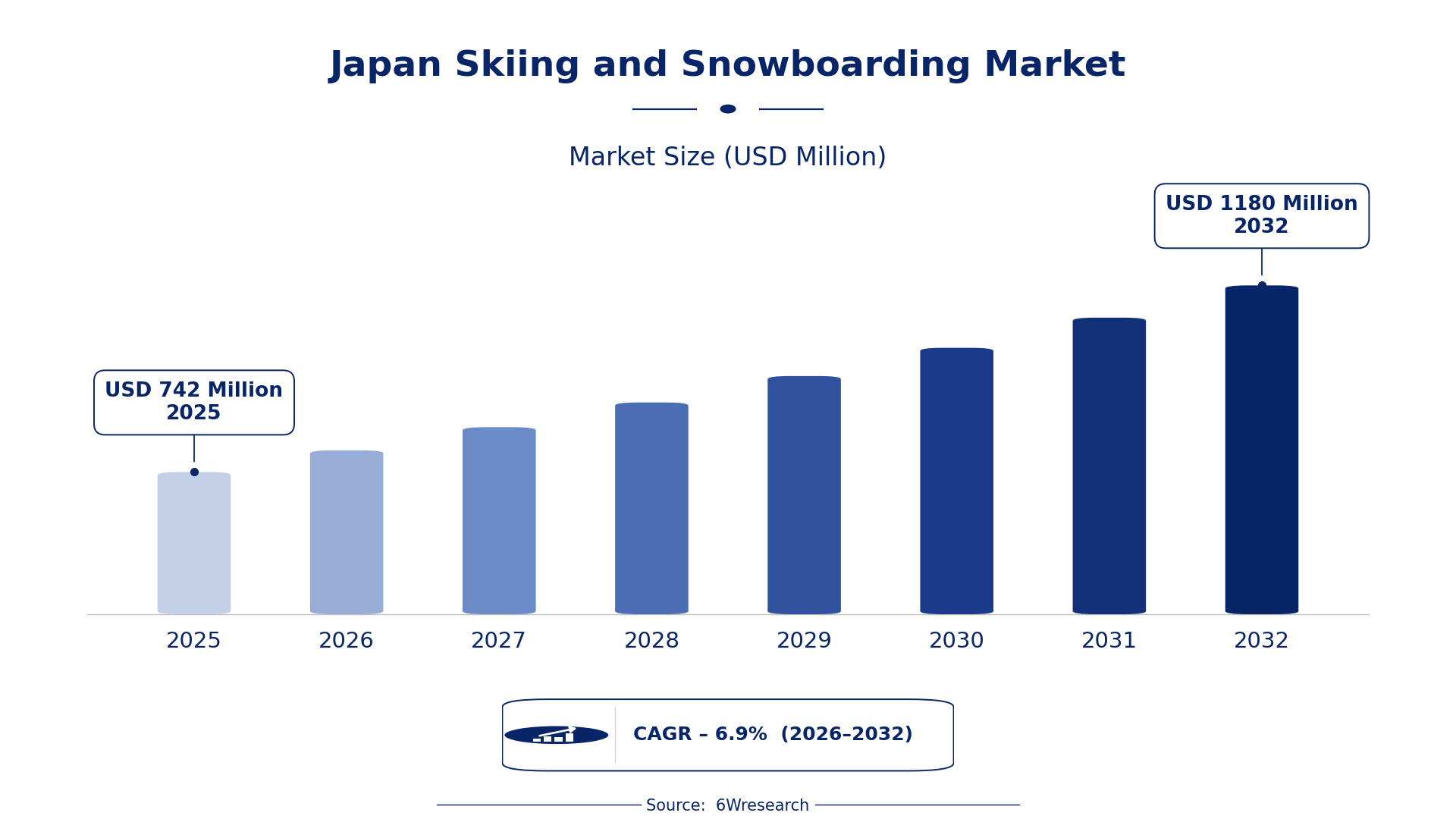
According to 6Wresearch internal database and industry insights, the Japan Skiing and Snowboarding Market was valued at USD 742 Million in 2025 and is projected to reach USD 1,180 Million by 2032, growing at a CAGR of approximately 6.9% during 2026–2032.
Japan Skiing and Snowboarding Market Highlights
| Report Metric | Details |
| Report Name | Japan Skiing and Snowboarding Market (2026-2032) |
| Market Size 2025 | USD 742 Million |
| Market Size 2032 | USD 1,180 Million |
| Absolute Growth 2025–2032 | USD 438 Million |
| CAGR 2026–2032 | 6.9% |
| Peak Annual Growth | 7.3% in 2027 |
| Forecast Period | 2026–2032 |
| Historical Data | 2022–2025 |
| Base Year | 2025 |
| Leading Product Type, 2025 | Skis (42% share) |
| Leading Equipment Type, 2025 | Alpine Equipment (50% share) |
| Leading Application Area, 2025 | Recreational Sports (37% share) |
| Leading Distribution Channel, 2025 | Retail Stores (35% share) |
| Leading End User, 2025 | Tourists (55% share) |
| Fastest-Growing Product Type | Protective Gear (9.5% CAGR) |
| Fastest-Growing Equipment Type | Safety Equipment (9.7% CAGR) |
| Fastest-Growing Application Area | Adventure Sports (8.1% CAGR) |
| Fastest-Growing Distribution Channel | Online Platforms (8.9% CAGR) |
| Fastest-Growing End User | Casual Users (8.8% CAGR) |
| Growing Sector | winter sports tourism |
| Key End Users | tourists, sports enthusiasts, professional athletes, casual users |
Japan Skiing and Snowboarding Market Year-wise Growth Rate and Key Drivers (2022–2032)
This graph illustrates the annual growth rates of the market from 2022 to 2032, highlighting a steady upward trajectory and projected market expansion over the forecast period.

The table below sets out the estimated growth rate for each year and the main factor behind it.
| Year | Estimated Annual Growth (%) | Market Rationale |
| 2022 | 2.3 | The market experienced steady participation in winter sports activities. |
| 2023 | 2.4 | Increased interest in winter sports led to higher sales of skiing and snowboarding gear. |
| 2024 | 1.6 | Growth slowed as consumer spending faced temporary constraints due to economic factors. |
| 2025 | 2.8 | A resurgence in tourism boosted demand for skiing and snowboarding equipment. |
| 2026 | 6.7 | Investment in ski resort infrastructure is expected to create new opportunities for winter sports. |
| 2027 | 7.3 | Peak growth will be driven by heightened domestic and international tourist arrivals. |
| 2028 | 6.8 | A slight slowdown is projected as the market adjusts to previous high growth rates. |
| 2029 | 6.9 | Continued interest in winter sports will lead to renewed purchasing activity. |
| 2030 | 7.0 | The market will maintain strong growth as new facilities attract more visitors. |
| 2031 | 6.1 | Growth is expected to slow as market saturation begins to influence purchasing patterns. |
| 2032 | 7.2 | Increased participation in winter sports is projected to sustain market expansion. |
Note: Market size estimations and growth projections presented in this report are based on 6Wresearch's proprietary forecasting methodology, utilizing the latest available industry data, government publications, and primary research inputs.
Japan Skiing and Snowboarding Market Synopsis
Skiing and snowboarding involve using skis and snowboards for winter sports, primarily manufactured from fiberglass, wood, and metal. The Japan Skiing and Snowboarding Market is expanding due to rising domestic participation and international tourism, particularly in regions like Hokkaido and Nagano. The government’s investment in ski resort infrastructure, with a budget of ¥10 billion in 2023, supports this growth, attracting more tourists and improving the overall skiing experience. Approximately 15% of the Japanese population engages in winter sports activities, indicating a strong consumer base.
Market Dynamics Impact Analysis (2026–2032)
| Factor | Type | Impact | Primary Segment Affected |
| Rising domestic participation in winter sports activities | Driver | High | Recreational Sports |
| Increased investment in ski resort infrastructure | Driver | High | Skis |
| Growing online sales of winter sports gear | Opportunity | High | Online Platforms |
| Expansion of ski schools catering to beginners | Opportunity | Medium | Skis |
| Seasonal weather fluctuations impacting snow availability | Restraint | High | Skis |
| High competition among ski resorts for tourist attraction | Restraint | Medium | Skis |
| Limited availability of skilled instructors in ski schools | Challenge | High | Skis |
| Increasing costs of ski equipment manufacturing | Challenge | Medium | Skis |
Evaluation of Drivers in Japan Skiing and Snowboarding Market (2026–2032)
Key forces behind demand, with the segment each one moves most, are listed below.
| Drivers | Primary Segment Affected | Why It Matters (Evidence) |
| Promotion of winter sports by tourism agencies | Recreational Sports | The Ski Association of Japan promotes skiing as part of its winter tourism strategy, increasing interest and participation. |
| Expansion of online sales channels | Skis | The growing online market for winter sports gear, with a 20% increase in sales, attracts younger consumers. |
| Investment in ski schools | Protective Gear | Over 200 ski schools are catering to beginners, driving demand for essential safety equipment. |
| Increased international tourism | Snowboards | Hokkaido attracts over 3 million tourists annually, boosting demand for snowboarding gear. |
| Government support for infrastructure | Alpine Equipment | The ¥10 billion investment in ski resort improvements enhances facilities, driving sales of alpine equipment. |
Buyers are adding capacity as participation in winter sports rises, with approximately 15% of the population engaging in these activities. Online sales channels for winter sports gear are expanding, with a 20% increase in recent years, appealing to younger consumers. Over 200 ski schools cater to beginners, further driving demand for equipment.
Evaluation of Restraints in Japan Skiing and Snowboarding Market
Below are the constraints most often cited by buyers and suppliers, with the segment each affects.
| Market Restraint | Primary Segment Affected | Why It Matters (Evidence) |
| Economic factors affecting consumer spending | Skis | Economic uncertainty can lead to reduced discretionary spending on winter sports gear, impacting sales. |
| High production costs for equipment | Protective Gear | Advanced manufacturing technology adoption is lagging, leading to a 15% increase in equipment prices for buyers. |
| Logistics expenses for importers | Snowboards | Shipping fees have surged by 25%, squeezing profit margins and affecting product availability. |
| Competition from international brands | Alpine Equipment | Local manufacturers face fierce competition, forcing them to lower prices, which risks compromising quality. |
| Inflated retail prices for winter gear | Safety Equipment | Retail prices for winter sports gear have risen by 10% annually, making participation less accessible. |
Japan Skiing and Snowboarding Market Challenges
Producers face high production costs due to outdated manufacturing processes, which can raise equipment prices by 15% for buyers. Importers are dealing with rising logistics expenses, as shipping fees have climbed by 25%, reducing profit margins and limiting product availability. Buyers are experiencing inflated retail prices for winter sports gear, which have surged by 10% annually, making participation less accessible for many. Local manufacturers are struggling against fierce competition from international brands, forcing them to lower prices, which risks compromising quality and diminishing their market presence.
Trends in the Japan Skiing and Snowboarding Market
Below are the shifts with the largest effect on the Japan Skiing and Snowboarding Market.
- Shift towards Online Sales Channels: Since 2020, online platforms for winter sports gear have gained traction, with sales increasing by 20%. This trend allows buyers to access a wider range of products conveniently, supporting overall market growth.
- Growing Interest in Adventure Sports: Adventure sports have seen a surge in popularity among sports enthusiasts since 2021, with an 8.1% CAGR projected. This shift encourages suppliers to diversify their offerings, catering to thrill-seekers looking for new experiences.
- Expansion of Ski Schools: The number of ski schools has increased significantly since 2022, with over 200 now operating. This expansion supports the influx of beginners, driving demand for skiing and snowboarding equipment across various regions.
- Enhanced Infrastructure at Ski Resorts: In 2023, the government launched a program to improve ski resort facilities, backed by a ¥10 billion budget. This investment is expected to attract more tourists and elevate the overall skiing experience.
Investment Opportunities in the Japan Skiing and Snowboarding Market
The openings below show where demand in the Japan Skiing and Snowboarding Market is visible and how suppliers can enter.
- Tourists Seeking Improved Experiences: Tourists are increasingly looking for enhanced ski experiences, with over 3 million visitors to Hokkaido annually. Investing in luxury accommodations and unique activities can attract this buyer group and enrich their overall experience.
- Partnerships with Local Ski Schools: Local ski schools need more instructors to meet demand, presenting an opportunity for partnerships. Collaborating with educational institutions can help address this gap and improve service offerings for students.
- Investment in Ski Resort Upgrades: With a ¥10 billion government budget for ski resort improvements, there is a considerable gap in modern facilities. Suppliers can enter this market by providing advanced equipment and services to enhance the visitor experience.
- Growth of Recreational Sports: The recreational sports segment is expanding, with a 37% share in 2025. Suppliers can capitalise on this growth by offering affordable and high-quality skiing and snowboarding gear to attract a wider audience.
Government Initiatives in the Japan Skiing and Snowboarding Market
The Industrial Safety and Health Act of 1972 establishes employer responsibilities for ensuring safe working conditions in ski resorts and equipment manufacturing. This law mandates regular safety inspections and compliance with safety standards, impacting producers and buyers alike by ensuring equipment safety and reliability. The Act also requires that all ski equipment meets established safety standards, benefiting users by reducing injury risks. Additionally, the Ski Association of Japan oversees safety compliance for ski schools and resorts, enhancing overall safety in the industry.
In 2023, a program initiated by the Digital Agency allocated ¥5 billion to improve digital infrastructure for ski resorts. This agency oversees the implementation of digital solutions to improve visitor experiences and operational efficiency, directly benefiting ski resort operators and their customers.
Future Insight of the Japan Skiing and Snowboarding Market
A new programme to upgrade ski resort infrastructure will begin, improving facilities for visitors. By 2032, advancements in production technology will streamline processes, allowing suppliers to efficiently meet rising demand. Increased participation in winter sports will drive sales of winter sports gear, projected to exceed 1 million pairs sold annually. Stricter safety regulations will raise quality standards, benefiting buyers and fostering trust in domestic products.
Market Segmentation Analysis
Japan Skiing and Snowboarding Market report covers a detailed analysis of the following market segments:
By Product Type – Skis Leads, Protective Gear Expected to Grow Fastest
According to Vasu Joshi, Associate Consultant at 6Wresearch, in 2025, Skis led the product type split with a 42% share. Skis dominate the market due to their necessity for skiing activities, with over 1 million pairs sold annually. Their significance is particularly pronounced in Hokkaido, where skiing attracts millions of tourists each year. Over 2026–2032, Protective Gear is expected to post the fastest growth, at a CAGR of 9.5%. Protective Gear is experiencing rapid growth as safety becomes increasingly critical for winter sports participants. The introduction of new safety regulations in 2023 has raised awareness and demand for protective equipment, ensuring its continued expansion. Suppliers should focus on enhancing the availability of protective gear to meet rising safety expectations.
By Equipment Type – Alpine Equipment Leads, Safety Equipment Expected to Grow Fastest
The largest equipment type category in 2025 was Alpine Equipment, at 50% of revenue. Alpine Equipment leads the market as it includes essential gear for alpine skiing, the most popular skiing type in Japan. The established JIS standards reinforce user trust and confidence in the quality of alpine equipment. Safety Equipment is projected to grow fastest, at a CAGR of 9.7% during 2026–2032. Safety Equipment is growing swiftly due to heightened concerns regarding injury prevention among winter sports participants. The recent introduction of safety regulations has intensified the focus on protective measures, driving demand for this segment. Manufacturers need to prioritise the development of advanced safety equipment to capitalise on this expanding market.
By Application Area – Recreational Sports Lead, Adventure Sports Expected to Grow Fastest
Recreational Sports accounted for 37% of the market by application area in 2025. Recreational Sports is the leading segment as it encompasses the majority of casual skiing and snowboarding activities enjoyed by the public. With approximately 15% of the population participating in winter sports, this category attracts a wide user base. Adventure Sports are set to record the highest CAGR in this split, 8.1% over 2026–2032. Adventure Sports is rapidly gaining traction, particularly among thrill-seekers looking for extreme experiences. The popularity of adventure sports is being boosted by the increasing number of ski schools offering specialized training. Providers should consider expanding offerings to cater to the adventurous demographic seeking unique winter sports experiences.
By Distribution Channel – Retail Stores Lead, Online Platforms Expected to Grow Fastest
Retail Stores took 35% of distribution channel revenue in 2025, more than any other category. Retail Stores are the primary sales channel for skiing equipment, offering direct access for consumers seeking gear. Their physical presence enables customers to assess products before purchasing, which enhances buyer confidence. The quickest growth will come from Online Platforms, forecast to expand at a CAGR of 8.9% between 2026 and 2032. Online Platforms are experiencing remarkable growth, with a 20% increase in sales as consumers increasingly prefer the convenience of online shopping. This trend is likely to continue as more users opt for digital channels to purchase winter sports gear. Retailers must improve their online strategies to effectively capture the growing consumer base that favours digital purchases.
By End User – Tourists Lead, Casual Users Expected to Grow Fastest
With 55% of end user revenue in 2025, Tourists was the largest category. Tourists represent the largest user group in ski resorts, significantly driving the demand for skiing and snowboarding equipment. With over 3 million tourists visiting Hokkaido annually, their participation is vital for the industry's success. Over 2026–2032, Casual Users are expected to post the fastest growth, at a CAGR of 8.8%. Casual Users are the fastest-growing segment as more individuals engage in skiing and snowboarding on an occasional basis. Government initiatives promoting winter sports are encouraging wider participation among this demographic, leading to increased demand. Suppliers should tailor marketing strategies to better engage casual users, enhancing accessibility to winter sports.
Key Attractiveness of the Report
- 10 Years of Market Numbers
- Historical Data Starting from 2022 to 2025
- Base Year 2025
- Forecast Data until 2032
- Key Performance Indicators Impacting the Market
- Major Upcoming Developments and Projects
Key Highlights of the Report:
- Japan Skiing and Snowboarding Market Outlook
- Market Size of Japan Skiing and Snowboarding Market, 2025
- Forecast of Japan Skiing and Snowboarding Market, 2032
- Historical Data and Forecast of Japan Skiing and Snowboarding Market Revenues & Volume for the Period 2022-2032F
- Japan Skiing and Snowboarding Market Trend Evolution
- Japan Skiing and Snowboarding Market Drivers and Challenges
- Japan Skiing and Snowboarding Market Price Trends
- Japan Skiing and Snowboarding Market Porter's Five Forces
- Japan Skiing and Snowboarding Market Industry Life Cycle
- Historical Data and Forecast of Japan Skiing and Snowboarding Market Revenues & Volume By Product Type for the Period 2022-2032F
- Historical Data and Forecast of Japan Skiing and Snowboarding Market Revenues & Volume By Skis for the Period 2022-2032F
- Historical Data and Forecast of Japan Skiing and Snowboarding Market Revenues & Volume By Snowboards for the Period 2022-2032F
- Historical Data and Forecast of Japan Skiing and Snowboarding Market Revenues & Volume By Protective Gear for the Period 2022-2032F
- Historical Data and Forecast of Japan Skiing and Snowboarding Market Revenues & Volume By Apparel for the Period 2022-2032F
- Historical Data and Forecast of Japan Skiing and Snowboarding Market Revenues & Volume By Equipment Type for the Period 2022-2032F
- Historical Data and Forecast of Japan Skiing and Snowboarding Market Revenues & Volume By Alpine Equipment for the Period 2022-2032F
- Historical Data and Forecast of Japan Skiing and Snowboarding Market Revenues & Volume By Freestyle Boards for the Period 2022-2032F
- Historical Data and Forecast of Japan Skiing and Snowboarding Market Revenues & Volume By Safety Equipment for the Period 2022-2032F
- Historical Data and Forecast of Japan Skiing and Snowboarding Market Revenues & Volume By Thermal Clothing for the Period 2022-2032F
- Historical Data and Forecast of Japan Skiing and Snowboarding Market Revenues & Volume By Application Area for the Period 2022-2032F
- Historical Data and Forecast of Japan Skiing and Snowboarding Market Revenues & Volume By Recreational Sports for the Period 2022-2032F
- Historical Data and Forecast of Japan Skiing and Snowboarding Market Revenues & Volume By Adventure Sports for the Period 2022-2032F
- Historical Data and Forecast of Japan Skiing and Snowboarding Market Revenues & Volume By Injury Prevention for the Period 2022-2032F
- Historical Data and Forecast of Japan Skiing and Snowboarding Market Revenues & Volume By Cold Weather Sports for the Period 2022-2032F
- Historical Data and Forecast of Japan Skiing and Snowboarding Market Revenues & Volume By Distribution Channel for the Period 2022-2032F
- Historical Data and Forecast of Japan Skiing and Snowboarding Market Revenues & Volume By Retail Stores for the Period 2022-2032F
- Historical Data and Forecast of Japan Skiing and Snowboarding Market Revenues & Volume By Online Platforms for the Period 2022-2032F
- Historical Data and Forecast of Japan Skiing and Snowboarding Market Revenues & Volume By Specialty Stores for the Period 2022-2032F
- Historical Data and Forecast of Japan Skiing and Snowboarding Market Revenues & Volume By Brand Outlets for the Period 2022-2032F
- Historical Data and Forecast of Japan Skiing and Snowboarding Market Revenues & Volume By End User for the Period 2022-2032F
- Historical Data and Forecast of Japan Skiing and Snowboarding Market Revenues & Volume By Tourists for the Period 2022-2032F
- Historical Data and Forecast of Japan Skiing and Snowboarding Market Revenues & Volume By Professional Athletes for the Period 2022-2032F
- Historical Data and Forecast of Japan Skiing and Snowboarding Market Revenues & Volume By Sports Enthusiasts for the Period 2022-2032F
- Historical Data and Forecast of Japan Skiing and Snowboarding Market Revenues & Volume By Casual Users for the Period 2022-2032F
- Japan Skiing and Snowboarding Market Import Export Trade Statistics
- Market Opportunity Assessment By Product Type
- Market Opportunity Assessment By Equipment Type
- Market Opportunity Assessment By Application Area
- Market Opportunity Assessment By Distribution Channel
- Market Opportunity Assessment By End User
- Japan Skiing and Snowboarding Market Top Companies Market Share
- Japan Skiing and Snowboarding Market Competitive Benchmarking By Technical and Operational Parameters
- Japan Skiing and Snowboarding Market Company Profiles
- Japan Skiing and Snowboarding Market Key Strategic Recommendations
Market Covered
This report examines the market across the segments below.
By Product Type
- Skis
- Snowboards
- Protective Gear
- Apparel
By Equipment Type
- Alpine Equipment
- Freestyle Boards
- Safety Equipment
- Thermal Clothing
By Application Area
- Recreational Sports
- Adventure Sports
- Injury Prevention
- Cold Weather Sports
By Distribution Channel
- Retail Stores
- Online Platforms
- Specialty Stores
- Brand Outlets
By End User
- Tourists
- Professional Athletes
- Sports Enthusiasts
- Casual Users































