Japan Solid-State LiDAR Market Size & Growth Rate
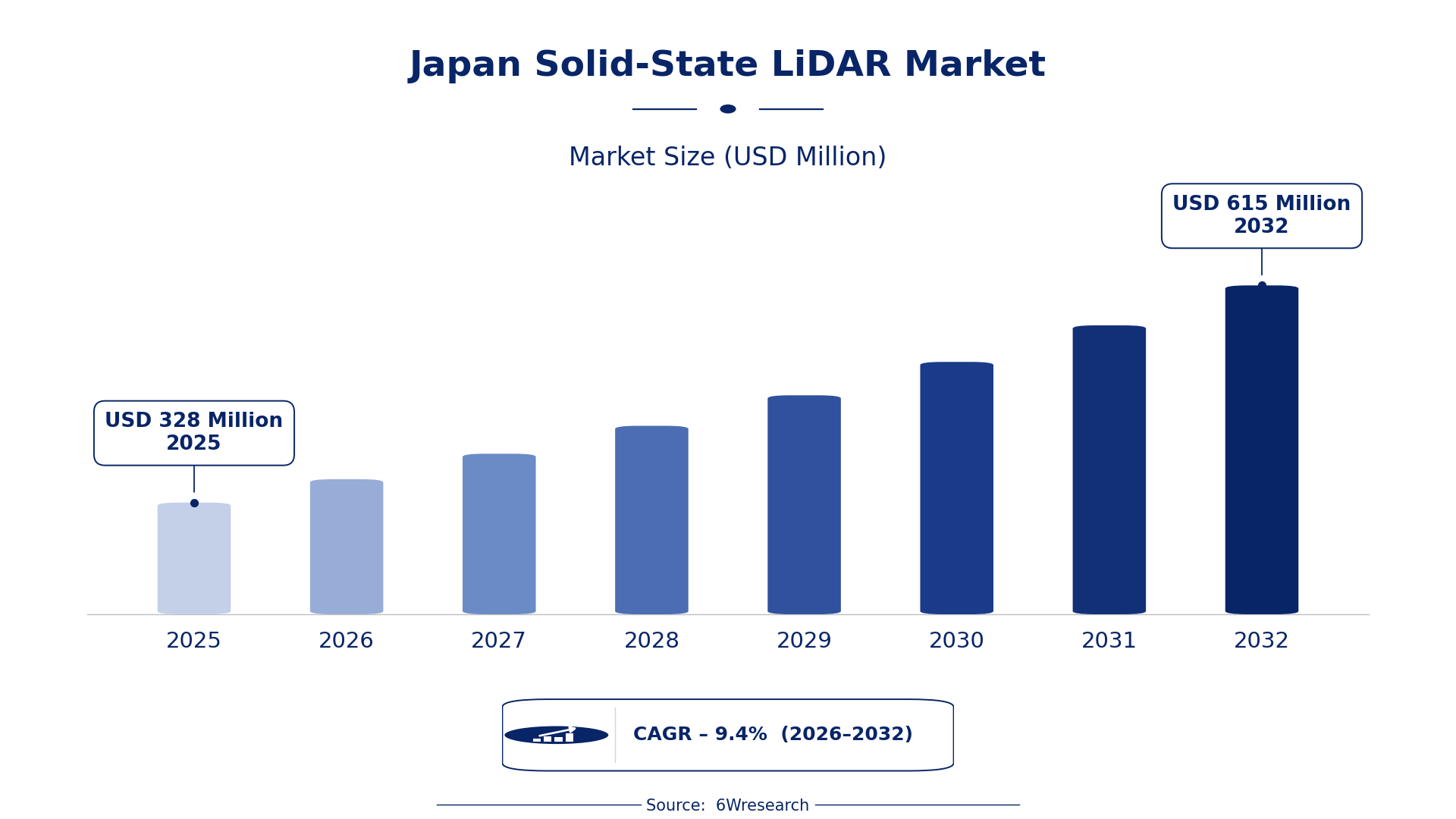
According to 6Wresearch internal database and industry insights, the Japan Solid-State LiDAR Market was valued at USD 328 Million in 2025 and is projected to reach USD 615 Million by 2032, growing at a CAGR of approximately 9.4% during 2026–2032.
Japan Solid-State LiDAR Market Highlights
| Report Metric | Details |
| Report Name | Japan Solid-State LiDAR Market (2026-2032) |
| Market Size 2025 | USD 328 Million |
| Market Size 2032 | USD 615 Million |
| Absolute Growth 2025–2032 | USD 287 Million |
| CAGR 2026–2032 | 9.4% |
| Peak Annual Growth | 10.2% in 2030 |
| Forecast Period | 2026–2032 |
| Historical Data | 2022–2025 |
| Base Year | 2025 |
| Leading Technology Type, 2025 | MEMS-Based (42% share) |
| Leading Beam Steering Method, 2025 | Mirrorless (39% share) |
| Leading Range Capability, 2025 | Long-Range (48% share) |
| Leading End User, 2025 | Autonomous Vehicle Makers (50% share) |
| Fastest-Growing Technology Type | Flash LiDAR (13.2% CAGR) |
| Fastest-Growing Beam Steering Method | No Moving Parts (13.6% CAGR) |
| Fastest-Growing Range Capability | Medium-Range (12.9% CAGR) |
| Fastest-Growing End User | ADAS Developers (12.6% CAGR) |
| Growing Sector | automotive |
| Key End Users | autonomous vehicle makers, robotics startups, ADAS developers |
Japan Solid-State LiDAR Market Year-wise Growth Rate and Key Drivers (2022–2032)
This graph illustrates the annual growth rates of the market from 2022 to 2032, highlighting a steady upward trajectory and projected market expansion over the forecast period.
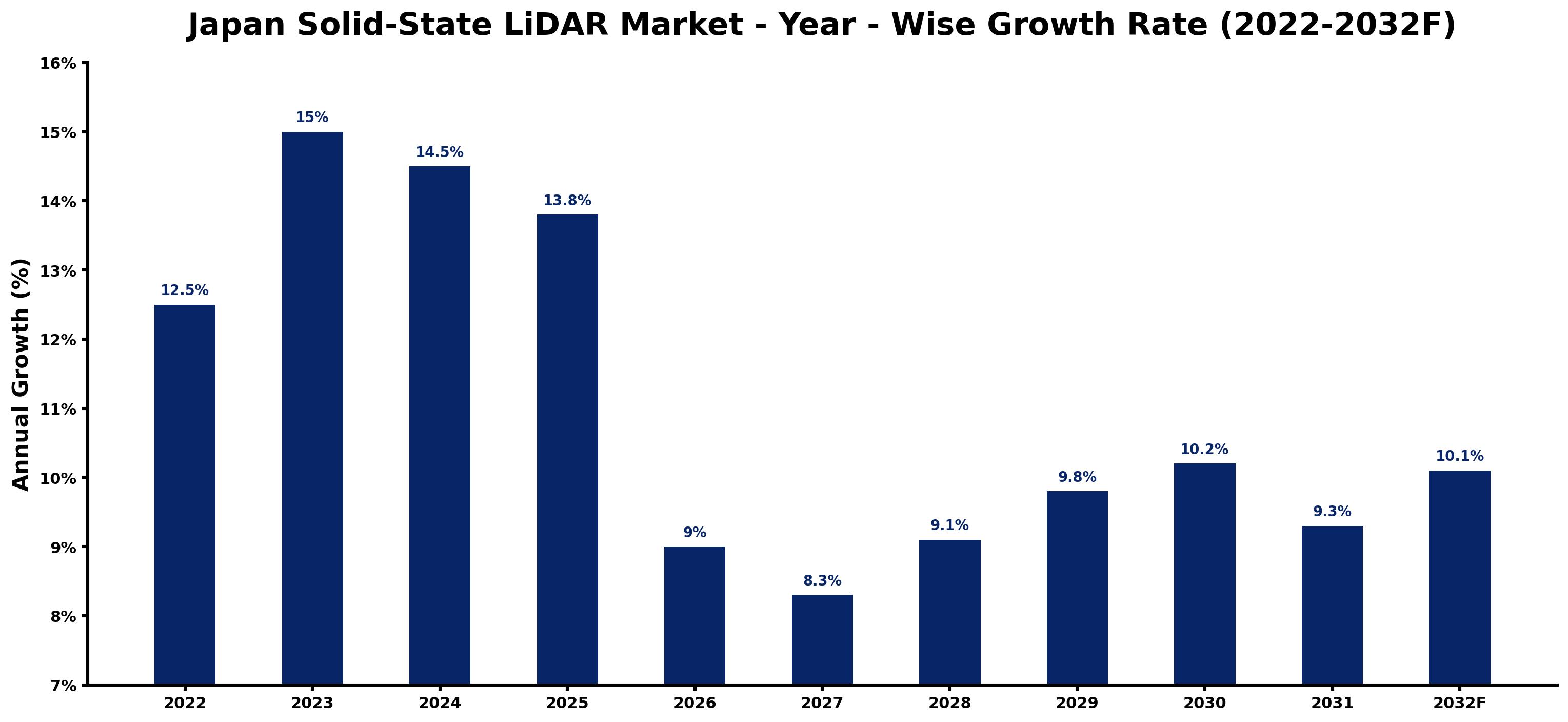
Annual growth estimates for each year appear below with the principal reason behind them, explaining the shifts that set the pace of the market.
| Year | Estimated Annual Growth (%) | Market Rationale |
| 2022 | 12.5 | The market exhibited strong activity, driven by automotive sector demand. |
| 2023 | 15.0 | Demand surged as over 5 million vehicles were produced, boosting LiDAR integration. |
| 2024 | 14.5 | Growth slowed slightly as the market adjusted to previous peaks in demand. |
| 2025 | 13.8 | Continued interest in autonomous vehicles maintained solid growth in the market. |
| 2026 | 9.0 | Investment in smart transportation systems is expected to normalise growth rates. |
| 2027 | 8.3 | Growth is projected to slow further as market saturation in some segments becomes apparent. |
| 2028 | 9.1 | A renewed focus on robotics is expected to revitalise interest in Solid-State LiDAR technologies. |
| 2029 | 9.8 | Increased funding for research and development is projected to spur demand across sectors. |
| 2030 | 10.2 | The peak growth rate is expected as autonomous vehicle technologies advance. |
| 2031 | 9.3 | Growth is projected to slow as the market stabilises after rapid expansions in previous years. |
| 2032 | 10.1 | Demand is expected to accelerate again as new applications for LiDAR emerge. |
Note: Market size estimations and growth projections presented in this report are based on 6Wresearch's proprietary forecasting methodology, utilizing the latest available industry data, government publications, and primary research inputs.
Japan Solid-State LiDAR Market Synopsis
Solid-State LiDAR measures distances using laser light and solid-state components, primarily applied in autonomous vehicles, robotics, and advanced driver-assistance systems. The Japan Solid-State LiDAR Market is expanding due to automotive production exceeding 5 million vehicles annually, along with government initiatives like the Economic Security Promotion Act supporting critical supply chains. The robotics sector, particularly in the Tokyo area, is also a key driver of demand, supported by substantial investments in smart transportation systems and R&D funding from the government.
Market Dynamics Impact Analysis (2026–2032)
| Factor | Type | Impact | Primary Segment Affected |
| Growing automotive production and integration of LiDAR in vehicles | Driver | High | MEMS-Based |
| Increased investment in robotics and smart transportation systems | Driver | High | Flash LiDAR |
| Rising demand for advanced driver-assistance systems in vehicles | Opportunity | High | ADAS Developers |
| Emerging applications in robotics and autonomous systems | Opportunity | High | Robotics Startups |
| High initial costs of LiDAR systems for manufacturers | Restraint | Medium | Long-Range |
| Limited awareness of Solid-State LiDAR benefits among smaller firms | Restraint | Medium | Medium-Range |
| Competition from alternative sensing technologies like radar | Challenge | High | Flash LiDAR |
| Dependence on semiconductor supply chains for production | Challenge | High | MEMS-Based |
Evaluation of Drivers in Japan Solid-State LiDAR Market (2026–2032)
These are the developments adding the most demand over the forecast period.
| Drivers | Primary Segment Affected | Why It Matters (Evidence) |
| Increased vehicle production in Japan | MEMS-Based | Over 5 million vehicles produced annually drive demand for precise distance measurement. |
| Government funding for R&D in LiDAR technologies | Flash LiDAR | Annual funding of ¥10 billion supports advancements in LiDAR applications. |
| Growing adoption of autonomous vehicles | Long-Range | The Economic Security Promotion Act supports LiDAR integration in future models. |
| Rising investments in robotics startups | Medium-Range | The Tokyo area accounts for 30% of Japan's robotics startups, increasing LiDAR demand. |
| Implementation of ISO 26262 for automotive safety | ADAS Developers | The standard's adoption improves the integration of LiDAR in safety systems. |
A wider customer base explains much of the growth, as Japan's automotive sector produces over 5 million vehicles annually, creating demand for precise distance measurement technologies. The adoption of ISO 26262 for automotive safety standards improves the integration of LiDAR systems, further boosting market growth.
Evaluation of Restraints in Japan Solid-State LiDAR Market
The table below lists the restraints and the evidence behind each.
| Market Restraint | Primary Segment Affected | Why It Matters (Evidence) |
| High initial costs of implementing LiDAR systems | Long-Range | The investment required for advanced systems can deter smaller manufacturers. |
| Limited awareness of LiDAR benefits among smaller firms | Medium-Range | Many smaller companies lack knowledge about the advantages of LiDAR technology. |
| Competition from alternative sensing technologies like radar | Flash LiDAR | Radar systems often present lower costs and established usage in the market. |
| Dependence on semiconductor supply chains for production | MEMS-Based | Supply chain disruptions can impact LiDAR manufacturing timelines. |
| Regulatory hurdles in automotive safety standards | ADAS Developers | Compliance with stringent regulations can delay product development and market entry. |
Japan Solid-State LiDAR Market Challenges
Producers face technological challenges as rapid advancements in semiconductor technologies can delay new Solid-State LiDAR product launches by up to six months. Compliance with the ISO 26262 standard incurs costs that can reach ¥500 million for manufacturers, which ultimately raises prices for buyers in the automotive sector. Increased production costs, driven by heightened demand for advanced components, can inflate prices for buyers by as much as 15%. A shortage of skilled engineers in semiconductor technologies hampers innovation, causing delays in project timelines for robotics developers.
Trends in the Japan Solid-State LiDAR Market
Buyers and suppliers in the Japan Solid-State LiDAR Market are adjusting to the following trends.
- Shift towards Autonomous Vehicles: In 2023, Japan's automotive sector saw a shift towards integrating Solid-State LiDAR in autonomous vehicles, supported by the Economic Security Promotion Act which aims to improve vehicle safety and navigation systems.
- Increase in Robotics Applications: Since 2023, the robotics sector has increasingly adopted Solid-State LiDAR technologies, particularly in the Tokyo area, where the industry was valued at ¥1.5 trillion, highlighting its importance in advanced navigation.
- Focus on Smart Transportation Systems: The Japanese government announced a plan to invest ¥1 trillion in smart transportation systems by 2025, promoting the use of Solid-State LiDAR for enhanced urban mobility solutions.
- Adoption of ISO 26262 Standards: The widespread adoption of the ISO 26262 standard in Japan's automotive sector ensures that Solid-State LiDAR systems meet stringent safety requirements, facilitating their integration into vehicles.
Investment Opportunities in the Japan Solid-State LiDAR Market
Below are the investment opportunities with the strongest case in the Japan Solid-State LiDAR Market.
- Investment in R&D for LiDAR Technologies: With the Japanese government allocating ¥10 billion for LiDAR R&D, there is an opportunity for companies to innovate and develop new applications in various sectors.
- Supply of Advanced Driver-Assistance Systems: ADAS developers are increasingly seeking Solid-State LiDAR solutions, driven by the need for improved vehicle safety features, making this a prime area for investment.
- Partnerships with Robotics Startups: As the Tokyo region hosts 30% of Japan's robotics startups, forming partnerships can help companies enter this growing market and supply necessary LiDAR technologies.
- Expansion into Smart City Initiatives: The government's push for smart city projects creates opportunities for Solid-State LiDAR suppliers to engage in urban planning and infrastructure development.
Government Initiatives in the Japan Solid-State LiDAR Market
The Semiconductor and Digital Industry Strategy, established in June 2021, mandates measures to secure domestic semiconductor manufacturing, directly impacting Solid-State LiDAR producers by ensuring a reliable supply chain for essential components. Additionally, the Economic Security Promotion Act of 2022 supports supply-chain resilience for critical products, including those necessary for LiDAR technologies, improving production stability.
In 2023, the Japanese government launched a plan with an investment of ¥1 trillion aimed at promoting autonomous vehicle technologies. The Ministry of Economy, Trade and Industry (METI) oversees this initiative, ensuring that funding is directed towards advancing LiDAR applications in the automotive sector and supporting relevant research.
Future Insight of the Japan Solid-State LiDAR Market
Investment in smart transportation systems will surge, with the government planning to invest ¥1 trillion by 2025. This funding will stimulate demand for advanced Solid-State LiDAR applications across various sectors. By 2032, the adoption of the 'Smart Mobility Strategy' will facilitate the integration of LiDAR in autonomous vehicles, improving safety and efficiency. The 'Robot Revolution Initiative' will further drive innovation in robotics, creating new opportunities for producers and enhancing user experiences.
Market Segmentation Analysis
Japan Solid-State LiDAR Market report covers a detailed analysis of the following market segments:
By Technology Type – MEMS-Based Leads, Flash LiDAR Expected to Grow Fastest
According to Saurav Kr Singh, Senior Research Analyst at 6Wresearch, MEMS-Based took 42% of technology type revenue in 2025, more than any other category. MEMS-Based technology leads the market due to its precision in distance measurement, essential for applications like autonomous vehicles. The automotive sector's production of over 5 million vehicles annually highlights the reliance on this technology. Over 2026–2032, Flash LiDAR is expected to post the fastest growth, at a CAGR of 13.2%. Flash LiDAR is growing rapidly as it captures large areas quickly, making it ideal for the expanding autonomous vehicle market. The Japanese government's 'Smart Mobility Strategy' supports this demand by promoting autonomous vehicle technologies. Suppliers should focus on enhancing Flash LiDAR capabilities to meet the growing needs of the automotive sector.
By Beam Steering Method – Mirrorless Leads, No Moving Parts Expected to Grow Fastest
The largest beam steering method category in 2025 was Mirrorless, at 39% of revenue. Mirrorless systems dominate the market as they offer compact designs that integrate seamlessly into vehicles, appealing to manufacturers focused on space efficiency. This is particularly relevant in the automotive sector, where design constraints are critical. No Moving Parts are set to record the highest CAGR in this split, 13.6% over 2026–2032. No Moving Parts technology is gaining traction due to its enhanced reliability and reduced maintenance needs, making it attractive for long-term investments in automotive applications. As vehicle manufacturers seek to lower operational costs, this method's appeal will likely increase. Buyers should consider the reliability of No Moving Parts systems when selecting LiDAR solutions for their vehicles.
By Range Capability – Long-Range Leads, Medium-Range Expected to Grow Fastest
Long-Range held 48% of the Japan Solid-State LiDAR Market by range capability in 2025. Long-Range capability holds the largest share as it is crucial for highway driving scenarios in autonomous vehicles, ensuring safety and navigation over extended distances. The average installed base of 1.2 million units in autonomous vehicles underscores this necessity. The quickest growth will come from Medium-Range, forecast to expand at a CAGR of 12.9% between 2026 and 2032. Medium-Range capability is experiencing rapid growth due to its effectiveness in automotive and robotics applications, where precise navigation is essential. The increasing valuation of Japan's robotics industry at ¥1.5 trillion highlights the demand for this range. Suppliers must ensure that Medium-Range systems are readily available to meet the rising demand in both automotive and robotics sectors.
By End User – Autonomous Vehicle Makers Lead, ADAS Developers Expected to Grow Fastest
With 50% of end user revenue in 2025, Autonomous Vehicle Makers was the largest category. Autonomous Vehicle Makers represent the largest share as they require advanced safety and navigation systems, driving substantial demand for Solid-State LiDAR technologies. The integration of LiDAR in over 5 million vehicles annually showcases this trend. ADAS Developers are projected to grow fastest, at a CAGR of 12.6% during 2026–2032. ADAS Developers are growing quickly as their focus on enhancing vehicle safety features aligns with increasing consumer expectations for advanced driver-assistance systems. The government's push for smart mobility further fuels this segment's expansion. Suppliers should prioritise partnerships with ADAS developers to capitalise on the growing demand for safety technologies.
Key Attractiveness of the Report
- 10 Years of Market Numbers
- Historical Data Starting from 2022 to 2025
- Base Year 2025
- Forecast Data until 2032
- Key Performance Indicators Impacting the Market
- Major Upcoming Developments and Projects
Key Highlights of the Report:
- Japan Solid-State LiDAR Market Outlook
- Market Size of Japan Solid-State LiDAR Market, 2025
- Forecast of Japan Solid-State LiDAR Market, 2032
- Historical Data and Forecast of Japan Solid-State LiDAR Revenues & Volume for the Period 2022-2032F
- Japan Solid-State LiDAR Market Trend Evolution
- Japan Solid-State LiDAR Market Drivers and Challenges
- Japan Solid-State LiDAR Price Trends
- Japan Solid-State LiDAR Porter's Five Forces
- Japan Solid-State LiDAR Industry Life Cycle
- Historical Data and Forecast of Japan Solid-State LiDAR Market Revenues & Volume By Technology Type for the Period 2022-2032F
- Historical Data and Forecast of Japan Solid-State LiDAR Market Revenues & Volume By MEMS-Based for the Period 2022-2032F
- Historical Data and Forecast of Japan Solid-State LiDAR Market Revenues & Volume By Flash LiDAR for the Period 2022-2032F
- Historical Data and Forecast of Japan Solid-State LiDAR Market Revenues & Volume By Optical Phased Array for the Period 2022-2032F
- Historical Data and Forecast of Japan Solid-State LiDAR Market Revenues & Volume By Frequency-Modulated for the Period 2022-2032F
- Historical Data and Forecast of Japan Solid-State LiDAR Market Revenues & Volume By Beam Steering Method for the Period 2022-2032F
- Historical Data and Forecast of Japan Solid-State LiDAR Market Revenues & Volume By Mirrorless for the Period 2022-2032F
- Historical Data and Forecast of Japan Solid-State LiDAR Market Revenues & Volume By No Moving Parts for the Period 2022-2032F
- Historical Data and Forecast of Japan Solid-State LiDAR Market Revenues & Volume By Electronically Tuned for the Period 2022-2032F
- Historical Data and Forecast of Japan Solid-State LiDAR Market Revenues & Volume By Continuous Wave for the Period 2022-2032F
- Historical Data and Forecast of Japan Solid-State LiDAR Market Revenues & Volume By Range Capability for the Period 2022-2032F
- Historical Data and Forecast of Japan Solid-State LiDAR Market Revenues & Volume By Medium-Range for the Period 2022-2032F
- Historical Data and Forecast of Japan Solid-State LiDAR Market Revenues & Volume By Short-Range for the Period 2022-2032F
- Historical Data and Forecast of Japan Solid-State LiDAR Market Revenues & Volume By Long-Range for the Period 2022-2032F
- Historical Data and Forecast of Japan Solid-State LiDAR Market Revenues & Volume By High Precision for the Period 2022-2032F
- Historical Data and Forecast of Japan Solid-State LiDAR Market Revenues & Volume By End User for the Period 2022-2032F
- Historical Data and Forecast of Japan Solid-State LiDAR Market Revenues & Volume By Autonomous Vehicle Makers for the Period 2022-2032F
- Historical Data and Forecast of Japan Solid-State LiDAR Market Revenues & Volume By Robotics Startups for the Period 2022-2032F
- Historical Data and Forecast of Japan Solid-State LiDAR Market Revenues & Volume By ADAS Developers for the Period 2022-2032F
- Historical Data and Forecast of Japan Solid-State LiDAR Market Revenues & Volume By Aerospace R&D for the Period 2022-2032F
- Japan Solid-State LiDAR Import Export Trade Statistics
- Market Opportunity Assessment By Technology Type
- Market Opportunity Assessment By Beam Steering Method
- Market Opportunity Assessment By Range Capability
- Market Opportunity Assessment By End User
- Japan Solid-State LiDAR Top Companies Market Share
- Japan Solid-State LiDAR Competitive Benchmarking By Technical and Operational Parameters
- Japan Solid-State LiDAR Company Profiles
- Japan Solid-State LiDAR Key Strategic Recommendations
Market Covered
The following segment groups are covered in the report.
By Technology Type
- MEMS-Based
- Flash LiDAR
- Optical Phased Array
- Frequency-Modulated
By Beam Steering Method
- Mirrorless
- No Moving Parts
- Electronically Tuned
- Continuous Wave
By Range Capability
- Medium-Range
- Short-Range
- Long-Range
- High Precision
By End User
- Autonomous Vehicle Makers
- Robotics Startups
- ADAS Developers
- Aerospace R&D































