Japan Sound Insulation for Vehicles Market Size & Growth Rate
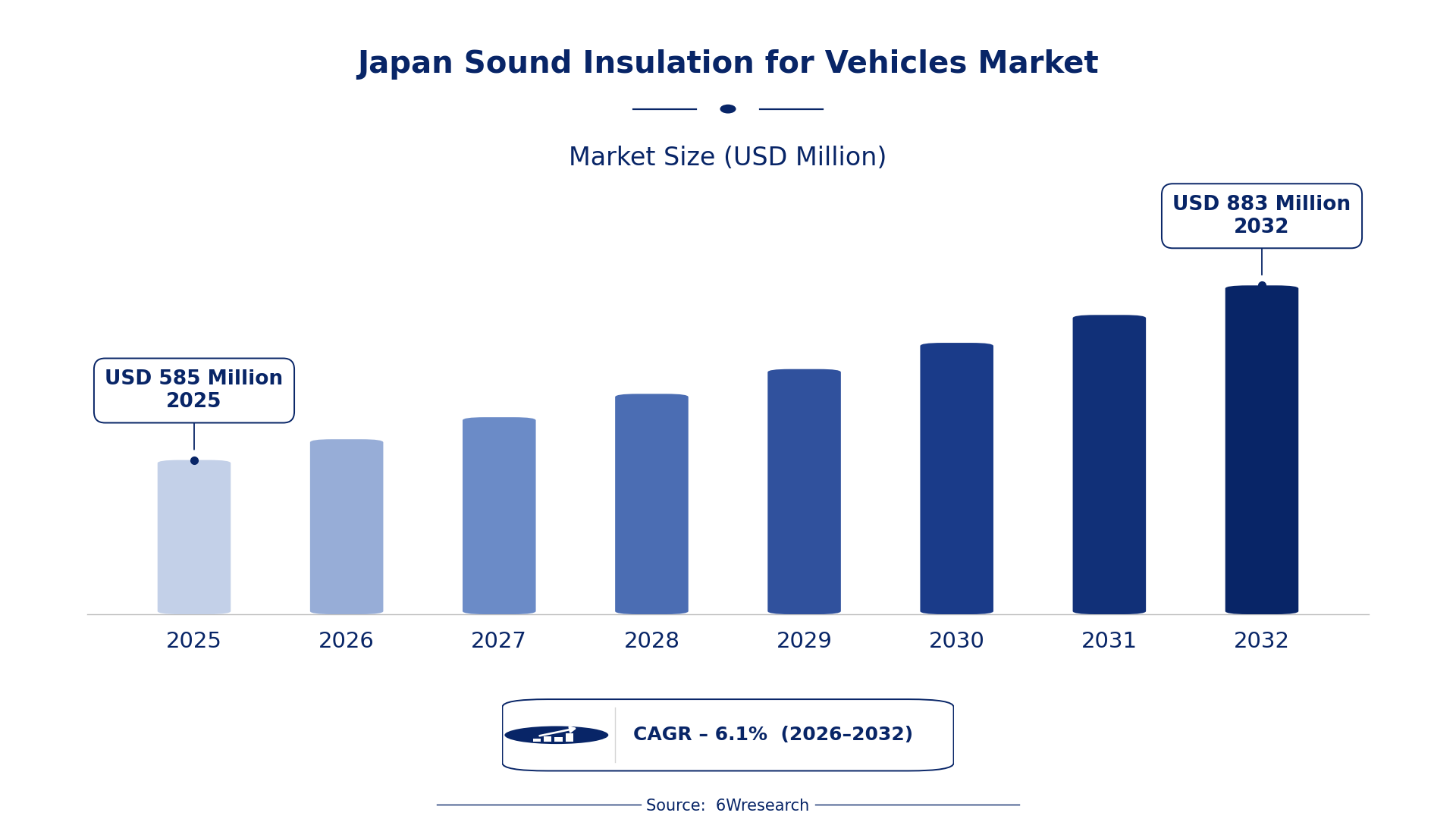
According to 6Wresearch internal database and industry insights, the Japan Sound Insulation for Vehicles Market was valued at USD 585 Million in 2025 and is projected to reach USD 883 Million by 2032, growing at a CAGR of approximately 6.1% during 2026–2032.
Japan Sound Insulation for Vehicles Market Highlights
| Report Metric | Details |
| Report Name | Japan Sound Insulation for Vehicles Market (2026-2032) |
| Market Size 2025 | USD 585 Million |
| Market Size 2032 | USD 883 Million |
| Absolute Growth 2025–2032 | USD 298 Million |
| CAGR 2026–2032 | 6.1% |
| Peak Annual Growth | 6.6% in 2032 |
| Forecast Period | 2026–2032 |
| Historical Data | 2022–2025 |
| Base Year | 2025 |
| Leading Insulation Type, 2025 | Damping Sheets (50% share) |
| Leading Material Used, 2025 | Polyurethane (42% share) |
| Leading Installation Area, 2025 | Cabin Floor (46% share) |
| Leading End User Vehicle Type, 2025 | Passenger Vehicles (39% share) |
| Fastest-Growing Material Used | Butyl Rubber (8.9% CAGR) |
| Fastest-Growing Installation Area | Door Panels (7.3% CAGR) |
| Fastest-Growing End User Vehicle Type | Commercial Vans (7.9% CAGR) |
| Growing Sector | automotive |
| Key End Users | automotive manufacturers, vehicle assemblers, aftermarket suppliers |
Japan Sound Insulation for Vehicles Market Year-wise Growth Rate and Key Drivers (2022–2032)
This graph illustrates the annual growth rates of the market from 2022 to 2032, highlighting a steady upward trajectory and projected market expansion over the forecast period.
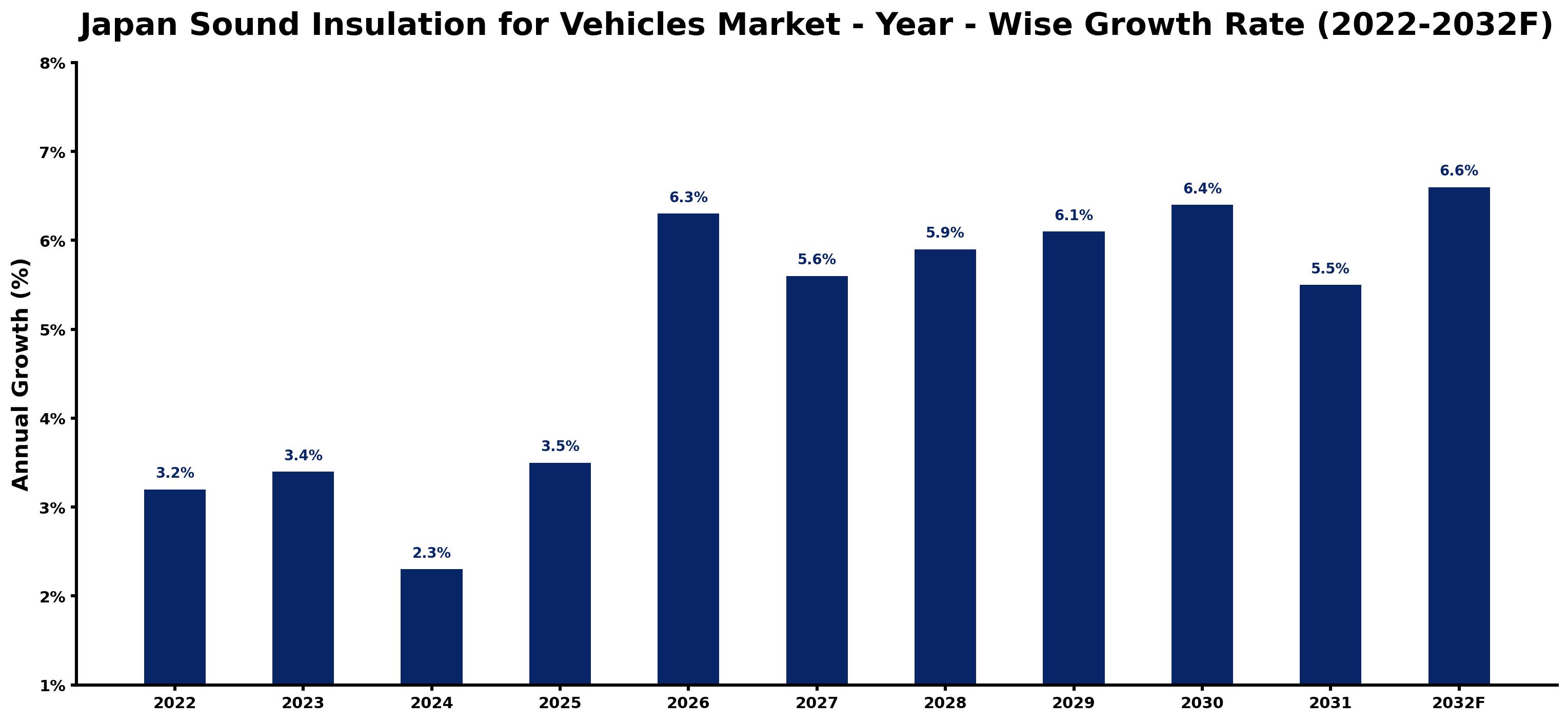
For each year, the table pairs the estimated growth rate with the leading influence on demand, showing how the drivers changed across the period.
| Year | Estimated Annual Growth (%) | Market Rationale |
| 2022 | 3.2 | The market experienced steady growth due to strong demand from domestic manufacturers and consumers. |
| 2023 | 3.4 | Growth accelerated as the automotive sector increased investments in sound insulation technologies to enhance comfort. |
| 2024 | 2.3 | Growth slowed as manufacturers encountered challenges in sourcing materials amid ongoing supply chain disruptions. |
| 2025 | 3.5 | Demand increased as more vehicles adopted sound insulation to meet evolving consumer comfort expectations. |
| 2026 | 6.3 | Investment in research and development is projected to surge, driving higher demand for advanced sound insulation solutions. |
| 2027 | 5.6 | Growth is expected to slow as market saturation in certain vehicle segments begins to emerge. |
| 2028 | 5.9 | Demand will rise again as new luxury models incorporate enhanced sound insulation features for improved comfort. |
| 2029 | 6.1 | Increased production of commercial vans is anticipated to create new opportunities for sound insulation applications. |
| 2030 | 6.4 | Demand will continue to rise as manufacturers aim to reduce overall vehicle noise pollution in line with regulatory targets. |
| 2031 | 5.5 | Growth is anticipated to decelerate as the market approaches maturity with established insulation technologies. |
| 2032 | 6.6 | The market is projected to peak as advanced materials and techniques gain widespread adoption. |
Note: Market size estimations and growth projections presented in this report are based on 6Wresearch's proprietary forecasting methodology, utilizing the latest available industry data, government publications, and primary research inputs.
Japan Sound Insulation for Vehicles Market Synopsis
Sound insulation for vehicles reduces cabin noise using materials like foams, mats, and coatings that absorb or block sound. This product improves passenger comfort and elevates the driving experience by minimising external noise. The Japan Sound Insulation for Vehicles Market is expanding due to strong domestic automotive production, with over 8 million vehicles produced in 2022, and increasing investments in soundproofing technologies. The automotive sector aims to cut noise pollution by 20% by 2030, further stimulating demand.
Market Dynamics Impact Analysis (2026–2032)
| Factor | Type | Impact | Primary Segment Affected |
| Rising investment in R&D within the automotive sector | Driver | High | Acoustic Foams |
| Increased consumer preference for quieter vehicles | Driver | High | Barrier Mats |
| Growing demand for sound insulation in luxury vehicles | Opportunity | High | Damping Sheets |
| Expansion of commercial van production in urban areas | Opportunity | Medium | Door Panels |
| Supply chain disruptions affecting material availability | Restraint | High | Polyurethane |
| High costs associated with advanced sound insulation materials | Restraint | Medium | Bitumen-Based |
| Competition from alternative noise reduction technologies | Challenge | High | Spray Coatings |
| Regulatory pressures to meet new noise reduction standards | Challenge | Medium | Engine Bay |
Evaluation of Drivers in Japan Sound Insulation for Vehicles Market (2026–2032)
The following drivers explain most of the expected growth.
| Drivers | Primary Segment Affected | Why It Matters (Evidence) |
| Increased focus on noise reduction in vehicles | Barrier Mats | This demand is driven by luxury vehicle manufacturers aiming to enhance passenger comfort, with barrier mats increasingly adopted in these models. |
| Growing adoption of acoustic foams | Acoustic Foams | Used in over 60% of new passenger vehicles, these materials are essential for meeting consumer expectations for quieter cabins. |
| Rising demand for damping sheets in commercial vans | Damping Sheets | Utilized in over 70% of commercial vans, these sheets effectively control noise, catering to the expanding commercial vehicle market. |
| Investment in retrofitting older vehicles | Polyurethane | As the average vehicle age approaches 10 years, there is a significant need for sound insulation upgrades to improve comfort and reduce noise. |
| Regulatory pressure for noise pollution reduction | Bitumen-Based | With the automotive industry aiming to cut noise pollution by 20% by 2030, bitumen-based materials are increasingly used in sound insulation applications. |
Orders keep climbing as the automotive sector invests heavily in R&D, with over ¥1 trillion allocated in 2023. This investment unlocks demand for new sound insulation materials, such as acoustic foams, which are used in over 60% of new passenger vehicles. The push for quieter vehicles drives manufacturers to adopt barrier mats, particularly in luxury models, enhancing passenger comfort. The production of commercial vans is increasing, with damping sheets widely utilised in these vehicles for effective noise control.
Evaluation of Restraints in Japan Sound Insulation for Vehicles Market
The key brakes on demand, and where they bite hardest, are shown below.
| Market Restraint | Primary Segment Affected | Why It Matters (Evidence) |
| Supply chain disruptions affecting material availability | Polyurethane | Manufacturers face challenges sourcing polyurethane, impacting production timelines and increasing costs. |
| High costs associated with advanced sound insulation materials | Bitumen-Based | The premium pricing of advanced materials limits their adoption in budget-friendly vehicle models, hindering market growth. |
| Emerging competition from alternative noise reduction technologies | Spray Coatings | New technologies threaten traditional sound insulation methods, affecting market share and pricing strategies. |
| Regulatory pressures to meet new noise reduction standards | Engine Bay | Manufacturers must invest in compliance measures, diverting resources from product development and innovation. |
| Limited awareness of the benefits of sound insulation among consumers | Damping Sheets | Low consumer knowledge restricts market growth potential for sound insulation products, affecting overall sales. |
Japan Sound Insulation for Vehicles Market Challenges
Producers face 15% higher production costs due to outdated sound insulation technology, which reduces profitability for vehicle manufacturers. Local suppliers struggle with pricing pressure from imported materials, causing delays in product availability for buyers. Stricter noise pollution regulations require compliance investments of approximately ¥50 billion annually, straining budgets for producers. A shortage of skilled workers in advanced material application techniques hampers production efficiency, leading to delays in meeting demand for high-quality sound insulation in vehicles.
Trends in the Japan Sound Insulation for Vehicles Market
Several trends are reshaping the Japan Sound Insulation for Vehicles Market; the most important are set out below.
- Shift from Traditional to Advanced Sound Insulation Materials: In 2023, the automotive industry increasingly adopted advanced sound insulation materials, such as polyurethane, which now accounts for 42% of the market. This shift improves vehicle performance and comfort, influencing manufacturers to invest in these technologies.
- Transition from Passive to Active Noise Control Solutions: The trend towards active noise control solutions began in 2022, with the Tokyo Motor Show showcasing innovations in this area. As a result, manufacturers are integrating these technologies into new models, improving overall driving experiences.
- Emergence of Custom Sound Insulation Modifications: In 2024, custom modifications for sound insulation gained popularity among vehicle enthusiasts. This trend has led to increased demand for spray coatings, which are now being used in various vehicle types for tailored solutions.
- Prioritisation of Noise Reduction in Luxury Vehicles: Luxury vehicles have prioritised noise reduction since 2022, with barrier mats becoming standard in many models. This focus on comfort has driven higher sales in the luxury segment, appealing to discerning consumers.
Investment Opportunities in the Japan Sound Insulation for Vehicles Market
The opportunities below stand out in the Japan Sound Insulation for Vehicles Market for new entrants and existing suppliers.
- Investment in Advanced Sound Insulation Materials: The automotive industry is investing heavily in R&D, creating opportunities to supply advanced sound insulation materials. The luxury vehicle segment, which is growing rapidly, seeks effective solutions to improve comfort and reduce noise.
- Growing Demand for Custom Sound Insulation Solutions: The increasing trend of custom vehicle modifications presents an opportunity to supply tailored sound insulation solutions. Enthusiasts in urban areas are seeking products that meet specific noise reduction needs, driving market growth.
- Expansion of Sound Insulation in Commercial Vans: The rising production of commercial vans creates a need for effective sound insulation solutions. Suppliers can target this growing segment by offering products that enhance comfort and reduce noise, appealing to manufacturers.
- Development of Eco-Friendly Sound Insulation Materials: As environmental concerns rise, there is an opportunity to develop eco-friendly sound insulation materials. The automotive sector aims to cut greenhouse gas emissions by 46% by 2030, creating demand for sustainable solutions.
Government Initiatives in the Japan Sound Insulation for Vehicles Market
The Building Energy Efficiency Act (2015, amended 2022) mandates that all new buildings meet specific energy standards, indirectly influencing the automotive sector to adopt energy-efficient sound insulation materials. This act encourages manufacturers to comply with regulations that promote sustainability and improve vehicle performance.
In 2023, the government launched a program to improve vehicle safety and comfort, with funding of ¥50 billion allocated for the initiative. The Ministry of Land, Infrastructure, Transport and Tourism oversees this program, ensuring that sound insulation technologies are integrated into new vehicle designs.
Future Insight of the Japan Sound Insulation for Vehicles Market
The investment pipeline for R&D will exceed ¥1 trillion by 2032, driving demand for advanced sound insulation materials. Government initiatives will support the integration of noise reduction technologies, enhancing vehicle comfort and safety. New ISO standards will streamline compliance processes, benefiting suppliers and buyers alike. As the average vehicle age rises, opportunities for retrofitting will increase, expanding the market for sound insulation upgrades.
Market Segmentation Analysis
Japan Sound Insulation for Vehicles Market report covers a detailed analysis of the following market segments:
By Insulation Type – Damping Sheets Lead and Record the Fastest Growth
According to Saurav Kr Singh, Senior Research Analyst at 6Wresearch, Damping Sheets took 50% of insulation type revenue in 2025, more than any other category. Damping sheets hold the largest share as they are extensively used in vehicles to effectively reduce vibrations and noise, particularly in passenger and commercial vehicles. Their widespread application is essential for meeting ISO 14001 standards, which many manufacturers in Japan follow. Damping Sheets are also forecast to expand faster than any other category, at a CAGR of 8.6% over 2026–2032. The growth of damping sheets is propelled by the automotive sector's focus on enhancing passenger comfort and reducing noise pollution, with their usage exceeding 70% in commercial vans. This consistent effectiveness in vibration control will likely sustain their demand. Suppliers should focus on advancing damping sheet technologies to align with the increasing requirements of the automotive industry.
By Material Used – Polyurethane Leads, Butyl Rubber Expected to Grow Fastest
In 2025, Polyurethane led the material used split with a 42% share. Polyurethane leads the market due to its excellent sound-absorbing properties, making it a preferred choice for many manufacturers in Japan's automotive sector. Its versatility allows for widespread application across various vehicle types, contributing to improved passenger comfort. Over 2026–2032, Butyl Rubber is expected to post the fastest growth, at a CAGR of 8.9%. Butyl rubber is experiencing rapid growth because of its superior sound-dampening qualities, particularly in commercial vans where noise reduction is becoming more critical. The rising preference for this material indicates a shift towards more effective insulation solutions in the market. Buyers should explore diverse material options to optimise sound insulation effectiveness in their vehicles.
By Installation Area – Cabin Floor Leads, Door Panels Expected to Grow Fastest
With 46% of installation area revenue in 2025, Cabin Floor was the largest category. The cabin floor is the primary installation area for sound insulation, significantly impacting passenger comfort by reducing road noise. This area is crucial for manufacturers aiming to enhance the overall driving experience for occupants. Door Panels are projected to grow fastest, at a CAGR of 7.3% during 2026–2032. Door panels are witnessing the fastest growth as they are essential for minimising noise entry, especially in urban environments with high external noise levels. Their strategic location makes them vital for achieving quieter vehicle interiors. Suppliers should prioritise innovations in door panel insulation to meet the increasing demand for improved noise reduction.
By End User Vehicle Type – Passenger Vehicles Lead, Commercial Vans Expected to Grow Fastest
Passenger Vehicles held 39% of the Japan Sound Insulation for Vehicles Market by end user vehicle type in 2025. Passenger vehicles represent the largest segment for sound insulation, driven by consumer preferences for comfort and reduced noise during travel. The production of over 8 million vehicles in 2022 underscores the strong demand in this segment. Commercial Vans are set to record the highest CAGR in this split, 7.9% over 2026–2032. Commercial vans are experiencing the fastest growth due to the rising need for noise reduction in urban logistics and transport applications. This segment's expansion reflects a broader trend within the automotive industry towards enhancing comfort for drivers and passengers alike. Manufacturers should develop tailored sound insulation solutions for commercial vans to address the specific requirements of this expanding market.
Key Attractiveness of the Report
- 10 Years of Market Numbers
- Historical Data Starting from 2022 to 2025
- Base Year 2025
- Forecast Data until 2032
- Key Performance Indicators Impacting the Market
- Major Upcoming Developments and Projects
Key Highlights of the Report:
- Japan Sound Insulation for Vehicles Market Outlook
- Market Size of Japan Sound Insulation for Vehicles Market, 2025
- Forecast of Japan Sound Insulation for Vehicles Market, 2032
- Historical Data and Forecast of Japan Sound Insulation for Vehicles Revenues & Volume for the Period 2022-2032F
- Japan Sound Insulation for Vehicles Market Trend Evolution
- Japan Sound Insulation for Vehicles Market Drivers and Challenges
- Japan Sound Insulation for Vehicles Price Trends
- Japan Sound Insulation for Vehicles Porter's Five Forces
- Japan Sound Insulation for Vehicles Industry Life Cycle
- Historical Data and Forecast of Japan Sound Insulation for Vehicles Market Revenues & Volume By Insulation Type for the Period 2022-2032F
- Historical Data and Forecast of Japan Sound Insulation for Vehicles Market Revenues & Volume By Acoustic Foams for the Period 2022-2032F
- Historical Data and Forecast of Japan Sound Insulation for Vehicles Market Revenues & Volume By Barrier Mats for the Period 2022-2032F
- Historical Data and Forecast of Japan Sound Insulation for Vehicles Market Revenues & Volume By Damping Sheets for the Period 2022-2032F
- Historical Data and Forecast of Japan Sound Insulation for Vehicles Market Revenues & Volume By Spray Coatings for the Period 2022-2032F
- Historical Data and Forecast of Japan Sound Insulation for Vehicles Market Revenues & Volume By Material Used for the Period 2022-2032F
- Historical Data and Forecast of Japan Sound Insulation for Vehicles Market Revenues & Volume By Polyurethane for the Period 2022-2032F
- Historical Data and Forecast of Japan Sound Insulation for Vehicles Market Revenues & Volume By Butyl Rubber for the Period 2022-2032F
- Historical Data and Forecast of Japan Sound Insulation for Vehicles Market Revenues & Volume By Bitumen-Based for the Period 2022-2032F
- Historical Data and Forecast of Japan Sound Insulation for Vehicles Market Revenues & Volume By Polymer for the Period 2022-2032F
- Historical Data and Forecast of Japan Sound Insulation for Vehicles Market Revenues & Volume By Installation Area for the Period 2022-2032F
- Historical Data and Forecast of Japan Sound Insulation for Vehicles Market Revenues & Volume By Engine Bay for the Period 2022-2032F
- Historical Data and Forecast of Japan Sound Insulation for Vehicles Market Revenues & Volume By Cabin Floor for the Period 2022-2032F
- Historical Data and Forecast of Japan Sound Insulation for Vehicles Market Revenues & Volume By Door Panels for the Period 2022-2032F
- Historical Data and Forecast of Japan Sound Insulation for Vehicles Market Revenues & Volume By Undercarriage for the Period 2022-2032F
- Historical Data and Forecast of Japan Sound Insulation for Vehicles Market Revenues & Volume By End User Vehicle Type for the Period 2022-2032F
- Historical Data and Forecast of Japan Sound Insulation for Vehicles Market Revenues & Volume By Passenger Vehicles for the Period 2022-2032F
- Historical Data and Forecast of Japan Sound Insulation for Vehicles Market Revenues & Volume By Commercial Vans for the Period 2022-2032F
- Historical Data and Forecast of Japan Sound Insulation for Vehicles Market Revenues & Volume By Luxury Cars for the Period 2022-2032F
- Historical Data and Forecast of Japan Sound Insulation for Vehicles Market Revenues & Volume By Off-Road Vehicles for the Period 2022-2032F
- Japan Sound Insulation for Vehicles Import Export Trade Statistics
- Market Opportunity Assessment By Insulation Type
- Market Opportunity Assessment By Material Used
- Market Opportunity Assessment By Installation Area
- Market Opportunity Assessment By End User Vehicle Type
- Japan Sound Insulation for Vehicles Top Companies Market Share
- Japan Sound Insulation for Vehicles Competitive Benchmarking By Technical and Operational Parameters
- Japan Sound Insulation for Vehicles Company Profiles
- Japan Sound Insulation for Vehicles Key Strategic Recommendations
Market Covered
This report examines the market across the segments below.
By Insulation Type
- Acoustic Foams
- Barrier Mats
- Damping Sheets
- Spray Coatings
By Material Used
- Polyurethane
- Butyl Rubber
- Bitumen-Based
- Polymer
By Installation Area
- Engine Bay
- Cabin Floor
- Door Panels
- Undercarriage
By End User Vehicle Type
- Passenger Vehicles
- Commercial Vans
- Luxury Cars
- Off-Road Vehicles































