Japan Space Apparel Market Size & Growth Rate
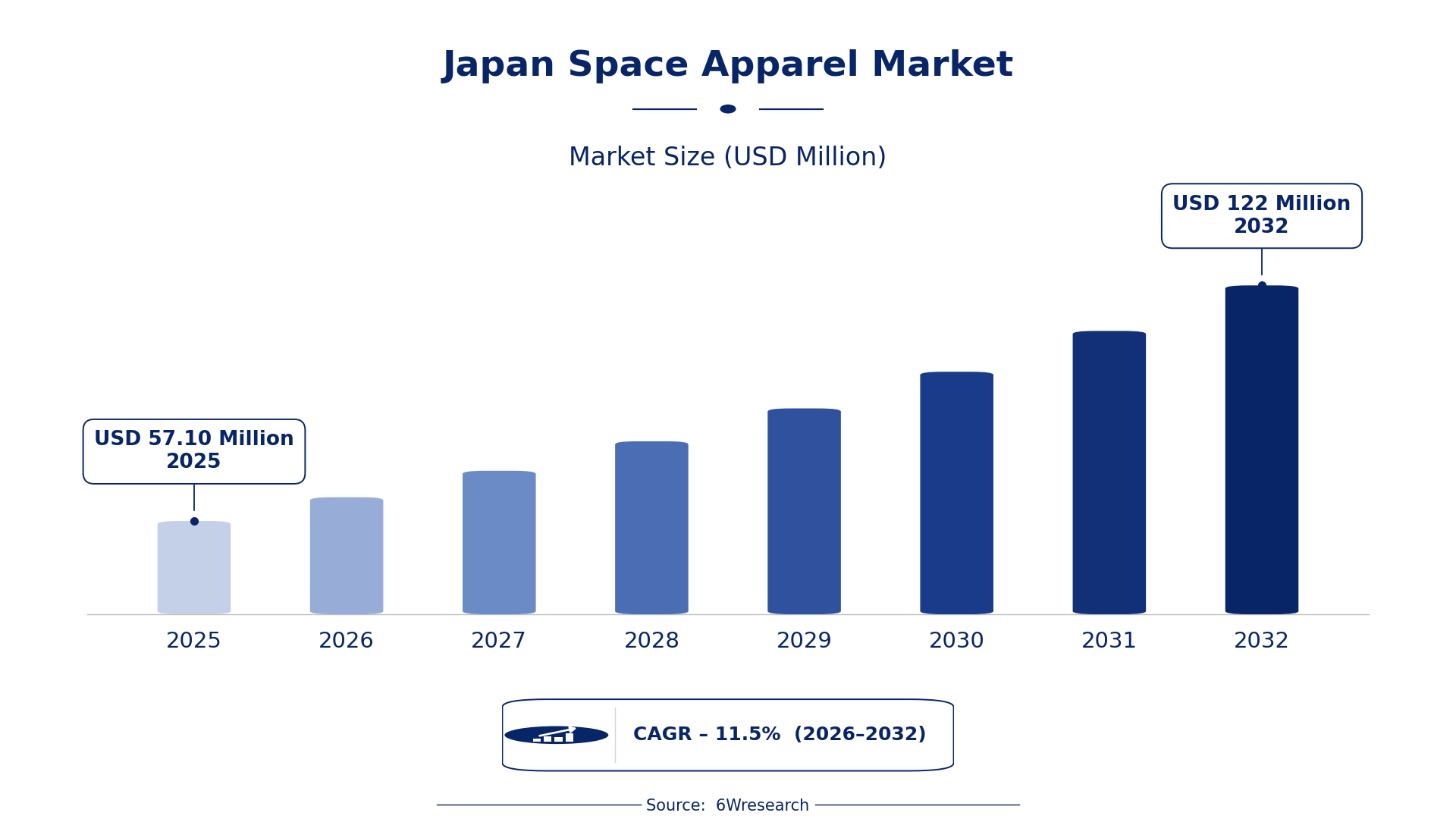
According to 6Wresearch internal database and industry insights, the Japan Space Apparel Market was valued at USD 57.10 Million in 2025 and is projected to reach USD 122 Million by 2032, growing at a CAGR of approximately 11.5% during 2026–2032.
Japan Space Apparel Market Highlights
| Report Metric | Details |
| Report Name | Japan Space Apparel Market (2026-2032) |
| Market Size 2025 | USD 57.10 Million |
| Market Size 2032 | USD 122 Million |
| Absolute Growth 2025–2032 | USD 64.90 Million |
| CAGR 2026–2032 | 11.5% |
| Peak Annual Growth | 13.6% in 2028 |
| Forecast Period | 2026–2032 |
| Historical Data | 2022–2025 |
| Base Year | 2025 |
| Leading Apparel Type, 2025 | Thermal Undergarments (40% share) |
| Leading Functionality, 2025 | Heat Retention (38% share) |
| Leading Material Composition, 2025 | Phase Change Materials (48% share) |
| Leading End User, 2025 | Astronauts (52% share) |
| Fastest-Growing Apparel Type | Radiation Suits (16.0% CAGR) |
| Fastest-Growing Functionality | Cosmic Ray Protection (15.1% CAGR) |
| Fastest-Growing Material Composition | Multi-layer Laminates (16.4% CAGR) |
| Fastest-Growing End User | Space Research Centers (14.7% CAGR) |
| Growing Sector | space exploration |
| Key End Users | astronauts, space research centres, space agencies, private space companies |
Japan Space Apparel Market Year-wise Growth Rate and Key Drivers (2022–2032)
This graph illustrates the annual growth rates of the market from 2022 to 2032, highlighting a steady upward trajectory and projected market expansion over the forecast period.
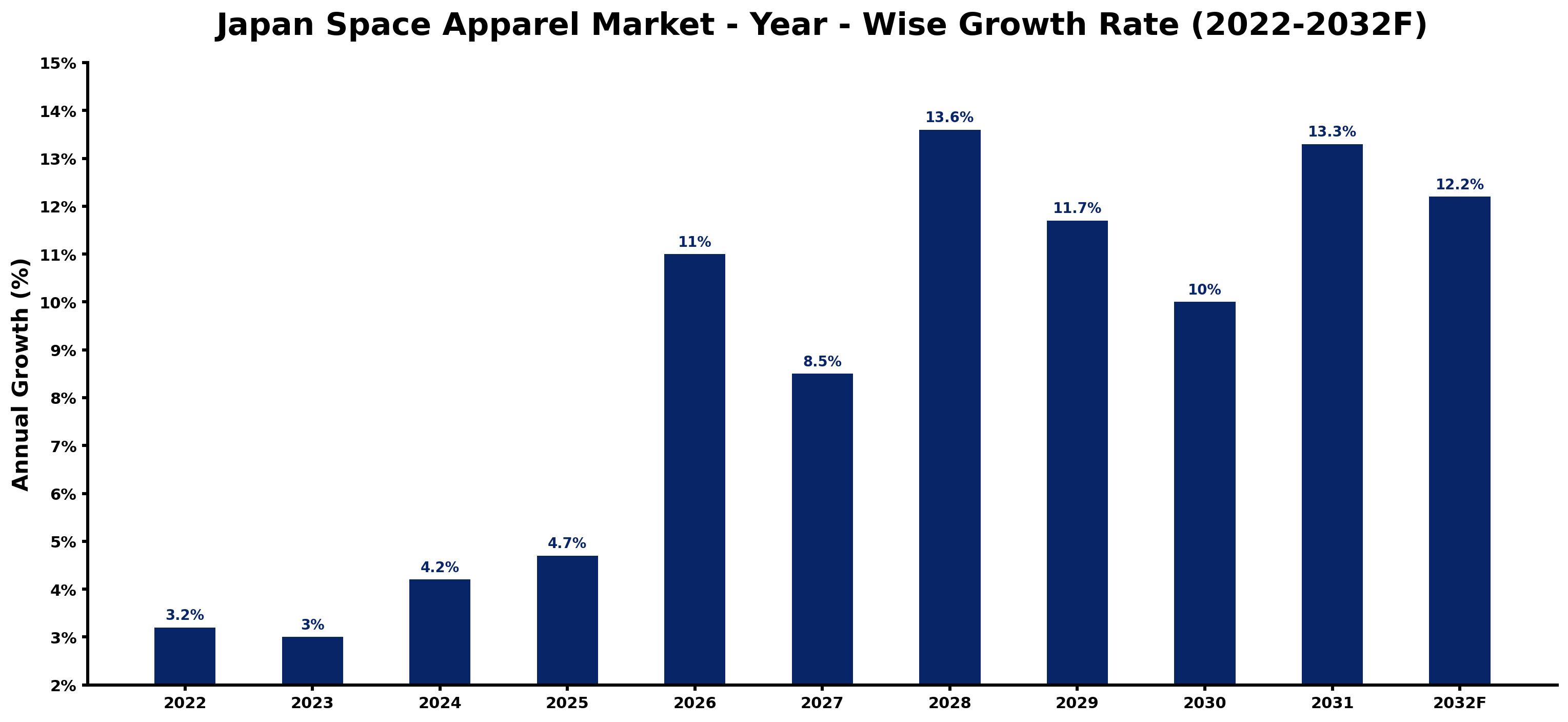
Below, each year's estimated growth is shown next to the factor that most influenced it.
| Year | Estimated Annual Growth (%) | Market Rationale |
| 2022 | 3.2 | The market exhibited steady growth, reflecting ongoing interest in space exploration. |
| 2023 | 3.0 | Growth slowed slightly as the market adjusted to previous expansions and demand patterns. |
| 2024 | 4.2 | Demand increased as new space missions were announced, boosting interest in apparel. |
| 2025 | 4.7 | Growth accelerated with the introduction of advanced thermal undergarments for long missions. |
| 2026 | 11.0 | The market is expected to experience growth due to rising investments in space technology. |
| 2027 | 8.5 | Growth is projected to decelerate slightly as the market stabilises after rapid expansions in previous years. |
| 2028 | 13.6 | Demand is expected to surge as new radiation suits are developed for lunar missions, driving purchases. |
| 2029 | 11.7 | Growth is projected to slow as the market adjusts to the previous peak in demand for space apparel. |
| 2030 | 10.0 | The market will continue to grow, supported by ongoing advancements in material technology. |
| 2031 | 13.3 | Demand is expected to increase as collaborations with universities improve pressurized suit designs. |
| 2032 | 12.2 | Growth is projected to slow as the market matures, focusing on refining existing product lines. |
Note: Market size estimations and growth projections presented in this report are based on 6Wresearch's proprietary forecasting methodology, utilizing the latest available industry data, government publications, and primary research inputs.
Japan Space Apparel Market Synopsis
Space apparel encompasses specialized clothing designed for astronauts, utilising advanced materials like multi-layer laminates and phase change materials. These garments provide essential life support, mobility, and protection from cosmic rays during missions. The Japan Space Apparel Market is expanding, driven by increasing investments in space technology, with total investments exceeding ¥100 billion since 2020. The Japan Aerospace Exploration Agency oversees standards, while private companies and research centres contribute to the growing demand for effective solutions in this sector.
Market Dynamics Impact Analysis (2026–2032)
| Factor | Type | Impact | Primary Segment Affected |
| Increasing investments in space technology programs | Driver | High | Thermal Undergarments |
| Development of advanced materials for space apparel | Driver | High | Radiation Suits |
| Growing interest in lunar missions | Opportunity | High | Pressurized Suits |
| Expansion of private space companies | Opportunity | Medium | Mission-Specific Gear |
| High costs of advanced materials | Restraint | High | Multi-layer Laminates |
| Limited production capacity for specialized apparel | Restraint | Medium | Phase Change Materials |
| High R&D costs for new technology | Challenge | High | Heat Retention |
| Competition from international space apparel markets | Challenge | Medium | Cosmic Ray Protection |
Evaluation of Drivers in Japan Space Apparel Market (2026–2032)
These are the developments adding the most demand over the forecast period.
| Drivers | Primary Segment Affected | Why It Matters (Evidence) |
| Increased government funding for space exploration | Thermal Undergarments | Japan's government has invested over ¥100 billion since 2020, driving demand for thermal undergarments essential for missions. |
| Advancements in material technology | Radiation Suits | The development of new radiation suits in Tsukuba has improved safety standards, attracting more buyers from space agencies. |
| Rising number of lunar missions | Pressurized Suits | With lunar missions planned, demand for pressurized suits is increasing, especially among space research centres. |
| Growth of private space ventures | Mission-Specific Gear | Private space companies are expanding their missions, increasing the need for customized mission-specific gear. |
| Collaborations with academic institutions | Life Support | Partnerships with universities in Tokyo are improving life support systems, driving demand for integrated apparel. |
This funding has led to advancements in material technology, particularly in the development of new radiation suits. Interest in lunar missions is boosting demand for pressurized suits, especially among space research centres. The growth of private space ventures is creating a need for mission-specific gear tailored to unique requirements. Collaborations with academic institutions are improving life support systems, further driving demand for integrated apparel solutions.
Evaluation of Restraints in Japan Space Apparel Market
These restraints slow adoption and weigh on supplier margins.
| Market Restraint | Primary Segment Affected | Why It Matters (Evidence) |
| High costs associated with advanced materials | Multi-layer Laminates | The use of advanced materials in multi-layer laminates increases production costs, limiting affordability for buyers. |
| Production capacity constraints for specialized apparel | Phase Change Materials | Limited production capabilities for phase change materials restrict supply, affecting timely deliveries to clients. |
| R&D costs for new technology development | Heat Retention | The high costs of R&D for heat retention technologies can deter investment from smaller companies. |
| Competition from international markets | Cosmic Ray Protection | International competitors with established supply chains pose challenges for local manufacturers in cosmic ray protection. |
| Regulatory compliance costs | Radiation Suits | Meeting stringent safety standards for radiation suits increases compliance costs for producers. |
Japan Space Apparel Market Challenges
Buyers face inflated costs due to a shortage of skilled professionals in space apparel design, which delays production timelines and raises expenses for manufacturers. Limited domestic suppliers for advanced materials results in increased prices, with costs rising by approximately 15% for buyers. Development of life support systems that comply with ISO 14644 standards complicates processes, extending timelines for producers. Disruptions in sourcing phase change materials lead to increased lead times by 20%, ultimately delaying product availability for buyers.
Trends in the Japan Space Apparel Market
The following changes are redrawing the Japan Space Apparel Market.
- Shift Towards Advanced Thermal Management: A shift is occurring towards advanced thermal management solutions in space apparel, particularly with the use of phase change materials. Research at the Tokyo Institute of Technology indicates these materials are vital for lunar missions and improve astronaut comfort.
- Increased Customization in Space Gear: Space research centres are demanding more customized mission-specific gear, reflecting the unique requirements of various space missions. This shift is evidenced by the rising number of tailored designs being developed for upcoming lunar explorations.
- Focus on Mobility Solutions: The Japan Aerospace Exploration Agency's Space Robotics Laboratory is prioritising mobility solutions for astronauts, improving their operational efficiency. This focus is important as missions become more complex and require greater flexibility in movement.
- Growing Interest in Space Exploration: Japan's population shows a growing interest in space exploration, with approximately 130 million people engaged in related activities. This interest is driving demand for effective space apparel solutions, particularly for private space companies.
Investment Opportunities in the Japan Space Apparel Market
The openings below show where demand in the Japan Space Apparel Market is visible and how suppliers can enter.
- Tokyo as a Hub for Space Innovation: Tokyo is emerging as a hub for space technology startups focusing on apparel and equipment. The current investment climate, with over ¥100 billion allocated since 2020, presents opportunities for partnerships and collaborations.
- Rising Demand for Lunar Mission Gear: With Japan's space population growing, there is an increasing demand for specialized gear for lunar missions. This presents opportunities for manufacturers to develop tailored solutions for space agencies and research centres.
- Investment in R&D for New Materials: Ongoing research in Kanagawa Prefecture for custom fabric blends highlights the opportunity for investment in new materials. Collaborating with local universities can improve product offerings and market presence.
- Expansion of Private Space Companies: The growth of private space companies is creating a demand for mission-specific gear. Entering this market through joint ventures can provide access to new customer bases and improve competitive advantage.
Government Initiatives in the Japan Space Apparel Market
The Economic Security Promotion Act of 2022 supports supply-chain resilience for critical products, including space apparel. This law encourages manufacturers to invest in advanced materials and technologies, ensuring a steady supply of essential components for space missions. The Chemical Substances Control Law of 1973 mandates the evaluation of chemical substances used in manufacturing, impacting the production processes for space apparel.
The Japan Aerospace Exploration Agency oversees compliance with safety standards for space apparel, ensuring that products meet rigorous requirements. The Ministry of Education, Culture, Sports, Science and Technology funds various space technology initiatives, supporting research and development in this sector. Their funding enables the development of new materials and technologies, improving the overall quality and safety of space apparel.
Future Insight of the Japan Space Apparel Market
New research facilities focused on space apparel development will enhance prototyping and testing processes. By 2032, improvements in thermal protection will elevate safety standards for space missions. Research from the Tokyo Institute of Technology will drive advancements in mobility solutions, refining suit designs. With government investments exceeding ¥100 billion since 2020, suppliers will gain better access to cutting-edge technologies, encouraging collaboration between academia and industry.
Market Segmentation Analysis
Japan Space Apparel Market report covers a detailed analysis of the following market segments:
By Apparel Type – Thermal Undergarments Lead, Radiation Suits Expected to Grow Fastest
According to Saurav Kr Singh, Senior Research Analyst at 6Wresearch, Thermal Undergarments took 40% of apparel type revenue in 2025, more than any other category. Thermal undergarments are essential for temperature regulation in space, ensuring astronauts remain comfortable during missions. Their established use in Japan's space programmes, particularly by the Japan Aerospace Exploration Agency, solidifies their leading market position. Radiation Suits are set to record the highest CAGR in this split, 16.0% over 2026–2032. Radiation suits are witnessing rapid growth due to increased focus on protecting astronauts from harmful cosmic radiation. The extensive testing facilities in Tsukuba, Ibaraki, are pivotal in advancing these protective garments, ensuring their effectiveness in space environments. Suppliers must focus on enhancing thermal undergarment technology to maintain their competitive edge in the market.
By Functionality – Heat Retention Leads, Cosmic Ray Protection Expected to Grow Fastest
With 38% of functionality revenue in 2025, Heat Retention was the largest category. Heat retention is critical for astronaut safety in extreme temperatures, ensuring that astronauts remain comfortable and functional during missions. This functionality is a primary requirement outlined by the Japan Aerospace Exploration Agency for all space apparel. Over 2026–2032, Cosmic Ray Protection is expected to post the fastest growth, at a CAGR of 15.1%. Cosmic ray protection is becoming increasingly vital for long-duration space missions, particularly as Japan aims to expand its presence in lunar exploration. The ongoing research at the National Institute of Space and Aeronautics highlights the urgency of developing effective solutions in this area. Buyers will need to prioritise apparel that offers advanced cosmic ray protection as mission durations increase.
By Material Composition – Phase Change Materials Lead, Multi-layer Laminates Expected to Grow Fastest
In 2025, Phase Change Materials led the material composition split with a 48% share. Phase change materials are integral to thermal management in space apparel, providing essential temperature regulation for astronauts. Their widespread use in various designs reflects the industry's commitment to safety and performance in extreme conditions. The quickest growth will come from Multi-layer Laminates, forecast to expand at a CAGR of 16.4% between 2026 and 2032. Multi-layer laminates are emerging as a key material for protective suits, driven by advancements in research from institutions like the Tokyo Institute of Technology. This material's versatility and effectiveness in shielding against environmental hazards contribute to its rapid growth. Suppliers should invest in research and development of multi-layer laminates to stay competitive in the evolving market.
By End User – Astronauts Lead, Space Research Centers Expected to Grow Fastest
The largest end user category in 2025 was Astronauts, at 52% of revenue. Astronauts are the primary users of space apparel, relying on these specialised garments for safety and performance during missions. The rigorous selection process for astronauts underscores the critical nature of this segment in the space industry. Space Research Centers are projected to grow fastest, at a CAGR of 14.7% during 2026–2032. Space research centers are increasingly utilising space apparel for testing and development, reflecting a growing collaboration between academia and industry. This trend is supported by significant government investments in space technology initiatives exceeding ¥100 billion since 2020. Suppliers should engage with research centres to align their products with the latest testing and development needs.
Key Attractiveness of the Report
- 10 Years of Market Numbers
- Historical Data Starting from 2022 to 2025
- Base Year 2025
- Forecast Data until 2032
- Key Performance Indicators Impacting the Market
- Major Upcoming Developments and Projects
Key Highlights of the Report:
- Japan Space Apparel Market Outlook
- Market Size of Japan Space Apparel Market, 2025
- Forecast of Japan Space Apparel Market, 2032
- Historical Data and Forecast of Japan Space Apparel Revenues & Volume for the Period 2022-2032F
- Japan Space Apparel Market Trend Evolution
- Japan Space Apparel Market Drivers and Challenges
- Japan Space Apparel Price Trends
- Japan Space Apparel Porter's Five Forces
- Japan Space Apparel Industry Life Cycle
- Historical Data and Forecast of Japan Space Apparel Market Revenues & Volume By Apparel Type for the Period 2022-2032F
- Historical Data and Forecast of Japan Space Apparel Market Revenues & Volume By Thermal Undergarments for the Period 2022-2032F
- Historical Data and Forecast of Japan Space Apparel Market Revenues & Volume By Radiation Suits for the Period 2022-2032F
- Historical Data and Forecast of Japan Space Apparel Market Revenues & Volume By Pressurized Suits for the Period 2022-2032F
- Historical Data and Forecast of Japan Space Apparel Market Revenues & Volume By Mission-Specific Gear for the Period 2022-2032F
- Historical Data and Forecast of Japan Space Apparel Market Revenues & Volume By Functionality for the Period 2022-2032F
- Historical Data and Forecast of Japan Space Apparel Market Revenues & Volume By Heat Retention for the Period 2022-2032F
- Historical Data and Forecast of Japan Space Apparel Market Revenues & Volume By Cosmic Ray Protection for the Period 2022-2032F
- Historical Data and Forecast of Japan Space Apparel Market Revenues & Volume By Life Support for the Period 2022-2032F
- Historical Data and Forecast of Japan Space Apparel Market Revenues & Volume By Mobility & Storage for the Period 2022-2032F
- Historical Data and Forecast of Japan Space Apparel Market Revenues & Volume By Material Composition for the Period 2022-2032F
- Historical Data and Forecast of Japan Space Apparel Market Revenues & Volume By Phase Change Materials for the Period 2022-2032F
- Historical Data and Forecast of Japan Space Apparel Market Revenues & Volume By Multi-layer Laminates for the Period 2022-2032F
- Historical Data and Forecast of Japan Space Apparel Market Revenues & Volume By Neoprene + Aluminum Foil for the Period 2022-2032F
- Historical Data and Forecast of Japan Space Apparel Market Revenues & Volume By Custom Fabric Blends for the Period 2022-2032F
- Historical Data and Forecast of Japan Space Apparel Market Revenues & Volume By End User for the Period 2022-2032F
- Historical Data and Forecast of Japan Space Apparel Market Revenues & Volume By Astronauts for the Period 2022-2032F
- Historical Data and Forecast of Japan Space Apparel Market Revenues & Volume By Space Research Centers for the Period 2022-2032F
- Historical Data and Forecast of Japan Space Apparel Market Revenues & Volume By Space Agencies for the Period 2022-2032F
- Historical Data and Forecast of Japan Space Apparel Market Revenues & Volume By Private Space Companies for the Period 2022-2032F
- Japan Space Apparel Import Export Trade Statistics
- Market Opportunity Assessment By Apparel Type
- Market Opportunity Assessment By Functionality
- Market Opportunity Assessment By Material Composition
- Market Opportunity Assessment By End User
- Japan Space Apparel Top Companies Market Share
- Japan Space Apparel Competitive Benchmarking By Technical and Operational Parameters
- Japan Space Apparel Company Profiles
- Japan Space Apparel Key Strategic Recommendations
Market Covered
The study includes the following segmentation.
By Apparel Type
- Thermal Undergarments
- Radiation Suits
- Pressurized Suits
- Mission-Specific Gear
By Functionality
- Heat Retention
- Cosmic Ray Protection
- Life Support
- Mobility & Storage
By Material Composition
- Phase Change Materials
- Multi-layer Laminates
- Neoprene + Aluminum Foil
- Custom Fabric Blends
By End User
- Astronauts
- Space Research Centers
- Space Agencies
- Private Space Companies































