Japan Space Exploration Equipment Market Size & Growth Rate
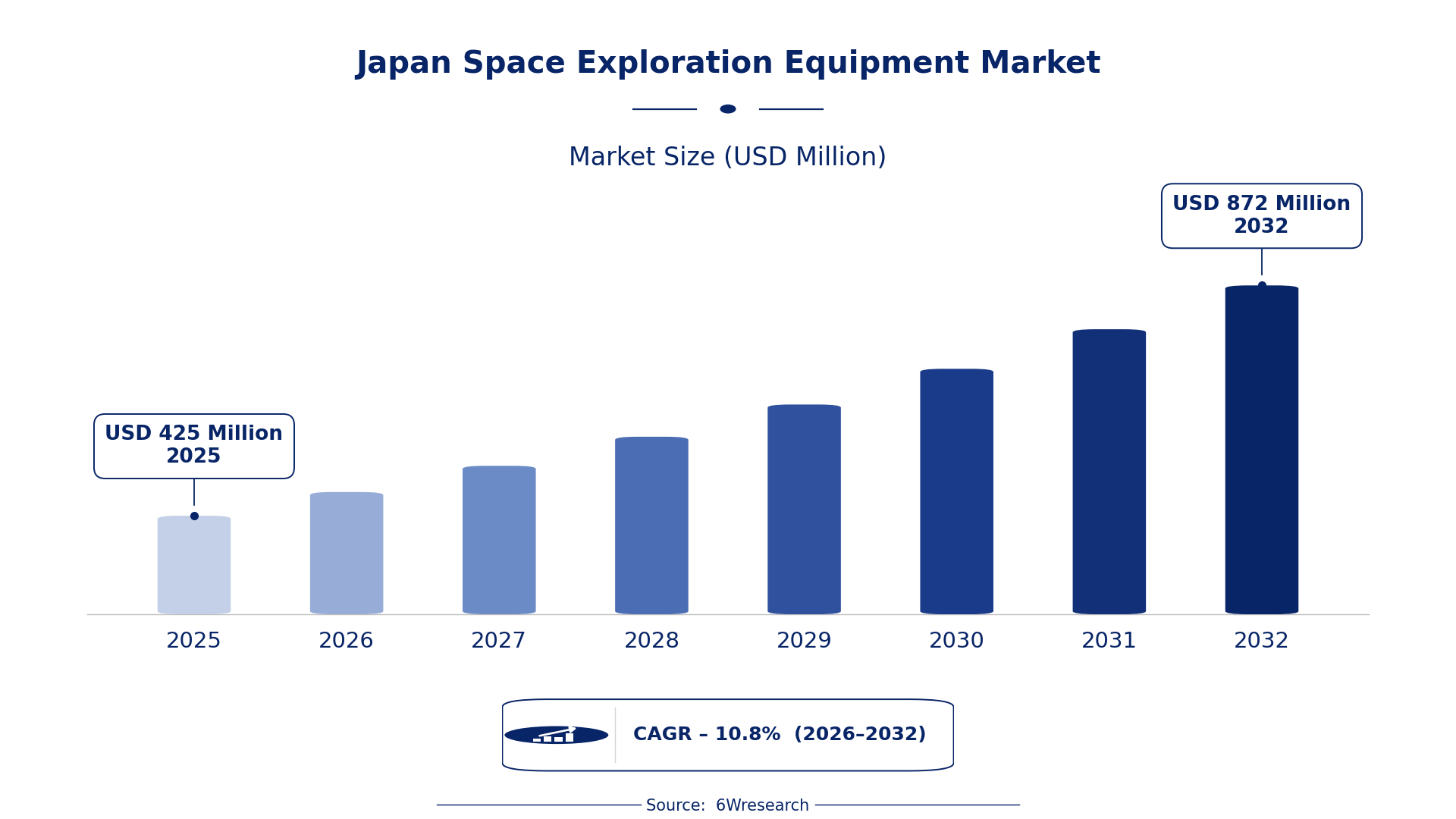
According to 6Wresearch internal database and industry insights, the Japan Space Exploration Equipment Market was valued at USD 425 Million in 2025 and is projected to reach USD 872 Million by 2032, growing at a CAGR of approximately 10.8% during 2026–2032.
Japan Space Exploration Equipment Market Highlights
| Report Metric | Details |
| Report Name | Japan Space Exploration Equipment Market (2026-2032) |
| Market Size 2025 | USD 425 Million |
| Market Size 2032 | USD 872 Million |
| Absolute Growth 2025–2032 | USD 447 Million |
| CAGR 2026–2032 | 10.8% |
| Peak Annual Growth | 11.2% in 2030 |
| Forecast Period | 2026–2032 |
| Historical Data | 2022–2025 |
| Base Year | 2025 |
| Leading Equipment Type, 2025 | Rovers (43% share) |
| Leading Functionality, 2025 | Surface Navigation (46% share) |
| Leading Mission Stage, 2025 | Planetary Missions (52% share) |
| Leading End User, 2025 | Space Agencies (48% share) |
| Fastest-Growing Equipment Type | Habitat Modules (14.8% CAGR) |
| Fastest-Growing Functionality | Life Support Systems (13.7% CAGR) |
| Fastest-Growing Mission Stage | Lunar/Martian Missions (15.0% CAGR) |
| Fastest-Growing End User | Space Contractors (13.6% CAGR) |
| Growing Sector | space exploration |
| Key End Users | space agencies, scientific missions, astronaut corps, space contractors |
Japan Space Exploration Equipment Market Year-wise Growth Rate and Key Drivers (2022–2032)
This graph illustrates the annual growth rates of the market from 2022 to 2032, highlighting a steady upward trajectory and projected market expansion over the forecast period.
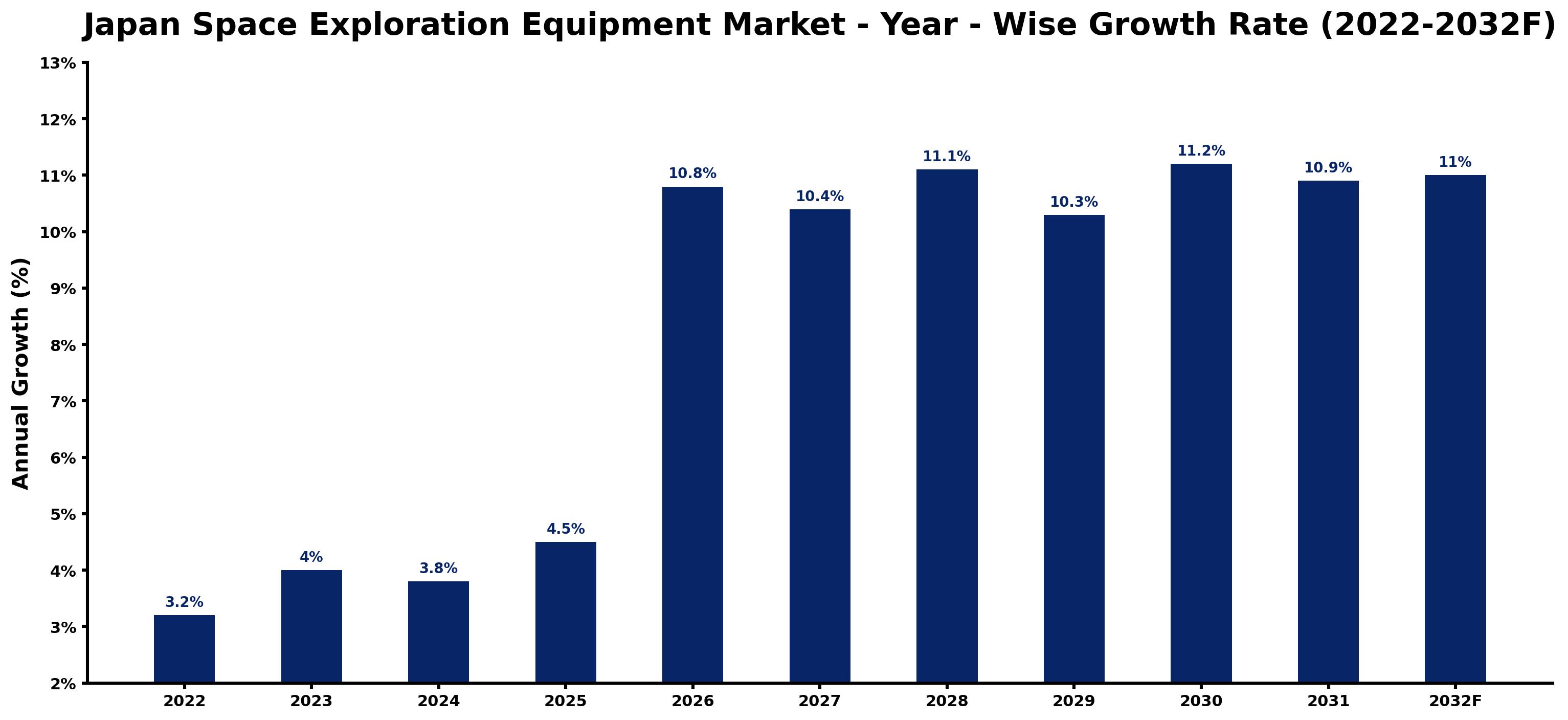
Annual growth estimates for each year appear below with the principal reason behind them, explaining the shifts that set the pace of the market.
| Year | Estimated Annual Growth (%) | Market Rationale |
| 2022 | 3.2 | The market showed steady growth with ongoing interest in space exploration. |
| 2023 | 4.0 | Growth accelerated due to increased funding for national space missions. |
| 2024 | 3.8 | The growth rate slowed slightly as projects faced resource allocation challenges. |
| 2025 | 4.5 | Demand rose as new lunar exploration initiatives gained momentum. |
| 2026 | 10.8 | The market is expected to surge with advancements in life support technologies. |
| 2027 | 10.4 | Growth is projected to moderate as the market adjusts to technological developments. |
| 2028 | 11.1 | A rebound in demand is expected with the launch of new planetary missions. |
| 2029 | 10.3 | Growth is projected to slow again as competition intensifies among suppliers. |
| 2030 | 11.2 | The market is expected to peak with substantial investments in lunar and Martian missions. |
| 2031 | 10.9 | A slight slowdown is projected as the market stabilises after rapid growth. |
| 2032 | 11.0 | Growth is expected to resume as new technologies and collaborations emerge. |
Note: Market size estimations and growth projections presented in this report are based on 6Wresearch's proprietary forecasting methodology, utilizing the latest available industry data, government publications, and primary research inputs.
Japan Space Exploration Equipment Market Synopsis
Space exploration equipment includes technologies for missions beyond Earth's atmosphere, such as rovers, habitat modules, and life support systems. The Japan Space Exploration Equipment Market is expanding due to increasing investments from domestic space agencies and scientific missions. With a budget of approximately 600 billion yen for 2023, initiatives like the Martian Moons Exploration mission set for 2024 are driving demand for advanced exploration technologies and creating opportunities for suppliers to innovate and collaborate.
Market Dynamics Impact Analysis (2026–2032)
| Factor | Type | Impact | Primary Segment Affected |
| Rising investments in lunar exploration missions drive demand for habitat modules. | Driver | High | Habitat Modules |
| Growing interest in planetary exploration fuels the need for advanced rovers. | Driver | High | Rovers |
| The need for improved life support systems presents opportunities for innovation. | Opportunity | High | Life Support Systems |
| Increased international collaboration opens new markets for exploration equipment. | Opportunity | Medium | Rovers |
| High development costs can limit the number of new projects initiated. | Restraint | High | Drilling Equipment |
| Stringent safety regulations may delay product approvals and market entry. | Restraint | Medium | Space Suits |
| Limited skilled workforce can hinder production capabilities in the sector. | Challenge | High | Space Contractors |
| Compliance with international standards can increase operational costs. | Challenge | Medium | Life Support Systems |
Evaluation of Drivers in Japan Space Exploration Equipment Market (2026–2032)
These are the developments adding the most demand over the forecast period.
| Drivers | Primary Segment Affected | Why It Matters (Evidence) |
| Increased funding for lunar missions boosts demand for habitat modules. | Habitat Modules | Japan's space exploration budget for 2023 is approximately 600 billion yen. |
| Advancements in robotics improve rover capabilities. | Rovers | Rovers developed in Japan are used in lunar exploration missions. |
| Growing interest in Mars missions drives demand for life support systems. | Life Support Systems | The Martian Moons Exploration (MMX) mission is set for launch in 2024. |
| International collaborations expand the market for space exploration equipment. | Rovers | Japan participates in the International Space Station (ISS) program. |
| Rising public interest in space exploration fuels demand for astronaut training. | Space Suits | The next generation of space suits is being developed for lunar missions by 2025. |
A wider customer base explains much of the growth, as increased funding for lunar missions boosts demand for habitat modules, with Japan's space exploration budget reaching approximately 600 billion yen in 2023. Advancements in robotics improve rover capabilities, leading to their deployment in lunar exploration missions. Interest in Mars missions drives demand for life support systems, especially with the upcoming Martian Moons Exploration mission set for launch in 2024.
Evaluation of Restraints in Japan Space Exploration Equipment Market
These are the pressures that could keep growth below its potential.
| Market Restraint | Primary Segment Affected | Why It Matters (Evidence) |
| High development costs can limit the number of new projects initiated. | Drilling Equipment | Development costs for advanced drilling equipment can exceed budgets for many projects. |
| Stringent safety regulations may delay product approvals and market entry. | Space Suits | Compliance with safety standards can prolong the approval process for new space suits. |
| Limited skilled workforce can hinder production capabilities in the sector. | Space Contractors | Japan's space industry employs over 20,000 professionals, but demand for skilled workers is rising. |
| Compliance with international standards can increase operational costs. | Life Support Systems | Meeting ISO 14644 standards for cleanrooms raises production costs for life support systems. |
| Resource allocation challenges can slow project timelines. | Rovers | Competing priorities within the space budget can delay rover development timelines. |
Japan Space Exploration Equipment Market Challenges
Japan's space exploration budget for 2023 is approximately 600 billion yen, limiting resources for technology development. This funding constraint arises from competing national priorities, resulting in delays for producers who cannot keep pace with global advancements. Heightened competition from international agencies compels local manufacturers to improve their offerings, which can erode their market share. Rising production costs, influenced by a national minimum wage of JPY 1,055 per hour, lead producers to increase prices, burdening buyers with higher costs for essential equipment.
Trends in the Japan Space Exploration Equipment Market
Below are the shifts with the largest effect on the Japan Space Exploration Equipment Market.
- Shift from Traditional to Advanced Rovers: Space agencies are increasingly adopting advanced rover technologies for lunar missions, as seen in the upcoming Martian Moons Exploration mission. This shift is supported by Japan's budget of 600 billion yen for 2023.
- Transition to Next-Generation Life Support Systems: The development of next-generation life support systems is gaining traction, particularly for lunar missions. The focus on sustainability aligns with Japan's goal to increase investment in space technology by 20% by 2025.
- Focus on International Collaboration: Japan's participation in the ISS program highlights a trend towards international collaboration in space exploration. This cooperation is expected to enhance technological exchange and joint missions, benefiting all involved parties.
- Increased Investment in Space Education: The National Institute of Space and Aeronautics is promoting space education initiatives, aiming to inspire the next generation of space professionals. This effort is important as Japan's space population continues to grow.
Investment Opportunities in the Japan Space Exploration Equipment Market
Investors looking at the Japan Space Exploration Equipment Market should consider the following areas.
- Gap in Advanced Habitat Modules: With Japan's space exploration budget set at 600 billion yen for 2023, there is an opportunity to supply advanced habitat modules for lunar missions. Collaborating with space agencies can facilitate market entry.
- Growing Demand for Life Support Systems: The projected increase in investment for space technology creates an opportunity to supply life support systems. Targeting space agencies will be essential to meet their evolving needs.
- Potential in Lunar Exploration Equipment: The Lunar Polar Exploration mission aims to investigate water ice on the Moon, creating demand for specialized exploration equipment. Engaging with research institutions can provide pathways for collaboration.
- Investment in Space Robotics: The Space Robotics Laboratory at Tohoku University is a leader in rover technology, indicating a need for investment in robotics. Partnering with educational institutions can enhance product development.
Government Initiatives in the Japan Space Exploration Equipment Market
The Industrial Safety and Health Act of 1972 mandates employer responsibilities regarding hazardous substances and machinery, ensuring that producers of space exploration equipment adhere to safety standards. This law impacts manufacturers by requiring them to implement rigorous safety protocols and conduct regular assessments of their equipment.
The Japan Aerospace Exploration Agency (JAXA) oversees national space missions and approves various projects related to space exploration. JAXA's funding of approximately 600 billion yen for 2023 supports initiatives aimed at improving Japan's capabilities in space technology and exploration.
Future Insight of the Japan Space Exploration Equipment Market
Investment in space technology is projected to rise by 20% by 2025, creating demand for advanced equipment. By 2032, missions like the Martian Moons Exploration will necessitate cutting-edge technologies, prompting suppliers to innovate. Enhanced international collaboration will enable suppliers to tap into larger markets and share expertise. The introduction of next-generation technologies for lunar missions will further advance capabilities, positioning Japan at the forefront of global space exploration.
Market Segmentation Analysis
Japan Space Exploration Equipment Market report covers a detailed analysis of the following market segments:
By Equipment Type – Rovers Lead, Habitat Modules Expected to Grow Fastest
According to Saurav Kr Singh, Senior Research Analyst at 6Wresearch, with 43% of equipment type revenue in 2025, Rovers was the largest category. Rovers hold the largest share due to their critical role in planetary exploration, enabling surface navigation on celestial bodies. For instance, rovers developed in Japan are integral to lunar exploration missions, showcasing their importance in national space initiatives. The quickest growth will come from Habitat Modules, forecast to expand at a CAGR of 14.8% between 2026 and 2032. The habitat modules segment is experiencing rapid growth as they are essential for sustaining life during long-term missions, particularly in the context of upcoming lunar and Martian explorations. The increasing focus on human presence in space drives demand for these modules. Suppliers should prioritise innovation in habitat modules to meet the rising demand from space agencies.
By Functionality – Surface Navigation Leads, Life Support Systems Expected to Grow Fastest
Surface Navigation took 46% of functionality revenue in 2025, more than any other category. Surface navigation commands the largest share due to its critical function in directing rovers and astronauts on planetary surfaces, ensuring mission success. For example, lunar exploration missions heavily depend on sophisticated surface navigation technologies to operate effectively in challenging environments. Life Support Systems are projected to grow fastest, at a CAGR of 13.7% during 2026–2032. Life support systems are witnessing rapid growth as they are essential for supplying breathable air and water to astronauts during missions. The upcoming lunar missions will require advancements in these systems to guarantee astronaut safety and mission success. Suppliers must focus on developing advanced life support systems to address the rising demands of future missions.
By Mission Stage – Planetary Missions Lead, Lunar/Martian Missions Expected to Grow Fastest
Planetary Missions held 52% of the Japan Space Exploration Equipment Market by mission stage in 2025. Planetary missions dominate the market as they target significant objectives like Mars, drawing substantial investment and interest from various stakeholders. Japan's strategic emphasis on these missions is reflected in its considerable budget allocation for exploration activities. Over 2026–2032, Lunar/Martian Missions are expected to post the fastest growth, at a CAGR of 15.0%. Lunar and Martian missions are the fastest-growing segment, driven by initiatives such as JAXA's Martian Moons Exploration mission set for 2024. This increasing focus corresponds with global trends in space exploration, boosting demand for associated technologies. Suppliers should tailor their offerings to align with the growing focus on lunar and Martian missions to seize emerging opportunities.
By End User – Space Agencies Lead, Space Contractors Expected to Grow Fastest
The largest end user category in 2025 was Space Agencies, at 48% of revenue. Space agencies lead the market as the primary users of exploration equipment, significantly shaping demand through their extensive national and international missions. Their substantial budgets and strategic initiatives play a crucial role in determining the trajectory of the space exploration market. Space Contractors are set to record the highest CAGR in this split, 13.6% over 2026–2032. Space contractors are rapidly growing as they provide vital support to space agencies through manufacturing and technical services, indicating a shift towards more collaborative efforts in space exploration. This trend is influenced by the increasing complexity of missions that require specialised expertise. Buyers should consider forming partnerships with space contractors to enhance their capabilities and improve project outcomes.
Key Attractiveness of the Report
- 10 Years of Market Numbers
- Historical Data Starting from 2022 to 2025
- Base Year 2025
- Forecast Data until 2032
- Key Performance Indicators Impacting the Market
- Major Upcoming Developments and Projects
Key Highlights of the Report:
- Japan Space Exploration Equipment Market Outlook
- Market Size of Japan Space Exploration Equipment Market, 2025
- Forecast of Japan Space Exploration Equipment Market, 2032
- Historical Data and Forecast of Japan Space Exploration Equipment Revenues & Volume for the Period 2022-2032F
- Japan Space Exploration Equipment Market Trend Evolution
- Japan Space Exploration Equipment Market Drivers and Challenges
- Japan Space Exploration Equipment Price Trends
- Japan Space Exploration Equipment Porter's Five Forces
- Japan Space Exploration Equipment Industry Life Cycle
- Historical Data and Forecast of Japan Space Exploration Equipment Market Revenues & Volume By Equipment Type for the Period 2022-2032F
- Historical Data and Forecast of Japan Space Exploration Equipment Market Revenues & Volume By Rovers for the Period 2022-2032F
- Historical Data and Forecast of Japan Space Exploration Equipment Market Revenues & Volume By Habitat Modules for the Period 2022-2032F
- Historical Data and Forecast of Japan Space Exploration Equipment Market Revenues & Volume By Drilling Equipment for the Period 2022-2032F
- Historical Data and Forecast of Japan Space Exploration Equipment Market Revenues & Volume By Space Suits for the Period 2022-2032F
- Historical Data and Forecast of Japan Space Exploration Equipment Market Revenues & Volume By Functionality for the Period 2022-2032F
- Historical Data and Forecast of Japan Space Exploration Equipment Market Revenues & Volume By Surface Navigation for the Period 2022-2032F
- Historical Data and Forecast of Japan Space Exploration Equipment Market Revenues & Volume By Life Support Systems for the Period 2022-2032F
- Historical Data and Forecast of Japan Space Exploration Equipment Market Revenues & Volume By Subsurface Sampling for the Period 2022-2032F
- Historical Data and Forecast of Japan Space Exploration Equipment Market Revenues & Volume By Human Mobility for the Period 2022-2032F
- Historical Data and Forecast of Japan Space Exploration Equipment Market Revenues & Volume By Mission Stage for the Period 2022-2032F
- Historical Data and Forecast of Japan Space Exploration Equipment Market Revenues & Volume By Planetary Missions for the Period 2022-2032F
- Historical Data and Forecast of Japan Space Exploration Equipment Market Revenues & Volume By Lunar/Martian Missions for the Period 2022-2032F
- Historical Data and Forecast of Japan Space Exploration Equipment Market Revenues & Volume By Exploration Phase for the Period 2022-2032F
- Historical Data and Forecast of Japan Space Exploration Equipment Market Revenues & Volume By EVA for the Period 2022-2032F
- Historical Data and Forecast of Japan Space Exploration Equipment Market Revenues & Volume By End User for the Period 2022-2032F
- Historical Data and Forecast of Japan Space Exploration Equipment Market Revenues & Volume By Space Agencies for the Period 2022-2032F
- Historical Data and Forecast of Japan Space Exploration Equipment Market Revenues & Volume By Space Contractors for the Period 2022-2032F
- Historical Data and Forecast of Japan Space Exploration Equipment Market Revenues & Volume By Scientific Missions for the Period 2022-2032F
- Historical Data and Forecast of Japan Space Exploration Equipment Market Revenues & Volume By Astronaut Corps for the Period 2022-2032F
- Japan Space Exploration Equipment Import Export Trade Statistics
- Market Opportunity Assessment By Equipment Type
- Market Opportunity Assessment By Functionality
- Market Opportunity Assessment By Mission Stage
- Market Opportunity Assessment By End User
- Japan Space Exploration Equipment Top Companies Market Share
- Japan Space Exploration Equipment Competitive Benchmarking By Technical and Operational Parameters
- Japan Space Exploration Equipment Company Profiles
- Japan Space Exploration Equipment Key Strategic Recommendations
Market Covered
Coverage by segment is as follows.
By Equipment Type
- Rovers
- Habitat Modules
- Drilling Equipment
- Space Suits
By Functionality
- Surface Navigation
- Life Support Systems
- Subsurface Sampling
- Human Mobility
By Mission Stage
- Planetary Missions
- Lunar/Martian Missions
- Exploration Phase
- EVA
By End User
- Space Agencies
- Space Contractors
- Scientific Missions
- Astronaut Corps































