Japan Space Exploration Technologies Market Size & Growth Rate
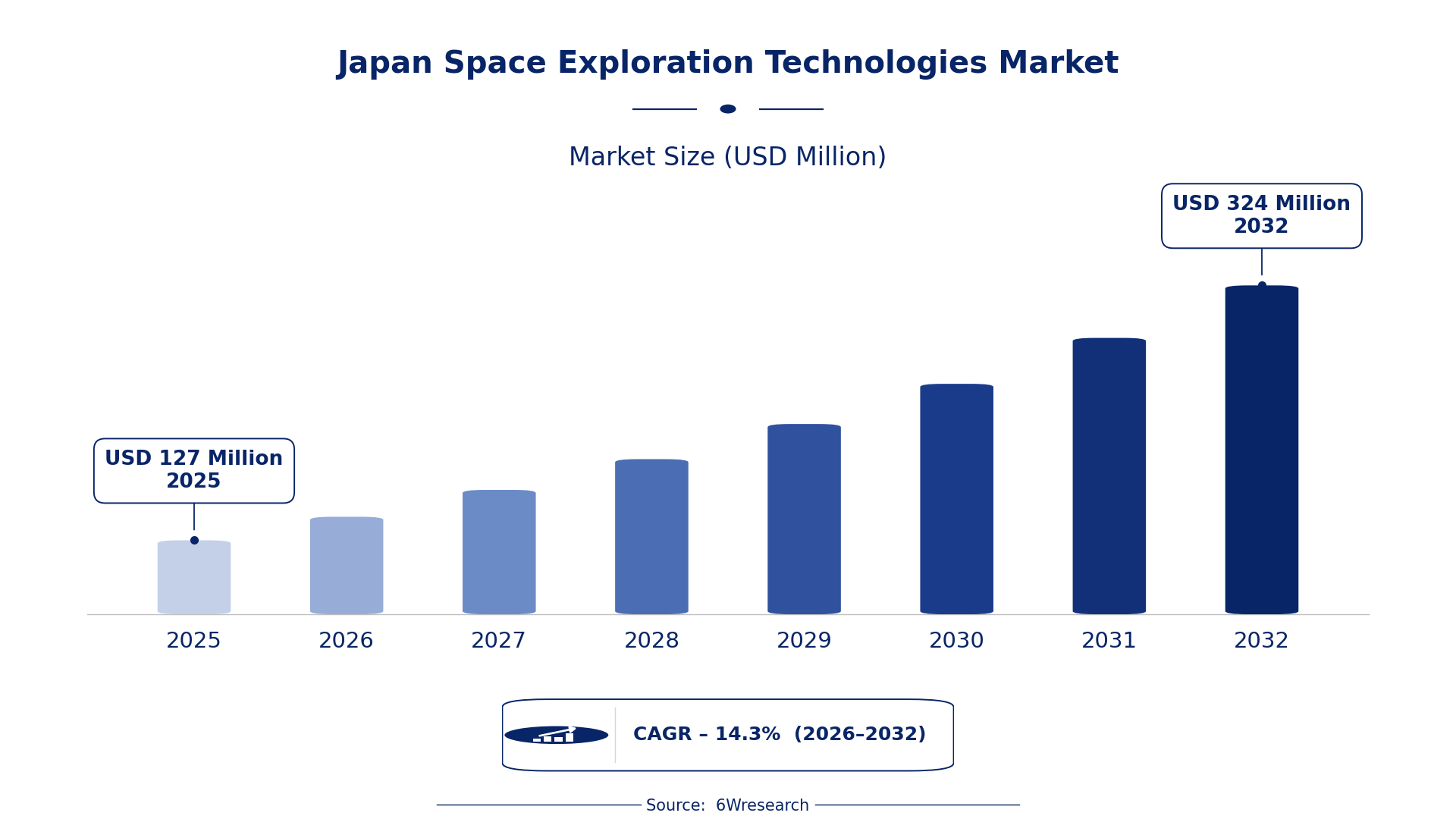
According to 6Wresearch internal database and industry insights, the Japan Space Exploration Technologies Market was valued at USD 127 Million in 2025 and is projected to reach USD 324 Million by 2032, growing at a CAGR of approximately 14.3% during 2026–2032.
Japan Space Exploration Technologies Market Highlights
| Report Metric | Details |
| Report Name | Japan Space Exploration Technologies Market (2026-2032) |
| Market Size 2025 | USD 127 Million |
| Market Size 2032 | USD 324 Million |
| Absolute Growth 2025–2032 | USD 197 Million |
| CAGR 2026–2032 | 14.3% |
| Peak Annual Growth | 15.9% in 2026 |
| Forecast Period | 2026–2032 |
| Historical Data | 2022–2025 |
| Base Year | 2025 |
| Leading Technology Type, 2025 | Propulsion Systems (50% share) |
| Leading Application Area, 2025 | Deep Space Travel (41% share) |
| Leading Development Phase, 2025 | R&D (51% share) |
| Leading End User, 2025 | Government Space Labs (51% share) |
| Fastest-Growing Technology Type | Re-entry Shields (21.5% CAGR) |
| Fastest-Growing Application Area | Thermal Protection (17.4% CAGR) |
| Fastest-Growing Development Phase | Prototype/Flight-Tested (18.1% CAGR) |
| Fastest-Growing End User | Launch Providers (18.0% CAGR) |
| Growing Sector | Space Exploration |
| Key End Users | Government Space Labs, Private Space Operators, Launch Providers, International Missions |
Japan Space Exploration Technologies Market Year-wise Growth Rate and Key Drivers (2022–2032)
This graph illustrates the annual growth rates of the market from 2022 to 2032, highlighting a steady upward trajectory and projected market expansion over the forecast period.
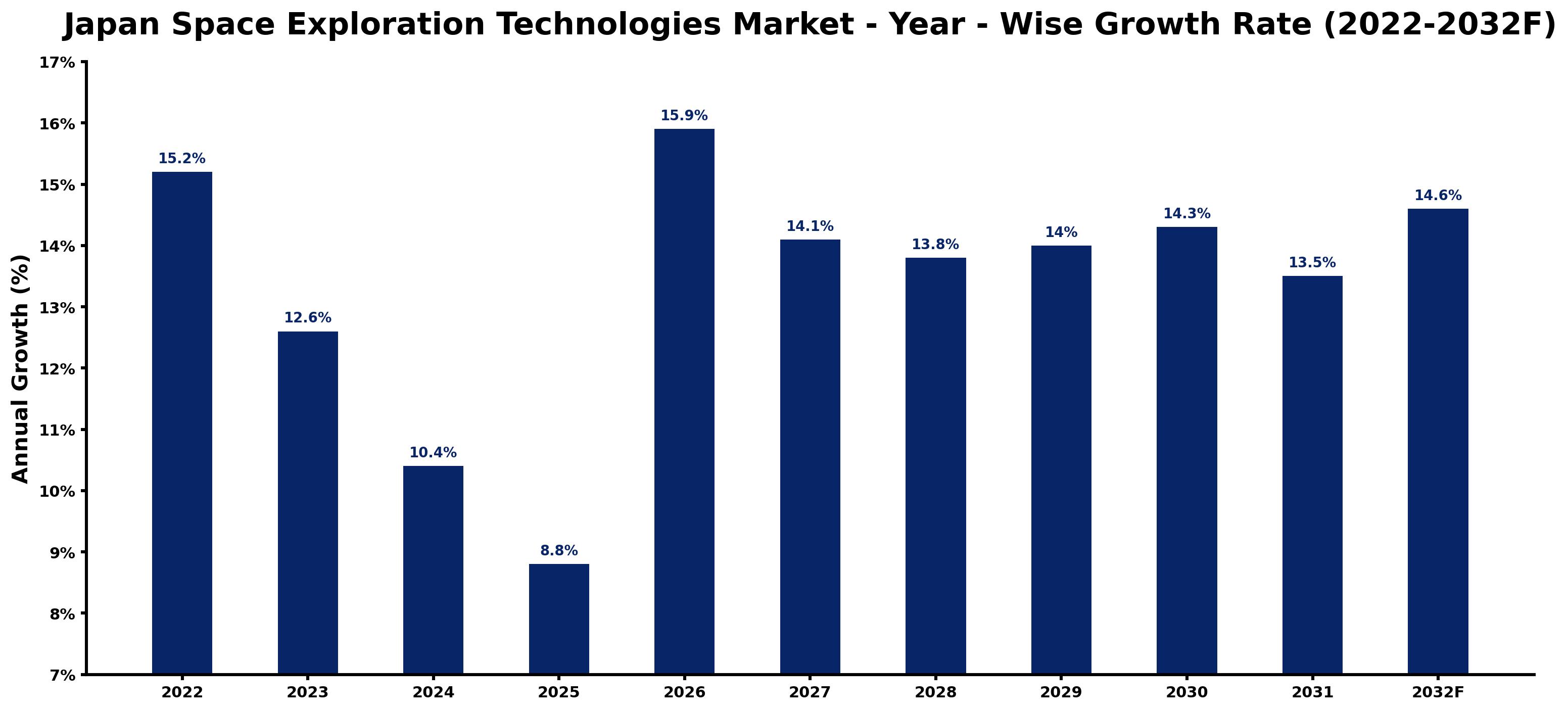
For each year, the table pairs the estimated growth rate with the leading influence on demand, showing how the drivers changed across the period.
| Year | Estimated Annual Growth (%) | Market Rationale |
| 2022 | 15.2 | Demand was strong due to successful missions like Hayabusa2 returning asteroid samples. |
| 2023 | 12.6 | Growth slowed as the market adjusted after the peak activity in the previous year. |
| 2024 | 10.4 | The market continued to grow, albeit at a slower pace, as investment stabilised. |
| 2025 | 8.8 | Growth slowed further as projects entered development phases, impacting overall demand. |
| 2026 | 15.9 | Demand is expected to surge with new initiatives and increased investment in space technologies. |
| 2027 | 14.1 | A moderation in growth is anticipated as the market stabilises after rapid expansion. |
| 2028 | 13.8 | A slight slowdown is expected as the market adapts to new technological developments. |
| 2029 | 14.0 | Demand is projected to accelerate again, driven by advancements in propulsion and robotics. |
| 2030 | 14.3 | Growth will continue as Japan's lunar base plans gain momentum, attracting investment. |
| 2031 | 13.5 | The market is projected to experience a slowdown as projects reach maturity and investment levels stabilise. |
| 2032 | 14.6 | Demand is expected to rise again with new international collaborations and missions. |
Note: Market size estimations and growth projections presented in this report are based on 6Wresearch's proprietary forecasting methodology, utilizing the latest available industry data, government publications, and primary research inputs.
Japan Space Exploration Technologies Market Synopsis
Space Exploration Technologies encompass advanced systems for exploring outer space, including propulsion systems and robotics. Japan's space budget for 2023 is approximately 500 billion yen, reflecting strong demand for these technologies. Growth is driven by domestic initiatives, international collaborations, and a skilled workforce, particularly in research and development, as Japan aims to establish a lunar base by 2030. This strategic focus positions Japan as a key player in the global space exploration market.
Market Dynamics Impact Analysis (2026–2032)
| Factor | Type | Impact | Primary Segment Affected |
| Increasing investment in R&D for space technologies | Driver | High | R&D |
| Growing international collaborations on space missions | Driver | High | International Missions |
| Expansion of private sector involvement in space | Opportunity | High | Private Space Operators |
| Emerging demand for advanced robotics in space applications | Opportunity | Medium | Advanced Robotics |
| High costs associated with space missions | Restraint | High | Deep Space Travel |
| Limited domestic manufacturing capabilities for advanced components | Restraint | Medium | Propulsion Systems |
| Dependence on international partnerships for technology transfer | Challenge | High | Launch Providers |
| Competition from other countries in space exploration | Challenge | Medium | Government Space Labs |
Evaluation of Drivers in Japan Space Exploration Technologies Market (2026–2032)
The table below links each growth driver to the segment it affects and the evidence for it.
| Drivers | Primary Segment Affected | Why It Matters (Evidence) |
| Increased funding for space exploration initiatives | R&D | Japan's space budget for 2023 is approximately 500 billion yen, encouraging more research projects. |
| Successful missions like Hayabusa2 | Deep Space Travel | The Hayabusa2 mission's success has inspired further investments in deep space exploration. |
| Growing demand for satellite launches | Launch Providers | The number of satellite launches from Japan has increased by 15% since 2021, boosting demand. |
| Technological advancements in robotics | Advanced Robotics | The JAXA Space Robotics Laboratory is developing technologies for lunar exploration, improving capabilities. |
| International collaborations with agencies like NASA | International Missions | Collaborations with NASA on various projects have expanded Japan's role in global space exploration. |
Japan's space budget for 2023 is approximately 500 billion yen, which fuels increased funding for R&D. The successful Hayabusa2 mission, which returned samples from asteroid Ryugu in 2020, has inspired further investments in deep space exploration. Since 2021, the number of satellite launches from Japan has increased by 15%, driving demand for launch providers. Technological advancements in robotics are being developed at the JAXA Space Robotics Laboratory, which is creating systems for lunar exploration. Collaborations with NASA have expanded Japan's role in global space missions, increasing overall demand.
Evaluation of Restraints in Japan Space Exploration Technologies Market
The key brakes on demand, and where they bite hardest, are shown below.
| Market Restraint | Primary Segment Affected | Why It Matters (Evidence) |
| High costs associated with developing space technologies | Deep Space Travel | Developing technologies for deep space missions requires substantial investment, limiting participation. |
| Limited domestic manufacturing capabilities for advanced components | Propulsion Systems | Japan's reliance on imports for certain components restricts growth in propulsion systems. |
| Dependence on international partnerships for technology transfer | Launch Providers | Relying on international partnerships can delay technology availability and impact launch schedules. |
| Competition from other countries in space exploration | Government Space Labs | Intense competition from nations with advanced space programs can hinder Japan's market share. |
| Regulatory hurdles for private sector involvement | Private Space Operators | Complex regulations can slow down the entry of private operators into the space market. |
Japan Space Exploration Technologies Market Challenges
High competition among domestic and international players drives down profit margins for producers, leading to financial challenges. Elevated development costs, with Japan's space budget set at approximately 500 billion yen for 2023, can delay project timelines for buyers. Supply chain issues in sourcing materials for rockets may postpone satellite launches, disrupting schedules for research institutions. Regulatory compliance with standards like ISO 14620 can prolong project approvals, creating delays for private sector investors aiming to enter the market.
Trends in the Japan Space Exploration Technologies Market
Several trends are reshaping the Japan Space Exploration Technologies Market; the most important are set out below.
- Shift towards Private Sector Involvement: Japan is experiencing a shift towards increased private sector involvement in space exploration, supported by the New Robot Strategy enacted in 2015. This act promotes private investment and has led to a 20% increase in private sector funding since 2020.
- Emergence of Advanced Robotics in Space Missions: The JAXA Space Robotics Laboratory has been at the forefront of developing advanced robotics for lunar exploration since 2020. This focus is expected to improve Japan's capabilities in autonomous space operations, with funding increasing by 30% in the past year.
- Increased Focus on Lunar Exploration: Japan aims to establish a lunar base by 2030 as part of its space strategy, with the Tokyo Institute of Technology leading research efforts. This initiative has received approximately 100 billion yen in funding, reflecting a strong commitment to lunar exploration.
- Expansion of International Collaborations: Japan's collaboration with NASA on various projects has intensified since 2020, leading to shared missions and technology exchange. This partnership is projected to increase joint missions by 25% over the next five years.
Investment Opportunities in the Japan Space Exploration Technologies Market
The openings below show where demand in the Japan Space Exploration Technologies Market is visible and how suppliers can enter.
- Investment in Advanced Robotics: The demand for advanced robotics in space applications is growing, with the JAXA Space Robotics Laboratory focusing on lunar exploration. Investing in robotics technology now can capture a market projected to grow by 21.5% by 2025.
- Supply of Propulsion Systems: The propulsion systems market is expanding as Japan increases satellite launches. With over 100 active satellites, suppliers can enter this market by partnering with local manufacturers to meet rising demand.
- Development of AI Navigation Systems: AI navigation systems are essential for autonomous spacecraft, with demand increasing as missions become more complex. The timing is ideal as Japan's space budget supports innovative technologies, creating opportunities for suppliers.
- Collaboration with Government Space Labs: Collaborating with government space labs can open doors for technology providers. With a 51% share in the end-user segment, these labs are actively seeking partnerships to enhance research capabilities.
Government Initiatives in the Japan Space Exploration Technologies Market
The New Robot Strategy, enacted in 2015, promotes private sector involvement in space exploration. This law encourages companies to engage in space activities by simplifying regulatory processes and providing a clearer framework for operations, which benefits buyers by facilitating access to necessary technologies and services.
The Japan Aerospace Exploration Agency (JAXA) oversees the implementation of the New Robot Strategy and supports private sector initiatives. JAXA funds projects that align with national space strategies, providing financial backing and technical expertise to private companies looking to innovate in space technologies.
Future Insight of the Japan Space Exploration Technologies Market
Investment in advanced space technologies will rise, driven by Japan's goal to establish a lunar base by 2030, creating demand for suppliers. The number of satellite launches from Japan has increased by 15% since 2021, indicating a growing market for satellite services. Collaboration with international agencies will expand, facilitating resource sharing and knowledge exchange. The Japanese government's target to boost private sector investment in space by 2025 will further stimulate innovation and development.
Market Segmentation Analysis
Japan Space Exploration Technologies Market report covers a detailed analysis of the following market segments:
By Technology Type – Propulsion Systems Lead, Re-entry Shields Expected to Grow Fastest
According to Prakhar Dixit, Senior Research Analyst at 6Wresearch, Propulsion Systems held 50% of the Japan Space Exploration Technologies Market by technology type in 2025. Propulsion Systems hold the largest share due to their essential role in spacecraft movement and manoeuvring in space. The demand for these systems is exemplified by Japan's ongoing missions, including the H-IIA rocket launches. The quickest growth will come from Re-entry Shields, forecast to expand at a CAGR of 21.5% between 2026 and 2032. Re-entry Shields are experiencing rapid growth as they are critical for protecting spacecraft during atmospheric re-entry. The increasing number of satellite launches, which has risen by 15% since 2021, significantly boosts this demand. Suppliers should focus on enhancing their offerings in re-entry technologies to capture the growing market.
By Application Area – Deep Space Travel Leads, Thermal Protection Expected to Grow Fastest
With 41% of application area revenue in 2025, Deep Space Travel was the largest category. Deep Space Travel leads the market as it is necessary for missions beyond Earth's orbit, reflecting Japan's ambitions for lunar exploration by 2030. The Hayabusa2 mission's success illustrates the importance of this application area. Thermal Protection is set to record the highest CAGR in this split, 17.4% over 2026–2032. Thermal Protection is the fastest-growing segment, vital for managing heat during re-entry and in space. The increasing complexity of missions necessitates advanced thermal management solutions, further propelling this segment's growth. Buyers will need to prioritise investments in thermal protection technologies to ensure mission success.
By Development Phase – R&D Leads, Prototype/Flight-Tested Expected to Grow Fastest
R&D took 51% of development phase revenue in 2025, more than any other category. R&D is the leading phase as it focuses on developing new technologies for future missions, supported by Japan's substantial space budget of approximately 500 billion yen for 2023. This investment underscores the commitment to advancing space exploration capabilities. Over 2026–2032, Prototype/Flight-Tested is expected to post the fastest growth, at a CAGR of 18.1%. Prototype/Flight-Tested is growing quickly as it represents technologies that have been tested in space conditions, a crucial step before commercialisation. The emphasis on reliable systems for upcoming missions propels this segment's rapid expansion. Suppliers must align their development strategies with the increasing emphasis on prototype testing to meet market demands.
By End User – Government Space Labs Lead, Launch Providers Expected to Grow Fastest
The largest end user category in 2025 was Government Space Labs, at 51% of revenue. Government Space Labs dominate the market as key users of space technologies for research, particularly through the Japan Aerospace Exploration Agency's initiatives. Their significant role in advancing space exploration underpins their leading position. Launch Providers are projected to grow fastest, at a CAGR of 18.0% during 2026–2032. Launch Providers are the fastest-growing end user segment, utilising technologies for launching payloads into space. The increase in satellite launches necessitates enhanced support and capabilities from this segment, driving their rapid growth. Suppliers should tailor their offerings to meet the specific needs of launch providers to capitalise on this growth.
Key Attractiveness of the Report
- 10 Years of Market Numbers
- Historical Data Starting from 2022 to 2025
- Base Year 2025
- Forecast Data until 2032
- Key Performance Indicators Impacting the Market
- Major Upcoming Developments and Projects
Key Highlights of the Report:
- Japan Space Exploration Technologies Market Outlook
- Market Size of Japan Space Exploration Technologies Market, 2025
- Forecast of Japan Space Exploration Technologies Market, 2032
- Historical Data and Forecast of Japan Space Exploration Technologies Revenues & Volume for the Period 2022-2032F
- Japan Space Exploration Technologies Market Trend Evolution
- Japan Space Exploration Technologies Market Drivers and Challenges
- Japan Space Exploration Technologies Price Trends
- Japan Space Exploration Technologies Porter's Five Forces
- Japan Space Exploration Technologies Industry Life Cycle
- Historical Data and Forecast of Japan Space Exploration Technologies Market Revenues & Volume By Technology Type for the Period 2022-2032F
- Historical Data and Forecast of Japan Space Exploration Technologies Market Revenues & Volume By Propulsion Systems for the Period 2022-2032F
- Historical Data and Forecast of Japan Space Exploration Technologies Market Revenues & Volume By Re-entry Shields for the Period 2022-2032F
- Historical Data and Forecast of Japan Space Exploration Technologies Market Revenues & Volume By AI Navigation Systems for the Period 2022-2032F
- Historical Data and Forecast of Japan Space Exploration Technologies Market Revenues & Volume By Advanced Robotics for the Period 2022-2032F
- Historical Data and Forecast of Japan Space Exploration Technologies Market Revenues & Volume By Application Area for the Period 2022-2032F
- Historical Data and Forecast of Japan Space Exploration Technologies Market Revenues & Volume By Deep Space Travel for the Period 2022-2032F
- Historical Data and Forecast of Japan Space Exploration Technologies Market Revenues & Volume By Thermal Protection for the Period 2022-2032F
- Historical Data and Forecast of Japan Space Exploration Technologies Market Revenues & Volume By Autonomous Guidance for the Period 2022-2032F
- Historical Data and Forecast of Japan Space Exploration Technologies Market Revenues & Volume By Payload Handling for the Period 2022-2032F
- Historical Data and Forecast of Japan Space Exploration Technologies Market Revenues & Volume By Development Phase for the Period 2022-2032F
- Historical Data and Forecast of Japan Space Exploration Technologies Market Revenues & Volume By R&D for the Period 2022-2032F
- Historical Data and Forecast of Japan Space Exploration Technologies Market Revenues & Volume By Prototype/Flight-Tested for the Period 2022-2032F
- Historical Data and Forecast of Japan Space Exploration Technologies Market Revenues & Volume By Commercialized for the Period 2022-2032F
- Historical Data and Forecast of Japan Space Exploration Technologies Market Revenues & Volume By Deployed for the Period 2022-2032F
- Historical Data and Forecast of Japan Space Exploration Technologies Market Revenues & Volume By End User for the Period 2022-2032F
- Historical Data and Forecast of Japan Space Exploration Technologies Market Revenues & Volume By Government Space Labs for the Period 2022-2032F
- Historical Data and Forecast of Japan Space Exploration Technologies Market Revenues & Volume By Launch Providers for the Period 2022-2032F
- Historical Data and Forecast of Japan Space Exploration Technologies Market Revenues & Volume By Private Space Operators for the Period 2022-2032F
- Historical Data and Forecast of Japan Space Exploration Technologies Market Revenues & Volume By International Missions for the Period 2022-2032F
- Japan Space Exploration Technologies Import Export Trade Statistics
- Market Opportunity Assessment By Technology Type
- Market Opportunity Assessment By Application Area
- Market Opportunity Assessment By Development Phase
- Market Opportunity Assessment By End User
- Japan Space Exploration Technologies Top Companies Market Share
- Japan Space Exploration Technologies Competitive Benchmarking By Technical and Operational Parameters
- Japan Space Exploration Technologies Company Profiles
- Japan Space Exploration Technologies Key Strategic Recommendations
Market Covered
This report examines the market across the segments below.
By Technology Type
- Propulsion Systems
- Re-entry Shields
- AI Navigation Systems
- Advanced Robotics
By Application Area
- Deep Space Travel
- Thermal Protection
- Autonomous Guidance
- Payload Handling
By Development Phase
- R&D
- Prototype/Flight-Tested
- Commercialized
- Deployed
By End User
- Government Space Labs
- Launch Providers
- Private Space Operators
- International Missions































