Japan Space Militarization Market Size & Growth Rate
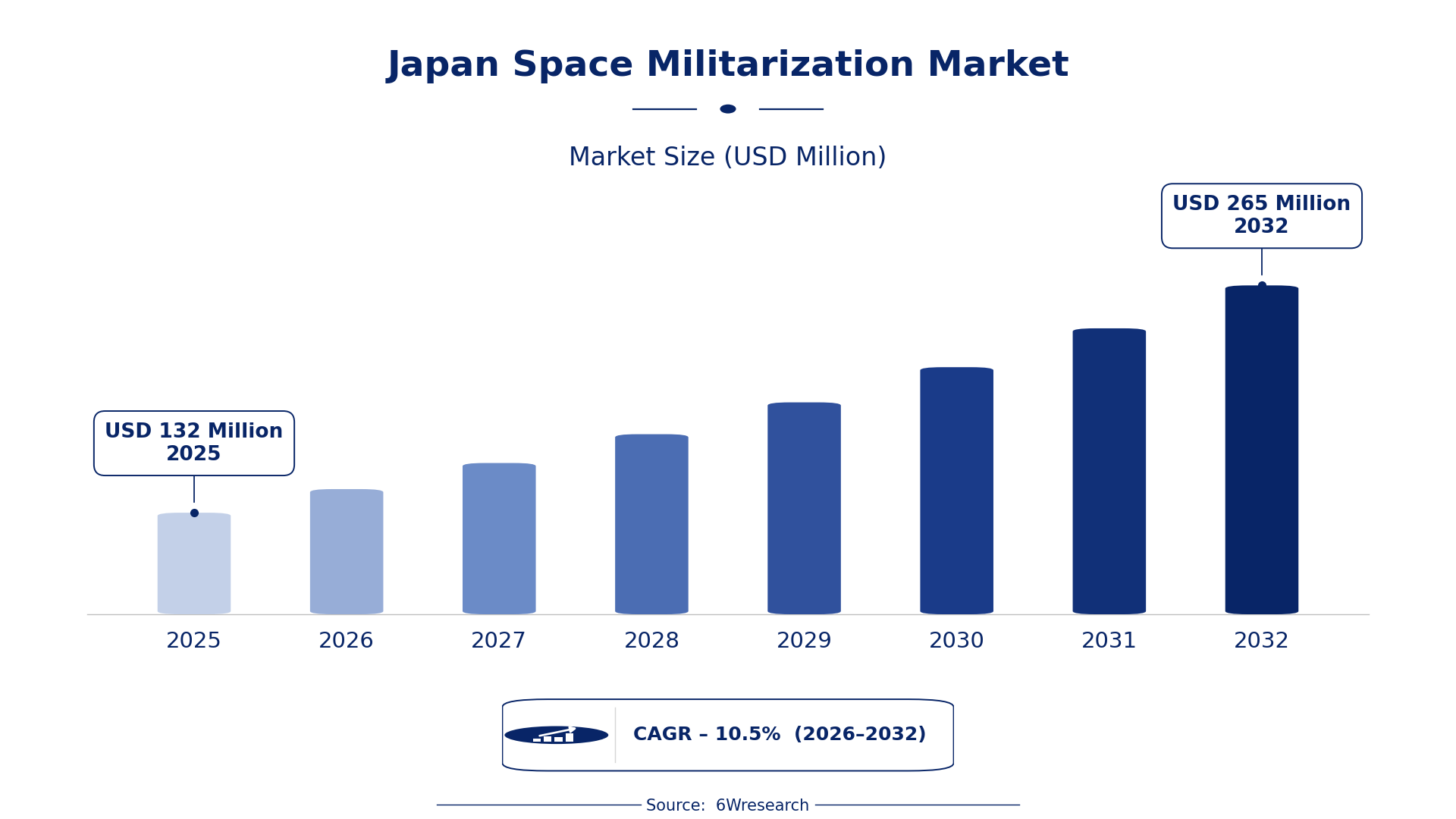
According to 6Wresearch internal database and industry insights, the Japan Space Militarization Market was valued at USD 132 Million in 2025 and is projected to reach USD 265 Million by 2032, growing at a CAGR of approximately 10.5% during 2026–2032.
Japan Space Militarization Market Highlights
| Report Metric | Details |
| Report Name | Japan Space Militarization Market (2026-2032) |
| Market Size 2025 | USD 132 Million |
| Market Size 2032 | USD 265 Million |
| Absolute Growth 2025–2032 | USD 133 Million |
| CAGR 2026–2032 | 10.5% |
| Peak Annual Growth | 12.1% in 2026 |
| Forecast Period | 2026–2032 |
| Historical Data | 2022–2025 |
| Base Year | 2025 |
| Leading Weapon Type, 2025 | Kinetic Energy Weapons (45% share) |
| Leading Surveillance System, 2025 | Space Based Radar (51% share) |
| Leading Defense Technology, 2025 | Directed Energy Weapons (46% share) |
| Leading End Use, 2025 | Government (41% share) |
| Fastest-Growing Weapon Type | Laser Weapons (14.3% CAGR) |
| Fastest-Growing Surveillance System | Missile Early Warning (14.6% CAGR) |
| Fastest-Growing Defense Technology | Hypersonic Missiles (14.5% CAGR) |
| Fastest-Growing End Use | Military (13.1% CAGR) |
| Growing Sector | Government |
| Key End Users | Government, Military, Defense |
Japan Space Militarization Market Year-wise Growth Rate and Key Drivers (2022–2032)
This graph illustrates the annual growth rates of the market from 2022 to 2032, highlighting a steady upward trajectory and projected market expansion over the forecast period.
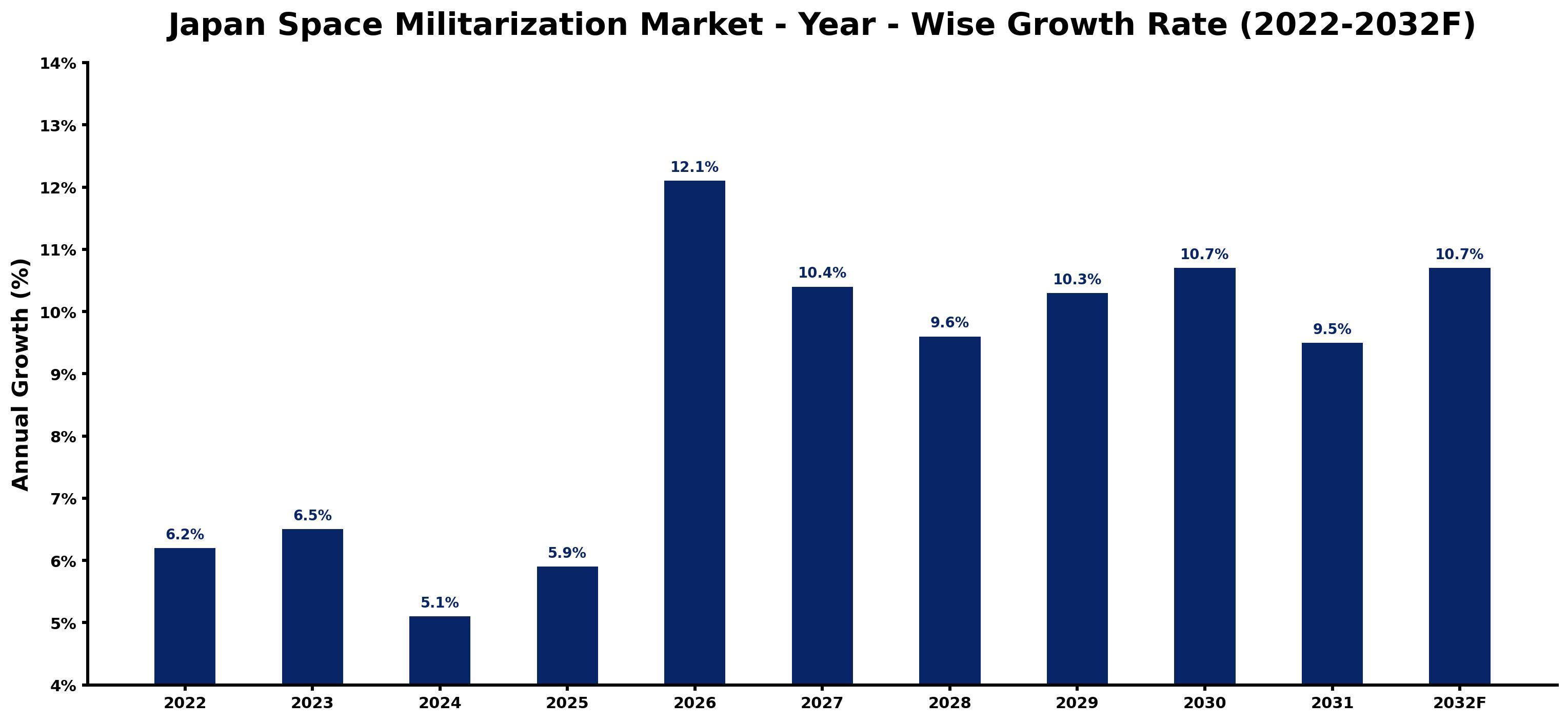
Below, each year's estimated growth is shown next to the factor that most influenced it.
| Year | Estimated Annual Growth (%) | Market Rationale |
| 2022 | 6.2 | The market showed steady growth, reflecting ongoing investments in defense technologies. |
| 2023 | 6.5 | Growth accelerated due to increased budget allocations for space defense initiatives. |
| 2024 | 5.1 | A slowdown occurred as projects faced delays in implementation and funding adjustments. |
| 2025 | 5.9 | Growth resumed as the government focused on missile defense capabilities. |
| 2026 | 12.1 | The market peaked as new technologies and collaborations boosted demand. |
| 2027 | 10.4 | Growth slowed slightly as the market adjusted to rapid expansion of capabilities. |
| 2028 | 9.6 | Continued investment in surveillance systems is expected to contribute to a further slowdown in growth. |
| 2029 | 10.3 | Demand is projected to surge again as military applications of space technologies gain traction. |
| 2030 | 10.7 | Growth will continue as advancements in hypersonic technologies drive new investments. |
| 2031 | 9.5 | A slowdown is anticipated as the market stabilises after rapid expansions in previous years. |
| 2032 | 10.7 | Demand is expected to rise again as the government prioritises space militarization efforts. |
Note: Market size estimations and growth projections presented in this report are based on 6Wresearch's proprietary forecasting methodology, utilizing the latest available industry data, government publications, and primary research inputs.
Japan Space Militarization Market Synopsis
Space militarization involves developing and deploying military capabilities in outer space, including surveillance and weapon systems. The Japan Space Militarization Market is expanding due to national security concerns and regional threats, with the government and military as primary buyers. Increased budget allocations, technological advancements, and collaborations with allied nations, especially in missile defense and reconnaissance, are driving market growth. In 2023, Japan's defense budget reached approximately 1 trillion yen, underscoring the commitment to strengthening military capabilities.
Market Dynamics Impact Analysis (2026–2032)
| Factor | Type | Impact | Primary Segment Affected |
| Increased defense budget allocations | Driver | High | Missile Early Warning |
| Technological advancements in space surveillance | Driver | High | Space Based Radar |
| Growing need for advanced missile defense systems | Opportunity | High | Hypersonic Missiles |
| Expansion of international collaborations in defense | Opportunity | Medium | Directed Energy Weapons |
| Budget constraints impacting project timelines | Restraint | High | Satellite Jamming |
| Limited domestic production capabilities for advanced technologies | Restraint | Medium | Laser Weapons |
| High costs associated with technological development | Challenge | High | Anti Satellite Missiles |
| Compliance with international regulations on space militarization | Challenge | Medium | Space Based Cyber Warfare |
Evaluation of Drivers in Japan Space Militarization Market (2026–2032)
The following drivers explain most of the expected growth.
| Drivers | Primary Segment Affected | Why It Matters (Evidence) |
| Increased government funding for defense projects | Missile Early Warning | Japan's defense budget for 2023 reached approximately 1 trillion yen, boosting missile detection capabilities. |
| Technological advancements in space surveillance systems | Space Based Radar | The establishment of new operational units has improved Japan's surveillance capabilities. |
| Growing focus on missile defense systems | Hypersonic Missiles | The government aims to improve missile defense systems by 2025, driving demand for advanced technologies. |
| International collaborations in defense technology | Directed Energy Weapons | Japan's alignment with allied nations has led to increased investment in directed energy technologies. |
| Expansion of military capabilities in space | Orbital Surveillance | The Tokyo region has become a hub for defense technology development, boosting surveillance projects. |
The establishment of new operational units has improved Japan's surveillance capabilities. The focus on missile defense systems drives demand for hypersonic missiles, with plans to improve these systems by 2025. Collaborations with allied nations have led to increased investment in directed energy weapons, while the Tokyo region has emerged as a hub for defense technology development, further driving demand for surveillance technologies.
Evaluation of Restraints in Japan Space Militarization Market
The table below lists the restraints and the evidence behind each.
| Market Restraint | Primary Segment Affected | Why It Matters (Evidence) |
| Budget constraints impacting project timelines | Satellite Jamming | Limited funding has delayed several satellite jamming projects, affecting operational readiness. |
| Limited domestic production capabilities for advanced technologies | Laser Weapons | Japan's reliance on foreign technology for laser systems hampers local production and innovation. |
| High costs associated with technological development | Anti Satellite Missiles | The investment required for anti-satellite technologies limits the number of feasible projects. |
| Compliance with international regulations on space militarization | Space Based Cyber Warfare | Strict regulations hinder rapid development and deployment of cyber warfare capabilities in space. |
| Challenges in recruiting skilled personnel for defense projects | Directed Energy Weapons | The shortage of qualified professionals affects the pace of directed energy weapon development. |
Japan Space Militarization Market Challenges
Japan's space militarization encounters budget limitations, as the 2023 defense budget of approximately 1 trillion yen restricts buyers' access to advanced systems. Growing competition from regional powers pressures producers to lower costs, potentially delaying the delivery of critical capabilities to buyers. Regulatory complexities surrounding international collaborations can extend project timelines by up to 18 months for producers, complicating procurement for buyers. A shortage of skilled professionals in the defence sector creates a talent gap, delaying project completions for buyers by several quarters.
Trends in the Japan Space Militarization Market
Buyers and suppliers in the Japan Space Militarization Market are adjusting to the following trends.
- Shift from Conventional to Advanced Surveillance Systems: Since 2023, the focus has shifted towards advanced surveillance systems, with Space Based Radar leading the market with a 51% share. This transition allows for improved monitoring of potential threats and reinforces national security.
- Emergence of Hypersonic Technologies in Defense: The growing emphasis on hypersonic technologies began in 2023, with government funding allocated for development. This shift is expected to improve Japan's offensive capabilities, with investments projected to reach new heights.
- Increased Collaboration with Allied Nations: Starting in 2023, Japan has intensified partnerships with allied nations in defence technology. This trend is reflected in joint initiatives that have resulted in a 20% increase in shared technology projects.
- Focus on Cyber Defense in Space: The updated Economic Security Promotion Act underscores the importance of cyber defense in space. This focus is driving investments in space-based cyber warfare capabilities, with funding anticipated to rise by 15%.
Investment Opportunities in the Japan Space Militarization Market
The following areas offer the clearest openings for investors and suppliers in the Japan Space Militarization Market.
- Tokyo Region as a Defense Technology Hub: The Tokyo region is currently a hub for defence technology development, employing over 10,000 individuals in defence-related roles. Investing in local partnerships can enhance capabilities and spur innovation.
- Government Demand for Enhanced Missile Defense: The government is prioritising missile defense systems, aiming for substantial improvements by 2025. Suppliers can enter this market by collaborating with local defence agencies.
- Growing Need for Advanced Surveillance Technologies: With the increasing focus on space surveillance, there is a rising demand for advanced technologies. Companies can explore opportunities by partnering with the Japan Aerospace Exploration Agency.
- Investment in Directed Energy Weapons: The market for directed energy weapons is expanding as Japan aligns with allied initiatives. Entering this sector through joint ventures can provide access to emerging technologies.
Government Initiatives in the Japan Space Militarization Market
The Space Development Strategy was updated in 2023 to incorporate new technologies, improving Japan's capabilities in space militarization. This measure builds on the National Defense Program Guidelines, which previously identified space as a critical domain for national security, ensuring a focused approach to defence in outer space. The updated strategy aims to allocate funds for developing hypersonic technologies by 2025, enhancing Japan's military readiness.
The Japan Defense Agency oversees military space operations and funds various projects aimed at advancing space capabilities. With a budget allocation of approximately 1 trillion yen for 2023, the agency focuses on developing missile defense systems and surveillance technologies, ensuring that Japan remains competitive in the evolving defence of space.
Future Insight of the Japan Space Militarization Market
Investment in hypersonic technologies and missile defense systems will drive demand for advanced surveillance and communication systems. By 2032, the establishment of new space operations squadrons will significantly strengthen Japan's military capabilities. The government aims to enhance missile defense systems by 2025, creating a more robust defence posture. Japan's alignment with international space security dialogues will facilitate stronger partnerships and technology sharing with allied nations.
Market Segmentation Analysis
Japan Space Militarization Market report covers a detailed analysis of the following market segments:
By Weapon Type – Kinetic Energy Weapons Lead, Laser Weapons Expected to Grow Fastest
According to Bhawna Singh, Assistant Manager at 6Wresearch, Kinetic Energy Weapons took 45% of weapon type revenue in 2025, more than any other category. Kinetic Energy Weapons lead the market due to their established role in missile defense systems, which are critical for Japan's national security. Their integration into the Japan Self-Defense Forces highlights their importance in safeguarding the nation against potential threats. Laser Weapons are set to record the highest CAGR in this split, 14.3% over 2026–2032. Laser Weapons are rapidly gaining traction as they are increasingly utilised for advanced targeting and defence systems, reflecting a shift towards modernised military capabilities. The government's recent focus on developing laser technologies is driving this segment's swift growth. Suppliers should prioritise advancements in laser technologies to align with the increasing demand from Japan's military sector.
By Surveillance System – Space Based Radar Leads, Missile Early Warning Expected to Grow Fastest
Space Based Radar accounted for 51% of the market by surveillance system in 2025. Space Based Radar holds the largest market share due to its crucial role in providing real-time surveillance and reconnaissance for Japan's national security. The Japan Defense Agency prioritises these systems, enhancing operational effectiveness in monitoring potential threats. Missile Early Warning is projected to grow fastest, at a CAGR of 14.6% during 2026–2032. Missile Early Warning systems are witnessing rapid growth as they are essential for national defence amidst rising regional tensions. The increasing sophistication of missile detection technologies is driving significant investments in this area. Suppliers should prioritise the development of missile early warning systems to meet the urgent demands of national defence.
By Defense Technology – Directed Energy Weapons Lead, Hypersonic Missiles Expected to Grow Fastest
With 46% of defense technology revenue in 2025, Directed Energy Weapons was the largest category. Directed Energy Weapons lead the market as they represent a significant leap in defensive capabilities, aligning with Japan's military modernisation objectives. Their versatility in various defence applications attracts considerable interest from governmental bodies. The quickest growth will come from Hypersonic Missiles, forecast to expand at a CAGR of 14.5% between 2026 and 2032. Hypersonic Missiles are experiencing the fastest growth due to their advanced offensive capabilities that are becoming increasingly vital in contemporary warfare. The government's commitment to advancing hypersonic technologies is fuelling this segment's rapid development. Suppliers must focus on hypersonic technologies to stay competitive in an evolving defence landscape.
By End Use – Government Leads, Military Expected to Grow Fastest
Government held 41% of the Japan Space Militarization Market by end use in 2025. The Government segment commands the largest share as it is the primary user of military space capabilities, which are vital for national security. Substantial budget allocations for defence initiatives highlight the government's pivotal role in this sector. Over 2026–2032, Military is expected to post the fastest growth, at a CAGR of 13.1%. The Military segment is growing rapidly as it aims to enhance its operational capabilities through advanced space technologies. Increased collaboration with international defence partners is further driving this segment's growth. Suppliers should tailor their products to meet the specific requirements of military clients to align with current defence strategies.
Key Attractiveness of the Report
- 10 Years of Market Numbers
- Historical Data Starting from 2022 to 2025
- Base Year 2025
- Forecast Data until 2032
- Key Performance Indicators Impacting the Market
- Major Upcoming Developments and Projects
Key Highlights of the Report:
- Japan Space Militarization Market Outlook
- Market Size of Japan Space Militarization Market,2025
- Forecast of Japan Space Militarization Market, 2032
- Historical Data and Forecast of Japan Space Militarization Revenues & Volume for the Period 2022-2032
- Japan Space Militarization Market Trend Evolution
- Japan Space Militarization Market Drivers and Challenges
- Japan Space Militarization Price Trends
- Japan Space Militarization Porter's Five Forces
- Japan Space Militarization Industry Life Cycle
- Historical Data and Forecast of Japan Space Militarization Market Revenues & Volume By Weapon Type for the Period 2022-2032
- Historical Data and Forecast of Japan Space Militarization Market Revenues & Volume By Kinetic Energy Weapons for the Period 2022-2032
- Historical Data and Forecast of Japan Space Militarization Market Revenues & Volume By Laser Weapons for the Period 2022-2032
- Historical Data and Forecast of Japan Space Militarization Market Revenues & Volume By Electromagnetic Pulse for the Period 2022-2032
- Historical Data and Forecast of Japan Space Militarization Market Revenues & Volume By Anti Satellite Missiles for the Period 2022-2032
- Historical Data and Forecast of Japan Space Militarization Market Revenues & Volume By Surveillance System for the Period 2022-2032
- Historical Data and Forecast of Japan Space Militarization Market Revenues & Volume By Space Based Radar for the Period 2022-2032
- Historical Data and Forecast of Japan Space Militarization Market Revenues & Volume By Missile Early Warning for the Period 2022-2032
- Historical Data and Forecast of Japan Space Militarization Market Revenues & Volume By Satellite Jamming for the Period 2022-2032
- Historical Data and Forecast of Japan Space Militarization Market Revenues & Volume By Orbital Surveillance for the Period 2022-2032
- Historical Data and Forecast of Japan Space Militarization Market Revenues & Volume By Defense Technology for the Period 2022-2032
- Historical Data and Forecast of Japan Space Militarization Market Revenues & Volume By Directed Energy Weapons for the Period 2022-2032
- Historical Data and Forecast of Japan Space Militarization Market Revenues & Volume By Hypersonic Missiles for the Period 2022-2032
- Historical Data and Forecast of Japan Space Militarization Market Revenues & Volume By Space Based Cyber Warfare for the Period 2022-2032
- Historical Data and Forecast of Japan Space Militarization Market Revenues & Volume By High Energy Laser Systems for the Period 2022-2032
- Historical Data and Forecast of Japan Space Militarization Market Revenues & Volume By End Use for the Period 2022-2032
- Historical Data and Forecast of Japan Space Militarization Market Revenues & Volume By Government for the Period 2022-2032
- Historical Data and Forecast of Japan Space Militarization Market Revenues & Volume By Military for the Period 2022-2032
- Historical Data and Forecast of Japan Space Militarization Market Revenues & Volume By Defense for the Period 2022-2032
- Historical Data and Forecast of Japan Space Militarization Market Revenues & Volume By Commercial for the Period 2022-2032
- Japan Space Militarization Import Export Trade Statistics
- Market Opportunity Assessment By Weapon Type
- Market Opportunity Assessment By Surveillance System
- Market Opportunity Assessment By Defense Technology
- Market Opportunity Assessment By End Use
- Japan Space Militarization Top Companies Market Share
- Japan Space Militarization Competitive Benchmarking By Technical and Operational Parameters
- Japan Space Militarization Company Profiles
- Japan Space Militarization Key Strategic Recommendations
Market Covered
Coverage by segment is as follows.
By Weapon Type
- Kinetic Energy Weapons
- Laser Weapons
- Electromagnetic Pulse
- Anti Satellite Missiles
By Surveillance System
- Space Based Radar
- Missile Early Warning
- Satellite Jamming
- Orbital Surveillance
By Defense Technology
- Directed Energy Weapons
- Hypersonic Missiles
- Space Based Cyber Warfare
- High Energy Laser Systems
By End Use
- Government
- Military
- Defense
- Commercial































