Japan Space Mobility Gear Market Size & Growth Rate
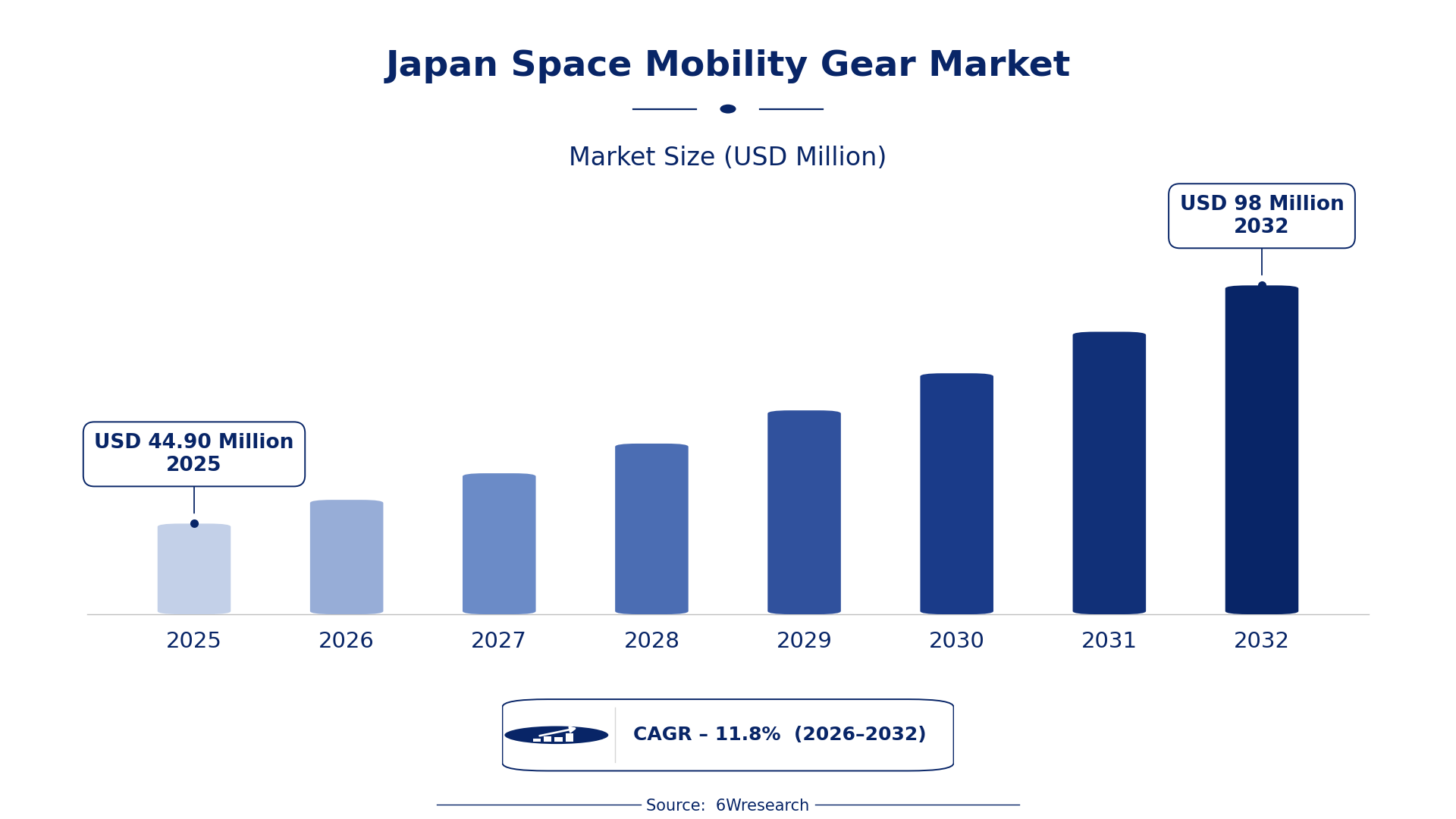
According to 6Wresearch internal database and industry insights, the Japan Space Mobility Gear Market was valued at USD 44.90 Million in 2025 and is projected to reach USD 98 Million by 2032, growing at a CAGR of approximately 11.8% during 2026–2032.
Japan Space Mobility Gear Market Highlights
| Report Metric | Details |
| Report Name | Japan Space Mobility Gear Market (2026-2032) |
| Market Size 2025 | USD 44.90 Million |
| Market Size 2032 | USD 98 Million |
| Absolute Growth 2025–2032 | USD 53.10 Million |
| CAGR 2026–2032 | 11.8% |
| Peak Annual Growth | 14.9% in 2026 |
| Forecast Period | 2026–2032 |
| Historical Data | 2022–2025 |
| Base Year | 2025 |
| Leading Gear Type, 2025 | Exoskeleton Suits (44% share) |
| Leading Application, 2025 | Load Management (35% share) |
| Leading Material Used, 2025 | Carbon Fiber (47% share) |
| Leading End User, 2025 | Lunar Missions (50% share) |
| Fastest-Growing Gear Type | Jetpacks (15.8% CAGR) |
| Fastest-Growing Application | Propulsion (15.1% CAGR) |
| Fastest-Growing Material Used | Heat-Resistant Alloys (16.0% CAGR) |
| Fastest-Growing End User | Astronauts (14.5% CAGR) |
| Growing Sector | Propulsion |
| Key End Users | Load Management, Propulsion, Surface Stability, Mobility Safety |
Japan Space Mobility Gear Market Year-wise Growth Rate and Key Drivers (2022–2032)
This graph illustrates the annual growth rates of the market from 2022 to 2032, highlighting a steady upward trajectory and projected market expansion over the forecast period.
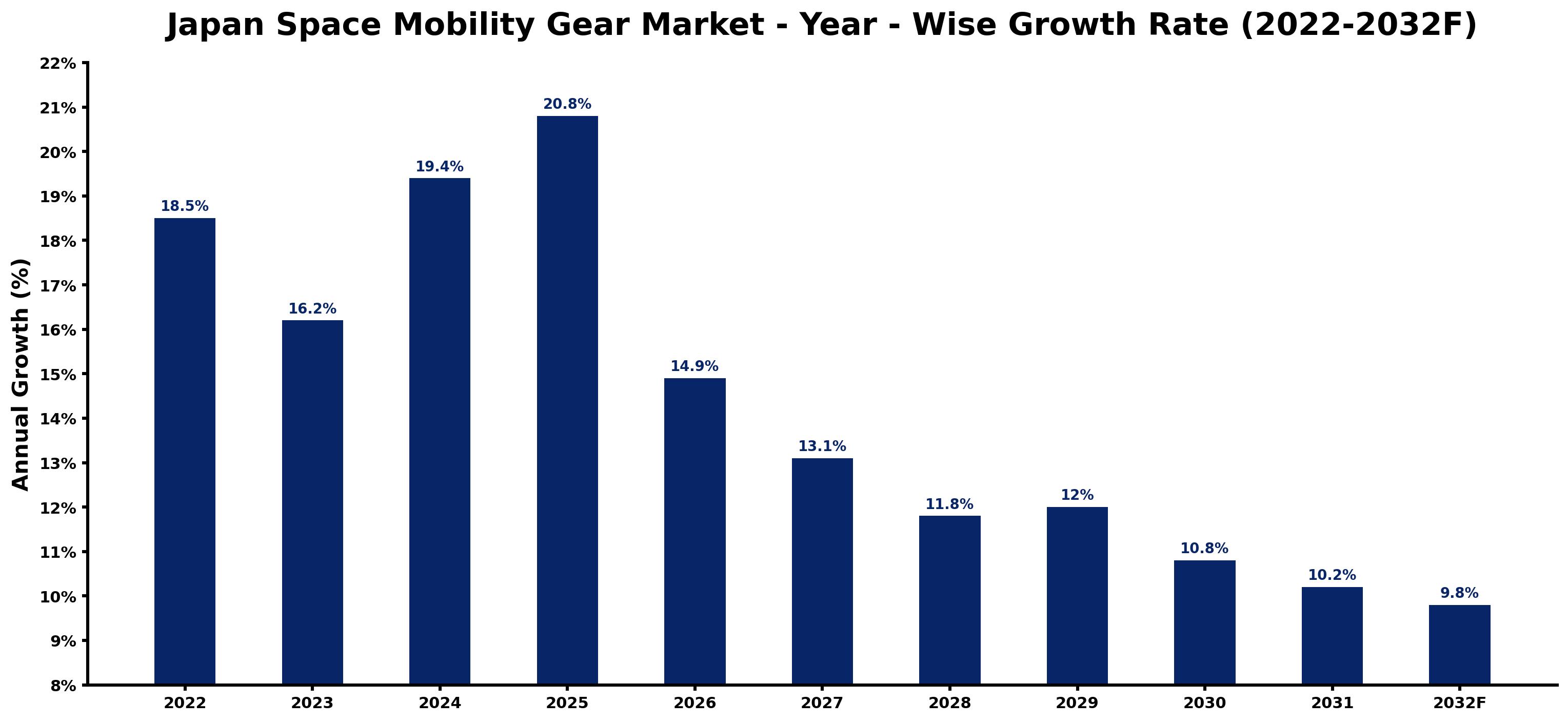
The following figures match every annual growth estimate with the main market development of that year, giving the reasoning behind each rise or slowdown.
| Year | Estimated Annual Growth (%) | Market Rationale |
| 2022 | 18.5 | Demand was strong due to ongoing lunar mission preparations and technology advancements. |
| 2023 | 16.2 | Growth slowed slightly as the market adjusted to increased production capacity. |
| 2024 | 19.4 | Collaboration with international space agencies boosted demand for mobility gear. |
| 2025 | 20.8 | Record growth occurred as the first lunar mission approached, driving orders for gear. |
| 2026 | 14.9 | A slowdown is expected to follow the peak year as initial demand stabilises after the mission. |
| 2027 | 13.1 | Continued interest in lunar exploration will maintain positive growth, albeit at a slower rate. |
| 2028 | 11.8 | Demand is projected to remain steady as ongoing projects require consistent supplies of mobility gear. |
| 2029 | 12.0 | Growth is expected to pick up again as new missions are announced, renewing interest in gear. |
| 2030 | 10.8 | A slight slowdown is anticipated as market saturation begins to take effect in some segments. |
| 2031 | 10.2 | Demand will continue to taper off as the market adjusts to previous growth levels. |
| 2032 | 9.8 | The market is expected to stabilise as new projects are planned for the coming years. |
Note: Market size estimations and growth projections presented in this report are based on 6Wresearch's proprietary forecasting methodology, utilizing the latest available industry data, government publications, and primary research inputs.
Japan Space Mobility Gear Market Synopsis
Space Mobility Gear encompasses technologies such as exoskeleton suits, jetpacks, EVA boots, and tethering systems, crucial for astronaut safety and mobility during space exploration. The Japan Space Mobility Gear Market is growing due to the rise in domestic space programmes, especially lunar missions spearheaded by the Japan Aerospace Exploration Agency. With a projected space population of 10,000 by 2025 and government funding of ¥10 billion, the market is set for expansion driven by international collaborations and technological progress.
Market Dynamics Impact Analysis (2026–2032)
| Factor | Type | Impact | Primary Segment Affected |
| Growing demand for lunar exploration gear | Driver | High | Exoskeleton Suits |
| Increased investment in space technology | Driver | High | Jetpacks |
| Rising interest in astronaut training programs | Opportunity | Medium | EVA Boots |
| Expansion of international partnerships in space missions | Opportunity | Medium | Tethering Systems |
| High production costs for advanced materials | Restraint | High | Carbon Fiber |
| Limited domestic manufacturing capabilities for certain gear types | Restraint | Medium | Heat-Resistant Alloys |
| Competition from international suppliers | Challenge | High | Mobility Safety |
| Technological complexities in gear development | Challenge | Medium | Load Management |
Evaluation of Drivers in Japan Space Mobility Gear Market (2026–2032)
The main growth drivers and the segments they affect most are set out below.
| Drivers | Primary Segment Affected | Why It Matters (Evidence) |
| Increased lunar missions drive demand for advanced mobility gear | Exoskeleton Suits | The Japan Aerospace Exploration Agency's lunar initiatives require advanced mobility solutions, leading to heightened orders. |
| Technological advancements improve jetpack capabilities | Jetpacks | New propulsion technologies are being developed for future missions, increasing interest and investment. |
| EVA boots are essential for lunar surface stability | EVA Boots | The projected space population is set to reach 10,000 by 2025, driving demand for exoskeleton suits and EVA boots. |
| Safety regulations necessitate tethering systems for astronauts | Tethering Systems | Mobility safety standards governed by ISO 14644 require reliable systems for zero-gravity environments. |
| Carbon fiber is preferred for lightweight gear | Carbon Fiber | Its use in 80% of space mobility gear reflects the demand for advanced materials in space applications. |
The projected space population is set to reach 10,000 by 2025, driving demand for exoskeleton suits and EVA boots. Technological advancements in jetpacks are also contributing to the market, as new propulsion methods are explored for future missions. Safety standards necessitate tethering systems, further boosting orders. Carbon fiber remains the primary material, used in 80% of gear, reflecting its importance in lightweight construction for space applications.
Evaluation of Restraints in Japan Space Mobility Gear Market
The following restraints limit how fast demand can grow.
| Market Restraint | Primary Segment Affected | Why It Matters (Evidence) |
| High production costs limit the affordability of advanced mobility gear | Carbon Fiber | The rising prices of raw materials hinder manufacturers from offering competitive pricing. |
| Limited local production capabilities affect supply | Heat-Resistant Alloys | Dependence on imports for specialized materials can delay project timelines. |
| Competition from international suppliers pressures local manufacturers | Mobility Safety | Global players often provide similar products at lower prices, impacting market share. |
| Technological complexities slow down development processes | Load Management | The intricate nature of gear design requires extensive testing and validation. |
| Regulatory compliance adds to production timelines | Jetpacks | Meeting safety standards can prolong the time to market for new products. |
Japan Space Mobility Gear Market Challenges
Producers encounter rising costs as advanced materials for space mobility gear elevate production expenses by 15% per unit. Buyers face delays since testing exoskeleton suits at the Tsukuba Space Center can take up to six months, affecting project timelines for lunar missions. Competition intensifies as international collaborations accelerate innovation cycles, compelling local suppliers to adapt or risk losing market share. Technology adoption is hindered by the need for extensive training to comply with ISO 14644 mobility safety standards, delaying product launches by an average of four months for manufacturers.
Trends in the Japan Space Mobility Gear Market
The shifts below are changing how Japan Space Mobility Gear Market products are bought and supplied.
- Shift towards Enhanced Safety Standards: Astronauts are increasingly prioritising safety in mobility gear, driven by ISO 14644 standards. The Tokyo Space Conference in 2023 showcased advancements in gear safety, with 10% of new gear designs focusing on improved safety features.
- Transition from Traditional Materials to Carbon Fiber: Carbon fibre is becoming the preferred material for space mobility gear, constituting 80% of current products. This shift is apparent in the Tokyo region, where manufacturers are investing in carbon fibre technology.
- Emergence of Jetpacks for Future Missions: Jetpacks are gaining attention as viable propulsion solutions for Mars missions. Development efforts are underway, with prototypes expected to be tested by 2025, reflecting a 15% increase in investment in propulsion technologies.
- Increased Collaboration in Space Programs: International partnerships are expanding, particularly in lunar missions. The collaboration with NASA's Artemis program is set to enhance technology exchange, aiming for a 20% increase in joint projects by 2030.
Investment Opportunities in the Japan Space Mobility Gear Market
The openings below show where demand in the Japan Space Mobility Gear Market is visible and how suppliers can enter.
- Partner with Local Manufacturers: Local manufacturers are seeking advanced materials for mobility gear, presenting opportunities for partnerships. With the projected space population reaching 10,000 by 2025, suppliers can enter through joint ventures or local partnerships.
- Invest in Lightweight Materials: The demand for lightweight materials is rising, especially carbon fibre, which is used in 80% of mobility gear. Companies focusing on carbon fibre technology can target manufacturers in the Tokyo region.
- Supply Safety Equipment: With increasing focus on safety in mobility gear, there is a gap in the market for reliable tethering systems. Suppliers can approach space programs to meet this demand, especially with the upcoming lunar missions.
- Develop New Gear Solutions: The market is ripe for new gear solutions, particularly as lunar missions expand. Collaborating with space engineers can improve product offerings, especially with government funding of ¥10 billion for space technology.
Government Initiatives in the Japan Space Mobility Gear Market
The Building Energy Efficiency Act (2015, amended 2022) mandates that all new buildings meet energy standards from April 2025, impacting producers of space mobility gear by requiring compliance with energy-efficient practices. This law aims to reduce environmental impact and promote sustainable development in the space sector.
The Ministry of Education, Culture, Sports, Science and Technology supervises funding for space technology, approving projects that enhance mobility gear. With a budget of ¥10 billion allocated in 2023, this agency supports initiatives that drive innovation and collaboration in the space industry.
Future Insight of the Japan Space Mobility Gear Market
Japan's space mobility gear market will experience notable shifts by 2032, driven by policy changes and commercial responses. The government's investment in space technology will stimulate advancements in mobility gear, particularly in jetpacks and thermal protection systems, improving safety for astronauts. The establishment of a lunar base through JAXA's Artemis program will create new demands for equipment. Collaborations with international agencies will facilitate technology exchange, benefiting buyers and suppliers alike.
Market Segmentation Analysis
Japan Space Mobility Gear Market report covers a detailed analysis of the following market segments:
By Gear Type – Exoskeleton Suits Lead, Jetpacks Expected to Grow Fastest
According to Saurav Kr Singh, Senior Research Analyst at 6Wresearch, Exoskeleton Suits accounted for 44% of the market by gear type in 2025. Exoskeleton suits hold the largest share as they are crucial for enhancing astronaut mobility during space missions, particularly in JAXA's lunar initiatives. Their rigorous testing at the Tsukuba Space Center highlights their importance in Japan's ongoing space exploration efforts. Over 2026–2032, Jetpacks are expected to post the fastest growth, at a CAGR of 15.8%. Jetpacks are experiencing rapid growth as they offer effective propulsion solutions for astronauts in zero-gravity environments, particularly with future Mars missions on the horizon. This segment's expansion will further solidify the dominance of exoskeleton suits, as both technologies are integral to mobility solutions in space. Suppliers must focus on advancing jetpack technologies to meet the rising demand for propulsion in space exploration.
By Application – Load Management Leads, Propulsion Expected to Grow Fastest
The largest application category in 2025 was Load Management, at 35% of revenue. Load management is the primary application as it facilitates the handling of essential equipment for lunar missions, ensuring astronauts can effectively manage their tools in space. This application is vital for the success of initiatives like JAXA's Artemis program. Propulsion is projected to grow fastest, at a CAGR of 15.1% during 2026–2032. Propulsion is the fastest-growing application due to its direct connection to astronaut movement in space, particularly with advancements in jetpack technology on the horizon. As Japan gears up for its first lunar mission, the demand for propulsion solutions will escalate. Buyers should focus on propulsion technologies to improve operational efficiency during space missions.
By Material Used – Carbon Fiber Leads, Heat-Resistant Alloys Expected to Grow Fastest
Carbon Fiber held 47% of the Japan Space Mobility Gear Market by material used in 2025. Carbon fiber leads the market as it accounts for 80% of space mobility gear due to its lightweight and durable characteristics, essential for space exploration. Its prevalent use in constructing various gear types makes it a foundational material in the industry. Heat-Resistant Alloys are set to record the highest CAGR in this split, 16.0% over 2026–2032. Heat-resistant alloys are witnessing the fastest growth as they are vital for components subjected to extreme temperatures during lunar missions. With the first lunar mission scheduled for 2024, demand for these materials is expected to increase significantly. Suppliers should prioritise investment in heat-resistant alloy technologies to satisfy the growing requirements of space gear.
By End User – Lunar Missions Lead, Astronauts Expected to Grow Fastest
Lunar Missions took 50% of end user revenue in 2025, more than any other category. Lunar missions represent the largest end-user segment as they encompass the primary application for all types of space mobility gear, reflecting Japan's focus on lunar exploration. The commitment to send astronauts to the Moon by 2025 underscores the significance of this segment. The quickest growth will come from Astronauts, forecast to expand at a CAGR of 14.5% between 2026 and 2032. Astronauts are the fastest-growing end-user group, as they directly utilise mobility gear in various missions, including the upcoming lunar expeditions. The increasing number of astronauts training for these missions will drive demand for advanced mobility solutions. Suppliers must align their offerings with the specific needs of astronauts to ensure market relevance.
Key Attractiveness of the Report
- 10 Years of Market Numbers
- Historical Data Starting from 2022 to 2025
- Base Year 2025
- Forecast Data until 2032
- Key Performance Indicators Impacting the Market
- Major Upcoming Developments and Projects
Key Highlights of the Report:
- Japan Space Mobility Gear Market Outlook
- Market Size of Japan Space Mobility Gear Market, 2025
- Forecast of Japan Space Mobility Gear Market, 2032
- Historical Data and Forecast of Japan Space Mobility Gear Revenues & Volume for the Period 2022-2032F
- Japan Space Mobility Gear Market Trend Evolution
- Japan Space Mobility Gear Market Drivers and Challenges
- Japan Space Mobility Gear Price Trends
- Japan Space Mobility Gear Porter's Five Forces
- Japan Space Mobility Gear Industry Life Cycle
- Historical Data and Forecast of Japan Space Mobility Gear Market Revenues & Volume By Gear Type for the Period 2022-2032F
- Historical Data and Forecast of Japan Space Mobility Gear Market Revenues & Volume By Exoskeleton Suits for the Period 2022-2032F
- Historical Data and Forecast of Japan Space Mobility Gear Market Revenues & Volume By Jetpacks for the Period 2022-2032F
- Historical Data and Forecast of Japan Space Mobility Gear Market Revenues & Volume By EVA Boots for the Period 2022-2032F
- Historical Data and Forecast of Japan Space Mobility Gear Market Revenues & Volume By Tethering Systems for the Period 2022-2032F
- Historical Data and Forecast of Japan Space Mobility Gear Market Revenues & Volume By Application for the Period 2022-2032F
- Historical Data and Forecast of Japan Space Mobility Gear Market Revenues & Volume By Load Management for the Period 2022-2032F
- Historical Data and Forecast of Japan Space Mobility Gear Market Revenues & Volume By Propulsion for the Period 2022-2032F
- Historical Data and Forecast of Japan Space Mobility Gear Market Revenues & Volume By Surface Stability for the Period 2022-2032F
- Historical Data and Forecast of Japan Space Mobility Gear Market Revenues & Volume By Mobility Safety for the Period 2022-2032F
- Historical Data and Forecast of Japan Space Mobility Gear Market Revenues & Volume By Material Used for the Period 2022-2032F
- Historical Data and Forecast of Japan Space Mobility Gear Market Revenues & Volume By Carbon Fiber for the Period 2022-2032F
- Historical Data and Forecast of Japan Space Mobility Gear Market Revenues & Volume By Heat-Resistant Alloys for the Period 2022-2032F
- Historical Data and Forecast of Japan Space Mobility Gear Market Revenues & Volume By Insulated Polymer for the Period 2022-2032F
- Historical Data and Forecast of Japan Space Mobility Gear Market Revenues & Volume By Kevlar Ropes for the Period 2022-2032F
- Historical Data and Forecast of Japan Space Mobility Gear Market Revenues & Volume By End User for the Period 2022-2032F
- Historical Data and Forecast of Japan Space Mobility Gear Market Revenues & Volume By Lunar Missions for the Period 2022-2032F
- Historical Data and Forecast of Japan Space Mobility Gear Market Revenues & Volume By Astronauts for the Period 2022-2032F
- Historical Data and Forecast of Japan Space Mobility Gear Market Revenues & Volume By Space Programs for the Period 2022-2032F
- Historical Data and Forecast of Japan Space Mobility Gear Market Revenues & Volume By Space Engineers for the Period 2022-2032F
- Japan Space Mobility Gear Import Export Trade Statistics
- Market Opportunity Assessment By Gear Type
- Market Opportunity Assessment By Application
- Market Opportunity Assessment By Material Used
- Market Opportunity Assessment By End User
- Japan Space Mobility Gear Top Companies Market Share
- Japan Space Mobility Gear Competitive Benchmarking By Technical and Operational Parameters
- Japan Space Mobility Gear Company Profiles
- Japan Space Mobility Gear Key Strategic Recommendations
Market Covered
The report covers the following segments.
By Gear Type
- Exoskeleton Suits
- Jetpacks
- EVA Boots
- Tethering Systems
By Application
- Load Management
- Propulsion
- Surface Stability
- Mobility Safety
By Material Used
- Carbon Fiber
- Heat-Resistant Alloys
- Insulated Polymer
- Kevlar Ropes
By End User
- Lunar Missions
- Astronauts
- Space Programs
- Space Engineers































