Japan Space Observation Equipment Market Size & Growth Rate
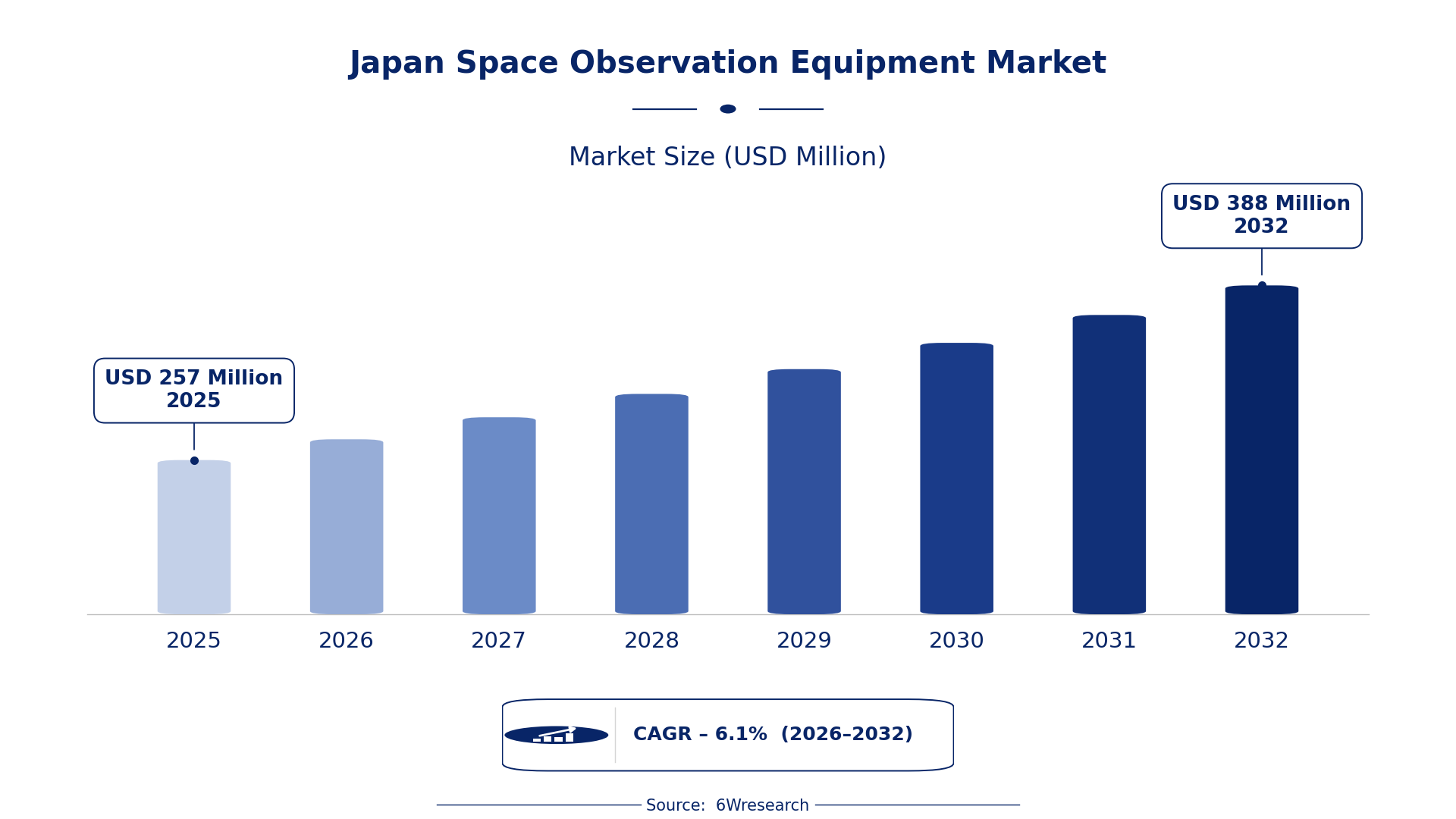
According to 6Wresearch internal database and industry insights, the Japan Space Observation Equipment Market was valued at USD 257 Million in 2025 and is projected to reach USD 388 Million by 2032, growing at a CAGR of approximately 6.1% during 2026–2032.
Japan Space Observation Equipment Market Highlights
| Report Metric | Details |
| Report Name | Japan Space Observation Equipment Market (2026-2032) |
| Market Size 2025 | USD 257 Million |
| Market Size 2032 | USD 388 Million |
| Absolute Growth 2025–2032 | USD 131 Million |
| CAGR 2026–2032 | 6.1% |
| Peak Annual Growth | 6.7% in 2032 |
| Forecast Period | 2026–2032 |
| Historical Data | 2022–2025 |
| Base Year | 2025 |
| Leading Equipment Type, 2025 | Telescopes (47% share) |
| Leading Observation Target, 2025 | Celestial Objects (46% share) |
| Leading Wavelength Spectrum, 2025 | Optical/Infrared (43% share) |
| Leading End User, 2025 | Astronomical Institutes (35% share) |
| Fastest-Growing Equipment Type | Imaging Sensors (8.8% CAGR) |
| Fastest-Growing Observation Target | Deep Space (8.0% CAGR) |
| Fastest-Growing Wavelength Spectrum | X-Ray/UV (8.2% CAGR) |
| Fastest-Growing End User | Space Research Centers (7.9% CAGR) |
| Growing Sector | astronomical research |
| Key End Users | astronomical institutes, space research centers, planetary scientists, satellite builders |
Japan Space Observation Equipment Market Year-wise Growth Rate and Key Drivers (2022–2032)
This graph illustrates the annual growth rates of the market from 2022 to 2032, highlighting a steady upward trajectory and projected market expansion over the forecast period.
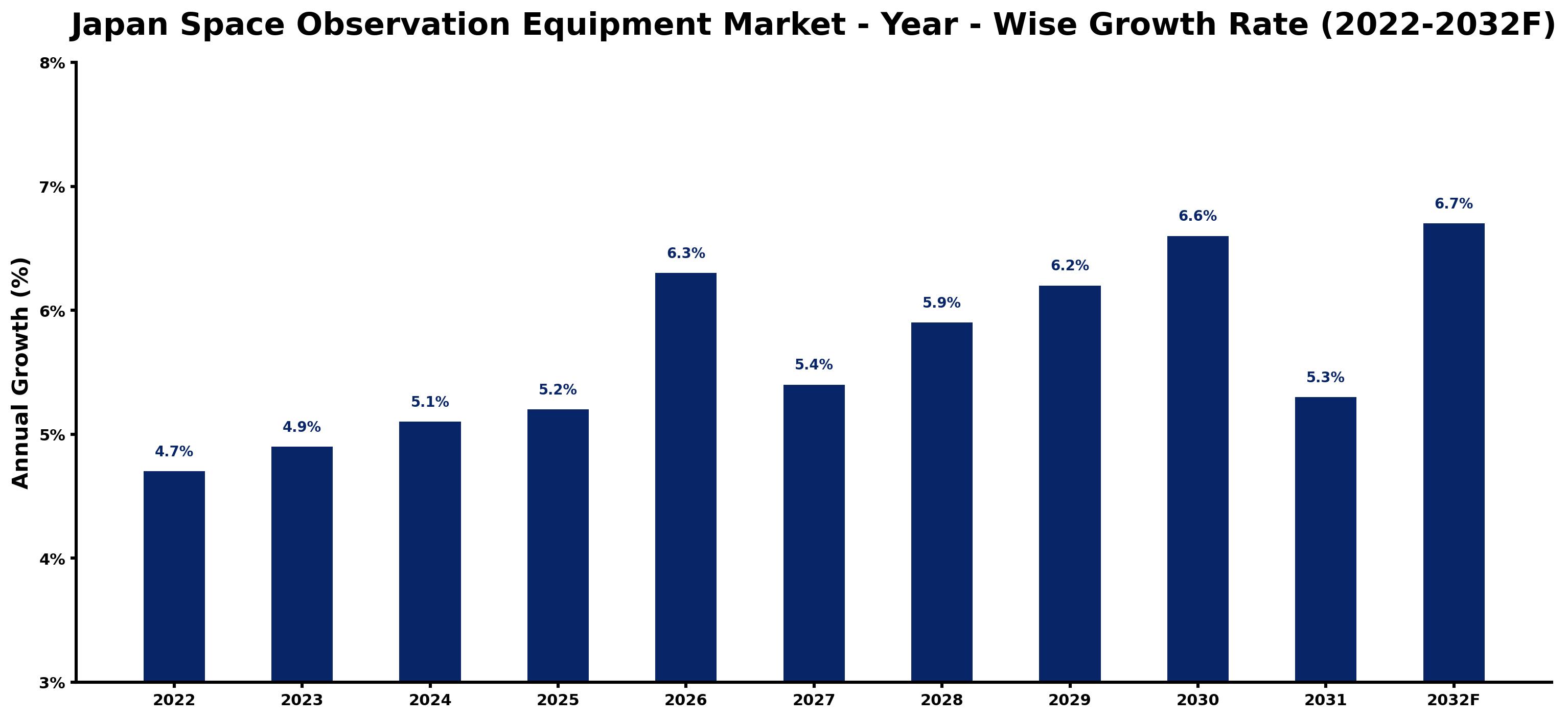
The yearly estimates that follow link every growth rate to its principal driver, so readers can see why the pace changed in each period.
| Year | Estimated Annual Growth (%) | Market Rationale |
| 2022 | 4.7 | The market showed steady growth due to increased interest in space exploration. |
| 2023 | 4.9 | Demand rose as educational astronomy programs gained popularity among the public. |
| 2024 | 5.1 | Growth accelerated with advancements in imaging sensor technology for telescopes. |
| 2025 | 5.2 | The market continued to expand as astronomical institutes increased their research budgets. |
| 2026 | 6.3 | Demand surged with the launch of new space missions requiring advanced equipment. |
| 2027 | 5.4 | Growth slowed slightly as market saturation began to affect new purchases. |
| 2028 | 5.9 | Interest in deep space observation increased, driving demand for specialized equipment. |
| 2029 | 6.2 | The market grew as international collaborations in space research expanded. |
| 2030 | 6.6 | Demand continued to rise with technological advancements in optical instruments. |
| 2031 | 5.3 | Growth slowed as competition intensified among manufacturers of observation equipment. |
| 2032 | 6.7 | The market peaked as new satellite missions created unprecedented demand. |
Note: Market size estimations and growth projections presented in this report are based on 6Wresearch's proprietary forecasting methodology, utilizing the latest available industry data, government publications, and primary research inputs.
Japan Space Observation Equipment Market Synopsis
Space observation equipment includes telescopes, imaging sensors, and spectrometers used for observing celestial phenomena. The market is expanding due to rising interest in astronomical research, particularly among educational institutions and research centres. With over 20 astronomical institutes in Japan and a budget of approximately 300 billion yen for space research in 2023, demand is driven by technological advancements and international collaborations that are increasing purchases of advanced observation equipment.
Market Dynamics Impact Analysis (2026–2032)
| Factor | Type | Impact | Primary Segment Affected |
| Increased funding for space research initiatives | Driver | High | Telescopes |
| Growing interest in educational astronomy programs | Driver | High | Imaging Sensors |
| Rising demand for deep space exploration technologies | Opportunity | High | Deep Space |
| Expansion of international collaborations in space research | Opportunity | High | Celestial Objects |
| High production costs for advanced imaging sensors | Restraint | Medium | Imaging Sensors |
| Limited domestic manufacturing capabilities for specialized equipment | Restraint | Medium | Spectrometers |
| Intense competition among manufacturers affecting pricing | Challenge | High | Telescopes |
| Technological obsolescence of existing equipment | Challenge | Medium | Star Trackers |
Evaluation of Drivers in Japan Space Observation Equipment Market (2026–2032)
The factors lifting demand, and the evidence behind each, are summarised below.
| Drivers | Primary Segment Affected | Why It Matters (Evidence) |
| Increased investment in space research | Telescopes | Japan's 2023 budget for space research is approximately 300 billion yen, supporting telescope development. |
| Growing public interest in astronomy | Imaging Sensors | Educational programs have driven demand, with Japan's population of 126 million engaging more in astronomy. |
| Technological advancements in imaging sensors | Spectrometers | Research from the Tokyo Institute of Technology is leading to better performance in spectrometers. |
| Rising collaboration with international space agencies | Celestial Objects | Japan's participation in international space initiatives boosts demand for observation equipment. |
| Increased focus on deep space missions | Deep Space | Recent missions have highlighted the need for advanced observation tools for deep space exploration. |
Orders keep climbing as Japan's 2023 budget for space research reaches approximately 300 billion yen, driving investments in advanced telescopes. Research from the Tokyo Institute of Technology improves spectrometer capabilities, supporting deeper analysis of celestial bodies.
Evaluation of Restraints in Japan Space Observation Equipment Market
These are the pressures that could keep growth below its potential.
| Market Restraint | Primary Segment Affected | Why It Matters (Evidence) |
| High costs of manufacturing advanced imaging sensors | Imaging Sensors | Production costs for advanced sensors can exceed 50 million yen per unit, limiting accessibility. |
| Limited domestic production of specialized equipment | Spectrometers | Japan relies on imports for many spectrometers, which can delay project timelines. |
| Intense competition leading to price wars | Telescopes | Manufacturers face pressure to lower prices, impacting profit margins and market viability. |
| Technological obsolescence of existing equipment | Star Trackers | Rapid advancements can render older models ineffective, necessitating frequent upgrades. |
| Regulatory challenges in equipment certification | Celestial Objects | Compliance with standards like ISO 9001 can prolong the time to market. |
Japan Space Observation Equipment Market Challenges
High costs of advanced materials burden producers, as the price of key components has risen significantly, forcing them to increase prices for buyers. Importers face rising international shipping rates, which can add up to 20% to the final cost of equipment, limiting their competitiveness. Buyers encounter delays in receiving equipment due to compliance with ISO 9001 standards, which can extend lead times by up to three months and disrupt project schedules. A shortage of skilled workers in precision engineering limits producers' capacity to innovate, resulting in slower responses to market demands for new technologies.
Trends in the Japan Space Observation Equipment Market
Several trends are reshaping the Japan Space Observation Equipment Market; the most important are set out below.
- Shift in Focus to Deep Space Exploration: Tokyo has seen a shift towards deep space observation since 2023, with JAXA's Hayabusa2 mission paving the way. This focus is driving demand for specialised telescopes and sensors, with investments exceeding 100 million yen in new technologies.
- Transition from Optical to X-Ray/UV Observation: Since 2026, the trend has shifted towards X-Ray/UV observation technologies, driven by advancements in sensor capabilities. The growing need for high-energy astronomical observations has led to an increase in demand, with a projected market value of 50 million yen.
- Emergence of Public Engagement in Astronomy: The Japan Society for Astronomical Studies has promoted public engagement initiatives since 2023, leading to increased participation in astronomy programs. This movement has resulted in a 30% rise in educational astronomy equipment purchases.
- Prioritisation of International Collaboration: The 2023 Space Exploration Strategy emphasises international collaboration, encouraging partnerships with global space agencies. This approach has led to a 25% increase in joint research projects, enhancing the demand for observation equipment.
Investment Opportunities in the Japan Space Observation Equipment Market
The openings below show where demand in the Japan Space Observation Equipment Market is visible and how suppliers can enter.
- Timing for Investment in Imaging Sensors: With the optical telescope market valued at approximately 1 billion yen, now is an ideal time to invest in imaging sensors. Educational institutions are increasingly seeking advanced equipment to improve their astronomy programs.
- Gap in Domestic Production of Spectrometers: The market gap for domestically produced spectrometers is clear, with imports dominating. Investing in local manufacturing could meet the needs of astronomical institutes, which have increased their budgets for research.
- Supply of Advanced Telescopes for Research Institutes: The demand for advanced telescopes is rising, particularly among astronomical institutes. Collaborating with local research centres can facilitate entry into this growing market, with potential investments exceeding 200 million yen.
- Approval Pathways for New Technologies: The current focus on improving satellite capabilities presents an opportunity for new technologies. Engaging with the Japan Space Industry Association can provide essential insights for navigating approval processes.
Government Initiatives in the Japan Space Observation Equipment Market
The 2023 Space Exploration Strategy emphasises international collaboration, adding to existing laws. This strategy encourages partnerships that boost funding and resources for space observation equipment, aligning with the Industrial Standardization Act to ensure high-quality production standards.
Approximately 300 billion yen is allocated for space research in 2023, administered by the Japan Aerospace Exploration Agency (JAXA). This funding supports various projects, including the development of advanced observation technologies and educational initiatives.
Future Insight of the Japan Space Observation Equipment Market
The advancement of satellite capabilities will transform demand for space observation equipment by 2032, driven by increased funding and research initiatives. The 2023 budget for space research is approximately 300 billion yen, which will support the development of new technologies. Educational astronomy programs will expand, backed by the Japan Space Forum, to enhance public interest. International collaborations will strengthen technological advancements and open new avenues for research, benefiting both buyers and suppliers.
Market Segmentation Analysis
Japan Space Observation Equipment Market report covers a detailed analysis of the following market segments:
By Equipment Type – Telescopes Lead, Imaging Sensors Expected to Grow Fastest
According to Saurav Kr Singh, Senior Research Analyst at 6Wresearch, Telescopes held 47% of the Japan Space Observation Equipment Market by equipment type in 2025. Telescopes hold the largest share due to their widespread use in astronomical observation across Japan's numerous astronomical institutes. With over 20 institutes dedicated to space observation, telescopes are essential for both research and educational purposes. Imaging Sensors are set to record the highest CAGR in this split, 8.8% over 2026–2032. Imaging Sensors are witnessing rapid growth as they are critical for capturing detailed images of celestial bodies, highlighted by their role in JAXA's Hayabusa2 mission. This increasing reliance on imaging technology will likely allow telescopes to maintain their leading position in the market. Suppliers should focus on enhancing imaging sensor capabilities to address the growing demand from research institutions.
By Observation Target – Celestial Objects Lead, Deep Space Expected to Grow Fastest
Celestial Objects took 46% of observation target revenue in 2025, more than any other category. Celestial Objects are the primary focus of observation equipment as they are the main targets for research conducted by Japan's astronomical institutes. This strong interest drives substantial investment in technologies aimed at observing these phenomena. The quickest growth will come from Deep Space, forecast to expand at a CAGR of 8.0% between 2026 and 2032. Deep Space is experiencing the fastest growth due to the increasing emphasis on exploring distant galaxies, highlighted in Japan's 2023 Space Exploration Strategy. This focus will further strengthen the position of celestial objects in the market. Buyers should prioritise equipment that supports deep space observation to align with emerging research trends.
By Wavelength Spectrum – Optical/Infrared Leads, X-Ray/UV Expected to Grow Fastest
In 2025, Optical/Infrared led the wavelength spectrum split with a 43% share. Optical/Infrared wavelengths dominate the market as they are the most commonly utilised range for telescopes in astronomical observations. This dominance is evident in the extensive applications across various research initiatives conducted in Japan. X-Ray/UV is projected to grow fastest, at a CAGR of 8.2% during 2026–2032. X-Ray/UV wavelengths are experiencing rapid growth due to their importance in observing high-energy astronomical phenomena, which are increasingly being explored by research centres. The rising interest in these wavelengths will likely strengthen the market position of optical/infrared equipment. Suppliers must invest in developing advanced X-Ray/UV technologies to meet the increasing demand from research institutions.
By End User – Astronomical Institutes Lead, Space Research Centers Expected to Grow Fastest
With 35% of end user revenue in 2025, Astronomical Institutes was the largest category. Astronomical Institutes account for the largest segment as they are the primary users of observation equipment, driving demand across various technologies. Their extensive research activities necessitate a diverse range of observational tools to support their studies effectively. Over 2026–2032, Space Research Centers are expected to post the fastest growth, at a CAGR of 7.9%. Space Research Centers are growing rapidly as they require advanced observation technologies for their research projects. This trend indicates a strengthening demand that will also benefit astronomical institutes in the long run. Suppliers should tailor their offerings to align with the specific needs of space research centres.
Key Attractiveness of the Report
- 10 Years of Market Numbers
- Historical Data Starting from 2022 to 2025
- Base Year 2025
- Forecast Data until 2032
- Key Performance Indicators Impacting the Market
- Major Upcoming Developments and Projects
Key Highlights of the Report:
- Japan Space Observation Equipment Market Outlook
- Market Size of Japan Space Observation Equipment Market, 2025
- Forecast of Japan Space Observation Equipment Market, 2032
- Historical Data and Forecast of Japan Space Observation Equipment Revenues & Volume for the Period 2022-2032F
- Japan Space Observation Equipment Market Trend Evolution
- Japan Space Observation Equipment Market Drivers and Challenges
- Japan Space Observation Equipment Price Trends
- Japan Space Observation Equipment Porter's Five Forces
- Japan Space Observation Equipment Industry Life Cycle
- Historical Data and Forecast of Japan Space Observation Equipment Market Revenues & Volume By Equipment Type for the Period 2022-2032F
- Historical Data and Forecast of Japan Space Observation Equipment Market Revenues & Volume By Telescopes for the Period 2022-2032F
- Historical Data and Forecast of Japan Space Observation Equipment Market Revenues & Volume By Imaging Sensors for the Period 2022-2032F
- Historical Data and Forecast of Japan Space Observation Equipment Market Revenues & Volume By Star Trackers for the Period 2022-2032F
- Historical Data and Forecast of Japan Space Observation Equipment Market Revenues & Volume By Spectrometers for the Period 2022-2032F
- Historical Data and Forecast of Japan Space Observation Equipment Market Revenues & Volume By Observation Target for the Period 2022-2032F
- Historical Data and Forecast of Japan Space Observation Equipment Market Revenues & Volume By Celestial Objects for the Period 2022-2032F
- Historical Data and Forecast of Japan Space Observation Equipment Market Revenues & Volume By Deep Space for the Period 2022-2032F
- Historical Data and Forecast of Japan Space Observation Equipment Market Revenues & Volume By Navigation for the Period 2022-2032F
- Historical Data and Forecast of Japan Space Observation Equipment Market Revenues & Volume By Elemental Analysis for the Period 2022-2032F
- Historical Data and Forecast of Japan Space Observation Equipment Market Revenues & Volume By Wavelength Spectrum for the Period 2022-2032F
- Historical Data and Forecast of Japan Space Observation Equipment Market Revenues & Volume By Optical/Infrared for the Period 2022-2032F
- Historical Data and Forecast of Japan Space Observation Equipment Market Revenues & Volume By X-Ray/UV for the Period 2022-2032F
- Historical Data and Forecast of Japan Space Observation Equipment Market Revenues & Volume By Visual Spectrum for the Period 2022-2032F
- Historical Data and Forecast of Japan Space Observation Equipment Market Revenues & Volume By Multispectral for the Period 2022-2032F
- Historical Data and Forecast of Japan Space Observation Equipment Market Revenues & Volume By End User for the Period 2022-2032F
- Historical Data and Forecast of Japan Space Observation Equipment Market Revenues & Volume By Astronomical Institutes for the Period 2022-2032F
- Historical Data and Forecast of Japan Space Observation Equipment Market Revenues & Volume By Space Research Centers for the Period 2022-2032F
- Historical Data and Forecast of Japan Space Observation Equipment Market Revenues & Volume By Satellite Builders for the Period 2022-2032F
- Historical Data and Forecast of Japan Space Observation Equipment Market Revenues & Volume By Planetary Scientists for the Period 2022-2032F
- Japan Space Observation Equipment Import Export Trade Statistics
- Market Opportunity Assessment By Equipment Type
- Market Opportunity Assessment By Observation Target
- Market Opportunity Assessment By Wavelength Spectrum
- Market Opportunity Assessment By End User
- Japan Space Observation Equipment Top Companies Market Share
- Japan Space Observation Equipment Competitive Benchmarking By Technical and Operational Parameters
- Japan Space Observation Equipment Company Profiles
- Japan Space Observation Equipment Key Strategic Recommendations
Market Covered
This report examines the market across the segments below.
By Equipment Type
- Telescopes
- Imaging Sensors
- Star Trackers
- Spectrometers
By Observation Target
- Celestial Objects
- Deep Space
- Navigation
- Elemental Analysis
By Wavelength Spectrum
- Optical/Infrared
- X-Ray/UV
- Visual Spectrum
- Multispectral
By End User
- Astronomical Institutes
- Space Research Centers
- Satellite Builders
- Planetary Scientists































