Japan Specialty Polymers Market Size & Growth Rate
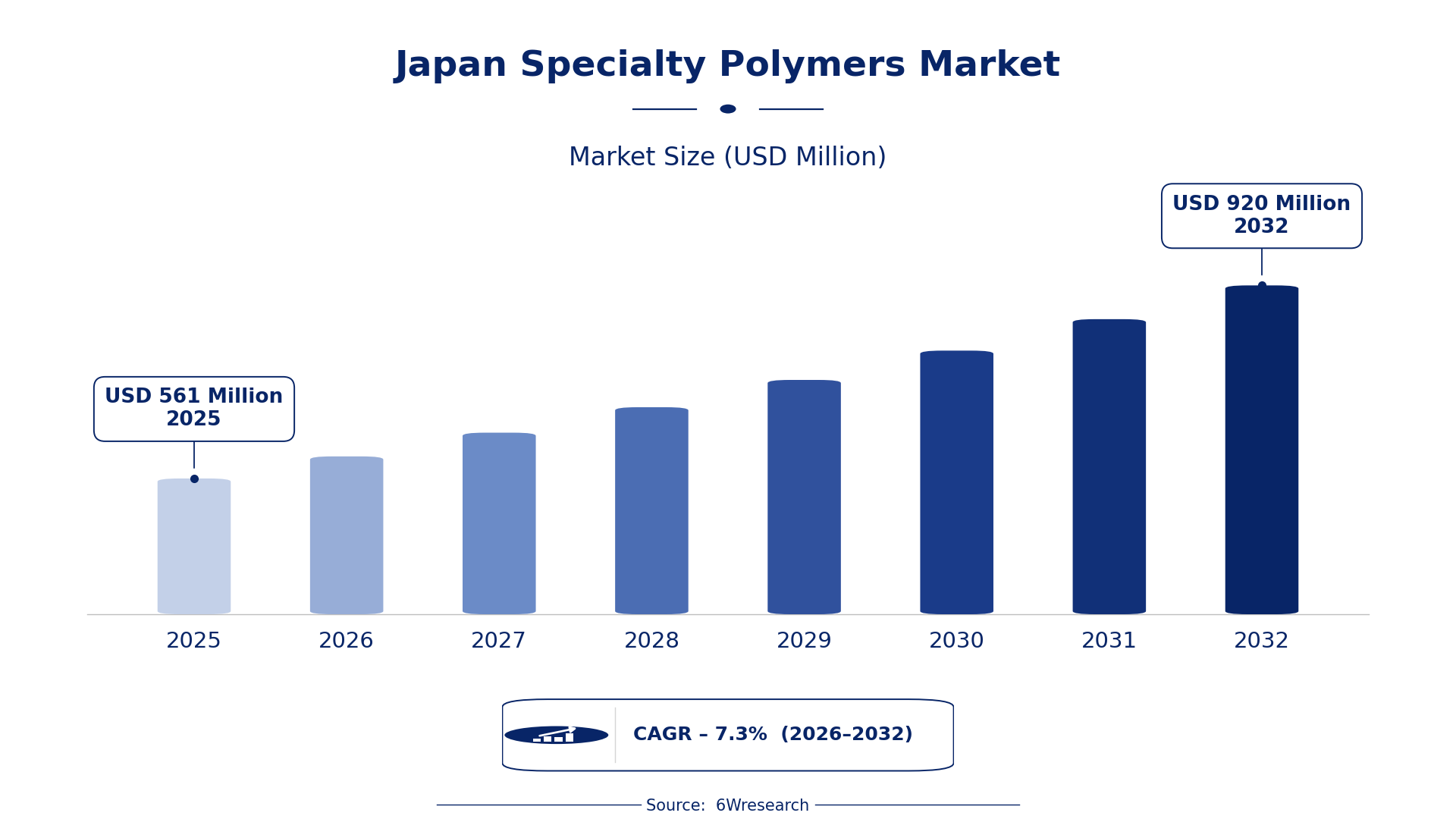
According to 6Wresearch internal database and industry insights, the Japan Specialty Polymers Market was valued at USD 561 Million in 2025 and is projected to reach USD 920 Million by 2032, growing at a CAGR of approximately 7.3% during 2026–2032.
Japan Specialty Polymers Market Highlights
| Report Metric | Details |
| Report Name | Japan Specialty Polymers Market (2026-2032) |
| Market Size 2025 | USD 561 Million |
| Market Size 2032 | USD 920 Million |
| Absolute Growth 2025–2032 | USD 359 Million |
| CAGR 2026–2032 | 7.3% |
| Peak Annual Growth | 8.0% in 2028 |
| Forecast Period | 2026–2032 |
| Historical Data | 2022–2025 |
| Base Year | 2025 |
| Leading Type, 2025 | Thermoplastics (47% share) |
| Leading Application, 2025 | Automotive (39% share) |
| Leading End Use, 2025 | Automotive (50% share) |
| Leading Property, 2025 | High Performance (42% share) |
| Fastest-Growing Type | Biodegradable (10.6% CAGR) |
| Fastest-Growing Application | Medical Devices (9.6% CAGR) |
| Fastest-Growing End Use | Healthcare (9.7% CAGR) |
| Fastest-Growing Property | Eco Friendly (10.1% CAGR) |
| Growing Sector | Healthcare |
| Key End Users | Automotive manufacturers, electronics producers, medical device companies |
Japan Specialty Polymers Market Year-wise Growth Rate and Key Drivers (2022–2032)
This graph illustrates the annual growth rates of the market from 2022 to 2032, highlighting a steady upward trajectory and projected market expansion over the forecast period.
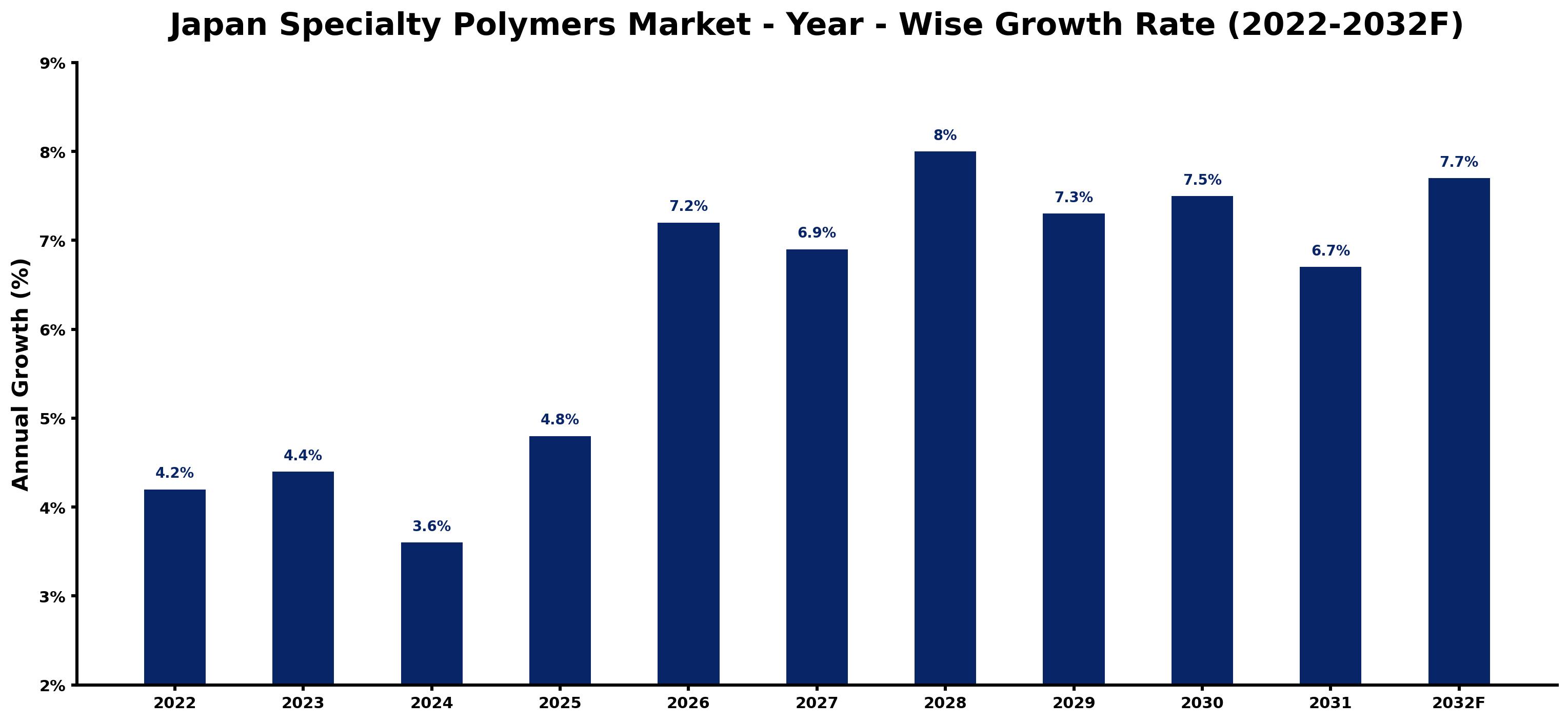
Each row of the following table gives one year's estimated growth and the event or demand shift that explains it.
| Year | Estimated Annual Growth (%) | Market Rationale |
| 2022 | 4.2 | The market exhibited steady growth, reflecting strong demand from the automotive sector. |
| 2023 | 4.4 | Growth accelerated due to increased production in the automotive industry, boosting polymer demand. |
| 2024 | 3.6 | A slowdown occurred as automotive production faced slight reductions, impacting polymer purchases. |
| 2025 | 4.8 | Demand surged as automotive designs increasingly incorporated specialty polymers for lightweighting. |
| 2026 | 7.2 | Growth is expected to accelerate again, driven by rising healthcare needs and medical device production. |
| 2027 | 6.9 | A slight slowdown is projected as the market adjusts to earlier rapid growth rates. |
| 2028 | 8.0 | The market is expected to peak with strong demand from automotive and electronics sectors driving sales. |
| 2029 | 7.3 | Growth is projected to decelerate slightly as the market stabilises after reaching its peak. |
| 2030 | 7.5 | Demand is expected to rise again, supported by ongoing innovations in automotive and electronics applications. |
| 2031 | 6.7 | A slowdown is anticipated as the market begins to normalise after several years of rapid growth. |
| 2032 | 7.7 | Growth is projected to accelerate again, driven by increasing healthcare applications and eco-friendly initiatives. |
Note: Market size estimations and growth projections presented in this report are based on 6Wresearch's proprietary forecasting methodology, utilizing the latest available industry data, government publications, and primary research inputs.
Japan Specialty Polymers Market Synopsis
Specialty polymers are advanced materials tailored for various applications, primarily produced through polymerization processes. The Japan Specialty Polymers Market is driven by the automotive sector, which produced 8.3 million vehicles in 2022, and the electronics industry, valued at ¥12 trillion. Growth in medical device companies and government promotion of eco-friendly materials are contributing to the market's expansion, with a projected size of USD 920 million by 2032.
Market Dynamics Impact Analysis (2026–2032)
| Factor | Type | Impact | Primary Segment Affected |
| Strong automotive production | Driver | High | Automotive |
| Rising healthcare needs | Driver | High | Medical Devices |
| Growing demand for eco-friendly materials | Opportunity | Medium | Biodegradable |
| Expansion of electronics manufacturing | Opportunity | High | Electronics |
| Regulatory compliance costs | Restraint | High | Elastomers |
| Limited awareness of specialty polymers | Restraint | Medium | Thermoplastics |
| High R&D costs for new materials | Challenge | High | High Performance |
| Competition from traditional materials | Challenge | Medium | Packaging |
Evaluation of Drivers in Japan Specialty Polymers Market (2026–2032)
The main growth drivers and the segments they affect most are set out below.
| Drivers | Primary Segment Affected | Why It Matters (Evidence) |
| Increased vehicle production | Automotive | Japan's automotive sector produced 8.3 million vehicles in 2022, boosting specialty polymer demand. |
| Growth in medical device companies | Medical Devices | Over 1,000 medical device companies operate in Japan, increasing the need for specialized materials. |
| Rising electronics manufacturing | Electronics | The Tokyo region's electronics industry is valued at ¥12 trillion, heavily utilizing specialty polymers in production. |
| Adoption of ISO 9001 standards | Thermoplastics | Widespread adoption of ISO 9001 ensures quality and reliability in specialty polymer production. |
| Government promotion of eco-friendly materials | Biodegradable | The Plastic Resource Circulation Act encourages the use of biodegradable materials in various applications. |
Several shifts outside the market lift sales. The automotive sector produced 8.3 million vehicles in 2022, increasing demand for specialty polymers. The presence of over 1,000 medical device companies in Japan drives the need for specialised materials, while the electronics manufacturing sector in the Tokyo region is valued at ¥12 trillion. The widespread adoption of ISO 9001 standards ensures production quality, encouraging more purchases from manufacturers.
Evaluation of Restraints in Japan Specialty Polymers Market
The main factors holding the market back are set out below.
| Market Restraint | Primary Segment Affected | Why It Matters (Evidence) |
| High compliance costs for regulations | Elastomers | Compliance with the Chemical Substances Control Law increases production costs for elastomers. |
| Limited market awareness of specialty polymers | Thermoplastics | Many manufacturers still rely on traditional materials due to a lack of awareness about specialty polymers. |
| Investment requirements for R&D | High Performance | High R&D costs limit the ability of companies to innovate in specialty polymer development. |
| Competition from traditional materials | Packaging | Traditional materials dominate the packaging market, limiting the growth of specialty polymers. |
| Market entry barriers for new players | Biodegradable | New entrants face challenges in establishing credibility and meeting regulatory standards. |
Japan Specialty Polymers Market Challenges
Over 8.3 million vehicles produced in Japan in 2022 create intense demand for specialty polymers, straining supply chains and causing delays for automotive producers. Increased costs arise for buyers as they compete for limited material availability, impacting their production schedules. Insufficient R&D funding of ¥20 billion restricts technological progress, hindering producers' ability to innovate and meet evolving market needs. Regulatory hurdles from the JIS K 6256 standard require extensive testing of elastomers, extending lead times and increasing costs for suppliers, which can disrupt the overall supply chain.
Trends in the Japan Specialty Polymers Market
These developments are changing demand patterns in the Japan Specialty Polymers Market.
- Shift from Traditional to Eco-Friendly Materials: The Tokyo Metropolitan Government launched a programme in 2023 to promote biodegradable materials, reflecting a growing trend towards sustainability. This shift is projected to increase demand for eco-friendly specialty polymers.
- Transition from Conventional to Advanced Electronics: In 2022, Japan's electronics industry, valued at ¥12 trillion, began prioritising advanced materials for insulation and structural components, resulting in increased demand for specialty polymers.
- Emergence of Medical Devices as a Key Application: With over 1,000 medical device companies operating in Japan, the medical devices sector is increasingly adopting specialty polymers, driving demand for high-performance materials.
- Growing Focus on Automotive Lightweighting: Specialty polymers are now used in over 60% of new automotive designs in Japan, reflecting a trend towards lightweight components for improved fuel efficiency.
Investment Opportunities in the Japan Specialty Polymers Market
The following opportunities in the Japan Specialty Polymers Market pair current demand with a clear way in.
- Tokyo Electronics Manufacturing Hub: The Tokyo region's electronics manufacturers are increasingly seeking specialty polymers, with a market gap of ¥12 trillion. Collaborating with local suppliers can facilitate entry into this market.
- Healthcare Sector Expansion: The healthcare sector is projected to grow, increasing the need for medical-grade polymers. Engaging with medical device companies can create opportunities for suppliers.
- Rising Demand for Biodegradable Materials: With the government's push for eco-friendly materials, the market gap for biodegradable polymers is expanding. Establishing joint ventures with local firms can support market entry.
- Automotive Lightweighting Initiatives: The automotive sector's focus on lightweight components presents an opportunity, with specialty polymers used in over 60% of new designs. Partnering with automotive manufacturers can drive growth.
Government Initiatives in the Japan Specialty Polymers Market
The Industrial Standardization Act, established in 1949 and amended in 2019, governs product and test standards in Japan. This law ensures that specialty polymer producers adhere to quality benchmarks, building consumer trust and market stability. Additionally, the Chemical Substances Control Law, enacted in 1973, mandates the evaluation and control of chemical substances, impacting the production processes of specialty polymers.
In 2023, the Ministry of Economy, Trade and Industry allocated ¥20 billion to support R&D in advanced materials, including specialty polymers. This funding aims to encourage innovation and competitiveness in the sector, while the Ministry of the Environment promotes sustainable practices through various initiatives.
Future Insight of the Japan Specialty Polymers Market
Government initiatives will drive a shift towards eco-friendly specialty polymers, prompting suppliers to innovate and adapt. The Tokyo Metropolitan Government's programme will facilitate the development of biodegradable materials, creating new opportunities for producers. By 2032, the healthcare sector's growth will elevate the demand for medical-grade polymers, leading to advancements in production processes. With Japan's automotive sector relying on specialty polymers for over 60% of new designs, technological improvements will enhance material performance, benefiting buyers across various industries.
Market Segmentation Analysis
Japan Specialty Polymers Market report covers a detailed analysis of the following market segments:
By Type – Thermoplastics Lead, Biodegradable Expected to Grow Fastest
According to Bhawna Singh, Assistant Manager at 6Wresearch, the largest type category in 2025 was Thermoplastics, at 47% of revenue. Thermoplastics dominate the market due to their extensive use in the automotive sector, where over 60% of new designs rely on these materials for their versatility. Their performance in electronics further solidifies their leading position in the specialty polymers market. Biodegradable is set to record the highest CAGR in this split, 10.6% over 2026–2032. The biodegradable segment is experiencing rapid growth as consumer preferences shift towards sustainable materials, particularly following government initiatives that promote eco-friendly solutions. The Tokyo Metropolitan Government's recent programme to encourage biodegradable materials exemplifies this trend. Suppliers should prioritise the development of sustainable options to satisfy the increasing demand for biodegradable specialty polymers.
By Application – Automotive Leads, Medical Devices Expected to Grow Fastest
Automotive held 39% of the Japan Specialty Polymers Market by application in 2025. The automotive sector is the largest user of specialty polymers, driven by the production of 8.3 million vehicles in 2022 that require lightweight components. This substantial output underscores the automotive industry's reliance on these advanced materials. Over 2026–2032, Medical Devices are expected to post the fastest growth, at a CAGR of 9.6%. Medical devices are the fastest-growing application due to the increasing number of medical device companies in Japan, which exceeds 1,000. The healthcare sector's projected growth further fuels this demand for biocompatible materials. Buyers in the healthcare sector should prepare for increased availability of advanced materials tailored for medical applications.
By End Use – Automotive Leads, Healthcare Expected to Grow Fastest
With 50% of end use revenue in 2025, Automotive was the largest category. The automotive sector is the largest consumer of specialty polymers, utilising these materials for lightweight components that are essential for vehicle production. The sector's robust output, with 8.3 million vehicles produced in 2022, highlights the ongoing demand for advanced materials. The quickest growth will come from Healthcare, forecast to expand at a CAGR of 9.7% between 2026 and 2032. Healthcare is emerging as the fastest-growing end use, driven by the sector's expansion and the rising need for medical-grade polymers in innovative applications. The projected growth in healthcare services will further boost the demand for these specialised materials. Suppliers should align their offerings with the healthcare sector's growth to take advantage of the increasing need for medical-grade polymers.
By Property – High Performance Leads, Eco Friendly Expected to Grow Fastest
High Performance accounted for 42% of the market by property in 2025. High performance polymers are crucial for numerous applications, particularly in automotive and electronics, where durability and reliability are paramount. Their essential role in new designs ensures they maintain a substantial market share. Eco Friendly is projected to grow fastest, at a CAGR of 10.1% during 2026–2032. Eco-friendly polymers are increasingly sought after as sustainability becomes a priority for consumers and manufacturers, influenced by government initiatives promoting green materials. This growing interest suggests potential for future market expansion. Suppliers must invest in eco-friendly product development to meet the rising demand for sustainable specialty polymers.
Key Attractiveness of the Report
- 10 Years of Market Numbers
- Historical Data Starting from 2022 to 2025
- Base Year 2025
- Forecast Data until 2032
- Key Performance Indicators Impacting the Market
- Major Upcoming Developments and Projects
Key Highlights of the Report:
- Japan Specialty Polymers Market Outlook
- Market Size of Japan Specialty Polymers Market,2025
- Forecast of Japan Specialty Polymers Market, 2032
- Historical Data and Forecast of Japan Specialty Polymers Revenues & Volume for the Period 2022-2032
- Japan Specialty Polymers Market Trend Evolution
- Japan Specialty Polymers Market Drivers and Challenges
- Japan Specialty Polymers Price Trends
- Japan Specialty Polymers Porter's Five Forces
- Japan Specialty Polymers Industry Life Cycle
- Historical Data and Forecast of Japan Specialty Polymers Market Revenues & Volume By Type for the Period 2022-2032
- Historical Data and Forecast of Japan Specialty Polymers Market Revenues & Volume By Thermoplastics for the Period 2022-2032
- Historical Data and Forecast of Japan Specialty Polymers Market Revenues & Volume By Elastomers for the Period 2022-2032
- Historical Data and Forecast of Japan Specialty Polymers Market Revenues & Volume By Composites for the Period 2022-2032
- Historical Data and Forecast of Japan Specialty Polymers Market Revenues & Volume By Biodegradable for the Period 2022-2032
- Historical Data and Forecast of Japan Specialty Polymers Market Revenues & Volume By Application for the Period 2022-2032
- Historical Data and Forecast of Japan Specialty Polymers Market Revenues & Volume By Automotive for the Period 2022-2032
- Historical Data and Forecast of Japan Specialty Polymers Market Revenues & Volume By Medical Devices for the Period 2022-2032
- Historical Data and Forecast of Japan Specialty Polymers Market Revenues & Volume By Electronics for the Period 2022-2032
- Historical Data and Forecast of Japan Specialty Polymers Market Revenues & Volume By Packaging for the Period 2022-2032
- Historical Data and Forecast of Japan Specialty Polymers Market Revenues & Volume By End Use for the Period 2022-2032
- Historical Data and Forecast of Japan Specialty Polymers Market Revenues & Volume By Automotive for the Period 2022-2032
- Historical Data and Forecast of Japan Specialty Polymers Market Revenues & Volume By Healthcare for the Period 2022-2032
- Historical Data and Forecast of Japan Specialty Polymers Market Revenues & Volume By Semiconductor & Electronics for the Period 2022-2032
- Historical Data and Forecast of Japan Specialty Polymers Market Revenues & Volume By Consumer Staples for the Period 2022-2032
- Historical Data and Forecast of Japan Specialty Polymers Market Revenues & Volume By Property for the Period 2022-2032
- Historical Data and Forecast of Japan Specialty Polymers Market Revenues & Volume By High Performance for the Period 2022-2032
- Historical Data and Forecast of Japan Specialty Polymers Market Revenues & Volume By Heat Resistance for the Period 2022-2032
- Historical Data and Forecast of Japan Specialty Polymers Market Revenues & Volume By Electrical Insulation for the Period 2022-2032
- Historical Data and Forecast of Japan Specialty Polymers Market Revenues & Volume By Eco Friendly for the Period 2022-2032
- Japan Specialty Polymers Import Export Trade Statistics
- Market Opportunity Assessment By Type
- Market Opportunity Assessment By Application
- Market Opportunity Assessment By End Use
- Market Opportunity Assessment By Property
- Japan Specialty Polymers Top Companies Market Share
- Japan Specialty Polymers Competitive Benchmarking By Technical and Operational Parameters
- Japan Specialty Polymers Company Profiles
- Japan Specialty Polymers Key Strategic Recommendations
Market Covered
The study includes the following segmentation.
By Type
- Thermoplastics
- Elastomers
- Composites
- Biodegradable
By Application
- Automotive
- Medical Devices
- Electronics
- Packaging
By End Use
- Automotive
- Healthcare
- Semiconductor & Electronics
- Consumer Staples
By Property
- High Performance
- Heat Resistance
- Electrical Insulation
- Eco Friendly































