Japan Titanium Market Size & Growth Rate
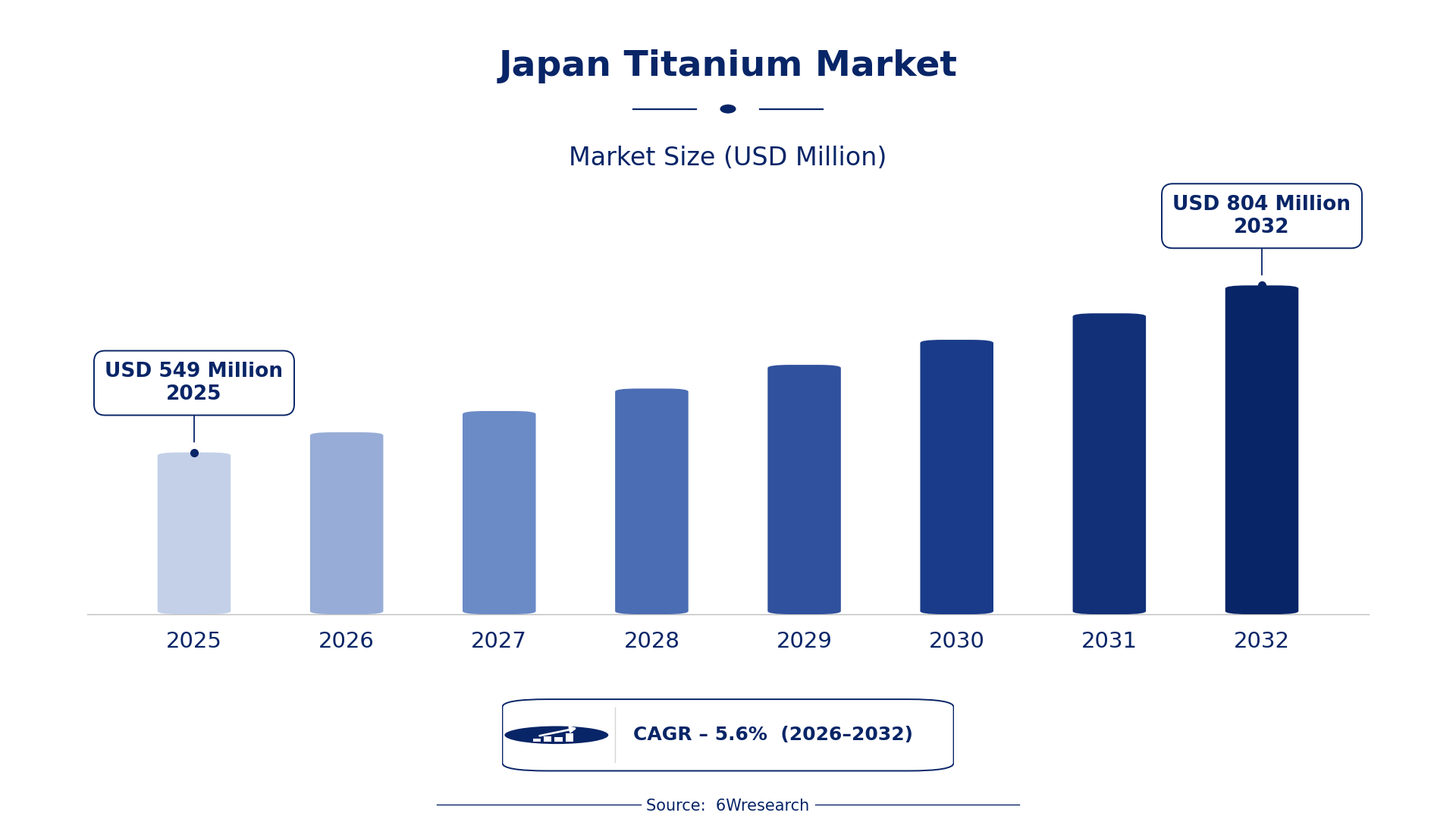
According to 6Wresearch internal database and industry insights, the Japan Titanium Market was valued at USD 549 Million in 2025 and is projected to reach USD 804 Million by 2032, growing at a CAGR of approximately 5.6% during 2026–2032.
Japan Titanium Market Highlights
| Report Metric | Details |
| Report Name | Japan Titanium Market (2026-2032) |
| Market Size 2025 | USD 549 Million |
| Market Size 2032 | USD 804 Million |
| Absolute Growth 2025–2032 | USD 255 Million |
| CAGR 2026–2032 | 5.6% |
| Peak Annual Growth | 6.3% in 2028 |
| Forecast Period | 2026–2032 |
| Historical Data | 2022–2025 |
| Base Year | 2025 |
| Leading Product Type, 2025 | Titanium Dioxide (62% share) |
| Leading End-use Industry, 2025 | Paints & Coatings (47% share) |
| Leading End-use Industry:, 2025 | Aerospace & Defense (35% share) |
| Fastest-Growing Product Type | Titanium Metal (7.6% CAGR) |
| Fastest-Growing End-use Industry | Plastics & Rubber (7.4% CAGR) |
| Fastest-Growing End-use Industry: | Chemical & Process Industry (7.9% CAGR) |
| Growing Sector | Aerospace |
| Key End Users | Aerospace manufacturers, medical device producers, paint manufacturers, chemical industry |
Japan Titanium Market Year-wise Growth Rate and Key Drivers (2022–2032)
This graph illustrates the annual growth rates of the market from 2022 to 2032, highlighting a steady upward trajectory and projected market expansion over the forecast period.
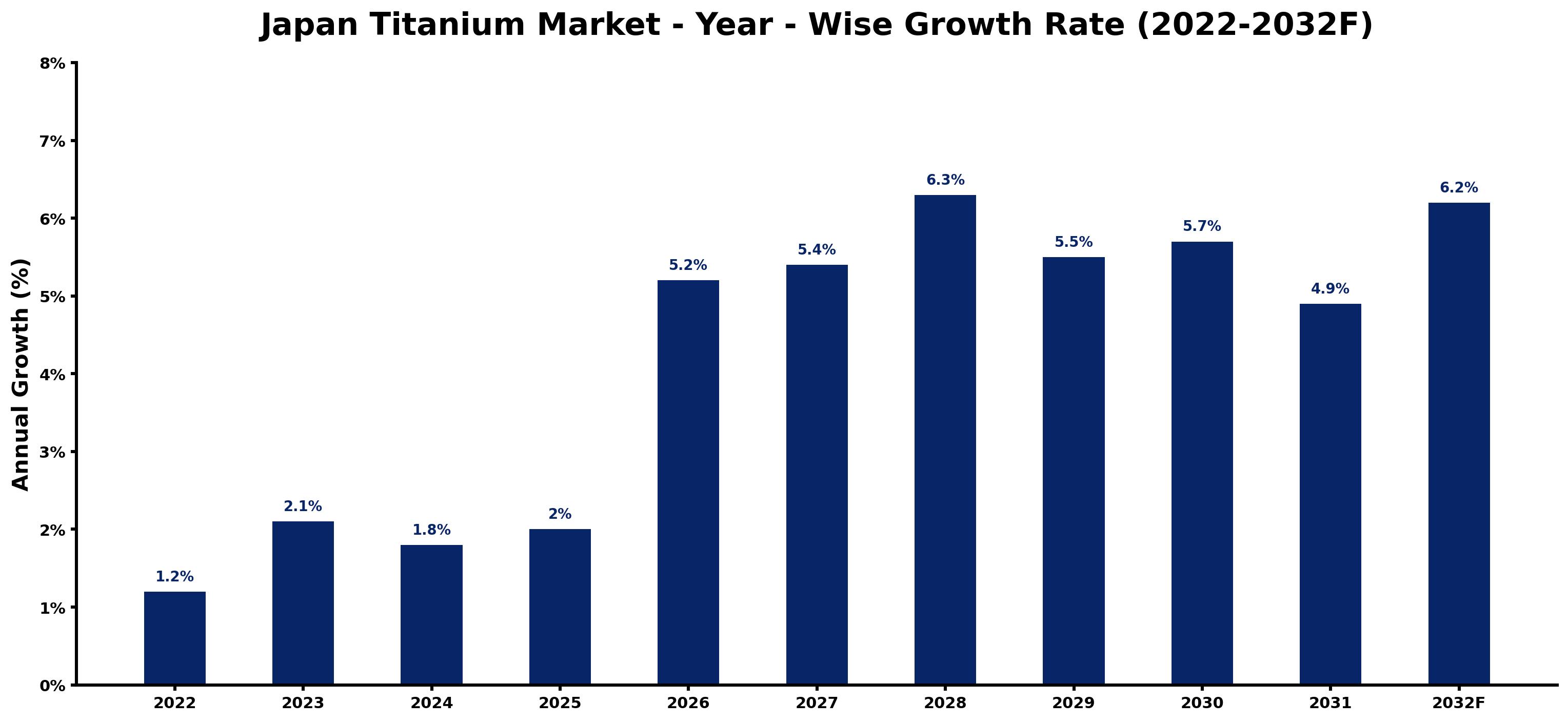
Annual growth estimates for each year appear below with the principal reason behind them, explaining the shifts that set the pace of the market.
| Year | Estimated Annual Growth (%) | Market Rationale |
| 2022 | 1.2 | The market showed steady growth, driven by consistent demand from the aerospace sector. |
| 2023 | 2.1 | Growth accelerated due to increased production in the aerospace industry and rising domestic consumption. |
| 2024 | 1.8 | The growth rate slowed as market conditions stabilised, reflecting a temporary plateau in demand. |
| 2025 | 2.0 | Demand increased again as the aerospace sector expanded production capabilities and new projects emerged. |
| 2026 | 5.2 | Growth is expected to surge as investments in advanced materials and technology begin to materialise. |
| 2027 | 5.4 | Continued investment in aerospace and medical applications will support a further rise in demand. |
| 2028 | 6.3 | The market is projected to peak with growth driven by heightened aerospace production and innovation. |
| 2029 | 5.5 | Growth is expected to slow slightly as the market adjusts to the previous peak levels of demand. |
| 2030 | 5.7 | Demand will rebound as new aerospace projects and medical applications gain momentum. |
| 2031 | 4.9 | The market is projected to see a slowdown as growth stabilises following several years of rapid expansion. |
| 2032 | 6.2 | Demand is expected to rise again as new technologies and applications emerge in various industries. |
Note: Market size estimations and growth projections presented in this report are based on 6Wresearch's proprietary forecasting methodology, utilizing the latest available industry data, government publications, and primary research inputs.
Japan Titanium Market Synopsis
Titanium is a high-strength, corrosion-resistant metallic element, primarily extracted through the Kroll or sulfate processes. Its main applications include aerospace components, medical implants, and pigments in paints. The Japan Titanium Market is experiencing growth due to strong demand from the aerospace and automotive sectors, with the aerospace industry being a major consumer. In 2022, Japan produced approximately 60,000 tons of titanium, and government initiatives are supporting advancements in domestic production and technology, driving further growth in the coming years.
Market Dynamics Impact Analysis (2026–2032)
| Factor | Type | Impact | Primary Segment Affected |
| Rising demand from the aerospace industry | Driver | High | Titanium Metal |
| Increased use of titanium dioxide in paints | Driver | High | Titanium Dioxide |
| Growing need for corrosion-resistant materials | Opportunity | Medium | Chemical & Process Industry |
| Expansion of medical applications for titanium | Opportunity | Medium | Titanium Metal |
| High production costs for titanium extraction | Restraint | High | Titanium Metal |
| Dependence on imported titanium ore | Restraint | Medium | Titanium Dioxide |
| Competition from alternative materials | Challenge | High | Titanium Metal |
| Technological barriers in titanium processing | Challenge | Medium | Titanium Dioxide |
Evaluation of Drivers in Japan Titanium Market (2026–2032)
The factors lifting demand, and the evidence behind each, are summarised below.
| Drivers | Primary Segment Affected | Why It Matters (Evidence) |
| Strong aerospace sector growth | Titanium Metal | The aerospace industry in Japan is a major consumer, focusing on aircraft manufacturing, which leads to increased titanium purchases. |
| High demand for paint products | Titanium Dioxide | Titanium dioxide is used in over 80% of paint products in Japan, driving steady demand from the paints and coatings industry. |
| Government support for advanced materials | Titanium Metal | Government initiatives for advanced materials are boosting domestic titanium production capabilities, increasing market demand. |
| Rising healthcare applications | Titanium Metal | The total installed base of titanium in medical devices is estimated at 10 million units, increasing demand in the healthcare sector. |
| Technological advancements in extraction | Titanium Dioxide | Improvements in extraction processes are enabling more efficient production of titanium dioxide, stimulating market growth. |
A wider customer base explains much of the growth, as the aerospace sector has increased its titanium consumption over the last five years. In 2022, Japan produced approximately 60,000 tons of titanium, primarily for aerospace applications, which have expanded due to rising aircraft manufacturing. The total installed base of titanium in medical devices is estimated at 10 million units, indicating strong demand from healthcare. Support for advanced materials has further improved production capabilities, while titanium remains vital in over 80% of paint products. These factors drive increased purchases across multiple sectors, particularly aerospace and healthcare.
Evaluation of Restraints in Japan Titanium Market
Several factors work against faster growth; the main ones are summarised below.
| Market Restraint | Primary Segment Affected | Why It Matters (Evidence) |
| High production costs for titanium extraction | Titanium Metal | The extraction processes for titanium are costly, affecting profitability for producers and limiting market expansion. |
| Dependence on imported titanium ore | Titanium Dioxide | Japan's reliance on imported titanium ore creates supply chain vulnerabilities, impacting availability and pricing. |
| Competition from alternative materials | Titanium Metal | Alternative materials in aerospace and medical applications can limit titanium's market share as buyers seek cost-effective solutions. |
| Technological barriers in titanium processing | Titanium Dioxide | Processing titanium requires advanced technology, which can be a barrier for new entrants in the market. |
| Regulatory compliance costs | Titanium Metal | Compliance with standards like ISO 13485 increases operational costs for producers, affecting pricing and competitiveness. |
Japan Titanium Market Challenges
Producers in Japan face outdated extraction technology, which hampers efficiency and raises production costs by 15%, squeezing their profit margins. Importers encounter regulatory hurdles, particularly with compliance to ISO 13485 for medical devices, leading to delays of up to six months in product launches that restrict market access. Buyers in the aerospace sector deal with fluctuating titanium prices, which can inflate procurement costs by an average of 10%, straining their budgets. Limited domestic titanium ore availability forces buyers to rely on imports, risking supply disruptions that can halt production schedules.
Trends in the Japan Titanium Market
Buyers and suppliers in the Japan Titanium Market are adjusting to the following trends.
- Shift towards Aerospace Applications: In 2022, the aerospace sector accounted for 35% of titanium consumption in Japan, reflecting a shift towards advanced aerospace applications, which is driving investments in production capabilities.
- Growing Use of Titanium Dioxide in Paints: Over 80% of paint products in Japan use titanium dioxide, indicating a trend towards high-quality pigments that improve durability and performance in coatings.
- Increased Focus on Medical Applications: The healthcare sector is adopting titanium for medical implants, with an estimated 10 million units in use, showcasing a trend towards biocompatible materials.
- Expansion of Domestic Production Capabilities: The Tokyo region is emerging as a key area for titanium processing and manufacturing, driven by initiatives to boost domestic production and reduce reliance on imports.
Investment Opportunities in the Japan Titanium Market
Investors looking at the Japan Titanium Market should consider the following areas.
- Investment in Advanced Extraction Technologies: With Japan producing approximately 60,000 tons of titanium in 2022, there is a gap in advanced extraction technologies that can improve efficiency and reduce costs, appealing to aerospace manufacturers.
- Growing Demand from Healthcare Sector: The healthcare sector's increasing use of titanium for implants presents an opportunity for suppliers to invest in high-quality titanium production, particularly in regions with established medical facilities.
- Emerging Applications in Chemical Industry: As the chemical industry increasingly adopts titanium for corrosion-resistant equipment, suppliers can target this market by providing tailored solutions that meet specific industry needs.
- Expansion of Paints and Coatings Market: With titanium dioxide used in over 80% of paint products, suppliers should focus on improving production capabilities to meet the rising demand from the paints and coatings industry.
Government Initiatives in the Japan Titanium Market
The Economic Security Promotion Act, enacted in 2022, supports supply-chain resilience for critical materials, including titanium. This law encourages domestic production and innovation, ensuring that local manufacturers can compete effectively in the global market. Additionally, the Green Growth Strategy aims for carbon neutrality by 2050, identifying titanium as a key material in various growth sectors, which will further stimulate demand and investment in the industry.
The Ministry of Economy, Trade and Industry (METI) oversees the implementation of various initiatives, including funding for advanced material research and development. METI's support for projects aimed at improving titanium production capabilities has led to increased investment in the sector. Furthermore, the PRTR Law requires businesses to report on chemical substances, ensuring compliance and environmental safety in titanium production processes.
Future Insight of the Japan Titanium Market
By 2032, Japan's titanium market will transform due to government strategies aimed at boosting domestic production, potentially increasing local output by 25%. This shift will drive suppliers to adopt advanced extraction technologies, improving operational efficiency. The implementation of the JIS H 4600 standard will streamline quality assurance for titanium alloys, benefiting manufacturers. Rising demand for titanium in medical applications will stimulate advancements in implant technologies, addressing the needs of Japan's aging population.
Market Segmentation Analysis
Japan Titanium Market report covers a detailed analysis of the following market segments:
By Product Type – Titanium Dioxide Leads, Titanium Metal Expected to Grow Fastest
According to Dhaval Chaurasia, Assistant Manager at 6Wresearch, the largest product type category in 2025 was Titanium Dioxide, at 62% of revenue. Titanium Dioxide holds the largest share as it is essential for over 80% of paint products in Japan, ensuring a steady demand from paint manufacturers. This widespread application in the coatings industry illustrates its critical role in maintaining product quality. Titanium Metal is projected to grow fastest, at a CAGR of 7.6% during 2026–2032. Titanium Metal is experiencing rapid growth due to its vital applications in the aerospace and medical sectors, particularly as the aerospace industry remains robust. The government's strategy to boost domestic titanium production will likely further accelerate this segment's expansion. Suppliers should focus on enhancing their titanium metal offerings to meet the rising demand from the aerospace sector.
By End-use Industry – Paints & Coatings Lead, Plastics & Rubber Expected to Grow Fastest
In 2025, Paints & Coatings led the end-use industry split with a 47% share. Paints & Coatings leads the market because it heavily relies on titanium dioxide for pigmentation, a crucial component in the majority of paint products in Japan. This reliance highlights the segment's strong foothold within the overall titanium market. The quickest growth will come from Plastics & Rubber, forecast to expand at a CAGR of 7.4% between 2026 and 2032. Plastics & Rubber is the fastest-growing segment as manufacturers increasingly incorporate titanium dioxide as a filler to enhance product properties. The surge in demand for advanced plastics across various sectors is driving this segment's growth. Buyers in the plastics industry should consider sourcing titanium dioxide to improve the performance and quality of their products.
By End-use Industry: – Aerospace & Defense Leads, Chemical & Process Industry Expected to Grow Fastest
Aerospace & Defense held 35% of the Japan Titanium Market by end-use industry: in 2025. Aerospace & Defense dominates the market due to the indispensable role of titanium in producing aircraft components, which are critical for Japan's advanced aerospace industry. The high standards and stringent regulations in this sector ensure a consistent demand for titanium. Chemical & Process Industry is set to record the highest CAGR in this split, 7.9% over 2026–2032. Chemical & Process Industry is witnessing rapid growth as titanium is increasingly used in manufacturing corrosion-resistant equipment. The ongoing advancements in the chemical sector in Japan are a significant factor propelling this segment's expansion. Suppliers should target the chemical industry to meet the increasing demand for titanium-based equipment.
Key Attractiveness of the Report
- 10 Years of Market Numbers
- Historical Data Starting from 2022 to 2025
- Base Year 2025
- Forecast Data until 2032
- Key Performance Indicators Impacting the Market
- Major Upcoming Developments and Projects
Key Highlights of the Report:
- Japan Titanium Market Outlook
- Market Size of Japan Titanium Market, 2025
- Forecast of Japan Titanium Market, 2032
- Historical Data and Forecast of Japan Titanium Revenues & Volume for the Period 2022-2032
- Japan Titanium Market Trend Evolution
- Japan Titanium Market Drivers and Challenges
- Japan Titanium Price Trends
- Japan Titanium Porter's Five Forces
- Japan Titanium Industry Life Cycle
- Historical Data and Forecast of Japan Titanium Market Revenues & Volume By Product Type for the Period 2022-2032
- Historical Data and Forecast of Japan Titanium Market Revenues & Volume By Titanium Dioxide for the Period 2022-2032
- Historical Data and Forecast of Japan Titanium Market Revenues & Volume By Titanium Metal for the Period 2022-2032
- Historical Data and Forecast of Japan Titanium Market Revenues & Volume By End-use Industry for the Period 2022-2032
- Historical Data and Forecast of Japan Titanium Market Revenues & Volume By Paints & Coatings for the Period 2022-2032
- Historical Data and Forecast of Japan Titanium Market Revenues & Volume By Plastics & Rubber for the Period 2022-2032
- Historical Data and Forecast of Japan Titanium Market Revenues & Volume By Paper for the Period 2022-2032
- Historical Data and Forecast of Japan Titanium Market Revenues & Volume By Others for the Period 2022-2032
- Historical Data and Forecast of Japan Titanium Market Revenues & Volume By End-use Industry: for the Period 2022-2032
- Historical Data and Forecast of Japan Titanium Market Revenues & Volume By Aerospace & Defense for the Period 2022-2032
- Historical Data and Forecast of Japan Titanium Market Revenues & Volume By Chemical & Process Industry for the Period 2022-2032
- Historical Data and Forecast of Japan Titanium Market Revenues & Volume By Energy & Power for the Period 2022-2032
- Historical Data and Forecast of Japan Titanium Market Revenues & Volume By Desalination for the Period 2022-2032
- Historical Data and Forecast of Japan Titanium Market Revenues & Volume By others for the Period 2022-2032
- Japan Titanium Import Export Trade Statistics
- Market Opportunity Assessment By Product Type
- Market Opportunity Assessment By End-use Industry
- Market Opportunity Assessment By End-use Industry:
- Japan Titanium Top Companies Market Share
- Japan Titanium Competitive Benchmarking By Technical and Operational Parameters
- Japan Titanium Company Profiles
- Japan Titanium Key Strategic Recommendations
Market Covered
The following segment groups are covered in the report.
By Product Type
- Titanium Dioxide
- Titanium Metal
By End-use Industry
- Paints & Coatings
- Plastics & Rubber
- Paper
- Others
By End-use Industry:
- Aerospace & Defense
- Chemical & Process Industry
- Energy & Power
- Desalination
- others































