Japan Traditional Radio Advertising Market Size & Growth Rate
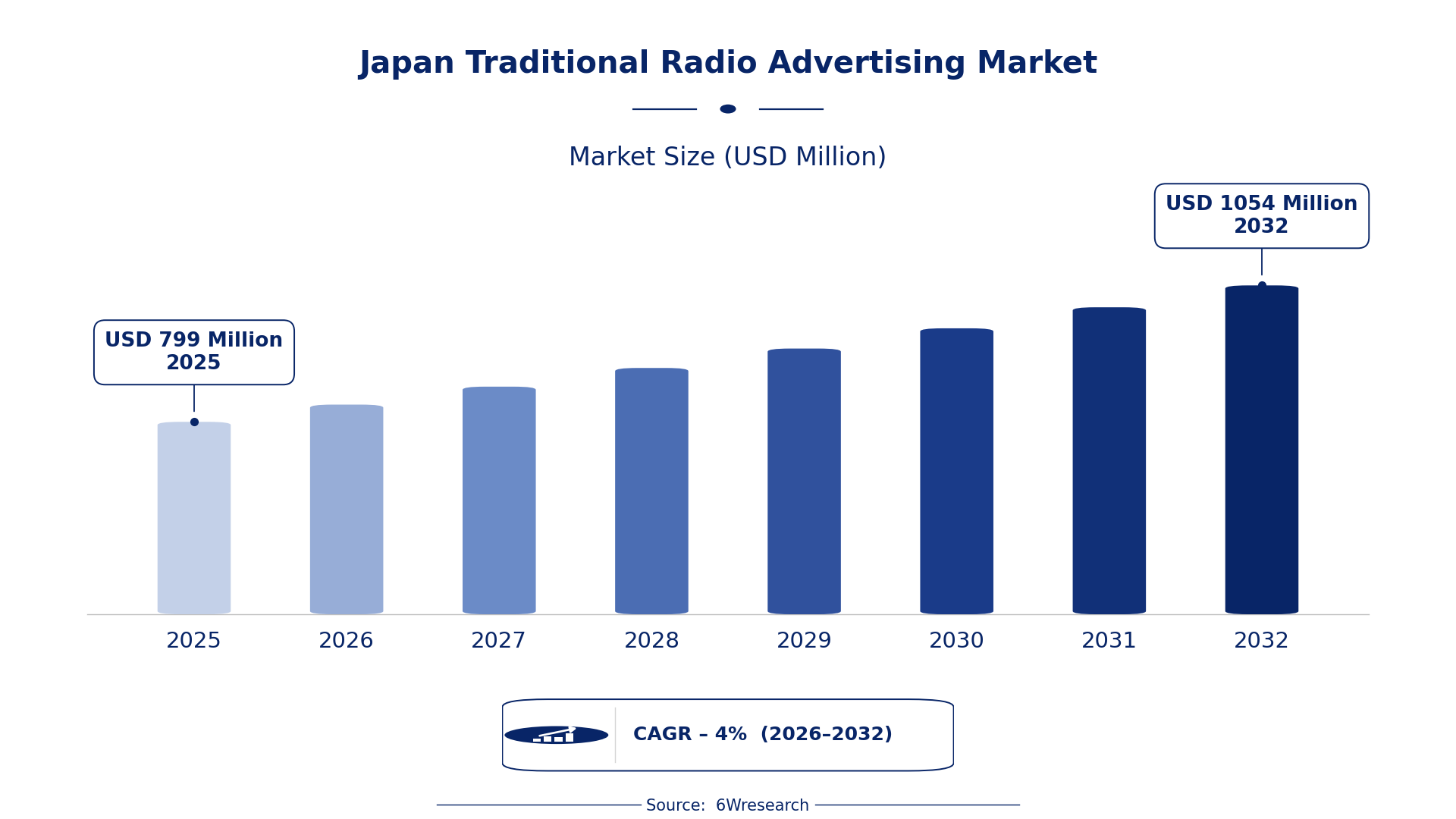
According to 6Wresearch internal database and industry insights, the Japan Traditional Radio Advertising Market was valued at USD 799 Million in 2025 and is projected to reach USD 1,054 Million by 2032, growing at a CAGR of approximately 4% during 2026–2032.
Japan Traditional Radio Advertising Market Highlights
| Report Metric | Details |
| Report Name | Japan Traditional Radio Advertising Market (2026-2032) |
| Market Size 2025 | USD 799 Million |
| Market Size 2032 | USD 1,054 Million |
| Absolute Growth 2025–2032 | USD 255 Million |
| CAGR 2026–2032 | 4% |
| Peak Annual Growth | 5.1% in 2029 |
| Forecast Period | 2026–2032 |
| Historical Data | 2022–2025 |
| Base Year | 2025 |
| Leading Type, 2025 | Terrestrial Radio Broadcast Advertising (58% share) |
| Leading Vertical, 2025 | Automotive (38% share) |
| Fastest-Growing Type | Satellite Radio Advertising (5.5% CAGR) |
| Fastest-Growing Vertical | Financial Services (5.6% CAGR) |
| Growing Sector | Automotive |
| Key End Users | Automotive brands, FMCG companies, media agencies, retailers |
Japan Traditional Radio Advertising Market Year-wise Growth Rate and Key Drivers (2022–2032)
This graph illustrates the annual growth rates of the market from 2022 to 2032, highlighting a steady upward trajectory and projected market expansion over the forecast period.
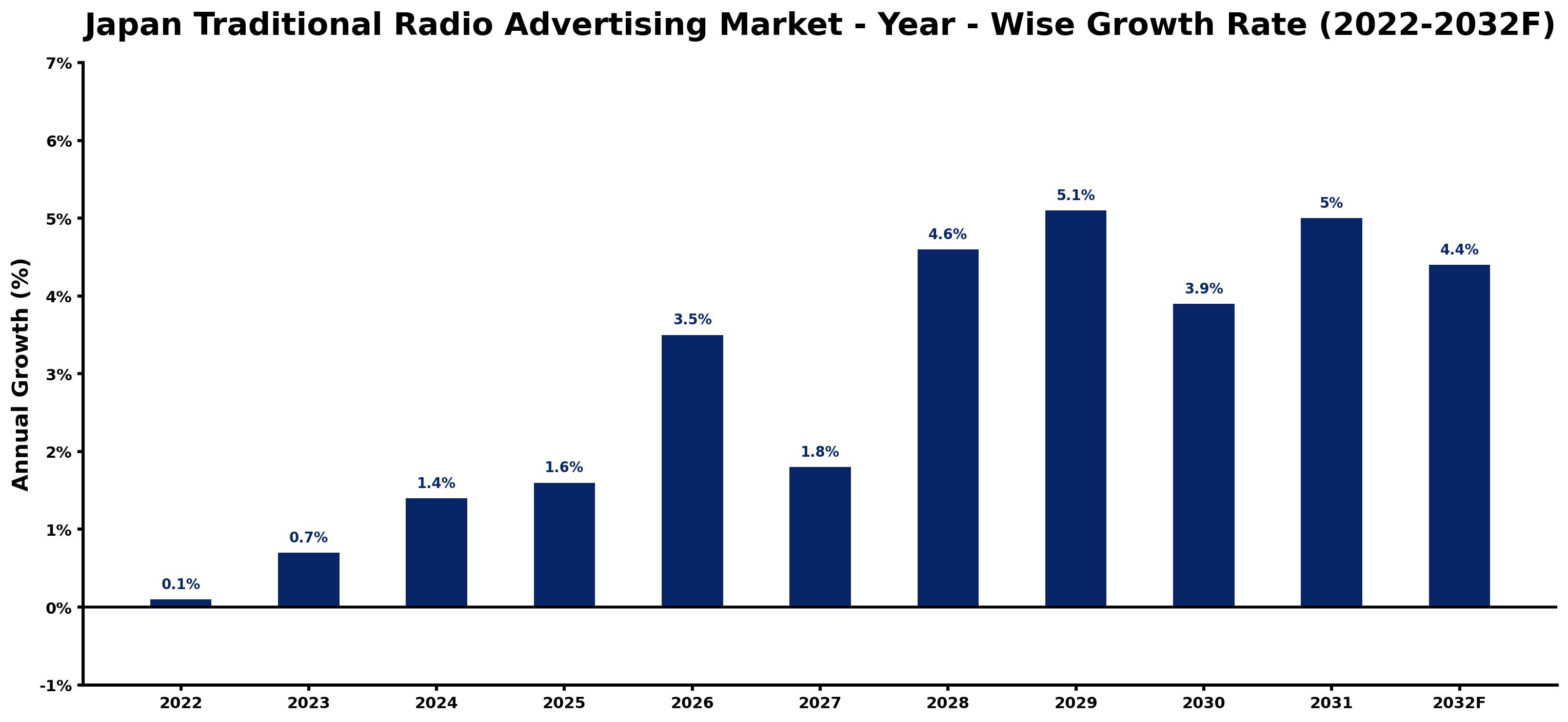
Below, each year's estimated growth is shown next to the factor that most influenced it.
| Year | Estimated Annual Growth (%) | Market Rationale |
| 2022 | 0.1 | The market experienced minimal growth due to limited advertising budgets from businesses. |
| 2023 | 0.7 | Growth accelerated as advertisers began to increase their spending on radio campaigns. |
| 2024 | 1.4 | The rise in radio listenership contributed to higher advertising revenues across sectors. |
| 2025 | 1.6 | A surge in automotive advertising on radio led to improved market performance. |
| 2026 | 3.5 | Increased digital transitions prompted advertisers to explore radio as a cost-effective medium. |
| 2027 | 1.8 | Growth slowed as competition from digital platforms began to impact traditional channels. |
| 2028 | 4.6 | A resurgence in FMCG advertising on radio stimulated renewed interest in the medium. |
| 2029 | 5.1 | Peak growth will be driven by automotive campaigns and increased listener engagement. |
| 2030 | 3.9 | The market growth rate will slow as advertisers diversify their media strategies. |
| 2031 | 5.0 | Increased investment in radio advertising by FMCG brands will lead to a strong year. |
| 2032 | 4.4 | Growth will moderate as advertisers balance their budgets across multiple platforms. |
Note: Market size estimations and growth projections presented in this report are based on 6Wresearch's proprietary forecasting methodology, utilizing the latest available industry data, government publications, and primary research inputs.
Japan Traditional Radio Advertising Market Synopsis
Traditional radio advertising in Japan promotes products through AM, FM, or satellite broadcasts, primarily targeting brand awareness and product promotion. In 2022, radio advertising revenue reached approximately 100 billion yen, driven by strong demand from sectors such as automotive and FMCG. The market is growing due to increased advertising budgets, a rise in radio listenership, and the ongoing digital transition, which encourages advertisers to view radio as a cost-effective medium.
Market Dynamics Impact Analysis (2026–2032)
| Factor | Type | Impact | Primary Segment Affected |
| Increased advertising budgets from automotive brands drive demand for terrestrial radio advertising. | Driver | High | Terrestrial Radio Broadcast Advertising |
| The growing popularity of radio among younger demographics creates new opportunities for advertisers. | Driver | Medium | Terrestrial Radio Broadcast Advertising |
| The shift towards digital radio opens new avenues for advertisers seeking innovative platforms. | Opportunity | High | Satellite Radio Advertising |
| The increasing integration of radio with digital platforms allows advertisers to reach broader audiences. | Opportunity | Medium | Terrestrial Radio Broadcast Advertising |
| Competition from digital advertising channels limits growth potential for traditional radio. | Restraint | High | Terrestrial Radio Broadcast Advertising |
| The limited reach of satellite radio compared to terrestrial options restricts its growth. | Restraint | Medium | Satellite Radio Advertising |
| Supply chain disruptions affect the production of radio advertising content, delaying campaigns. | Challenge | High | Terrestrial Radio Broadcast Advertising |
| Technological limitations in some regions hinder the expansion of digital radio services. | Challenge | Medium | Satellite Radio Advertising |
Evaluation of Drivers in Japan Traditional Radio Advertising Market (2026–2032)
Below are the drivers that matter most for revenue growth, with supporting evidence.
| Drivers | Primary Segment Affected | Why It Matters (Evidence) |
| Increased automotive advertising spending | Terrestrial Radio Broadcast Advertising | In 2022, 60% of automotive ads were aired on terrestrial radio, boosting demand. |
| Rising listenership among younger audiences | Terrestrial Radio Broadcast Advertising | The average Japanese adult listens to radio for about 1.5 hours daily, increasing engagement. |
| Digital radio transitions | Satellite Radio Advertising | The government launched a programme in 2023 to support digital radio transitions, expanding reach. |
| Integration of radio with social media | Terrestrial Radio Broadcast Advertising | Advertising strategies increasingly incorporate social media, improving audience interaction. |
| Growing FMCG advertising | Terrestrial Radio Broadcast Advertising | Radio advertising is a key component for 70% of FMCG companies, driving demand. |
A wider customer base explains much of the growth, as automotive brands increased their advertising budgets, with 60% of ads aired on terrestrial radio in 2022. The average Japanese adult listens to radio for about 1.5 hours daily, which boosts engagement and encourages advertisers to invest more. The integration of radio with social media platforms is improving audience interaction, leading to more effective advertising strategies. The FMCG sector heavily utilises radio, with 70% of companies relying on it for brand promotion, further driving demand. Digital radio transitions are opening new avenues for growth, creating opportunities for advertisers to connect with younger demographics.
Evaluation of Restraints in Japan Traditional Radio Advertising Market
Several factors work against faster growth; the main ones are summarised below.
| Market Restraint | Primary Segment Affected | Why It Matters (Evidence) |
| Competition from digital advertising channels limits growth potential for traditional radio. | Terrestrial Radio Broadcast Advertising | The rise of digital platforms has diverted advertising budgets away from traditional media, affecting revenue. |
| Limited reach of satellite radio compared to terrestrial options restricts its growth. | Satellite Radio Advertising | With fewer users, satellite radio struggles to attract advertising revenue. |
| Supply chain disruptions affect the production of radio advertising content, delaying campaigns. | Terrestrial Radio Broadcast Advertising | Content production delays can lead to missed advertising opportunities for brands. |
| Technological limitations in some regions hinder the expansion of digital radio services. | Satellite Radio Advertising | Inadequate infrastructure restricts access to digital radio, limiting audience growth. |
| High production costs for quality radio ads can deter smaller advertisers. | Terrestrial Radio Broadcast Advertising | Smaller brands may find it challenging to allocate budgets for effective radio campaigns. |
Japan Traditional Radio Advertising Market Challenges
In 2022, radio advertising revenue in Japan was approximately 100 billion yen, highlighting the cost pressures faced by radio stations competing with digital platforms. Many agencies lack the skills to transition to digital formats, which hampers growth and leads to lost revenue opportunities for producers. Regulatory requirements from the Ministry of Internal Affairs and Communications impose compliance costs, straining radio stations and reducing their operational efficiency. Buyers face challenges as 60% of automotive ads are still aired on traditional channels, while contending with a market where digital options provide more precise targeting and analytics.
Trends in the Japan Traditional Radio Advertising Market
Below are the shifts with the largest effect on the Japan Traditional Radio Advertising Market.
- Shift from Terrestrial to Digital Radio Advertising: In 2023, a government initiative was launched to support digital radio transitions, encouraging advertisers to explore new formats. This shift is anticipated to increase overall advertising revenue in the sector.
- Rising Engagement through Social Media Integration: Tokyo is experiencing a trend where radio advertising is increasingly integrated with social media campaigns, improving audience engagement. This approach has led to a notable increase in listener interaction.
- Automotive Brands Focusing on Radio: Automotive brands are prioritising radio advertising, with 60% of their ads aired on terrestrial channels in 2022. This focus is expected to drive revenue growth in the sector.
- Growth of Localised Radio Content: Local retailers are investing in radio advertising to promote sales events, with Tokyo and Osaka being the largest markets. This trend is projected to boost local advertising revenue significantly.
Investment Opportunities in the Japan Traditional Radio Advertising Market
Below are the investment opportunities with the strongest case in the Japan Traditional Radio Advertising Market.
- Current Demand for Digital Radio: With the government's support for digital transitions, there is an opportunity for advertisers to invest in digital radio platforms, targeting younger demographics who are increasingly tuning in.
- Automotive Sector's Radio Advertising Needs: The automotive sector is actively seeking advertising solutions, making it an ideal time for agencies to partner with radio stations to create tailored campaigns.
- Entry into Local Radio Markets: The growing demand for localised content presents opportunities for partnerships with regional radio stations, allowing advertisers to effectively reach targeted audiences.
- Gap in Satellite Radio Advertising: With satellite radio underutilised, there is an opportunity for advertisers to invest in this segment, especially as digital transitions gain traction.
Government Initiatives in the Japan Traditional Radio Advertising Market
The Ministry of Internal Affairs and Communications oversees radio broadcasting regulations, ensuring compliance with industry standards. The Japanese Association of Radio Broadcasters promotes best practices, helping maintain quality in traditional radio advertising. These measures support advertisers by providing a framework for effective campaigns and ensuring that content meets regulatory requirements.
In 2023, the government allocated JPY 5 billion to support digital radio transitions, administered by the Ministry of Internal Affairs and Communications. This funding aims to improve the capabilities of radio broadcasters and the overall advertising environment.
Future Insight of the Japan Traditional Radio Advertising Market
The shift towards digital radio technologies will redefine advertising strategies by 2032. As radio stations adopt these technologies, audience engagement and data analysis will improve significantly. The government's support programme for digital transitions will facilitate this transformation. By 2032, the average Japanese adult's daily radio listening time will decrease, prompting buyers to rethink their marketing strategies and suppliers to explore digital avenues.
Market Segmentation Analysis
Japan Traditional Radio Advertising Market report covers a detailed analysis of the following market segments:
By Type – Terrestrial Radio Broadcast Advertising Leads, Satellite Radio Advertising Expected to Grow Fastest
According to Vasudha, AM at 6Wresearch, Terrestrial Radio Broadcast Advertising accounted for 58% of the market by type in 2025. Terrestrial Radio Broadcast Advertising holds the largest share due to its extensive reach across Japan, with over 100 AM and FM stations broadcasting nationwide. This method is the primary choice for advertisers aiming to connect with a broad audience, particularly in major markets like Tokyo and Osaka. Satellite Radio Advertising is set to record the highest CAGR in this split, 5.5% over 2026–2032. Satellite Radio Advertising is experiencing rapid growth as consumers increasingly seek diverse audio content options, supported by the government's recent programme to facilitate digital radio transitions. This shift indicates a growing acceptance of satellite options among listeners, which may lead to increased advertising revenue in this segment. Suppliers should consider expanding their offerings to include satellite options to capture the evolving preferences of advertisers.
By Vertical – Automotive Leads, Financial Services Expected to Grow Fastest
In 2025, Automotive led the vertical split with a 38% share. The Automotive sector commands the largest share of radio advertising as it consistently utilises audio promotions, with 60% of automotive ads aired on terrestrial radio in 2022. This strong reliance on radio reflects the sector's strategy to effectively engage with a broad audience. Over 2026–2032, Financial Services are expected to post the fastest growth, at a CAGR of 5.6%. Financial Services is witnessing the fastest growth due to a rising awareness of radio's potential to connect with prospective clients, even though it is less frequently used than other media. This shift suggests a growing inclination towards audio channels for improving client outreach. Suppliers should focus on the financial sector to leverage its increasing interest in radio advertising.
Key Attractiveness of the Report
- 10 Years of Market Numbers
- Historical Data Starting from 2022 to 2025
- Base Year 2025
- Forecast Data until 2032
- Key Performance Indicators Impacting the Market
- Major Upcoming Developments and Projects
Key Highlights of the Report:
- Japan Traditional Radio Advertising Market Outlook
- Market Size of Japan Traditional Radio Advertising Market, 2025
- Forecast of Japan Traditional Radio Advertising Market, 2032
- Historical Data and Forecast of Japan Traditional Radio Advertising Revenues & Volume for the Period 2022-2032
- Japan Traditional Radio Advertising Market Trend Evolution
- Japan Traditional Radio Advertising Market Drivers and Challenges
- Japan Traditional Radio Advertising Price Trends
- Japan Traditional Radio Advertising Porter's Five Forces
- Japan Traditional Radio Advertising Industry Life Cycle
- Historical Data and Forecast of Japan Traditional Radio Advertising Market Revenues & Volume By Type for the Period 2022-2032
- Historical Data and Forecast of Japan Traditional Radio Advertising Market Revenues & Volume By Terrestrial Radio Broadcast Advertising for the Period 2022-2032
- Historical Data and Forecast of Japan Traditional Radio Advertising Market Revenues & Volume By Satellite Radio Advertising for the Period 2022-2032
- Historical Data and Forecast of Japan Traditional Radio Advertising Market Revenues & Volume By Vertical for the Period 2022-2032
- Historical Data and Forecast of Japan Traditional Radio Advertising Market Revenues & Volume By Automotive for the Period 2022-2032
- Historical Data and Forecast of Japan Traditional Radio Advertising Market Revenues & Volume By Financial Services for the Period 2022-2032
- Historical Data and Forecast of Japan Traditional Radio Advertising Market Revenues & Volume By Media & Entertainment for the Period 2022-2032
- Historical Data and Forecast of Japan Traditional Radio Advertising Market Revenues & Volume By FMCG for the Period 2022-2032
- Historical Data and Forecast of Japan Traditional Radio Advertising Market Revenues & Volume By Retail for the Period 2022-2032
- Historical Data and Forecast of Japan Traditional Radio Advertising Market Revenues & Volume By Real Estate for the Period 2022-2032
- Historical Data and Forecast of Japan Traditional Radio Advertising Market Revenues & Volume By Education for the Period 2022-2032
- Historical Data and Forecast of Japan Traditional Radio Advertising Market Revenues & Volume By Others for the Period 2022-2032
- Japan Traditional Radio Advertising Import Export Trade Statistics
- Market Opportunity Assessment By Type
- Market Opportunity Assessment By Vertical
- Japan Traditional Radio Advertising Top Companies Market Share
- Japan Traditional Radio Advertising Competitive Benchmarking By Technical and Operational Parameters
- Japan Traditional Radio Advertising Company Profiles
- Japan Traditional Radio Advertising Key Strategic Recommendations
Market Covered
The following segment groups are covered in the report.
By Type
- Terrestrial Radio Broadcast Advertising
- Satellite Radio Advertising
By Vertical
- Automotive
- Financial Services
- Media & Entertainment
- FMCG
- Retail
- Real Estate
- Education
- Others































