Japan Transcatheter Aortic Valve Replacement (TAVR) Market Size & Growth Rate
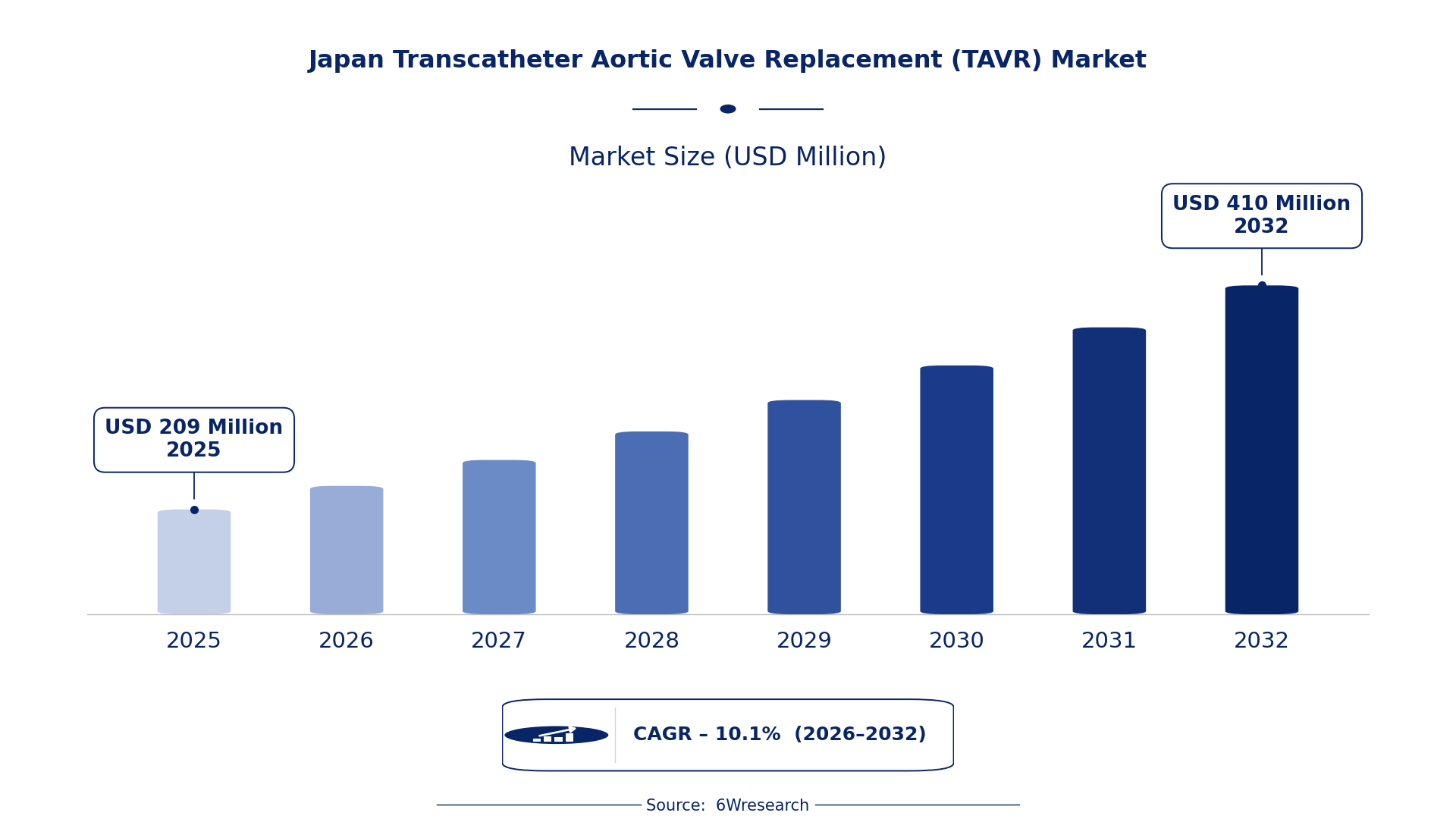
According to 6Wresearch internal database and industry insights, the Japan Transcatheter Aortic Valve Replacement (TAVR) Market was valued at USD 209 Million in 2025 and is projected to reach USD 410 Million by 2032, growing at a CAGR of approximately 10.1% during 2026–2032.
Japan Transcatheter Aortic Valve Replacement (TAVR) Market Highlights
| Report Metric | Details |
| Report Name | Japan Transcatheter Aortic Valve Replacement (TAVR) Market (2026-2032) |
| Market Size 2025 | USD 209 Million |
| Market Size 2032 | USD 410 Million |
| Absolute Growth 2025–2032 | USD 201 Million |
| CAGR 2026–2032 | 10.1% |
| Peak Annual Growth | 10.8% in 2026 |
| Forecast Period | 2026–2032 |
| Historical Data | 2022–2025 |
| Base Year | 2025 |
| Leading Type, 2025 | Transfemoral Approach (48% share) |
| Leading Application, 2025 | Aortic Stenosis (53% share) |
| Fastest-Growing Type | Transapical Approach (13.6% CAGR) |
| Fastest-Growing Application | Aortic Regurgitation (12.9% CAGR) |
| Growing Sector | Cardiology |
| Key End Users | hospitals, healthcare providers, cardiologists |
Japan Transcatheter Aortic Valve Replacement (TAVR) Market Year-wise Growth Rate and Key Drivers (2022–2032)
This graph illustrates the annual growth rates of the market from 2022 to 2032, highlighting a steady upward trajectory and projected market expansion over the forecast period.
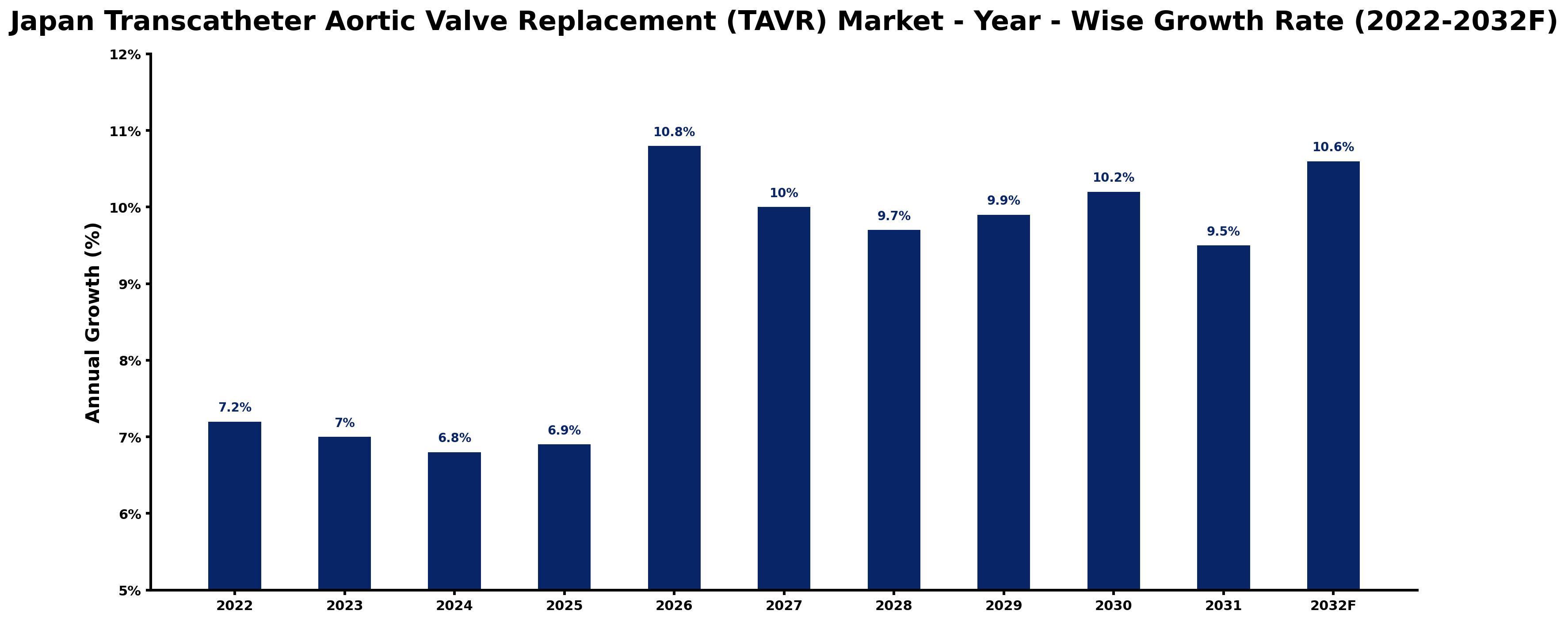
The yearly estimates that follow link every growth rate to its principal driver, so readers can see why the pace changed in each period.
| Year | Estimated Annual Growth (%) | Market Rationale |
| 2022 | 7.2 | The market showed strong activity with a high number of procedures performed. |
| 2023 | 7.0 | Growth slowed slightly as healthcare providers adjusted to evolving guidelines and practices. |
| 2024 | 6.8 | A continued slowdown occurred as the market stabilised after rapid growth in previous years. |
| 2025 | 6.9 | Growth accelerated as hospitals increased TAVR adoption in response to positive clinical outcomes. |
| 2026 | 10.8 | Demand is expected to surge due to advancements in TAVR technology and training programmes. |
| 2027 | 10.0 | Growth is projected to slow as the market begins to normalise after the peak in the previous year. |
| 2028 | 9.7 | A slight slowdown is anticipated as hospitals optimise their TAVR protocols and resources. |
| 2029 | 9.9 | Growth is expected to pick up again as new clinical studies reinforce the benefits of TAVR. |
| 2030 | 10.2 | Demand will continue to rise as healthcare facilities expand their TAVR offerings. |
| 2031 | 9.5 | Growth is projected to slow as the market approaches saturation in key regions. |
| 2032 | 10.6 | Demand is expected to rise again as new technologies and training methods emerge. |
Note: Market size estimations and growth projections presented in this report are based on 6Wresearch's proprietary forecasting methodology, utilizing the latest available industry data, government publications, and primary research inputs.
Japan Transcatheter Aortic Valve Replacement (TAVR) Market Synopsis
Transcatheter Aortic Valve Replacement (TAVR) is a minimally invasive procedure that replaces a narrowed aortic valve, primarily for patients with aortic stenosis. In 2022, approximately 15,000 TAVR procedures were performed in Japan, reflecting strong demand from domestic healthcare providers. The Japan Transcatheter Aortic Valve Replacement (TAVR) Market is driven by advancements in TAVR technology, increasing awareness among healthcare professionals, and supportive training programmes that encourage adoption among hospitals and cardiologists.
Market Dynamics Impact Analysis (2026–2032)
| Factor | Type | Impact | Primary Segment Affected |
| Growing number of TAVR procedures performed annually | Driver | High | Transfemoral Approach |
| Advancements in TAVR technology and techniques | Driver | High | Transfemoral Approach |
| Increasing awareness of TAVR benefits among healthcare providers | Opportunity | High | Aortic Stenosis |
| Expansion of training programmes for cardiologists | Opportunity | High | Transfemoral Approach |
| Regulatory compliance requirements for TAVR devices | Restraint | Medium | Transfemoral Approach |
| Limited availability of advanced training for healthcare professionals | Restraint | Medium | Transfemoral Approach |
| High costs associated with TAVR procedures | Challenge | High | Aortic Stenosis |
| Potential delays in regulatory approvals for new devices | Challenge | Medium | Transfemoral Approach |
Evaluation of Drivers in Japan Transcatheter Aortic Valve Replacement (TAVR) Market (2026–2032)
Key forces behind demand, with the segment each one moves most, are listed below.
| Drivers | Primary Segment Affected | Why It Matters (Evidence) |
| Increased number of TAVR procedures | Transfemoral Approach | In 2022, over 15,000 procedures were performed, leading to higher demand for TAVR devices. |
| Technological advancements in TAVR | Transfemoral Approach | New bioprosthetic valves have improved patient outcomes, encouraging hospitals to adopt TAVR more widely. |
| Awareness of TAVR benefits | Aortic Stenosis | The Japan Society of Interventional Cardiology promotes TAVR guidelines, boosting provider interest and adoption. |
| Training programmes for cardiologists | Transfemoral Approach | The Ministry of Health, Labour and Welfare supports TAVR training, increasing procedure adoption across facilities. |
| Clinical studies demonstrating TAVR efficacy | Transfemoral Approach | Recent studies show improved survival rates, motivating healthcare providers to offer TAVR more frequently. |
The strongest pull on demand comes from the increasing number of TAVR procedures performed, with approximately 15,000 conducted in 2022. Technological advancements in bioprosthetic valves have improved patient outcomes, leading hospitals to adopt TAVR more widely. New clinical studies demonstrating improved survival rates in high-risk patients are encouraging healthcare providers to expand their TAVR offerings, ensuring better patient outcomes and higher demand for devices.
Evaluation of Restraints in Japan Transcatheter Aortic Valve Replacement (TAVR) Market
The following restraints limit how fast demand can grow.
| Market Restraint | Primary Segment Affected | Why It Matters (Evidence) |
| High costs of TAVR procedures | Transfemoral Approach | The average cost of TAVR procedures can be prohibitive, limiting access for some patients. |
| Regulatory compliance for TAVR devices | Transfemoral Approach | Compliance with JIS standards can delay market entry for new TAVR devices. |
| Limited training opportunities for healthcare professionals | Transfemoral Approach | The availability of advanced training programmes is insufficient to meet growing demand. |
| Variability in hospital adoption rates | Aortic Stenosis | Differences in hospital resources and expertise affect the speed of TAVR adoption. |
| Potential delays in clinical study outcomes | Transfemoral Approach | New studies may take time to complete, slowing the introduction of improved techniques. |
Japan Transcatheter Aortic Valve Replacement (TAVR) Market Challenges
In 2022, 15,000 TAVR procedures were performed in Japan, leading to high operational costs for hospitals due to the expensive bioprosthetic valves. Price competition in Tokyo and Osaka pressures producers to lower margins, which can result in reduced investment in quality improvements. A shortage of trained cardiologists limits procedure availability, increasing waiting times for patients who need timely interventions. Compliance with JIS standards for medical devices imposes additional costs on producers, potentially delaying product availability and restricting patient access to necessary treatments.
Trends in the Japan Transcatheter Aortic Valve Replacement (TAVR) Market
The following changes are redrawing the Japan Transcatheter Aortic Valve Replacement (TAVR) Market.
- Shift to Minimally Invasive Procedures: Tokyo is experiencing a shift towards minimally invasive procedures, with over 80% of TAVR procedures using the transfemoral approach. This trend reflects a growing preference for less invasive options among patients and healthcare providers.
- Increased Focus on Training: In 2023, the Japanese Ministry of Health, Labour and Welfare launched a new training initiative for cardiologists, aiming to improve TAVR procedure proficiency. This effort supports the rising number of procedures performed annually, which reached approximately 15,000 in 2022.
- Emergence of New Clinical Studies: A new clinical study on TAVR outcomes was launched in 2023, highlighting the procedure's benefits. Such studies are critical for reinforcing the efficacy of TAVR, which has improved survival rates in high-risk patients.
- Growing Demand from Aged Population: With the average age of TAVR patients around 80 years, the demand for these procedures is increasing. This demographic trend is particularly evident in Osaka, where healthcare facilities are adapting to meet the needs of older patients.
Investment Opportunities in the Japan Transcatheter Aortic Valve Replacement (TAVR) Market
The following opportunities in the Japan Transcatheter Aortic Valve Replacement (TAVR) Market pair current demand with a clear way in.
- Expansion of TAVR Facilities in Tokyo: Tokyo is currently expanding its TAVR facilities, with a focus on increasing procedure capacity. This expansion is necessary due to the rising number of aortic stenosis cases, with approximately 15,000 procedures performed in 2022.
- Investment in Training Programmes: Now is the ideal time to invest in training programmes for cardiologists, as the Ministry of Health, Labour and Welfare supports these initiatives. This investment can improve TAVR procedure proficiency among healthcare providers.
- Collaboration with Healthcare Providers: Collaborating with hospitals in Osaka presents an opportunity to supply TAVR devices and training. This partnership can facilitate access to the growing market, which is projected to reach USD 410 million by 2032.
- Development of New TAVR Technologies: The increasing demand for TAVR creates opportunities for developing new technologies. Engaging with the Japan Society of Interventional Cardiology can provide insights into the latest advancements and market needs.
Government Initiatives in the Japan Transcatheter Aortic Valve Replacement (TAVR) Market
The Water Supply Act of 1957 sets standards for drinking-water quality and supply, while the Sewerage Act of 1958 governs sewerage systems and wastewater treatment. These laws ensure that medical facilities providing TAVR procedures maintain high standards of hygiene and safety, which is critical for patient outcomes.
The Japanese Ministry of Health, Labour and Welfare oversees the approval of TAVR devices and supports training initiatives for cardiologists. With funding aimed at improving procedural proficiency, the ministry facilitates TAVR adoption across healthcare facilities.
Future Insight of the Japan Transcatheter Aortic Valve Replacement (TAVR) Market
Japan's commitment to cutting greenhouse-gas emissions by 46% by fiscal 2030 will drive the development of more sustainable TAVR devices. By 2032, improved training programmes for cardiologists will enhance procedural efficiency and patient outcomes. New clinical studies will provide critical insights, fostering innovation in TAVR techniques. Consequently, hospitals can expect better patient throughput and shorter average hospital stays, which currently last about 5 days.
Market Segmentation Analysis
Japan Transcatheter Aortic Valve Replacement (TAVR) Market report covers a detailed analysis of the following market segments:
By Type – Transfemoral Approach Leads, Transapical Approach Expected to Grow Fastest
According to Vasudha, AM at 6Wresearch, with 48% of type revenue in 2025, Transfemoral Approach was the largest category. The Transfemoral Approach holds the largest share as it is the most commonly used method for TAVR, accounting for over 80% of procedures in Japan. Its appeal lies in its minimally invasive nature, making it a preferred choice among healthcare providers in regions like Tokyo and Osaka. Over 2026–2032, Transapical Approach is expected to post the fastest growth, at a CAGR of 13.6%. The Transapical Approach is experiencing rapid growth due to its application in patients with specific anatomical challenges, leading to increased utilisation in high-risk cases. Recent clinical studies have highlighted its effectiveness, which has spurred interest among cardiologists and expanded its adoption. This trend suggests that suppliers should focus on enhancing support and training for the Transapical Approach to meet the changing demands of healthcare providers.
By Application – Aortic Stenosis Leads, Aortic Regurgitation Expected to Grow Fastest
In 2025, Aortic Stenosis led the application split with a 53% share. Aortic Stenosis is the leading application for TAVR, as it is the primary condition addressed by the procedure, with approximately 15,000 cases performed in Japan annually. This high volume reflects the critical need for effective treatment options for patients suffering from this severe condition. Aortic Regurgitation is projected to grow fastest, at a CAGR of 12.9% during 2026–2032. Aortic Regurgitation is seeing the fastest growth in TAVR applications due to increasing recognition of the procedure's benefits for this condition. As awareness rises, more healthcare providers are likely to consider TAVR as a viable option for patients with aortic regurgitation. Buyers should prepare for a shift in treatment protocols as Aortic Regurgitation becomes a more recognised application for TAVR.
Key Attractiveness of the Report
- 10 Years of Market Numbers
- Historical Data Starting from 2022 to 2025
- Base Year 2025
- Forecast Data until 2032
- Key Performance Indicators Impacting the Market
- Major Upcoming Developments and Projects
Key Highlights of the Report:
- Japan Transcatheter Aortic Valve Replacement (TAVR) Market Outlook
- Market Size of Japan Transcatheter Aortic Valve Replacement (TAVR) Market, 2025
- Forecast of Japan Transcatheter Aortic Valve Replacement (TAVR) Market, 2032
- Historical Data and Forecast of Japan Transcatheter Aortic Valve Replacement (TAVR) Revenues & Volume for the Period 2022-2032
- Japan Transcatheter Aortic Valve Replacement (TAVR) Market Trend Evolution
- Japan Transcatheter Aortic Valve Replacement (TAVR) Market Drivers and Challenges
- Japan Transcatheter Aortic Valve Replacement (TAVR) Price Trends
- Japan Transcatheter Aortic Valve Replacement (TAVR) Porter's Five Forces
- Japan Transcatheter Aortic Valve Replacement (TAVR) Industry Life Cycle
- Historical Data and Forecast of Japan Transcatheter Aortic Valve Replacement (TAVR) Market Revenues & Volume By Type for the Period 2022-2032
- Historical Data and Forecast of Japan Transcatheter Aortic Valve Replacement (TAVR) Market Revenues & Volume By Transfemoral Approach for the Period 2022-2032
- Historical Data and Forecast of Japan Transcatheter Aortic Valve Replacement (TAVR) Market Revenues & Volume By Transapical Approach for the Period 2022-2032
- Historical Data and Forecast of Japan Transcatheter Aortic Valve Replacement (TAVR) Market Revenues & Volume By Others for the Period 2022-2032
- Historical Data and Forecast of Japan Transcatheter Aortic Valve Replacement (TAVR) Market Revenues & Volume By Application for the Period 2022-2032
- Historical Data and Forecast of Japan Transcatheter Aortic Valve Replacement (TAVR) Market Revenues & Volume By Aortic Stenosis for the Period 2022-2032
- Historical Data and Forecast of Japan Transcatheter Aortic Valve Replacement (TAVR) Market Revenues & Volume By Aortic Regurgitation for the Period 2022-2032
- Historical Data and Forecast of Japan Transcatheter Aortic Valve Replacement (TAVR) Market Revenues & Volume By Others for the Period 2022-2032
- Japan Transcatheter Aortic Valve Replacement (TAVR) Import Export Trade Statistics
- Market Opportunity Assessment By Type
- Market Opportunity Assessment By Application
- Japan Transcatheter Aortic Valve Replacement (TAVR) Top Companies Market Share
- Japan Transcatheter Aortic Valve Replacement (TAVR) Competitive Benchmarking By Technical and Operational Parameters
- Japan Transcatheter Aortic Valve Replacement (TAVR) Company Profiles
- Japan Transcatheter Aortic Valve Replacement (TAVR) Key Strategic Recommendations
Market Covered
Segments analysed in this report are listed below.
By Type
- Transfemoral Approach
- Transapical Approach
- Others
By Application
- Aortic Stenosis
- Aortic Regurgitation
- Others































