Japan Ultrasound AI Market Size & Growth Rate
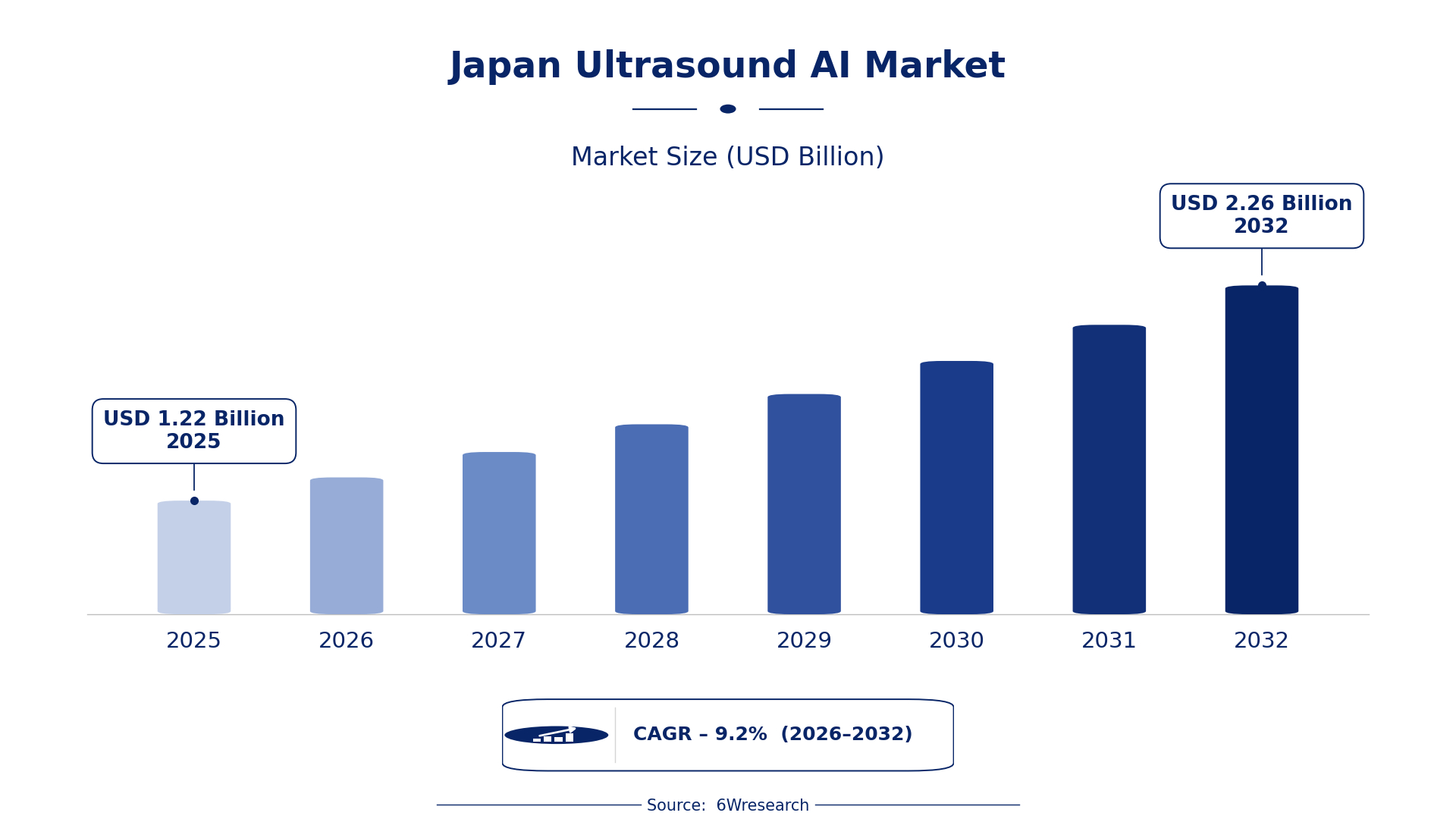
According to 6Wresearch internal database and industry insights, the Japan Ultrasound AI Market was valued at USD 1.22 billion in 2025 and is projected to reach USD 2.26 billion by 2032, growing at a CAGR of approximately 9.2% during 2026–2032.
Japan Ultrasound AI Market Highlights
| Report Metric | Details |
| Report Name | Japan Ultrasound AI Market |
| Market Size 2025 | USD 1.22 billion |
| Market Size 2032 | USD 2.26 billion |
| Absolute Growth 2025–2032 | USD 1.04 billion |
| CAGR 2026–2032 | 9.2% |
| Peak Annual Growth | 11.5% in 2028 |
| Forecast Period | 2026–2032 |
| Historical Data | 2022–2025 |
| Base Year | 2025 |
| Leading AI Feature, 2025 | Anomaly Detection (40% share) |
| Leading Application Area, 2025 | General Diagnostics (39% share) |
| Leading Deployment Mode, 2025 | On-Premise (37% share) |
| Leading End User, 2025 | Hospitals (35% share) |
| Fastest-Growing AI Feature | Workflow Automation (11.1% CAGR) |
| Fastest-Growing Application Area | Musculoskeletal (11.7% CAGR) |
| Fastest-Growing Deployment Mode | Cloud-Based (11.4% CAGR) |
| Fastest-Growing End User | AI Health Startups (10.2% CAGR) |
| Growing Sector | Musculoskeletal |
| Key End Users | General Diagnostics, OB/GYN, Cardiology, Musculoskeletal |
Japan Ultrasound AI Market Year-wise Growth Rate and Key Drivers (2022–2032)
This graph illustrates the annual growth rates of the market from 2022 to 2032, highlighting a steady upward trajectory and projected market expansion over the forecast period.
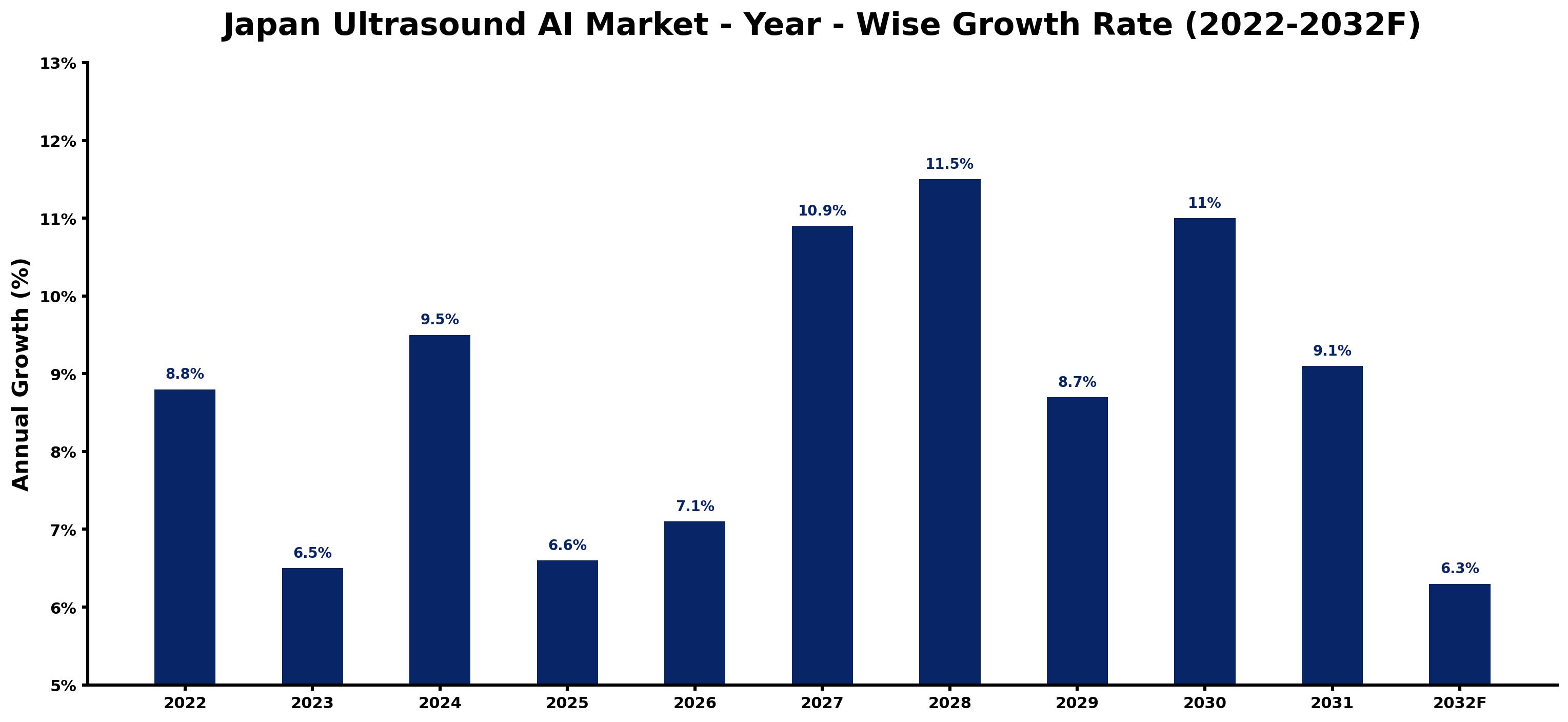
Annual growth estimates for each year appear below with the principal reason behind them, explaining the shifts that set the pace of the market.
| Year | Estimated Annual Growth (%) | Market Rationale |
| 2022 | 8.8 | The market was characterised by strong demand from hospitals and diagnostic labs. |
| 2023 | 6.5 | Growth slowed as hospitals adjusted to new technologies and workflows. |
| 2024 | 9.5 | Increased investments in diagnostic imaging technologies spurred faster growth. |
| 2025 | 6.6 | Demand stabilised as hospitals continued to integrate ultrasound AI into their practices. |
| 2026 | 7.1 | A renewed focus on improving diagnostic accuracy is expected to drive market growth. |
| 2027 | 10.9 | Rising healthcare expenditure supports investments in advanced imaging technologies. |
| 2028 | 11.5 | The peak growth year will be driven by advancements in AI algorithms and hospital adoption. |
| 2029 | 8.7 | Growth is projected to slow as the market begins to mature and competition increases. |
| 2030 | 11.0 | Technological innovations will revitalise interest in ultrasound AI solutions. |
| 2031 | 9.1 | Growth is expected to decelerate as market saturation begins to take effect. |
| 2032 | 6.3 | The market continues to grow, albeit at a slower pace, due to ongoing healthcare demands. |
Note: Market size estimations and growth projections presented in this report are based on 6Wresearch's proprietary forecasting methodology, utilizing the latest available industry data, government publications, and primary research inputs.
Japan Ultrasound AI Market Synopsis
Ultrasound AI in Japan encompasses advanced imaging technologies that improve diagnostic accuracy through artificial intelligence algorithms. This technology is developed using machine learning techniques and large datasets of ultrasound images. The Japan Ultrasound AI Market is expanding due to increasing healthcare expenditure, which reached approximately 42 trillion yen in 2023, and a growing population with rising diagnostic needs. Hospitals and diagnostic labs are primary users, driving demand for improved imaging solutions. The 'Healthcare Innovation Strategy' launched in 2023 aims to boost AI integration in healthcare, further supporting market growth.
Market Dynamics Impact Analysis (2026–2032)
| Factor | Type | Impact | Primary Segment Affected |
| Increasing healthcare expenditure drives demand for advanced imaging technologies. | Driver | High | General Diagnostics |
| Rising number of diagnostic imaging centers enhances service availability. | Driver | High | Diagnostic Labs |
| Growing demand for AI-enhanced imaging solutions presents investment opportunities. | Opportunity | High | Hospitals |
| Emerging AI Health Startups are seeking advanced imaging technologies. | Opportunity | Medium | AI Health Startups |
| Regulatory compliance can delay the introduction of new technologies. | Restraint | High | On-Premise |
| High initial costs of implementing ultrasound AI can limit adoption. | Restraint | Medium | Cloud-Based |
| Healthcare providers face challenges in integrating new technologies into existing workflows. | Challenge | High | Clinics |
| Competition among suppliers can lead to pricing pressures in the market. | Challenge | Medium | Hospitals |
Evaluation of Drivers in Japan Ultrasound AI Market (2026–2032)
The main growth drivers and the segments they affect most are set out below.
| Drivers | Primary Segment Affected | Why It Matters (Evidence) |
| Increased healthcare expenditure supports the adoption of advanced imaging technologies. | General Diagnostics | Japan's healthcare expenditure reached approximately 42 trillion yen in 2023, encouraging hospitals to invest in ultrasound AI. |
| The rising number of diagnostic imaging centers improves service availability. | Diagnostic Labs | With over 1,200 imaging centers across Japan, accessibility to advanced imaging solutions is improving. |
| The ageing population is increasing the demand for diagnostic imaging services. | Hospitals | As the average age of the population rises, hospitals are investing more in ultrasound AI for better health assessments. |
| The 'Healthcare Innovation Strategy' aims to integrate AI in healthcare. | AI Health Startups | This 2023 initiative promotes investment in AI technologies, leading to increased demand for ultrasound AI solutions. |
| The Japan Society of Ultrasonics in Medicine sets guidelines for best practices. | On-Premise | Following these guidelines encourages hospitals to adopt ultrasound AI for improved diagnostic accuracy. |
Growth in the Ultrasound AI market in Japan is driven by rising healthcare expenditure, a demand for advanced imaging technologies, and a growing number of diagnostic imaging centres. Japan's healthcare expenditure reached approximately 42 trillion yen in 2023, leading hospitals to invest in ultrasound AI for better diagnostic capabilities. The ageing population compels hospitals to seek improved health assessment tools as the average age continues to rise. The 'Healthcare Innovation Strategy' launched in 2023 supports AI integration in healthcare, further increasing demand for ultrasound AI solutions. As a result, diagnostic imaging centres are adopting these technologies to improve patient outcomes.
Evaluation of Restraints in Japan Ultrasound AI Market
Below mentioned are some major restraints and their influence on market dynamics.
| Market Restraint | Primary Segment Affected | Why It Matters (Evidence) |
| Regulatory compliance can delay the introduction of new technologies. | On-Premise | The PMD Act requires thorough testing and approval, which can extend the time to market for new ultrasound AI products. |
| High initial costs of implementing ultrasound AI can limit adoption. | Cloud-Based | The investment required for advanced imaging technologies may deter smaller clinics from adopting these solutions. |
| Integration challenges arise when incorporating new technologies into existing workflows. | Clinics | Healthcare providers may face difficulties adapting their processes to include ultrasound AI, impacting efficiency. |
| Limited awareness among some healthcare providers can hinder market penetration. | Diagnostic Labs | Some diagnostic labs may not fully understand the benefits of ultrasound AI, leading to slower adoption rates. |
| Competition among suppliers can lead to pricing pressures in the market. | Hospitals | As more players enter the market, hospitals may experience challenges in negotiating favourable terms for ultrasound AI solutions. |
Japan Ultrasound AI Market Challenges
Producers in the Japan Ultrasound AI market face regulatory hurdles, as the Ministry of Health, Labour and Welfare imposes strict standards that can delay product approvals by up to six months. Cost constraints burden hospitals, with healthcare expenditure reaching approximately 42 trillion yen in 2023, forcing many to limit investments in advanced ultrasound technologies. Technological challenges arise for diagnostic imaging centers, as outdated infrastructure restricts AI integration, leading to inefficiencies in workflows and lower diagnostic accuracy. Competition intensifies among over 200 AI health startups, resulting in price wars that can compromise service quality for hospitals and diagnostic labs.
Trends in the Japan Ultrasound AI Market
Below mentioned are some of the trends shaping the Japan Ultrasound AI Market growth.
- Shift from Traditional Imaging to AI Solutions: Japan is increasingly adopting AI-driven ultrasound technologies, with hospitals integrating these solutions to improve diagnostic accuracy. In 2023, the average number of ultrasound examinations reached around 8 million, reflecting this shift.
- Transition from On-Premise to Cloud-Based Solutions: The healthcare sector in Japan is moving towards cloud-based ultrasound AI solutions, driven by the need for flexible data management. By 2026, cloud-based deployments are expected to grow significantly, with a projected CAGR of 11.4%.
- Emergence of AI Health Startups in Medical Imaging: AI Health Startups are gaining traction in Japan, focusing on new applications of ultrasound AI. With over 200 active startups in the sector, this trend is reshaping the market dynamics.
- Increased Focus on Workflow Automation in Diagnostics: There is a growing emphasis on workflow automation within ultrasound diagnostics, improving efficiency in hospitals. The segment is projected to grow at a CAGR of 11.1% from 2026 to 2032.
Investment Opportunities in the Japan Ultrasound AI Market
Below are the investment opportunities with the strongest case in the Japan Ultrasound AI Market.
- Growing Demand for Advanced Imaging Solutions: The current healthcare environment in Japan presents an opportunity to supply advanced ultrasound AI technologies, with hospitals seeking improved diagnostic tools. The market size is expected to reach USD 2.26 billion by 2032.
- Investment in AI Health Startups: AI Health Startups are actively seeking ultrasound AI solutions to improve their offerings. Engaging with these startups can provide entry into a rapidly growing market segment.
- Partnerships with Diagnostic Labs: Collaborating with diagnostic labs can facilitate the introduction of ultrasound AI technologies. With over 1,200 imaging centers in Japan, this presents a significant opportunity for suppliers.
- Regulatory Compliance Solutions for Healthcare Providers: There is a need for solutions that assist healthcare providers in navigating regulatory compliance for ultrasound AI. This is particularly relevant as the PMD Act governs product approvals.
Government Initiatives in the Japan Ultrasound AI Market
The 'Healthcare Innovation Strategy' launched in 2023 aims to boost AI integration in healthcare, building on existing frameworks like the PMD Act, which regulates medical devices. This strategy facilitates funding and support for AI technologies, promoting the development and adoption of ultrasound AI in Japan. Additionally, the Japanese government allocated 10 billion yen for healthcare technology advancements, which will improve resources available for producers and buyers alike.
In 2022, the Japanese government allocated 10 billion yen for healthcare technology advancements, with the Ministry of Health, Labour and Welfare overseeing the implementation. The PMDA reviews and approves medical devices, ensuring compliance with safety and efficacy standards, which is essential for ultrasound AI producers. This oversight helps maintain high-quality standards in the industry.
Future Insight of the Japan Ultrasound AI Market
The Japan Ultrasound AI market will experience significant advancements by 2032, driven by the 'Healthcare Innovation Strategy' that encourages AI integration in medical practices. Buyers and suppliers will benefit from improved diagnostic accuracy as AI technologies evolve, supported by research initiatives from the National Institute of Advanced Industrial Science and Technology. The average number of ultrasound examinations per year is projected to increase to around 10 million, reflecting the rising healthcare demands of an ageing population. The healthcare workforce is set to grow by 5% by 2025, ensuring a skilled talent pool to support these developments.
Market Segmentation Analysis
The report offers a comprehensive study of the following market segments and their leading categories in the market.
By AI Feature – Anomaly Detection Dominated, Workflow Automation Expected to Grow Fastest
According to Bhawna Singh, Assistant Manager at 6Wresearch, Anomaly Detection held a 40% share of the Japan Ultrasound AI Market by ai feature in 2025. Anomaly Detection holds the largest share due to its critical role in identifying potential health issues in imaging, which is essential for hospitals. With over 8 million ultrasound examinations performed annually in Japan, this feature significantly enhances diagnostic accuracy. Workflow Automation is set to record the highest CAGR in this split, 11.1% over 2026–2032. Workflow Automation is experiencing rapid growth as healthcare facilities seek to streamline processes and reduce wait times, which average around two weeks in urban areas. As hospitals adopt more efficient operational practices, this trend is expected to gain momentum. Suppliers should focus on developing anomaly detection capabilities to meet the strong demand from hospitals.
By Application Area – General Diagnostics Dominated, Musculoskeletal Expected to Grow Fastest
General Diagnostics accounted for a 39% market share by application area in 2025. General Diagnostics commands the largest market share as it is extensively used for various health assessments across numerous medical conditions. Its widespread application in over 8,000 hospitals in Japan highlights its importance within the healthcare system. The quickest growth will come from Musculoskeletal, forecast to expand at a CAGR of 11.7% between 2026 and 2032. Musculoskeletal applications are experiencing swift growth, propelled by rising awareness of joint and muscle conditions among the ageing population. As the average age increases, the demand for specialised diagnostics in this area is anticipated to rise. Buyers should consider investing in ultrasound AI solutions tailored to general diagnostics to capitalise on the existing market demand.
By Deployment Mode – On-Premise Dominated, Cloud-Based Expected to Grow Fastest
In 2025, On-Premise led the deployment mode split with a 37% share. On-Premise deployment is preferred by hospitals for its direct benefits in data security, crucial for maintaining patient confidentiality. Japan's strict healthcare regulations require compliance and reliability in sensitive environments, making this mode the top choice. Over 2026–2032, Cloud-Based is expected to post the fastest growth, at a CAGR of 11.4%. Cloud-Based solutions are gaining traction as facilities pursue flexible storage options to manage increasing data volumes. This trend is likely to accelerate as more healthcare providers undergo digital transformation. Suppliers should enhance cloud offerings to attract hospitals seeking scalable and secure ultrasound AI solutions.
By End User – Hospitals Dominated, AI Health Startups Expected to Grow Fastest
Hospitals took a 35% share of end user in 2025, more than any other category. Hospitals dominate the market share as the primary users of ultrasound AI technology, employing it across various diagnostic procedures. The extensive network of over 8,000 hospitals in Japan creates substantial demand for these advanced imaging technologies. AI Health Startups are projected to grow fastest, at a CAGR of 10.2% during 2026–2032. AI Health Startups are rapidly emerging, developing new applications that leverage ultrasound AI technology to address specific healthcare challenges. This growth indicates a shift towards innovative solutions that could reshape the market. Suppliers should engage with AI Health Startups to explore collaborative opportunities that can drive innovation in ultrasound AI applications.
Key Attractiveness of the Report
- 10 Years of Market Numbers
- Historical Data Starting from 2022 to 2025
- Base Year 2025
- Forecast Data until 2032
- Key Performance Indicators Impacting the Market
- Major Upcoming Developments and Projects
Key Highlights of the Report:
- Japan Ultrasound AI Market Outlook
- Market Size of Japan Ultrasound AI Market, 2025
- Forecast of Japan Ultrasound AI Market, 2032
- Historical Data and Forecast of Japan Ultrasound AI Revenues & Volume for the Period 2022 - 2032F
- Japan Ultrasound AI Market Trend Evolution
- Japan Ultrasound AI Market Drivers and Challenges
- Japan Ultrasound AI Price Trends
- Japan Ultrasound AI Porter's Five Forces
- Japan Ultrasound AI Industry Life Cycle
- Historical Data and Forecast of Japan Ultrasound AI Market Revenues & Volume By AI Feature for the Period 2022 - 2032F
- Historical Data and Forecast of Japan Ultrasound AI Market Revenues & Volume By Image Enhancement for the Period 2022 - 2032F
- Historical Data and Forecast of Japan Ultrasound AI Market Revenues & Volume By Anomaly Detection for the Period 2022 - 2032F
- Historical Data and Forecast of Japan Ultrasound AI Market Revenues & Volume By Workflow Automation for the Period 2022 - 2032F
- Historical Data and Forecast of Japan Ultrasound AI Market Revenues & Volume By Decision Support for the Period 2022 - 2032F
- Historical Data and Forecast of Japan Ultrasound AI Market Revenues & Volume By Application Area for the Period 2022 - 2032F
- Historical Data and Forecast of Japan Ultrasound AI Market Revenues & Volume By General Diagnostics for the Period 2022 - 2032F
- Historical Data and Forecast of Japan Ultrasound AI Market Revenues & Volume By OB/GYN for the Period 2022 - 2032F
- Historical Data and Forecast of Japan Ultrasound AI Market Revenues & Volume By Cardiology for the Period 2022 - 2032F
- Historical Data and Forecast of Japan Ultrasound AI Market Revenues & Volume By Musculoskeletal for the Period 2022 - 2032F
- Historical Data and Forecast of Japan Ultrasound AI Market Revenues & Volume By Deployment Mode for the Period 2022 - 2032F
- Historical Data and Forecast of Japan Ultrasound AI Market Revenues & Volume By Cloud-Based for the Period 2022 - 2032F
- Historical Data and Forecast of Japan Ultrasound AI Market Revenues & Volume By On-Premise for the Period 2022 - 2032F
- Historical Data and Forecast of Japan Ultrasound AI Market Revenues & Volume By SaaS Platform for the Period 2022 - 2032F
- Historical Data and Forecast of Japan Ultrasound AI Market Revenues & Volume By Embedded Systems for the Period 2022 - 2032F
- Historical Data and Forecast of Japan Ultrasound AI Market Revenues & Volume By End User for the Period 2022 - 2032F
- Historical Data and Forecast of Japan Ultrasound AI Market Revenues & Volume By Hospitals for the Period 2022 - 2032F
- Historical Data and Forecast of Japan Ultrasound AI Market Revenues & Volume By Diagnostic Labs for the Period 2022 - 2032F
- Historical Data and Forecast of Japan Ultrasound AI Market Revenues & Volume By Clinics for the Period 2022 - 2032F
- Historical Data and Forecast of Japan Ultrasound AI Market Revenues & Volume By AI Health Startups for the Period 2022 - 2032F
- Japan Ultrasound AI Import Export Trade Statistics
- Market Opportunity Assessment By AI Feature
- Market Opportunity Assessment By Application Area
- Market Opportunity Assessment By Deployment Mode
- Market Opportunity Assessment By End User
- Japan Ultrasound AI Top Companies Market Share
- Japan Ultrasound AI Competitive Benchmarking By Technical and Operational Parameters
- Japan Ultrasound AI Company Profiles
- Japan Ultrasound AI Key Strategic Recommendations
Market Covered
Segments analysed in this report are listed below.
By AI Feature
- Image Enhancement
- Anomaly Detection
- Workflow Automation
- Decision Support
By Application Area
- General Diagnostics
- OB/GYN
- Cardiology
- Musculoskeletal
By Deployment Mode
- Cloud-Based
- On-Premise
- SaaS Platform
- Embedded Systems
By End User
- Hospitals
- Diagnostic Labs
- Clinics
- AI Health Startups































