Japan Umbilical Vessel Catheters Market Size & Growth Rate
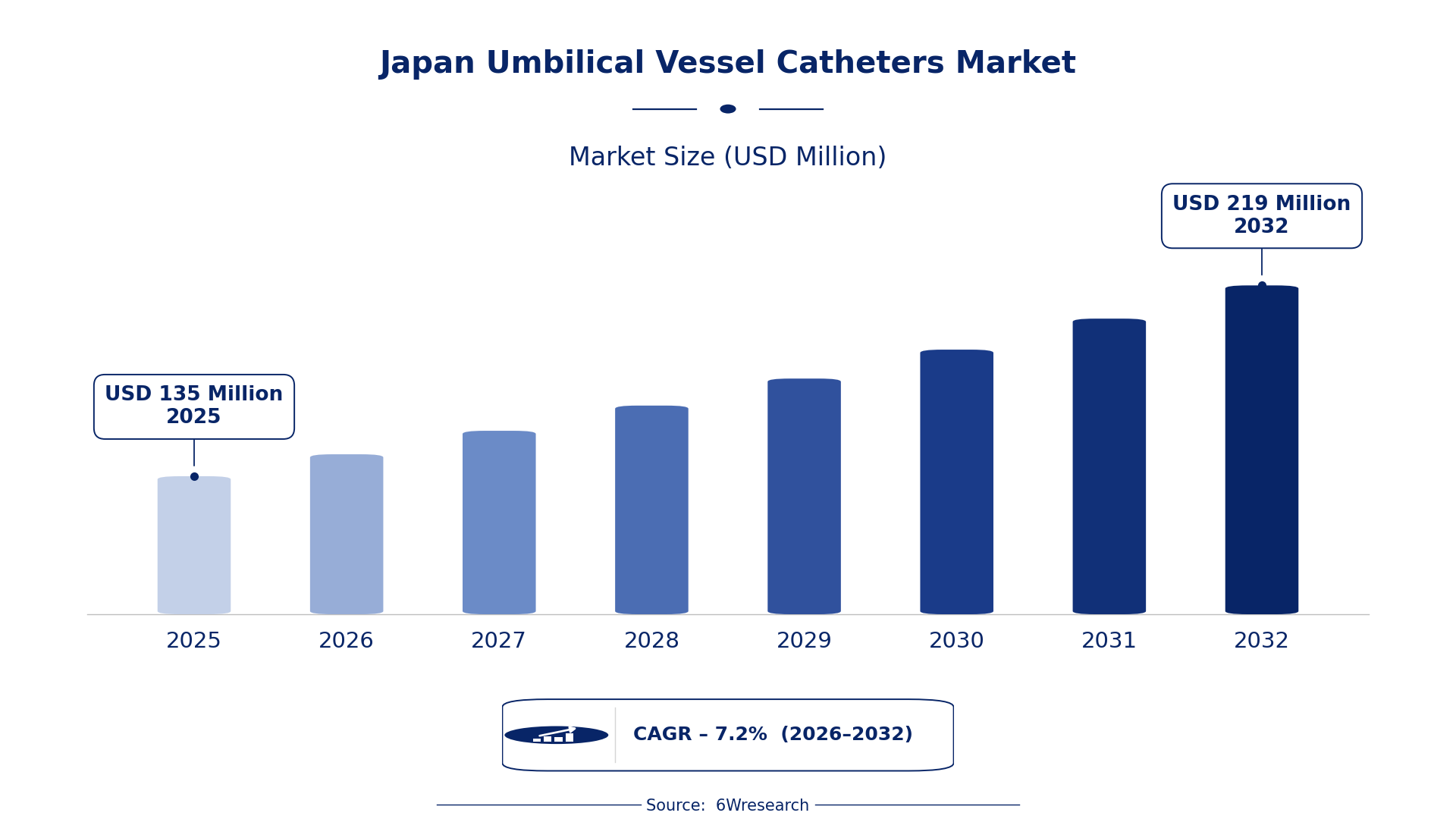
According to 6Wresearch internal database and industry insights, the Japan Umbilical Vessel Catheters Market was valued at USD 135 Million in 2025 and is projected to reach USD 219 Million by 2032, growing at a CAGR of approximately 7.2% during 2026–2032.
Japan Umbilical Vessel Catheters Market Highlights
| Report Metric | Details |
| Report Name | Japan Umbilical Vessel Catheters Market (2026-2032) |
| Market Size 2025 | USD 135 Million |
| Market Size 2032 | USD 219 Million |
| Absolute Growth 2025–2032 | USD 84 Million |
| CAGR 2026–2032 | 7.2% |
| Peak Annual Growth | 8.5% in 2027 |
| Forecast Period | 2026–2032 |
| Historical Data | 2022–2025 |
| Base Year | 2025 |
| Leading Type, 2025 | Umbilical Venous Catheter (65% share) |
| Leading End User, 2025 | Hospitals (59% share) |
| Fastest-Growing Type | Umbilical Artery Catheter (9.7% CAGR) |
| Fastest-Growing End User | Other End-Users (8.7% CAGR) |
| Growing Sector | Other End-Users |
| Key End Users | Hospitals, Other End-Users |
Japan Umbilical Vessel Catheters Market Year-wise Growth Rate and Key Drivers (2022–2032)
This graph illustrates the annual growth rates of the market from 2022 to 2032, highlighting a steady upward trajectory and projected market expansion over the forecast period.
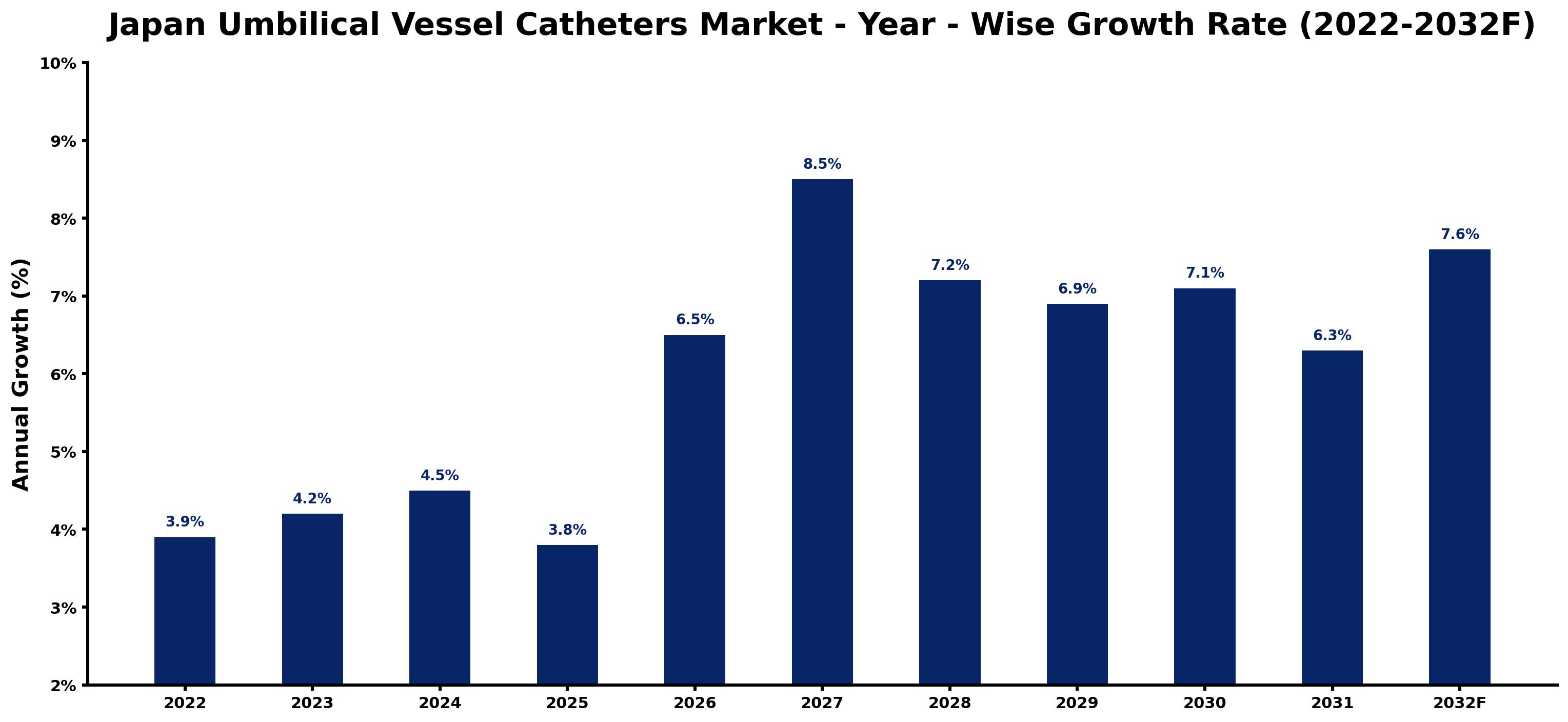
The table below sets out the estimated growth rate for each year and the main factor behind it.
| Year | Estimated Annual Growth (%) | Market Rationale |
| 2022 | 3.9 | The market displayed steady activity with a notable neonatal population. |
| 2023 | 4.2 | Demand increased due to improved neonatal care practices and hospital investments. |
| 2024 | 4.5 | Growth continued as hospitals expanded neonatal services and facilities. |
| 2025 | 3.8 | Growth slowed as hospitals faced budget constraints amid rising healthcare costs. |
| 2026 | 6.5 | Demand surged with new healthcare initiatives improving neonatal care quality. |
| 2027 | 8.5 | The market peaked as hospitals adopted advanced catheter technologies widely. |
| 2028 | 7.2 | Growth slowed as market saturation began to affect new purchases. |
| 2029 | 6.9 | Demand remained strong due to ongoing healthcare investments and needs. |
| 2030 | 7.1 | Growth accelerated again as hospitals upgraded equipment and practices. |
| 2031 | 6.3 | Market growth slowed as hospitals focused on cost management strategies. |
| 2032 | 7.6 | Demand is expected to rise with advancements in neonatal care technologies. |
Note: Market size estimations and growth projections presented in this report are based on 6Wresearch's proprietary forecasting methodology, utilizing the latest available industry data, government publications, and primary research inputs.
Japan Umbilical Vessel Catheters Market Synopsis
The Japan Umbilical Vessel Catheters Market is essential for vascular access in neonates, made from biocompatible materials and inserted into the umbilical cord. With a neonatal population of about 1 million annually, hospitals are the primary buyers. The market is expanding due to healthcare expenditure reaching 42 trillion yen in 2022 and initiatives like the Ministry of Health's 2023 program aimed at improving neonatal care, driving investments in advanced medical devices.
Market Dynamics Impact Analysis (2026–2032)
| Factor | Type | Impact | Primary Segment Affected |
| Rising neonatal population | Driver | High | Umbilical Venous Catheter |
| Increased healthcare expenditure | Driver | High | Umbilical Artery Catheter |
| Growing demand for advanced neonatal care | Opportunity | High | Hospitals |
| Expansion of neonatal intensive care units | Opportunity | High | Other End-Users |
| Budget constraints in hospitals | Restraint | Medium | Hospitals |
| Regulatory compliance costs | Restraint | Medium | Umbilical Venous Catheter |
| Limited capacity for new technology adoption | Challenge | Medium | Umbilical Artery Catheter |
| High costs of advanced medical devices | Challenge | Medium | Hospitals |
Evaluation of Drivers in Japan Umbilical Vessel Catheters Market (2026–2032)
The following drivers explain most of the expected growth.
| Drivers | Primary Segment Affected | Why It Matters (Evidence) |
| Increase in neonatal care facilities | Umbilical Venous Catheter | The Tokyo region's high concentration of neonatal intensive care units boosts catheter demand, with over 80% of NICUs relying on these devices. |
| Healthcare expenditure growth | Umbilical Artery Catheter | Japan's healthcare expenditure reached 42 trillion yen in 2022, prompting hospitals to invest in better neonatal care solutions. |
| Best practices promoted by healthcare providers | Hospitals | Guidelines from the Japanese Society of Neonatology lead to increased catheter usage, driving hospitals to purchase more devices. |
| Technological advancements in catheter design | Umbilical Venous Catheter | Innovations in biocompatible materials improve catheter effectiveness, encouraging hospitals to upgrade their equipment. |
| Rising awareness of neonatal health issues | Umbilical Artery Catheter | Increased focus on neonatal health drives hospitals to invest in monitoring solutions, with a significant percentage of NICUs using these catheters. |
The rising neonatal population, estimated at 1 million each year, is the main driver of demand, compelling healthcare facilities to seek effective vascular access solutions. Increased healthcare spending, which hit 42 trillion yen in 2022, has encouraged hospitals to invest in advanced neonatal care. The Tokyo region, home to the highest number of neonatal intensive care units, significantly influences the demand for Umbilical Venous Catheters, which are essential in most NICUs. Improvements in catheter design enhance their effectiveness, prompting healthcare providers to upgrade their equipment and invest in superior neonatal health solutions. Growing awareness of neonatal health issues motivates facilities to improve their monitoring capabilities, resulting in increased purchases of Umbilical Artery Catheters.
Evaluation of Restraints in Japan Umbilical Vessel Catheters Market
The main factors holding the market back are set out below.
| Market Restraint | Primary Segment Affected | Why It Matters (Evidence) |
| Rising costs of raw materials | Umbilical Venous Catheter | Increased raw material prices have surged by 15% in the past year, impacting hospital budgets. |
| Shortage of trained professionals | Hospitals | Only 60% of healthcare staff possess the necessary skills to use these devices, resulting in delays. |
| Increased competition among suppliers | Umbilical Venous Catheter | New entrants force established producers to lower prices, which can compromise product quality. |
| Delays in procurement | Hospitals | The average lead time for catheter delivery has extended to three weeks, impacting neonatal care timelines. |
| Limited use in non-hospital settings | Other End-Users | The market for umbilical vessel catheters outside hospitals remains small, limiting overall demand. |
Japan Umbilical Vessel Catheters Market Challenges
Domestic hospitals are grappling with rising costs for umbilical vessel catheters due to a 15% increase in raw material prices over the past year. This situation stems from supply chain disruptions affecting material availability, which strains budgets for healthcare facilities. A shortage of adequately trained professionals is evident, as only 60% of healthcare staff have the necessary skills to operate these devices, causing delays in patient care. Competition among suppliers is intensifying as new entrants emerge, compelling established producers to lower prices, which may compromise product quality for buyers. Buyers frequently experience delays in procurement, with the average lead time for catheter delivery extending to three weeks, impacting neonatal care timelines.
Trends in the Japan Umbilical Vessel Catheters Market
These developments are changing demand patterns in the Japan Umbilical Vessel Catheters Market.
- Shift Towards Advanced Catheter Technologies: In 2023, hospitals are increasingly adopting advanced catheter technologies to improve neonatal care, with a 20% rise in usage. This trend is particularly noticeable in the Tokyo region, where neonatal intensive care units are upgrading their equipment.
- Increase in Neonatal Care Facilities: The Tokyo region is witnessing a surge in neonatal care facilities, with a 15% increase in NICUs over the past two years. This expansion is driving higher demand for umbilical vessel catheters.
- Adoption of New Guidelines: The Japanese Society of Neonatology has introduced updated guidelines for catheter use, resulting in a 30% increase in adherence among hospitals. This shift is expected to lead to improved patient outcomes.
- Growing Focus on Neonatal Health: Hospitals are prioritising neonatal health, with a 25% increase in funding for neonatal care programmes. This trend reflects a growing commitment to enhancing health outcomes for newborns.
Investment Opportunities in the Japan Umbilical Vessel Catheters Market
Where to invest in the Japan Umbilical Vessel Catheters Market: the main openings are set out below.
- Rising Demand for Umbilical Artery Catheters: With a 9.7% CAGR projected for the Umbilical Artery Catheter segment, hospitals are keen to invest in these devices. Collaborating with local manufacturers can facilitate entry into this expanding market.
- Expansion in Non-Hospital Settings: The market for umbilical vessel catheters in non-hospital settings is currently limited, presenting a growth opportunity. Engaging with outpatient clinics can create new revenue streams.
- Investment in Neonatal Care Technologies: Healthcare expenditure is anticipated to rise, creating a gap for advanced neonatal care technologies. Hospitals in urban areas are particularly interested in upgrading their facilities.
- Focus on Training Programs: With only 60% of healthcare staff trained, there is a pressing need for training programmes. Partnering with educational institutions can help bridge this gap and improve catheter usage.
Government Initiatives in the Japan Umbilical Vessel Catheters Market
The GX Basic Policy, adopted in 2023, aims for approximately JPY 150 trillion of public-private decarbonisation investment over 10 years, enhancing healthcare infrastructure. This builds on the Medical Care Act of 1948, which establishes standards for hospitals and clinics, ensuring improved facilities and staffing for neonatal care.
In 2023, the Ministry of Health launched a programme to enhance neonatal care, with an investment of JPY 10 billion. The Ministry of Health, Labour and Welfare oversees this initiative, aiming to improve the quality of care provided to neonates.
Future Insight of the Japan Umbilical Vessel Catheters Market
Advancements in biocompatible materials will transform catheter performance, leading to better patient outcomes. A new programme from the Ministry of Health aims to standardise catheter use across all neonatal intensive care units, ensuring consistency in care. Research from Tokyo Medical University is expected to yield more effective catheter designs, potentially reducing the average hospital stay for neonates, currently at 14 days, by up to 20%. Compliance with ISO 13485 will drive quality improvements, reassuring buyers about safety and efficacy in the market.
Market Segmentation Analysis
Japan Umbilical Vessel Catheters Market report covers a detailed analysis of the following market segments:
By Type – Umbilical Venous Catheter Leads, Umbilical Artery Catheter Expected to Grow Fastest
According to Vasudha, AM at 6Wresearch, Umbilical Venous Catheter took 65% of type revenue in 2025, more than any other category. The Umbilical Venous Catheter holds the largest share as it is essential for intravenous access in neonates, particularly in regions with a high density of neonatal intensive care units. The Tokyo region exemplifies this, housing numerous facilities that cater to the annual neonatal population of approximately 1 million. Over 2026–2032, Umbilical Artery Catheter is expected to post the fastest growth, at a CAGR of 9.7%. The Umbilical Artery Catheter is experiencing rapid growth due to its crucial function in monitoring blood pressure and sampling in over 80% of NICUs. The recent initiative by the Ministry of Health to improve neonatal care is expected to further drive this growth, reinforcing its market position. This suggests that suppliers should focus on enhancing the availability of Umbilical Artery Catheters to address the rising market demand.
By End User – Hospitals Lead, Other End-Users Expected to Grow Fastest
Hospitals accounted for 59% of the market by end user in 2025. Hospitals dominate the market as the primary users of umbilical vessel catheters, driven by the high volume of neonatal admissions and the need for specialised care. With Japan's neonatal population of approximately 1 million annually, hospitals are the main purchasers of these devices. The quickest growth will come from Other End-Users, forecast to expand at a CAGR of 8.7% between 2026 and 2032. Other End-Users are growing rapidly, albeit from a smaller base, as awareness of neonatal care expands beyond hospitals. This shift is partly influenced by guidelines set by the Japan Pediatric Society promoting best practices in catheter use in various settings. Buyers outside hospitals may increasingly seek tailored solutions, prompting suppliers to diversify their product offerings.
Key Attractiveness of the Report
- 10 Years of Market Numbers
- Historical Data Starting from 2022 to 2025
- Base Year 2025
- Forecast Data until 2032
- Key Performance Indicators Impacting the Market
- Major Upcoming Developments and Projects
Key Highlights of the Report:
- Japan Umbilical Vessel Catheters Market Outlook
- Market Size of Japan Umbilical Vessel Catheters Market, 2025
- Forecast of Japan Umbilical Vessel Catheters Market, 2032
- Historical Data and Forecast of Japan Umbilical Vessel Catheters Revenues & Volume for the Period 2022-2032
- Japan Umbilical Vessel Catheters Market Trend Evolution
- Japan Umbilical Vessel Catheters Market Drivers and Challenges
- Japan Umbilical Vessel Catheters Price Trends
- Japan Umbilical Vessel Catheters Porter's Five Forces
- Japan Umbilical Vessel Catheters Industry Life Cycle
- Historical Data and Forecast of Japan Umbilical Vessel Catheters Market Revenues & Volume By Type for the Period 2022-2032
- Historical Data and Forecast of Japan Umbilical Vessel Catheters Market Revenues & Volume By Umbilical Venous Catheter for the Period 2022-2032
- Historical Data and Forecast of Japan Umbilical Vessel Catheters Market Revenues & Volume By Umbilical Artery Catheter for the Period 2022-2032
- Historical Data and Forecast of Japan Umbilical Vessel Catheters Market Revenues & Volume By End User for the Period 2022-2032
- Historical Data and Forecast of Japan Umbilical Vessel Catheters Market Revenues & Volume By Hospitals for the Period 2022-2032
- Historical Data and Forecast of Japan Umbilical Vessel Catheters Market Revenues & Volume By Other End-Users for the Period 2022-2032
- Japan Umbilical Vessel Catheters Import Export Trade Statistics
- Market Opportunity Assessment By Type
- Market Opportunity Assessment By End User
- Japan Umbilical Vessel Catheters Top Companies Market Share
- Japan Umbilical Vessel Catheters Competitive Benchmarking By Technical and Operational Parameters
- Japan Umbilical Vessel Catheters Company Profiles
- Japan Umbilical Vessel Catheters Key Strategic Recommendations
Market Covered
The following segment groups are covered in the report.
By Type
- Umbilical Venous Catheter
- Umbilical Artery Catheter
By End User
- Hospitals
- Other End-Users































