Japan Urea Cycle Disorder Market Size & Growth Rate
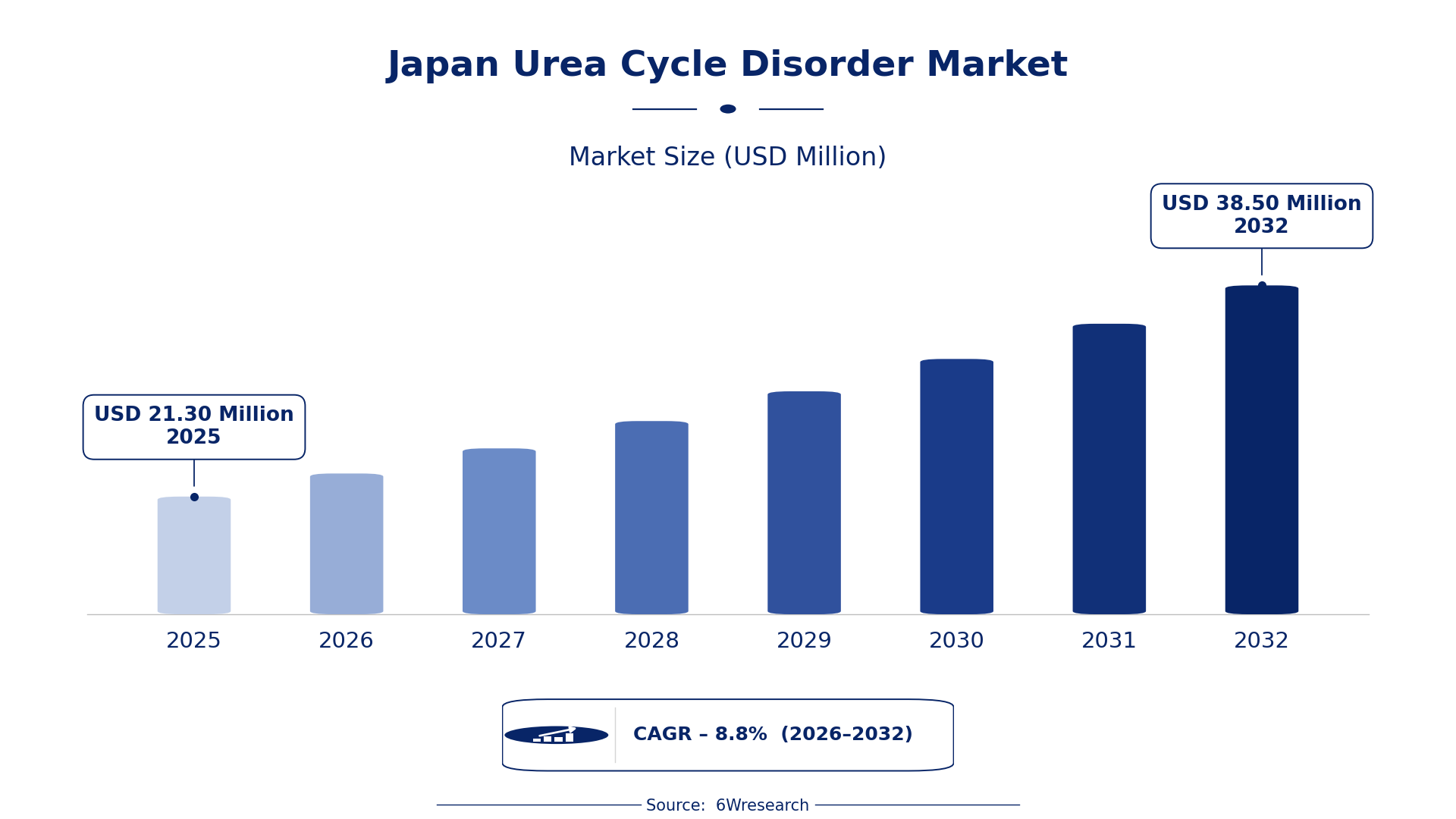
According to 6Wresearch internal database and industry insights, the Japan Urea Cycle Disorder Market was valued at USD 21.30 Million in 2025 and is projected to reach USD 38.50 Million by 2032, growing at a CAGR of approximately 8.8% during 2026–2032.
Japan Urea Cycle Disorder Market Highlights
| Report Metric | Details |
| Report Name | Japan Urea Cycle Disorder Market (2026-2032) |
| Market Size 2025 | USD 21.30 Million |
| Market Size 2032 | USD 38.50 Million |
| Absolute Growth 2025–2032 | USD 17.20 Million |
| CAGR 2026–2032 | 8.8% |
| Peak Annual Growth | 9.6% in 2027 |
| Forecast Period | 2026–2032 |
| Historical Data | 2022–2025 |
| Base Year | 2025 |
| Leading Type, 2025 | Inherited Disorder (33% share) |
| Leading Treatment, 2025 | Medication (48% share) |
| Leading Drug Class, 2025 | Nitrogen Scavengers (33% share) |
| Leading End Use, 2025 | Hospitals (39% share) |
| Fastest-Growing Type | Late-Onset (12.3% CAGR) |
| Fastest-Growing Treatment | Gene Therapy (11.9% CAGR) |
| Fastest-Growing Drug Class | Ammonia Detoxifiers (11.5% CAGR) |
| Fastest-Growing End Use | Research Centers (11.7% CAGR) |
| Growing Sector | Hospitals |
| Key End Users | Hospitals, Specialty Clinics, Research Centers, Patients |
Japan Urea Cycle Disorder Market Year-wise Growth Rate and Key Drivers (2022–2032)
This graph illustrates the annual growth rates of the market from 2022 to 2032, highlighting a steady upward trajectory and projected market expansion over the forecast period.
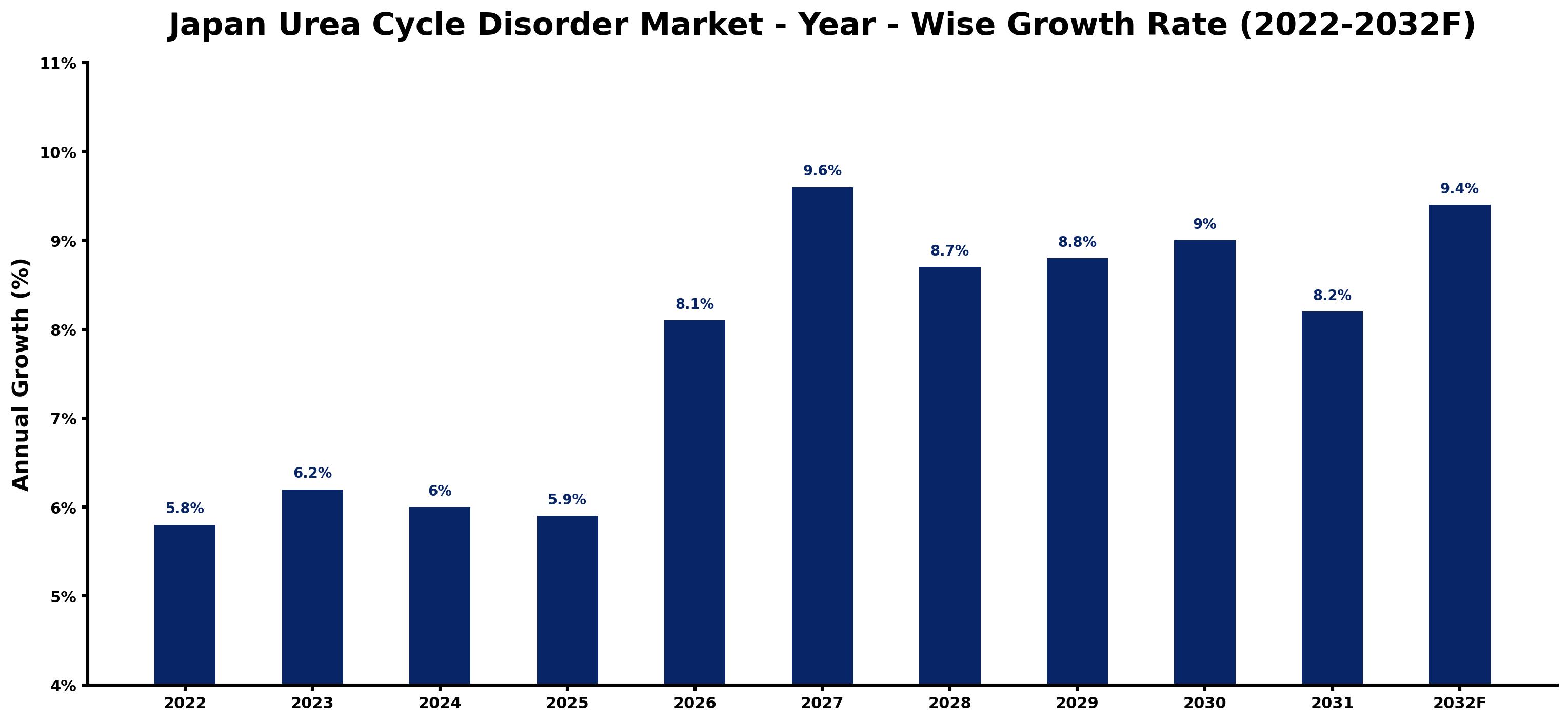
Annual growth estimates for each year appear below with the principal reason behind them, explaining the shifts that set the pace of the market.
| Year | Estimated Annual Growth (%) | Market Rationale |
| 2022 | 5.8 | The market experienced steady growth, driven by increased awareness of Urea Cycle Disorders. |
| 2023 | 6.2 | Demand rose as healthcare facilities improved their capabilities to treat UCD patients. |
| 2024 | 6.0 | Growth slowed slightly due to market saturation in certain treatment areas. |
| 2025 | 5.9 | A gradual slowdown in growth rate occurred as competition intensified among treatment options. |
| 2026 | 8.1 | Growth is expected to accelerate as new treatment modalities gain traction in specialized clinics. |
| 2027 | 9.6 | The market is projected to peak with heightened investment in UCD research and treatment facilities. |
| 2028 | 8.7 | Growth is anticipated to slow as the market begins to stabilise after the peak in 2027. |
| 2029 | 8.8 | Demand is expected to increase as awareness campaigns target healthcare professionals and patients. |
| 2030 | 9.0 | The market will continue to grow as new therapies enter the market and gain approval. |
| 2031 | 8.2 | Growth is projected to moderate as the market adjusts to the influx of new treatment options. |
| 2032 | 9.4 | Demand is expected to surge again as clinical trials for new therapies progress. |
Note: Market size estimations and growth projections presented in this report are based on 6Wresearch's proprietary forecasting methodology, utilizing the latest available industry data, government publications, and primary research inputs.
Japan Urea Cycle Disorder Market Synopsis
Urea Cycle Disorder (UCD) is a genetic condition that impairs the body's ability to eliminate ammonia from the bloodstream, necessitating effective management strategies. The Japan Urea Cycle Disorder Market is expanding due to rising patient numbers, with approximately 1 in 35,000 live births affected. Increased investment in specialised medical facilities and ongoing clinical trials for new therapies are driving demand. The healthcare system in Japan supports both domestic users and specialised clinics, ensuring a steady flow of patients seeking treatment.
Market Dynamics Impact Analysis (2026–2032)
| Factor | Type | Impact | Primary Segment Affected |
| Increasing prevalence of Urea Cycle Disorders among newborns | Driver | High | Inherited Disorder |
| Growth in specialized medical facilities for UCD treatment | Driver | High | Hospitals |
| Expansion of clinical trials for innovative therapies | Opportunity | High | Gene Therapy |
| Rising demand for dietary management solutions | Opportunity | Medium | Dietary Management |
| Limited awareness among healthcare providers | Restraint | High | Neonatal-Onset |
| Challenges in patient access to specialized care | Restraint | Medium | Specialty Clinics |
| High costs associated with advanced therapies | Challenge | High | Medication |
| Regulatory hurdles for new treatment approvals | Challenge | Medium | Gene Therapy |
Evaluation of Drivers in Japan Urea Cycle Disorder Market (2026–2032)
Below are the drivers that matter most for revenue growth, with supporting evidence.
| Drivers | Primary Segment Affected | Why It Matters (Evidence) |
| Rising incidence of Urea Cycle Disorders | Inherited Disorder | Approximately 1 in 35,000 live births is affected, increasing demand for effective treatments. |
| Investment in specialized medical facilities | Hospitals | Facilities like Tokyo Medical University improve treatment capacity for UCD patients. |
| Growing awareness of dietary management | Dietary Management | Healthcare providers are increasingly focusing on low-protein diets to control ammonia levels effectively. |
| Support from healthcare initiatives | Medication | Funding for UCD treatment initiatives enhances accessibility. |
| Clinical trials for new therapies | Gene Therapy | Ongoing studies are essential for developing new treatments, attracting patient participation. |
Orders keep climbing as the number of diagnosed Urea Cycle Disorder patients increases, with over 1,000 cases reported in Japan. Investment in specialised medical facilities, such as those at Tokyo Medical University, improves treatment capacity, leading to more effective patient care. Continuous clinical trials for new therapies are crucial for developing treatment options, encouraging patient participation. Dietary management strategies are gaining traction, with healthcare providers advocating low-protein diets to control ammonia levels effectively.
Evaluation of Restraints in Japan Urea Cycle Disorder Market
These are the pressures that could keep growth below its potential.
| Market Restraint | Primary Segment Affected | Why It Matters (Evidence) |
| Limited awareness of UCD among healthcare providers | Neonatal-Onset | Many healthcare professionals lack knowledge about UCD, leading to delays in diagnosis and treatment. |
| Access challenges for patients requiring specialized care | Specialty Clinics | Geographical barriers limit patient access to facilities that provide UCD treatment. |
| High costs of advanced therapies for UCD | Medication | Patients face financial burdens due to expensive medications and treatment options. |
| Regulatory hurdles for new treatment approvals | Gene Therapy | Lengthy approval processes can delay the availability of new therapies for patients. |
| Limited availability of specialized dietary management resources | Dietary Management | Healthcare providers may struggle to offer adequate dietary plans for UCD patients. |
Japan Urea Cycle Disorder Market Challenges
In Japan, approximately 1 in 35,000 live births is affected by Urea Cycle Disorders, leading to intense competition among healthcare providers that can delay treatment access for patients. Rising costs for producers stem from stringent regulatory requirements, which can push prices higher for hospitals and clinics. Many specialised medical facilities struggle with inadequate funding for UCD research, causing delays in developing new therapies for patients. Buyers face challenges in obtaining advanced technologies for UCD management, as ongoing clinical trials for gene therapy may take years to complete, extending wait times for effective solutions.
Trends in the Japan Urea Cycle Disorder Market
Below are the shifts with the largest effect on the Japan Urea Cycle Disorder Market.
- Expansion of Clinical Trials for Gene Therapy: Ongoing studies for gene therapy targeting Urea Cycle Disorders are expanding across Japan. As of 2023, these trials are crucial for developing new treatment options, improving patient outcomes.
- Shift Towards Dietary Management in Treatment Plans: A growing emphasis on dietary management is evident as healthcare providers recommend low-protein diets to control ammonia levels effectively. This shift is critical for patient care.
- Increased Focus on Specialized Medical Facilities: The establishment of specialised medical facilities for UCD treatment began in 2023, improving care for patients. These facilities are critical for providing tailored treatment and support.
- Rising Patient Registries for Rare Diseases: The Japanese government has established a national registry for rare diseases, including UCD, as of 2023. This initiative aims to improve data collection and patient tracking.
Investment Opportunities in the Japan Urea Cycle Disorder Market
Several openings in the Japan Urea Cycle Disorder Market merit attention from investors.
- Investment in Specialized Medical Facilities: With over 1,000 diagnosed patients, there is a need for specialised medical facilities. Investing in hospitals that focus on UCD treatment can meet this demand and improve patient outcomes.
- Development of Dietary Management Solutions: As dietary management becomes increasingly important, there is a gap in low-protein food options for UCD patients. Suppliers can capitalise on this by providing tailored dietary products.
- Expansion of Clinical Trials for New Therapies: The ongoing clinical trials present an opportunity for investment in new therapies. Collaborating with research centres can facilitate the development of effective treatment options.
- Growth in Home Care Services for UCD Patients: With rising patient numbers, there is a growing demand for home care services. Investing in home care solutions can provide essential support for UCD patients and their families.
Government Initiatives in the Japan Urea Cycle Disorder Market
The Hydrogen Society Promotion Act, enacted in 2024, supports low-carbon hydrogen and ammonia supply chains, which indirectly benefits UCD treatment through cleaner energy sources. The Long-Term Care Insurance Act, in force since 2000, provides funding for care services, ensuring that UCD patients receive necessary support.
The Ministry of Health, Labour and Welfare oversees funding for UCD treatment initiatives and clinical trials. Their support for the Next-Generation Medical Infrastructure Act enables the anonymisation of medical data for research, facilitating advancements in UCD treatment.
Future Insight of the Japan Urea Cycle Disorder Market
The development of dedicated treatment facilities for UCD will improve patient access by 2032. Research initiatives from the Japan Society for Inherited Metabolic Disorders will advance management strategies significantly. Clinical trials for new therapies are expected to produce results that broaden treatment options for patients. By 2032, the average age of diagnosis is projected to decrease to 1 month, allowing for earlier interventions and better long-term health outcomes.
Market Segmentation Analysis
Japan Urea Cycle Disorder Market report covers a detailed analysis of the following market segments:
By Type – Inherited Disorder Leads, Late-Onset Expected to Grow Fastest
According to Bhawna Singh, Assistant Manager at 6Wresearch, the largest type category in 2025 was Inherited Disorder, at 33% of revenue. Inherited disorders account for the majority of Urea Cycle Disorder cases in Japan, with a prevalence of approximately 1 in 35,000 live births. This classification is essential for understanding the patient population and the specific treatment requirements at facilities like the Tokyo Medical University. Late-Onset is projected to grow fastest, at a CAGR of 12.3% during 2026–2032. The late-onset form of UCD is increasingly recognised due to its potential to manifest later in life, necessitating continuous management. As awareness grows, the demand for tailored treatment options is expected to rise, propelling this segment's growth. Suppliers should prioritise the development of targeted therapies for late-onset UCD to align with the increasing demand.
By Treatment – Medication Leads, Gene Therapy Expected to Grow Fastest
Medication took 48% of treatment revenue in 2025, more than any other category. Medication is vital for managing symptoms and ammonia levels, making it the cornerstone of UCD treatment in Japan. Its established role in hospitals and specialised centres underscores its importance in ensuring effective patient care. Over 2026–2032, Gene Therapy is expected to post the fastest growth, at a CAGR of 11.9%. Gene therapy is emerging as a promising approach, with ongoing clinical trials focused on addressing the genetic causes of UCD. As advancements are made, this segment is anticipated to grow rapidly, attracting interest from both patients and healthcare providers. Investments in gene therapy research could yield substantial returns as this treatment modality develops.
By Drug Class – Nitrogen Scavengers Lead, Ammonia Detoxifiers Expected to Grow Fastest
In 2025, Nitrogen Scavengers led the drug class split with a 33% share. Nitrogen scavengers are essential in Japan for effectively managing UCD by helping to eliminate excess nitrogen from the body. Their established use in treatment protocols ensures they remain a primary choice among healthcare providers. The quickest growth will come from Ammonia Detoxifiers, forecast to expand at a CAGR of 11.5% between 2026 and 2032. Ammonia detoxifiers are increasingly recognised for their targeted approach to reducing ammonia levels in the bloodstream, which is critical for UCD patients. This growing awareness is expected to accelerate their adoption in clinical settings. Suppliers should prioritise the development of ammonia detoxifiers to align with the anticipated growth in this segment.
By End Use – Hospitals Lead, Research Centers Expected to Grow Fastest
Hospitals held 39% of the Japan Urea Cycle Disorder Market by end use in 2025. Hospitals serve as the primary facilities for the treatment and management of UCD, providing crucial care to patients. Their integral role within the healthcare framework ensures a steady demand for UCD treatments and medications. Research Centers are set to record the highest CAGR in this split, 11.7% over 2026–2032. Research centres are gaining prominence as they focus on studying UCD and developing new treatment options, which is essential for improving patient outcomes. This increasing emphasis on research is likely to spur demand for advanced solutions. Engaging with research centres may provide suppliers with critical insights into future treatment developments and market opportunities.
Key Attractiveness of the Report
- 10 Years of Market Numbers
- Historical Data Starting from 2022 to 2025
- Base Year 2025
- Forecast Data until 2032
- Key Performance Indicators Impacting the Market
- Major Upcoming Developments and Projects
Key Highlights of the Report:
- Japan Urea Cycle Disorder Market Outlook
- Market Size of Japan Urea Cycle Disorder Market,2025
- Forecast of Japan Urea Cycle Disorder Market, 2032
- Historical Data and Forecast of Japan Urea Cycle Disorder Revenues & Volume for the Period 2022-2032
- Japan Urea Cycle Disorder Market Trend Evolution
- Japan Urea Cycle Disorder Market Drivers and Challenges
- Japan Urea Cycle Disorder Price Trends
- Japan Urea Cycle Disorder Porter's Five Forces
- Japan Urea Cycle Disorder Industry Life Cycle
- Historical Data and Forecast of Japan Urea Cycle Disorder Market Revenues & Volume By Type for the Period 2022-2032
- Historical Data and Forecast of Japan Urea Cycle Disorder Market Revenues & Volume By Inherited Disorder for the Period 2022-2032
- Historical Data and Forecast of Japan Urea Cycle Disorder Market Revenues & Volume By Neonatal-Onset for the Period 2022-2032
- Historical Data and Forecast of Japan Urea Cycle Disorder Market Revenues & Volume By Late-Onset for the Period 2022-2032
- Historical Data and Forecast of Japan Urea Cycle Disorder Market Revenues & Volume By Partial Deficiency for the Period 2022-2032
- Historical Data and Forecast of Japan Urea Cycle Disorder Market Revenues & Volume By Others for the Period 2022-2032
- Historical Data and Forecast of Japan Urea Cycle Disorder Market Revenues & Volume By Treatment for the Period 2022-2032
- Historical Data and Forecast of Japan Urea Cycle Disorder Market Revenues & Volume By Medication for the Period 2022-2032
- Historical Data and Forecast of Japan Urea Cycle Disorder Market Revenues & Volume By Dietary Management for the Period 2022-2032
- Historical Data and Forecast of Japan Urea Cycle Disorder Market Revenues & Volume By Gene Therapy for the Period 2022-2032
- Historical Data and Forecast of Japan Urea Cycle Disorder Market Revenues & Volume By Liver Transplant for the Period 2022-2032
- Historical Data and Forecast of Japan Urea Cycle Disorder Market Revenues & Volume By Symptom Management for the Period 2022-2032
- Historical Data and Forecast of Japan Urea Cycle Disorder Market Revenues & Volume By Drug Class for the Period 2022-2032
- Historical Data and Forecast of Japan Urea Cycle Disorder Market Revenues & Volume By Nitrogen Scavengers for the Period 2022-2032
- Historical Data and Forecast of Japan Urea Cycle Disorder Market Revenues & Volume By Sodium Phenylbutyrate for the Period 2022-2032
- Historical Data and Forecast of Japan Urea Cycle Disorder Market Revenues & Volume By Ammonia Detoxifiers for the Period 2022-2032
- Historical Data and Forecast of Japan Urea Cycle Disorder Market Revenues & Volume By Ornithine Transcarbamylase for the Period 2022-2032
- Historical Data and Forecast of Japan Urea Cycle Disorder Market Revenues & Volume By Carbamoyl Phosphate Synthetase for the Period 2022-2032
- Historical Data and Forecast of Japan Urea Cycle Disorder Market Revenues & Volume By End Use for the Period 2022-2032
- Historical Data and Forecast of Japan Urea Cycle Disorder Market Revenues & Volume By Hospitals for the Period 2022-2032
- Historical Data and Forecast of Japan Urea Cycle Disorder Market Revenues & Volume By Specialty Clinics for the Period 2022-2032
- Historical Data and Forecast of Japan Urea Cycle Disorder Market Revenues & Volume By Research Centers for the Period 2022-2032
- Historical Data and Forecast of Japan Urea Cycle Disorder Market Revenues & Volume By Clinical Trials for the Period 2022-2032
- Historical Data and Forecast of Japan Urea Cycle Disorder Market Revenues & Volume By Home Care for the Period 2022-2032
- Historical Data and Forecast of Japan Urea Cycle Disorder Market Revenues & Volume By End Use for the Period 2022-2032
- Historical Data and Forecast of Japan Urea Cycle Disorder Market Revenues & Volume By Professional Tattooing for the Period 2022-2032
- Historical Data and Forecast of Japan Urea Cycle Disorder Market Revenues & Volume By Tattoo Studios for the Period 2022-2032
- Japan Urea Cycle Disorder Import Export Trade Statistics
- Market Opportunity Assessment By Type
- Market Opportunity Assessment By Treatment
- Market Opportunity Assessment By Drug Class
- Market Opportunity Assessment By End Use
- Market Opportunity Assessment By End Use
- Japan Urea Cycle Disorder Top Companies Market Share
- Japan Urea Cycle Disorder Competitive Benchmarking By Technical and Operational Parameters
- Japan Urea Cycle Disorder Company Profiles
- Japan Urea Cycle Disorder Key Strategic Recommendations
Market Covered
The study includes the following segmentation.
By Type
- Inherited Disorder
- Neonatal-Onset
- Late-Onset
- Partial Deficiency
- Others
By Treatment
- Medication
- Dietary Management
- Gene Therapy
- Liver Transplant
- Symptom Management
By Drug Class
- Nitrogen Scavengers
- Sodium Phenylbutyrate
- Ammonia Detoxifiers
- Ornithine Transcarbamylase
- Carbamoyl Phosphate Synthetase
By End Use
- Hospitals
- Specialty Clinics
- Research Centers
- Clinical Trials
- Home Care































