Japan Ventilation Equipment Market Size & Growth Rate
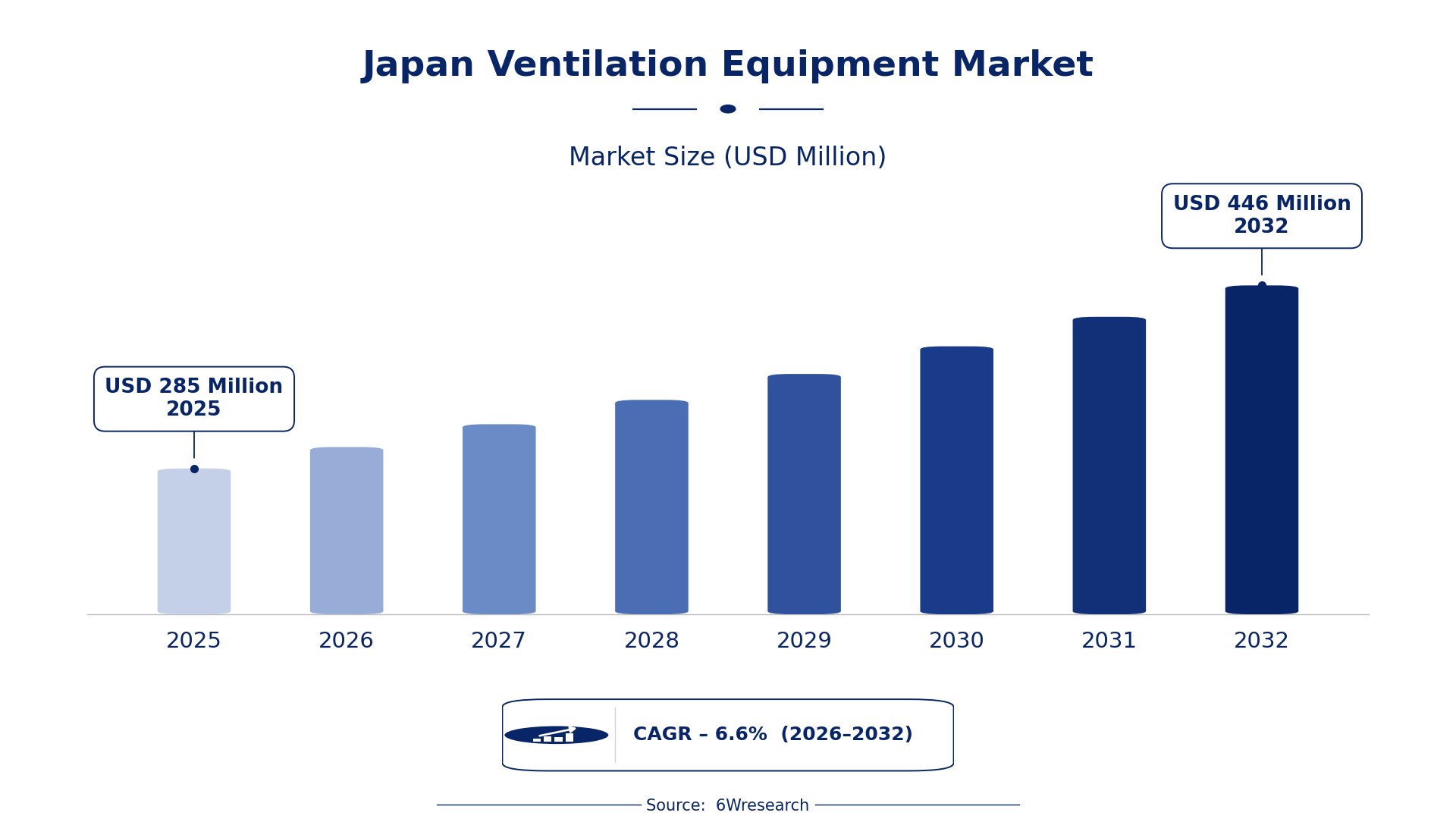
According to 6Wresearch internal database and industry insights, the Japan Ventilation Equipment Market was valued at USD 285 Million in 2025 and is projected to reach USD 446 Million by 2032, growing at a CAGR of approximately 6.6% during 2026–2032.
Japan Ventilation Equipment Market Highlights
| Report Metric | Details |
| Report Name | Japan Ventilation Equipment Market (2026-2032) |
| Market Size 2025 | USD 285 Million |
| Market Size 2032 | USD 446 Million |
| Absolute Growth 2025–2032 | USD 161 Million |
| CAGR 2026–2032 | 6.6% |
| Peak Annual Growth | 7.5% in 2028 |
| Forecast Period | 2026–2032 |
| Historical Data | 2022–2025 |
| Base Year | 2025 |
| Leading Product Type, 2025 | Mechanical Ventilators (58% share) |
| Leading Application, 2025 | Industrial Ventilation (56% share) |
| Leading Technology, 2025 | Natural Ventilation (62% share) |
| Leading End User, 2025 | Manufacturing Plants (55% share) |
| Leading Feature, 2025 | Energy-Efficient (66% share) |
| Fastest-Growing Product Type | Air Handling Units (8.8% CAGR) |
| Fastest-Growing Application | Commercial Ventilation (8.4% CAGR) |
| Fastest-Growing Technology | Mechanical Ventilation (8.6% CAGR) |
| Fastest-Growing End User | Commercial Buildings (8.1% CAGR) |
| Fastest-Growing Feature | Noise-Reduction (8.2% CAGR) |
| Growing Sector | Manufacturing |
| Key End Users | Manufacturing Plants, Commercial Buildings, Hospitals, Shopping Malls |
Japan Ventilation Equipment Market Year-wise Growth Rate and Key Drivers (2022–2032)
This graph illustrates the annual growth rates of the market from 2022 to 2032, highlighting a steady upward trajectory and projected market expansion over the forecast period.
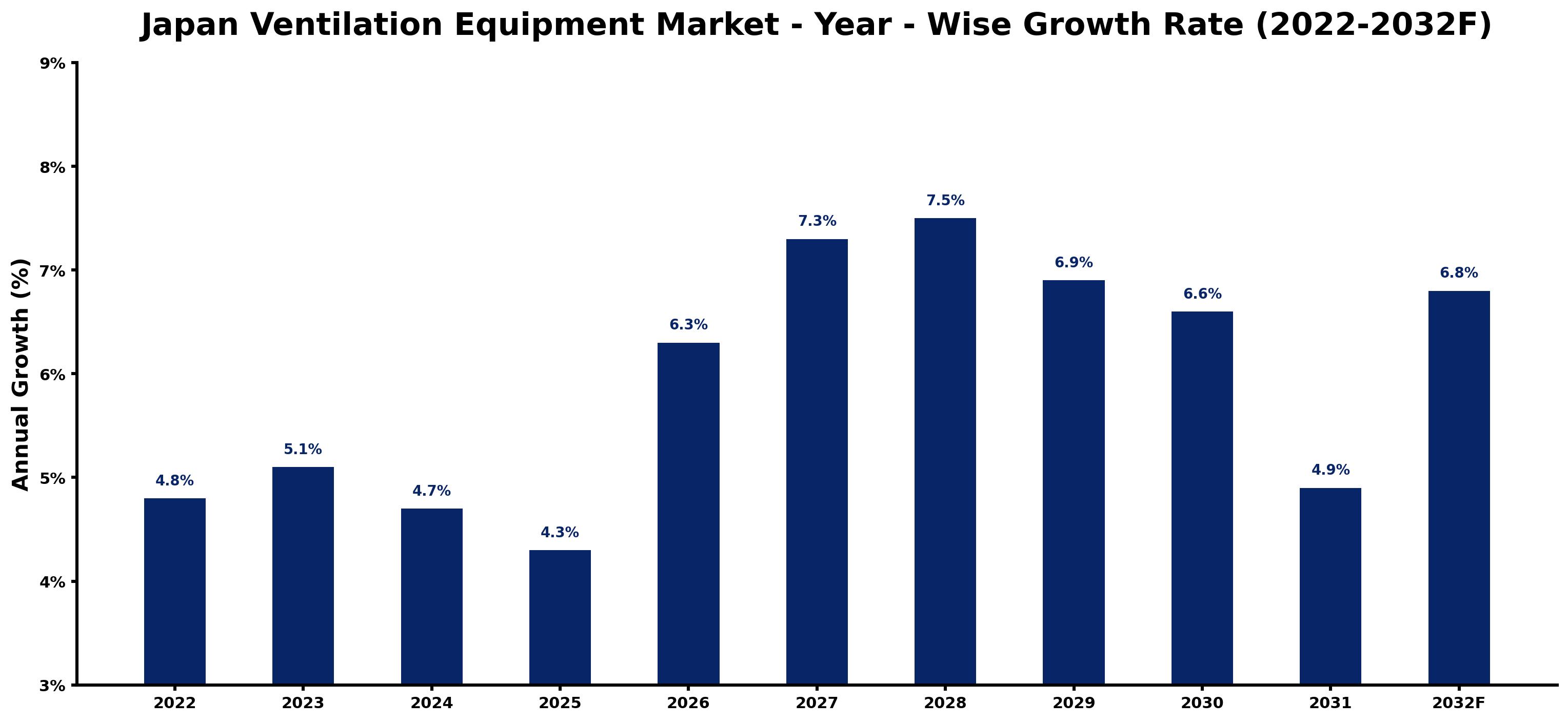
For each year, the table pairs the estimated growth rate with the leading influence on demand, showing how the drivers changed across the period.
| Year | Estimated Annual Growth (%) | Market Rationale |
| 2022 | 4.8 | The market experienced steady growth due to ongoing construction projects and a focus on air quality. |
| 2023 | 5.1 | Demand increased as the commercial building sector invested in ventilation upgrades. |
| 2024 | 4.7 | Growth slowed as some projects faced delays and budget constraints in the industrial sector. |
| 2025 | 4.3 | A continued slowdown occurred as the market adjusted to previous high growth rates. |
| 2026 | 6.3 | Demand is expected to rise sharply as energy efficiency becomes a priority for many facilities. |
| 2027 | 7.3 | The market will expand further, driven by increased awareness of indoor air quality. |
| 2028 | 7.5 | Peak growth is projected as technological advancements in ventilation systems are widely adopted. |
| 2029 | 6.9 | Growth is expected to slow slightly as the market begins to stabilise after rapid expansion. |
| 2030 | 6.6 | Demand will continue to slow as the market adjusts to new energy regulations and standards. |
| 2031 | 4.9 | A further slowdown is anticipated as the market stabilises after several years of growth. |
| 2032 | 6.8 | Growth will pick up again as new energy-efficient technologies gain traction. |
Note: Market size estimations and growth projections presented in this report are based on 6Wresearch's proprietary forecasting methodology, utilizing the latest available industry data, government publications, and primary research inputs.
Japan Ventilation Equipment Market Synopsis
Ventilation equipment in Japan includes mechanical ventilators and air handling units designed to improve indoor air quality. These systems are vital for industrial and commercial applications, particularly in the Kanto and Kansai regions. The Japan Ventilation Equipment Market is expanding due to rising demand from the manufacturing sector and substantial investments in energy-efficient upgrades. The government supports energy efficiency initiatives, further driving market growth, with the commercial building sector projected to invest heavily by 2025.
Market Dynamics Impact Analysis (2026–2032)
| Factor | Type | Impact | Primary Segment Affected |
| Increased focus on energy efficiency in buildings | Driver | High | Energy-Efficient |
| Rising demand for improved indoor air quality | Driver | High | Mechanical Ventilators |
| Growing investments in commercial building upgrades | Opportunity | High | Commercial Ventilation |
| Expansion of construction projects in urban areas | Opportunity | High | Industrial Ventilation |
| High costs associated with retrofitting older systems | Restraint | Medium | Air Handling Units |
| Stringent regulations on indoor air quality | Restraint | High | Mechanical Ventilators |
| Challenges in sourcing energy-efficient components | Challenge | Medium | Energy-Efficient |
| Competition from alternative air management solutions | Challenge | Medium | Natural Ventilation |
Evaluation of Drivers in Japan Ventilation Equipment Market (2026–2032)
Demand rests on the following drivers, each shown with the segment it touches most.
| Drivers | Primary Segment Affected | Why It Matters (Evidence) |
| Growing construction projects in urban areas | Industrial Ventilation | The construction industry is projected to invest heavily in urban development, increasing demand for advanced ventilation solutions. |
| Increased focus on energy efficiency | Energy-Efficient | Government initiatives lead to higher adoption rates among commercial buildings, driving demand for energy-efficient systems. |
| Rising awareness of indoor air quality | Mechanical Ventilators | The installed base of mechanical ventilators is substantial, particularly in hospitals, where infection control is critical. |
| Government subsidies for retrofitting | Air Handling Units | Subsidies for energy-efficient retrofits in older buildings encourage upgrades in commercial facilities. |
| Demand from the manufacturing sector | Commercial Ventilation | The manufacturing sector continues to utilise ventilation systems for optimal air circulation, particularly in Kanto and Kansai. |
What keeps demand rising is the increasing focus on energy efficiency in buildings, particularly as commercial facilities invest in advanced systems. In 2023, the commercial building sector is expected to invest heavily in ventilation upgrades, contributing to a notable rise in demand. The installed base of mechanical ventilators is substantial, especially in hospitals, where infection control is critical. The manufacturing sector continues to drive demand for effective air management solutions, particularly in regions with high industrial activity.
Evaluation of Restraints in Japan Ventilation Equipment Market
These restraints slow adoption and weigh on supplier margins.
| Market Restraint | Primary Segment Affected | Why It Matters (Evidence) |
| High costs of retrofitting older systems | Air Handling Units | Retrofitting costs can deter investment in energy-efficient upgrades, limiting market growth. |
| Stringent regulations on indoor air quality | Mechanical Ventilators | Compliance with regulations can increase operational costs for producers, impacting profitability. |
| Challenges in sourcing energy-efficient components | Energy-Efficient | Supply chain issues can delay the availability of necessary components, impacting project timelines. |
| Competition from alternative air management solutions | Natural Ventilation | The rise of alternative solutions may divert investments away from traditional ventilation systems. |
| Market saturation in certain regions | Commercial Ventilation | High penetration rates in established markets can limit growth opportunities for new entrants. |
Japan Ventilation Equipment Market Challenges
High installation costs for advanced ventilation systems burden commercial building owners, with expenses reaching JPY 5 million per unit. Many producers grapple with outdated technology, limiting their ability to meet the growing needs of the construction industry. A shortage of skilled workers in the HVAC sector delays project completions, affecting contractors who depend on timely installations to secure future contracts. Stringent regulations for indoor air quality complicate compliance for suppliers, resulting in increased costs that may hinder the launch of new products in the market.
Trends in the Japan Ventilation Equipment Market
These developments are changing demand patterns in the Japan Ventilation Equipment Market.
- Shift towards Energy-Efficient Solutions: The construction industry is prioritising energy-efficient ventilation systems, supported by government incentives. In 2023, the commercial building sector is expected to invest heavily in these upgrades, creating a more sustainable market.
- Rise of Noise-Reduction Features: Urban commercial buildings increasingly demand noise-reduction features in ventilation systems to improve user comfort. In 2023, the adoption of noise-reduction technology is expected to rise, reflecting changing buyer preferences.
- Expansion of Natural Ventilation in Urban Areas: Natural ventilation is gaining traction in new urban development projects, encouraged by government initiatives. In 2023, the Tokyo metropolitan area is implementing guidelines to promote natural ventilation in high-rise buildings.
- Increased Adoption of Mechanical Ventilation: Mechanical ventilation is becoming essential in various sectors, particularly healthcare. In 2023, hospitals are investing more in these systems for improved air quality and infection control.
Investment Opportunities in the Japan Ventilation Equipment Market
Below are the investment opportunities with the strongest case in the Japan Ventilation Equipment Market.
- Manufacturing Plants Seeking Upgrades: Manufacturing plants in Kanto are looking to invest in energy-efficient ventilation systems, with demand projected to increase by 2025. Collaborating with local suppliers can facilitate market entry.
- Commercial Buildings Requiring Modern Solutions: Commercial buildings are in need of advanced ventilation solutions to comply with new regulations. The projected investment in upgrades by 2025 presents a strong opportunity for suppliers.
- Urban Development Projects in Kansai: Urban development projects in Kansai are creating demand for innovative ventilation solutions. Suppliers can enter this market by partnering with local construction firms to provide tailored systems.
- Government Incentives for Energy Efficiency: Government incentives for energy-efficient retrofits are creating opportunities for suppliers. The projected funding for these initiatives by 2025 makes it an ideal time to invest.
Government Initiatives in the Japan Ventilation Equipment Market
The Act on the Rational Use of Energy mandates improvements in energy efficiency for large energy users, introducing new requirements for reporting and compliance. This law complements existing regulations by enforcing stricter standards for energy consumption in ventilation systems, ensuring better energy management practices.
The Ministry of the Environment funds initiatives aimed at improving air quality and energy efficiency in buildings. These initiatives include grants for retrofitting older systems and promoting compliance with the latest standards, benefiting both producers and buyers.
Future Insight of the Japan Ventilation Equipment Market
Advancements in smart ventilation technology will reshape demand by 2032, allowing for improved energy management in buildings. The government's energy efficiency programme aims to retrofit older systems, driving investments of JPY 1 trillion in the sector. By 2030, targets for reducing energy consumption will compel buyers to seek more efficient solutions. Integration of ISO 9001 standards will ensure that suppliers maintain high product quality, meeting the rising expectations of buyers in the market.
Market Segmentation Analysis
Japan Ventilation Equipment Market report covers a detailed analysis of the following market segments:
By Product Type – Mechanical Ventilators Lead, Air Handling Units Expected to Grow Fastest
According to Bhawna Singh, Assistant Manager at 6Wresearch, Mechanical Ventilators took 58% of product type revenue in 2025, more than any other category. Mechanical ventilators are essential in hospitals, where they ensure air quality and infection control. Their extensive use across various industrial applications in Japan solidifies their leading market position. Air Handling Units are projected to grow fastest, at a CAGR of 8.8% during 2026–2032. Air handling units are rapidly growing due to significant investments in ventilation upgrades for commercial buildings, driven by the need for improved indoor air quality. The expected financial commitment from the commercial sector by 2025 will further accelerate this segment's expansion. Suppliers should focus on enhancing the capabilities of air handling units to meet the increasing demands from commercial users.
By Application – Industrial Ventilation Leads, Commercial Ventilation Expected to Grow Fastest
Industrial Ventilation held 56% of the Japan Ventilation Equipment Market by application in 2025. Industrial ventilation holds the largest share as it is vital for maintaining air quality in manufacturing plants, especially in the Kanto and Kansai regions. The strict adherence to air quality regulations in these sectors reinforces its dominant position in the market. Over 2026–2032, Commercial Ventilation is expected to post the fastest growth, at a CAGR of 8.4%. Commercial ventilation is experiencing the fastest growth, fuelled by the rising demand for enhanced comfort and air quality in commercial spaces. The anticipated investments in building upgrades by 2025 will significantly drive this segment's growth. Buyers in the commercial sector should prioritise acquiring advanced ventilation systems to ensure compliance with air quality standards.
By Technology – Natural Ventilation Leads, Mechanical Ventilation Expected to Grow Fastest
Natural Ventilation accounted for 62% of the market by technology in 2025. Natural ventilation is the leading technology, primarily due to its application in new urban development projects where it is encouraged for energy efficiency. Its relevance in sustainable building practices contributes to its substantial share in the market. Mechanical Ventilation is set to record the highest CAGR in this split, 8.6% over 2026–2032. Mechanical ventilation is growing rapidly as it is widely adopted for effective air management in various settings, including hospitals and commercial buildings. The increasing focus on energy efficiency and air quality improvement initiatives supports its fast growth. Suppliers must innovate mechanical ventilation solutions to align with the growing emphasis on energy efficiency and air quality.
By End User – Manufacturing Plants Lead, Commercial Buildings Expected to Grow Fastest
With 55% of end user revenue in 2025, Manufacturing Plants was the largest category. Manufacturing plants are the primary users of ventilation systems, as they require effective solutions to maintain air quality and ensure worker safety. The ongoing need for compliance with health and safety regulations in these facilities strengthens their leading market share. The quickest growth will come from Commercial Buildings, forecast to expand at a CAGR of 8.1% between 2026 and 2032. Commercial buildings are the fastest-growing end user category, propelled by the urgent need for air handling solutions that improve comfort and meet regulatory standards. The projected investments in commercial building upgrades by 2025 will further boost this growth. Suppliers should tailor their offerings to the commercial building sector, addressing specific air quality and comfort needs.
By Feature – Energy-Efficient Leads, Noise-Reduction Expected to Grow Fastest
In 2025, Energy-Efficient led the feature split with a 66% share. Energy-efficient features are crucial for reducing operational costs, making them the most sought-after characteristic in ventilation systems. The promotion of energy-efficient solutions under the Energy Saving Act highlights their importance in the market. Noise-Reduction is projected to grow fastest, at a CAGR of 8.2% during 2026–2032. Noise-reduction features are increasingly important as urban commercial buildings seek quieter operations to enhance user comfort. The growing emphasis on noise reduction reflects changing consumer preferences and market trends. Suppliers should integrate advanced noise-reduction technologies into their products to align with the evolving demands of urban commercial environments.
Key Attractiveness of the Report
- 10 Years of Market Numbers
- Historical Data Starting from 2022 to 2025
- Base Year 2025
- Forecast Data until 2032
- Key Performance Indicators Impacting the Market
- Major Upcoming Developments and Projects
Key Highlights of the Report:
- Japan Ventilation Equipment Market Outlook
- Market Size of Japan Ventilation Equipment Market,2025
- Forecast of Japan Ventilation Equipment Market, 2032
- Historical Data and Forecast of Japan Ventilation Equipment Revenues & Volume for the Period 2022-2032
- Japan Ventilation Equipment Market Trend Evolution
- Japan Ventilation Equipment Market Drivers and Challenges
- Japan Ventilation Equipment Price Trends
- Japan Ventilation Equipment Porter's Five Forces
- Japan Ventilation Equipment Industry Life Cycle
- Historical Data and Forecast of Japan Ventilation Equipment Market Revenues & Volume By Product Type for the Period 2022-2032
- Historical Data and Forecast of Japan Ventilation Equipment Market Revenues & Volume By Mechanical Ventilators for the Period 2022-2032
- Historical Data and Forecast of Japan Ventilation Equipment Market Revenues & Volume By Air Handling Units for the Period 2022-2032
- Historical Data and Forecast of Japan Ventilation Equipment Market Revenues & Volume By Application for the Period 2022-2032
- Historical Data and Forecast of Japan Ventilation Equipment Market Revenues & Volume By Industrial Ventilation for the Period 2022-2032
- Historical Data and Forecast of Japan Ventilation Equipment Market Revenues & Volume By Commercial Ventilation for the Period 2022-2032
- Historical Data and Forecast of Japan Ventilation Equipment Market Revenues & Volume By Technology for the Period 2022-2032
- Historical Data and Forecast of Japan Ventilation Equipment Market Revenues & Volume By Natural Ventilation for the Period 2022-2032
- Historical Data and Forecast of Japan Ventilation Equipment Market Revenues & Volume By Mechanical Ventilation for the Period 2022-2032
- Historical Data and Forecast of Japan Ventilation Equipment Market Revenues & Volume By End User for the Period 2022-2032
- Historical Data and Forecast of Japan Ventilation Equipment Market Revenues & Volume By Manufacturing Plants for the Period 2022-2032
- Historical Data and Forecast of Japan Ventilation Equipment Market Revenues & Volume By Commercial Buildings for the Period 2022-2032
- Historical Data and Forecast of Japan Ventilation Equipment Market Revenues & Volume By Feature for the Period 2022-2032
- Historical Data and Forecast of Japan Ventilation Equipment Market Revenues & Volume By Energy-Efficient for the Period 2022-2032
- Historical Data and Forecast of Japan Ventilation Equipment Market Revenues & Volume By Noise-Reduction for the Period 2022-2032
- Japan Ventilation Equipment Import Export Trade Statistics
- Market Opportunity Assessment By Product Type
- Market Opportunity Assessment By Application
- Market Opportunity Assessment By Technology
- Market Opportunity Assessment By End User
- Market Opportunity Assessment By Feature
- Japan Ventilation Equipment Top Companies Market Share
- Japan Ventilation Equipment Competitive Benchmarking By Technical and Operational Parameters
- Japan Ventilation Equipment Company Profiles
- Japan Ventilation Equipment Key Strategic Recommendations
Market Covered
The study includes the following segmentation.
By Product Type
- Mechanical Ventilators
- Air Handling Units
By Application
- Industrial Ventilation
- Commercial Ventilation
By Technology
- Natural Ventilation
- Mechanical Ventilation
By End User
- Manufacturing Plants
- Commercial Buildings
By Feature
- Energy-Efficient
- Noise-Reduction































