Japan Vertebral Augmentation Market Size & Growth Rate
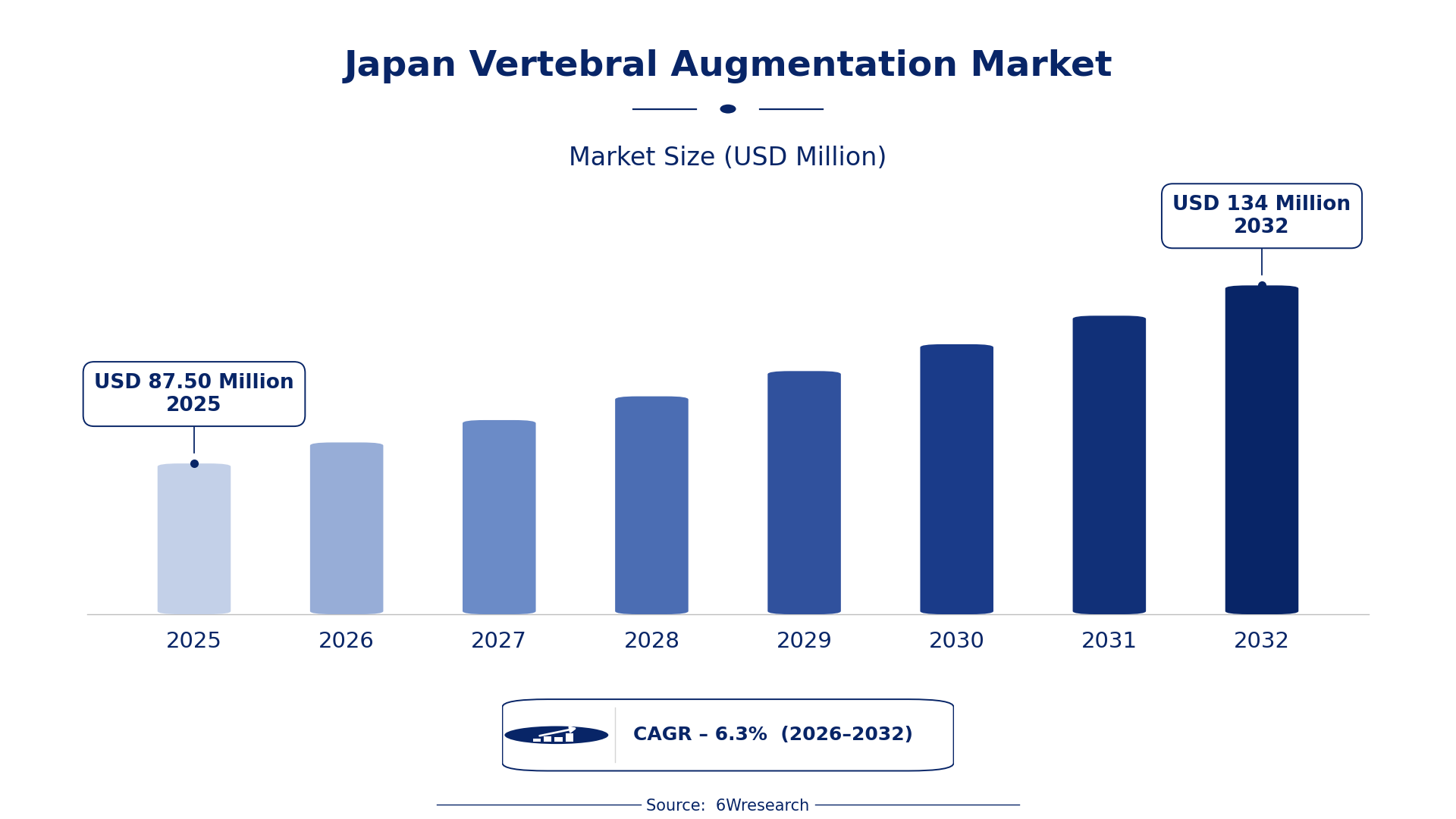
According to 6Wresearch internal database and industry insights, the Japan Vertebral Augmentation Market was valued at USD 87.50 Million in 2025 and is projected to reach USD 134 Million by 2032, growing at a CAGR of approximately 6.3% during 2026–2032.
Japan Vertebral Augmentation Market Highlights
| Report Metric | Details |
| Report Name | Japan Vertebral Augmentation Market (2026-2032) |
| Market Size 2025 | USD 87.50 Million |
| Market Size 2032 | USD 134 Million |
| Absolute Growth 2025–2032 | USD 46.50 Million |
| CAGR 2026–2032 | 6.3% |
| Peak Annual Growth | 7.0% in 2028 |
| Forecast Period | 2026–2032 |
| Historical Data | 2022–2025 |
| Base Year | 2025 |
| Leading Procedure Type, 2025 | Vertebroplasty (58% share) |
| Leading Indication, 2025 | Osteoporotic Fractures (62% share) |
| Leading Approach, 2025 | Transpedicular (60% share) |
| Leading Material, 2025 | Polymethylmethacrylate (PMMA) (56% share) |
| Leading Imaging Guidance, 2025 | Fluoroscopy (58% share) |
| Fastest-Growing Procedure Type | Kyphoplasty (8.4% CAGR) |
| Fastest-Growing Indication | Vertebral Compression Fractures (8.0% CAGR) |
| Fastest-Growing Approach | Extrapedicular (7.8% CAGR) |
| Fastest-Growing Material | Calcium Phosphate Cement (8.9% CAGR) |
| Fastest-Growing Imaging Guidance | CT Guidance (8.2% CAGR) |
| Growing Sector | Healthcare |
| Key End Users | Hospitals, Specialized Clinics, Patients, Healthcare Providers |
Japan Vertebral Augmentation Market Year-wise Growth Rate and Key Drivers (2022–2032)
This graph illustrates the annual growth rates of the market from 2022 to 2032, highlighting a steady upward trajectory and projected market expansion over the forecast period.
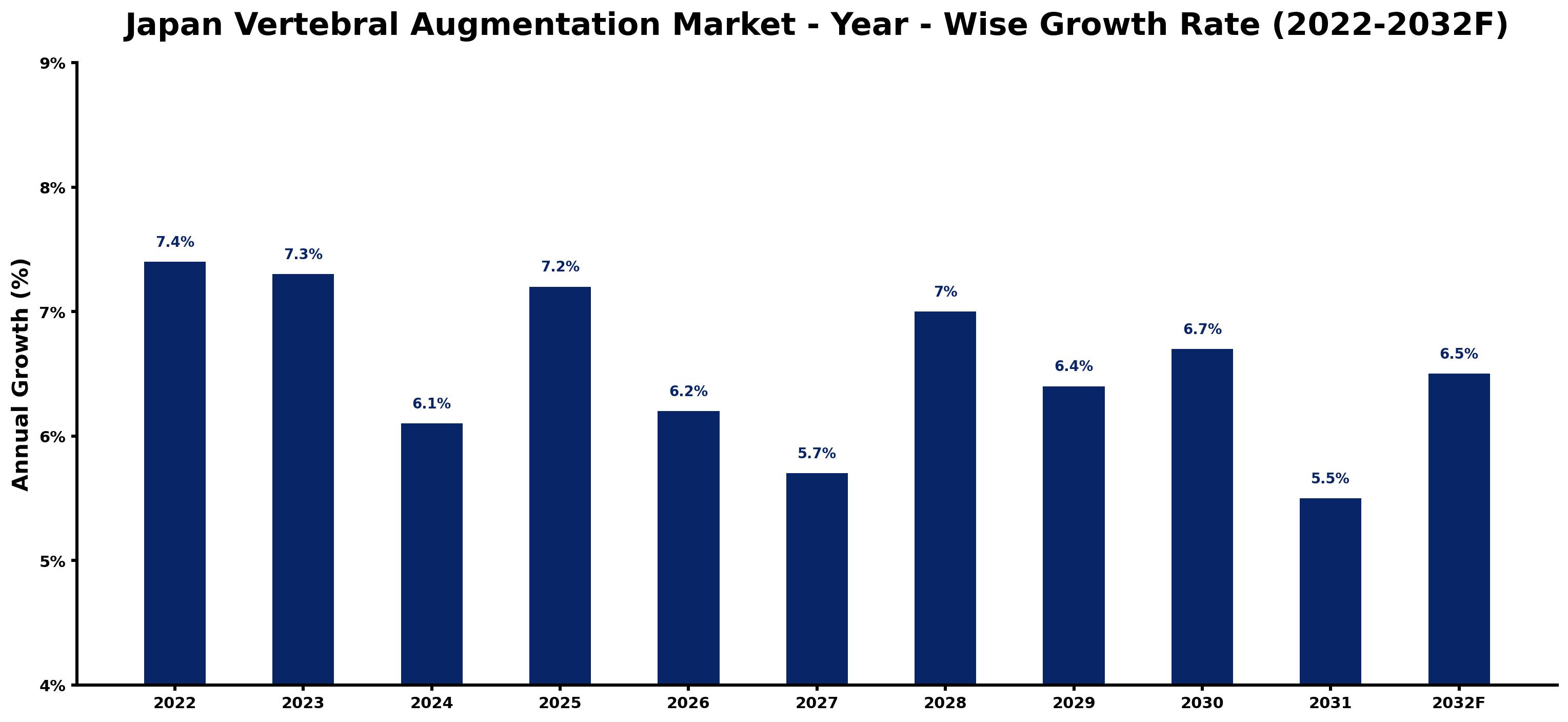
Annual growth estimates for each year appear below with the principal reason behind them, explaining the shifts that set the pace of the market.
| Year | Estimated Annual Growth (%) | Market Rationale |
| 2022 | 7.4 | The market showed strong activity with a notable number of procedures performed. |
| 2023 | 7.3 | Growth slowed slightly as the market adjusted to previous peaks in demand. |
| 2024 | 6.1 | A further slowdown occurred as the market stabilised after rapid growth. |
| 2025 | 7.2 | Growth accelerated again due to rising patient awareness and treatment options. |
| 2026 | 6.2 | A slowdown is expected as competition intensifies among providers. |
| 2027 | 5.7 | Continued growth is projected, albeit at a reduced rate compared to previous years. |
| 2028 | 7.0 | Demand is expected to surge again, driven by advancements in surgical techniques and materials. |
| 2029 | 6.4 | The market is projected to see a slowdown as it adjusts to the previous year's rapid growth. |
| 2030 | 6.7 | Growth is expected to pick up again, supported by increasing healthcare investments and technology. |
| 2031 | 5.5 | A slowdown in growth is anticipated as market saturation begins to set in. |
| 2032 | 6.5 | Demand is projected to rise again as new treatment guidelines are adopted. |
Note: Market size estimations and growth projections presented in this report are based on 6Wresearch's proprietary forecasting methodology, utilizing the latest available industry data, government publications, and primary research inputs.
Japan Vertebral Augmentation Market Synopsis
Vertebral augmentation is a minimally invasive procedure used to stabilise fractured vertebrae, primarily employing materials like polymethylmethacrylate (PMMA). In Japan, approximately 100,000 procedures were performed in 2022, with osteoporotic fractures accounting for 70% of cases. The Japan Vertebral Augmentation Market is growing due to the rising incidence of osteoporosis, increasing investments in healthcare, and advancements in surgical techniques. The Japan Society for Spine Surgery and Related Research actively promotes these techniques, driving demand for vertebral augmentation procedures.
Market Dynamics Impact Analysis (2026–2032)
| Factor | Type | Impact | Primary Segment Affected |
| Increasing incidence of osteoporosis-related fractures | Driver | High | Osteoporotic Fractures |
| Rising number of healthcare facilities adopting advanced techniques | Driver | High | Kyphoplasty |
| Growing demand for minimally invasive surgical options | Opportunity | High | Vertebroplasty |
| Expansion of training programs for spine surgeons | Opportunity | Medium | Kyphoplasty |
| High costs associated with vertebral augmentation procedures | Restraint | High | Vertebroplasty |
| Limited insurance coverage for certain procedures | Restraint | Medium | Osteoporotic Fractures |
| Competition among healthcare providers for patient volume | Challenge | High | Kyphoplasty |
| Need for continuous training and certification for surgeons | Challenge | Medium | Vertebroplasty |
Evaluation of Drivers in Japan Vertebral Augmentation Market (2026–2032)
Demand rests on the following drivers, each shown with the segment it touches most.
| Drivers | Primary Segment Affected | Why It Matters (Evidence) |
| Rising patient population aged 75 and above | Osteoporotic Fractures | This demographic accounts for a large percentage of vertebral augmentation cases, with the average age of patients being 75 years. |
| Increased awareness of vertebral augmentation benefits | Kyphoplasty | Patient education initiatives have led to a higher acceptance of vertebral augmentation as a treatment option. |
| Government funding for osteoporosis treatment programs | Kyphoplasty | In 2023, ¥1 billion was allocated to increase procedure accessibility. |
| Support from professional societies promoting best practices | Osteoporotic Fractures | The Japan Osteoporosis Society provides guidelines that encourage the adoption of vertebral augmentation techniques. |
| Technological advancements in surgical materials | Vertebroplasty | The use of calcium phosphate cement has improved patient outcomes, driving demand for these procedures. |
What keeps demand rising is the increasing patient population aged 75 and above, which contributes to vertebral augmentation cases. Approximately 70% of these procedures are for osteoporotic fractures, highlighting the need for effective treatment options. The average age of patients undergoing vertebroplasty is 75 years, indicating a growing demographic in need of care. Support from professional societies promotes best practices, further driving demand for these procedures.
Evaluation of Restraints in Japan Vertebral Augmentation Market
Several factors work against faster growth; the main ones are summarised below.
| Market Restraint | Primary Segment Affected | Why It Matters (Evidence) |
| High costs associated with vertebral augmentation procedures | Vertebroplasty | The average cost of vertebroplasty in Japan is approximately ¥300,000, which can deter patients from seeking treatment. |
| Limited insurance coverage for certain procedures | Osteoporotic Fractures | The Japan Health Insurance Association covers procedures under specific conditions, limiting access for some patients. |
| Variability in patient outcomes based on facility type | Osteoporotic Fractures | Outcomes can differ between hospitals and specialized clinics, affecting patient trust. |
| Need for continuous training and certification for surgeons | Kyphoplasty | Surgeons must stay updated on techniques, which can delay procedure availability. |
| Competition among healthcare providers for patient volume | Kyphoplasty | As more facilities offer vertebral augmentation, providers face pressure to attract and retain patients. |
Japan Vertebral Augmentation Market Challenges
Regulatory barriers obstruct vertebral augmentation practices in Japan, as stringent oversight from the Ministry of Health, Labour and Welfare can delay approvals, impacting hospitals' ability to provide timely care. Slow technology adoption, particularly in advanced imaging, results in longer procedure times, increasing risks for clinics and leading to higher operational costs. The average procedure cost of ¥300,000 discourages many patients from seeking treatment, resulting in untreated fractures that can worsen health outcomes. Supply chain disruptions for PMMA, the primary material, can cause delays, forcing hospitals to postpone critical treatments for patients in need.
Trends in the Japan Vertebral Augmentation Market
Several trends are reshaping the Japan Vertebral Augmentation Market; the most important are set out below.
- Shift from PMMA to Calcium Phosphate Cement: A noticeable shift towards using calcium phosphate cement in vertebral augmentation procedures is occurring due to its bioactivity. This material is increasingly preferred, with its usage growing significantly in recent years.
- Increase in Training Programs for Spine Surgeons: The Japan Spine Society launched a new training program in 2023 aimed at improving the skills of spine surgeons. This initiative is expected to improve procedural outcomes and patient safety, with over 200 surgeons participating in the first year.
- Growing Preference for Kyphoplasty: Kyphoplasty is gaining traction, preferred in 60% of vertebral compression fracture procedures. This trend indicates a shift towards methods that restore vertebral height and reduce pain more effectively.
- Expansion of Imaging Guidance Techniques: Fluoroscopy remains the leading imaging guidance method, utilised in 90% of vertebroplasty procedures. Its dominance is being challenged by CT guidance, which is gaining popularity for complex cases, indicating evolving practices.
Investment Opportunities in the Japan Vertebral Augmentation Market
Investors looking at the Japan Vertebral Augmentation Market should consider the following areas.
- Partnerships with Healthcare Facilities: Now is the time to invest in partnerships with hospitals and clinics that perform vertebral augmentation. With approximately 100,000 procedures performed annually, aligning with key facilities can strengthen market presence.
- Expansion in Kyoto Prefecture: Kyoto Prefecture has the highest number of procedures, presenting an opportunity for local partnerships. Engaging with healthcare providers here can drive growth, especially with the rising incidence of fractures.
- Investment in Training Programs: Investing in training programs for spine surgeons is essential now as the demand for skilled professionals increases. Collaborating with the Japan Spine Society can facilitate access to a growing network of trained surgeons.
- Development of Cost-effective Solutions: With average procedure costs around ¥300,000, there is a pressing need for cost-effective solutions. Focusing on affordable materials and techniques can attract more patients and increase procedure uptake.
Government Initiatives in the Japan Vertebral Augmentation Market
The Building Energy Efficiency Act, amended in 2022, requires all new healthcare facilities to meet energy standards by April 2025. This measure ensures that hospitals investing in vertebral augmentation are built to modern energy efficiency standards, reducing operational costs and improving patient care environments.
The Ministry of Health, Labour and Welfare oversees regulations for vertebral augmentation practices, ensuring compliance with JIS standards. This oversight guarantees that materials used in procedures meet safety and efficacy requirements, benefiting both patients and healthcare providers.
Future Insight of the Japan Vertebral Augmentation Market
A policy-driven shift in osteoporosis treatment will prompt hospitals to invest in advanced training programs for spine surgeons, improving procedural efficiency. The integration of new imaging technologies will streamline operations, enhancing patient outcomes and reducing hospital stays. A national registry for vertebral augmentation outcomes will provide valuable data, encouraging best practices and standardisation across clinics. With a projected 20% increase in vertebral compression fractures by 2025, demand for effective treatments will escalate, prompting suppliers to innovate and elevate their offerings.
Market Segmentation Analysis
Japan Vertebral Augmentation Market report covers a detailed analysis of the following market segments:
By Procedure Type – Vertebroplasty Leads, Kyphoplasty Expected to Grow Fastest
According to Bhawna Singh, Assistant Manager at 6Wresearch, with 58% of procedure type revenue in 2025, Vertebroplasty was the largest category. Vertebroplasty is the predominant method for stabilising vertebral fractures, particularly among the elderly, with approximately 100,000 procedures performed annually in Japan. Its established presence in hospitals and specialised clinics reinforces its leading market position. The quickest growth will come from Kyphoplasty, forecast to expand at a CAGR of 8.4% between 2026 and 2032. Kyphoplasty is growing rapidly due to its effectiveness in restoring vertebral height, which is becoming increasingly important as the incidence of vertebral compression fractures rises. The projected 20% increase in such fractures by 2025 will further boost the demand for this technique. Suppliers should focus on enhancing training and resources for kyphoplasty to effectively meet the rising demand.
By Indication – Osteoporotic Fractures Lead, Vertebral Compression Fractures Expected to Grow Fastest
The largest indication category in 2025 was Osteoporotic Fractures, at 62% of revenue. Osteoporotic fractures represent the largest segment, accounting for 70% of vertebral augmentation cases in Japan, primarily due to the ageing demographic. This high prevalence ensures a steady demand for effective treatment options across healthcare facilities. Vertebral Compression Fractures are set to record the highest CAGR in this split, 8.0% over 2026–2032. Vertebral compression fractures are gaining prominence, with a notable increase in incidence projected, leading healthcare providers to pursue effective treatment solutions. This shift suggests a more aggressive approach to managing these fractures in the future. Buyers can expect a wider array of treatment options as the market adapts to the increasing incidence of vertebral compression fractures.
By Approach – Transpedicular Leads, Extrapedicular Expected to Grow Fastest
Transpedicular held 60% of the Japan Vertebral Augmentation Market by approach in 2025. The transpedicular approach is widely accepted as the standard method for accessing vertebrae, known for its reliability in clinical settings. Its extensive use in the majority of procedures solidifies its leading market share. Over 2026–2032, Extrapedicular is expected to post the fastest growth, at a CAGR of 7.8%. Extrapedicular approaches are gaining traction as they offer alternatives for specific cases requiring different access methods. As more surgeons become proficient in this technique, its market adoption is expected to increase significantly. Suppliers should consider developing training programmes for extrapedicular techniques to align with the changing needs of surgical practices.
By Material – Polymethylmethacrylate (PMMA) Leads, Calcium Phosphate Cement Expected to Grow Fastest
Polymethylmethacrylate (PMMA) took 56% of material revenue in 2025, more than any other category. Polymethylmethacrylate (PMMA) is the primary material used in vertebral augmentation, favoured for its reliability and effectiveness in stabilising fractures. Its widespread use in procedures solidifies its leading position in the market. Calcium Phosphate Cement is projected to grow fastest, at a CAGR of 8.9% during 2026–2032. Calcium phosphate cement is rapidly gaining popularity due to its bioactivity, providing an alternative that appeals to surgeons looking for advanced materials. This shift reflects a growing trend towards more biocompatible solutions in vertebral augmentation. Suppliers should invest in research and development of calcium phosphate cement to capitalise on its increasing acceptance among healthcare professionals.
By Imaging Guidance – Fluoroscopy Leads, CT Guidance Expected to Grow Fastest
In 2025, Fluoroscopy led the imaging guidance split with a 58% share. Fluoroscopy is the main imaging guidance used in 90% of vertebroplasty procedures, providing real-time imaging that enhances accuracy during operations. Its crucial role in ensuring successful outcomes secures its dominant market position. The quickest growth will come from CT Guidance, forecast to expand at a CAGR of 8.2% between 2026 and 2032. CT guidance is becoming increasingly popular for complex cases, offering the precision that modern surgical practices demand. This shift towards advanced imaging techniques indicates a change in practice standards within the field. Healthcare providers must invest in advanced imaging technologies to maintain competitiveness and meet evolving care standards.
Key Attractiveness of the Report
- 10 Years of Market Numbers
- Historical Data Starting from 2022 to 2025
- Base Year 2025
- Forecast Data until 2032
- Key Performance Indicators Impacting the Market
- Major Upcoming Developments and Projects
Key Highlights of the Report:
- Japan Vertebral Augmentation Market Outlook
- Market Size of Japan Vertebral Augmentation Market,2025
- Forecast of Japan Vertebral Augmentation Market, 2032
- Historical Data and Forecast of Japan Vertebral Augmentation Revenues & Volume for the Period 2022-2032
- Japan Vertebral Augmentation Market Trend Evolution
- Japan Vertebral Augmentation Market Drivers and Challenges
- Japan Vertebral Augmentation Price Trends
- Japan Vertebral Augmentation Porter's Five Forces
- Japan Vertebral Augmentation Industry Life Cycle
- Historical Data and Forecast of Japan Vertebral Augmentation Market Revenues & Volume By Procedure Type for the Period 2022-2032
- Historical Data and Forecast of Japan Vertebral Augmentation Market Revenues & Volume By Vertebroplasty for the Period 2022-2032
- Historical Data and Forecast of Japan Vertebral Augmentation Market Revenues & Volume By Kyphoplasty for the Period 2022-2032
- Historical Data and Forecast of Japan Vertebral Augmentation Market Revenues & Volume By Indication for the Period 2022-2032
- Historical Data and Forecast of Japan Vertebral Augmentation Market Revenues & Volume By Osteoporotic Fractures for the Period 2022-2032
- Historical Data and Forecast of Japan Vertebral Augmentation Market Revenues & Volume By Vertebral Compression Fractures for the Period 2022-2032
- Historical Data and Forecast of Japan Vertebral Augmentation Market Revenues & Volume By Approach for the Period 2022-2032
- Historical Data and Forecast of Japan Vertebral Augmentation Market Revenues & Volume By Transpedicular for the Period 2022-2032
- Historical Data and Forecast of Japan Vertebral Augmentation Market Revenues & Volume By Extrapedicular for the Period 2022-2032
- Historical Data and Forecast of Japan Vertebral Augmentation Market Revenues & Volume By Material for the Period 2022-2032
- Historical Data and Forecast of Japan Vertebral Augmentation Market Revenues & Volume By Polymethylmethacrylate (PMMA) for the Period 2022-2032
- Historical Data and Forecast of Japan Vertebral Augmentation Market Revenues & Volume By Calcium Phosphate Cement for the Period 2022-2032
- Historical Data and Forecast of Japan Vertebral Augmentation Market Revenues & Volume By Imaging Guidance for the Period 2022-2032
- Historical Data and Forecast of Japan Vertebral Augmentation Market Revenues & Volume By Fluoroscopy for the Period 2022-2032
- Historical Data and Forecast of Japan Vertebral Augmentation Market Revenues & Volume By CT Guidance for the Period 2022-2032
- Japan Vertebral Augmentation Import Export Trade Statistics
- Market Opportunity Assessment By Procedure Type
- Market Opportunity Assessment By Indication
- Market Opportunity Assessment By Approach
- Market Opportunity Assessment By Material
- Market Opportunity Assessment By Imaging Guidance
- Japan Vertebral Augmentation Top Companies Market Share
- Japan Vertebral Augmentation Competitive Benchmarking By Technical and Operational Parameters
- Japan Vertebral Augmentation Company Profiles
- Japan Vertebral Augmentation Key Strategic Recommendations
Market Covered
Segments analysed in this report are listed below.
By Procedure Type
- Vertebroplasty
- Kyphoplasty
By Indication
- Osteoporotic Fractures
- Vertebral Compression Fractures
By Approach
- Transpedicular
- Extrapedicular
By Material
- Polymethylmethacrylate (PMMA)
- Calcium Phosphate Cement
By Imaging Guidance
- Fluoroscopy
- CT Guidance































