Japan Veterinary Laser Market Size & Growth Rate
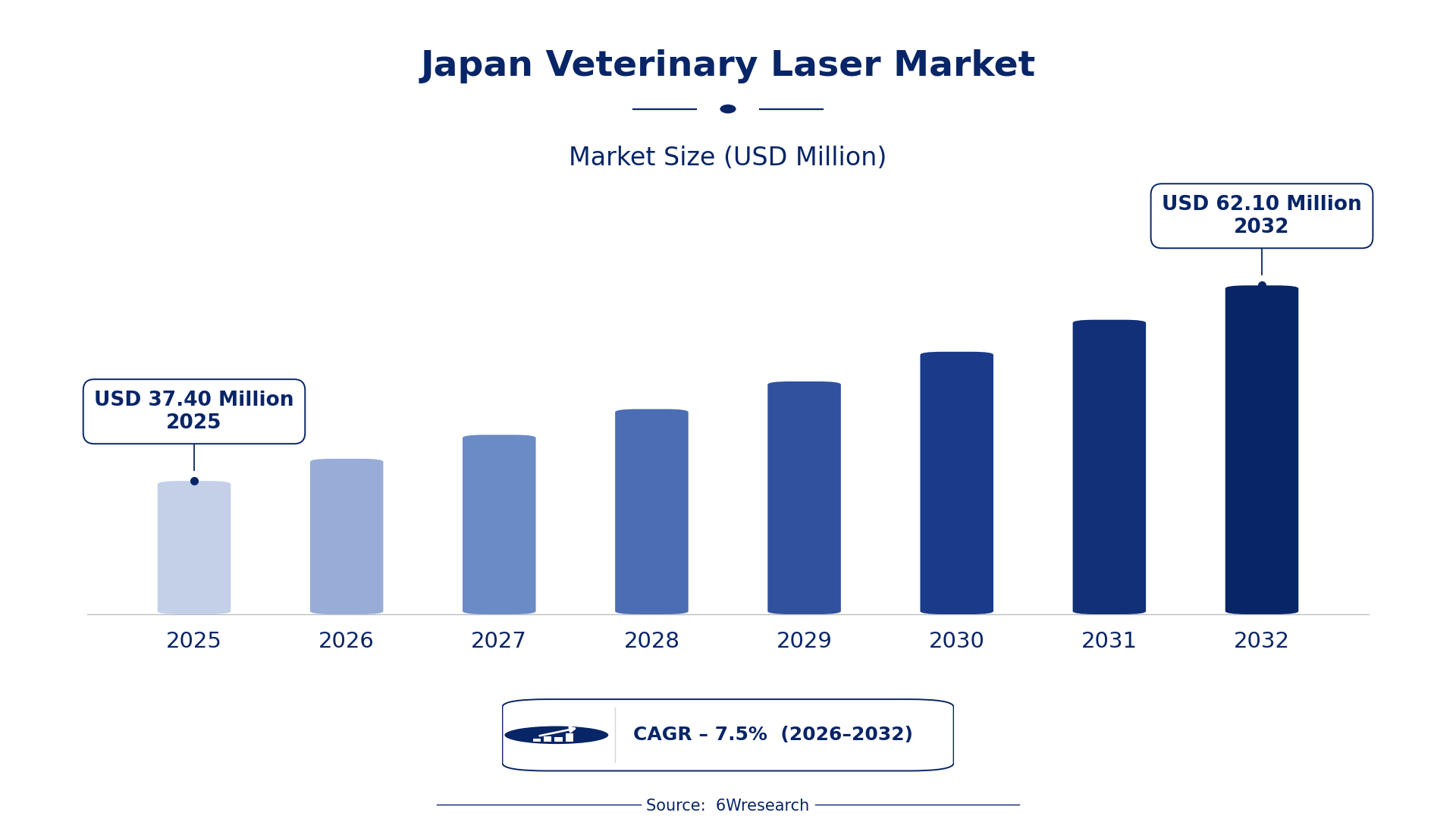
According to 6Wresearch internal database and industry insights, the Japan Veterinary Laser Market was valued at USD 37.40 Million in 2025 and is projected to reach USD 62.10 Million by 2032, growing at a CAGR of approximately 7.5% during 2026–2032.
Japan Veterinary Laser Market Highlights
| Report Metric | Details |
| Report Name | Japan Veterinary Laser Market (2026-2032) |
| Market Size 2025 | USD 37.40 Million |
| Market Size 2032 | USD 62.10 Million |
| Absolute Growth 2025–2032 | USD 24.70 Million |
| CAGR 2026–2032 | 7.5% |
| Peak Annual Growth | 8.6% in 2029 |
| Forecast Period | 2026–2032 |
| Historical Data | 2022–2025 |
| Base Year | 2025 |
| Leading Laser Type, 2025 | Low-Level Laser (59% share) |
| Leading Application, 2025 | Pain Management (68% share) |
| Leading Wavelength, 2025 | 600-900 nm (57% share) |
| Leading Animal Type, 2025 | Dogs (63% share) |
| Leading End User, 2025 | Veterinary Clinics (56% share) |
| Fastest-Growing Laser Type | High-Power Laser (10.2% CAGR) |
| Fastest-Growing Application | Surgical Procedures (9.7% CAGR) |
| Fastest-Growing Wavelength | >900 nm (9.4% CAGR) |
| Fastest-Growing Animal Type | Horses (10.6% CAGR) |
| Fastest-Growing End User | Research Labs (9.5% CAGR) |
| Growing Sector | Veterinary Care |
| Key End Users | Veterinary Clinics, Research Laboratories, Pet Owners |
Japan Veterinary Laser Market Year-wise Growth Rate and Key Drivers (2022–2032)
This graph illustrates the annual growth rates of the market from 2022 to 2032, highlighting a steady upward trajectory and projected market expansion over the forecast period.
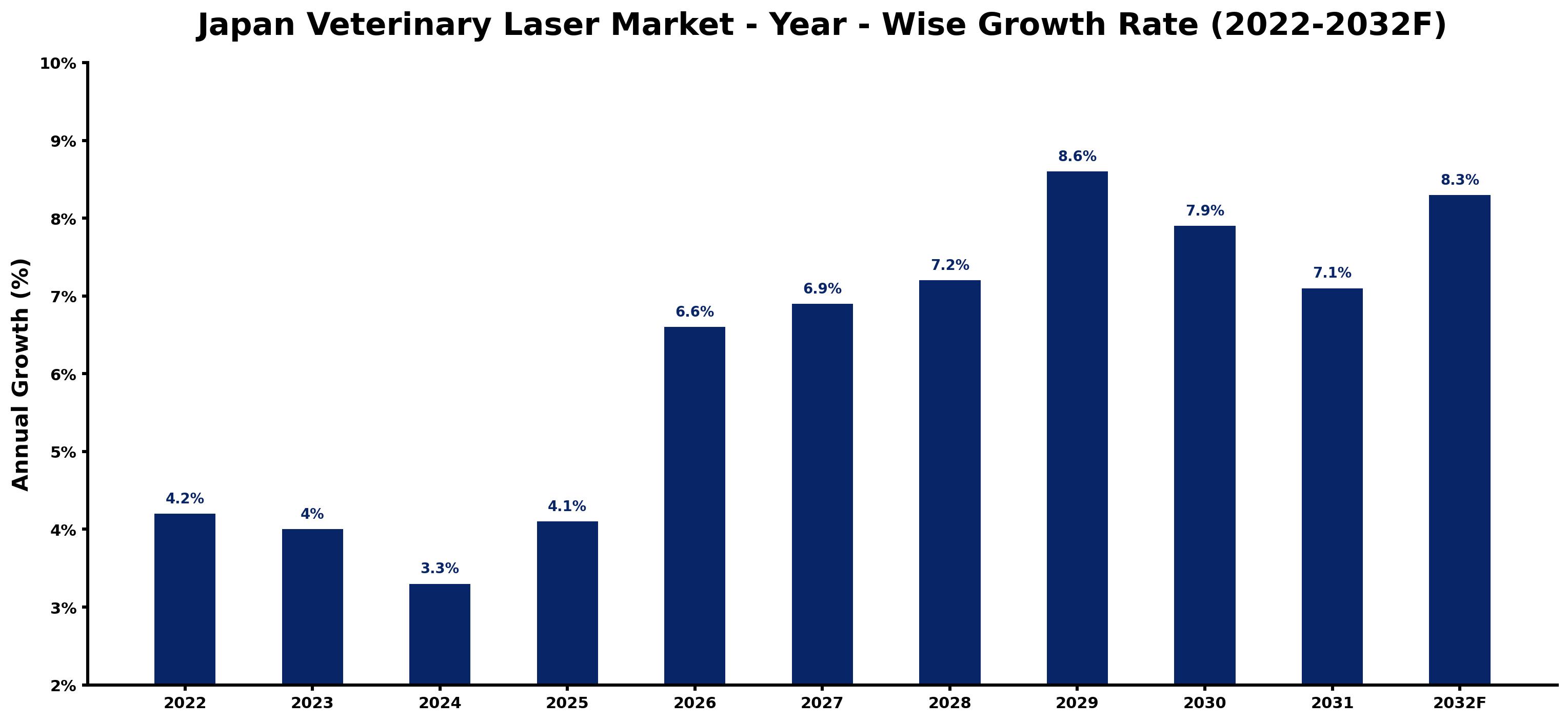
Year by year, the estimates below pair each growth rate with the development that shaped it.
| Year | Estimated Annual Growth (%) | Market Rationale |
| 2022 | 4.2 | The market showed steady growth due to increasing pet ownership rates. |
| 2023 | 4.0 | Growth slowed slightly as veterinary clinics adjusted to new technologies. |
| 2024 | 3.3 | Demand continued to rise, but at a slower pace amid market saturation. |
| 2025 | 4.1 | Growth accelerated as more clinics adopted advanced laser technologies. |
| 2026 | 6.6 | The market is expected to gain momentum from rising pet healthcare spending. |
| 2027 | 6.9 | Demand is projected to rise as awareness of laser treatments increases. |
| 2028 | 7.2 | Growth is anticipated to continue as more clinics invest in laser equipment. |
| 2029 | 8.6 | The peak growth rate reflects advancements in veterinary care technologies. |
| 2030 | 7.9 | Growth is expected to slow as the market matures and competition increases. |
| 2031 | 7.1 | Demand is projected to remain strong, driven by ongoing pet care trends. |
| 2032 | 8.3 | The market will see renewed growth as new applications for lasers emerge. |
Note: Market size estimations and growth projections presented in this report are based on 6Wresearch's proprietary forecasting methodology, utilizing the latest available industry data, government publications, and primary research inputs.
Japan Veterinary Laser Market Synopsis
Veterinary lasers are advanced medical devices used primarily for pain management and surgical procedures in animals. They emit specific wavelengths of light to treat soft tissue injuries and promote healing. The Japan Veterinary Laser Market is expanding due to rising pet ownership, with over 9 million pet dogs in 2022, and increasing investments in veterinary technologies. Government programs aimed at improving veterinary care are driving demand, particularly in urban areas like Tokyo and Osaka.
Market Dynamics Impact Analysis (2026–2032)
| Factor | Type | Impact | Primary Segment Affected |
| Increasing pet ownership rates | Driver | High | Pain Management |
| Adoption of advanced laser technologies | Driver | High | Surgical Procedures |
| Growth in veterinary clinics | Opportunity | High | Veterinary Clinics |
| Expansion of research laboratories | Opportunity | Medium | Research Labs |
| High initial investment costs | Restraint | High | High-Power Laser |
| Limited awareness among pet owners | Restraint | Medium | Low-Level Laser |
| Competition from alternative therapies | Challenge | High | Surgical Procedures |
| Regulatory hurdles for new technologies | Challenge | Medium | Pain Management |
Evaluation of Drivers in Japan Veterinary Laser Market (2026–2032)
These are the developments adding the most demand over the forecast period.
| Drivers | Primary Segment Affected | Why It Matters (Evidence) |
| Rising pet ownership | Pain Management | Approximately 9 million pet dogs in Japan increase demand for pain relief solutions. |
| Technological advancements in veterinary care | Surgical Procedures | The introduction of new laser systems improves surgical outcomes in veterinary clinics. |
| Growing awareness of laser therapy benefits | Low-Level Laser | Veterinary clinics are increasingly adopting low-level lasers for pain management. |
| Investment in veterinary healthcare technologies | High-Power Laser | Government programs are funding advancements in veterinary laser applications. |
| Increase in veterinary clinic numbers | Veterinary Clinics | Over 20,000 registered clinics in Japan drive demand for veterinary lasers. |
What keeps demand rising is the increasing pet ownership rate, with approximately 9 million pet dogs in Japan driving the need for effective pain management solutions. The growing number of registered veterinary clinics, exceeding 20,000, fuels demand for advanced surgical procedures. Technological advancements in veterinary care, including new laser systems, improve treatment outcomes and lead to higher adoption rates. Funding for veterinary healthcare technologies supports the expansion of laser applications, particularly in urban areas like Tokyo and Osaka. This combination of factors is boosting the market for veterinary lasers across the country.
Evaluation of Restraints in Japan Veterinary Laser Market
The main factors holding the market back are set out below.
| Market Restraint | Primary Segment Affected | Why It Matters (Evidence) |
| High initial investment costs for clinics | High-Power Laser | Many veterinary clinics face financial barriers when investing in advanced laser systems. |
| Limited awareness among pet owners about laser therapy | Low-Level Laser | A lack of knowledge can hinder the demand for laser treatments in veterinary practices. |
| Competition from alternative therapies | Surgical Procedures | Other treatment options may be preferred by some veterinary clinics and pet owners. |
| Regulatory hurdles for new technologies | Pain Management | Approval processes can delay the introduction of new laser therapies. |
| Market saturation in urban areas | Veterinary Clinics | High competition in cities like Tokyo limits growth opportunities for new clinics. |
Japan Veterinary Laser Market Challenges
Producers struggle with a shortage of skilled technicians, as training programs for advanced laser technology are limited in Japan. This lack of expertise delays product development and increases costs for manufacturers, forcing them to invest heavily in training initiatives. Buyers face higher prices due to a scarcity of technology options, with only a few local manufacturers complying with ISO 13485 standards. This situation limits access to affordable veterinary lasers, impacting clinics' ability to provide effective care. Supply chain disruptions occur as producers encounter difficulties sourcing components, leading to delays in product availability for veterinary clinics.
Trends in the Japan Veterinary Laser Market
The following changes are redrawing the Japan Veterinary Laser Market.
- Shift towards Non-Invasive Treatments: The trend towards non-invasive treatments is clear as more veterinary clinics adopt laser therapy for pain management. In 2023, approximately 30% of clinics reported using laser technology, reflecting a growing preference for less invasive options.
- Emergence of Advanced Laser Technologies: The introduction of advanced laser technologies in veterinary practices began in 2022, focusing on improving surgical outcomes. This shift is likely to improve treatment efficacy, with over 50% of clinics planning to invest in new systems by 2025.
- Increasing Focus on Pet Wellness: Pet wellness is becoming a priority, with veterinary clinics in Osaka reporting a significant increase in demand for preventive care services. This trend drives the adoption of laser treatments for routine health maintenance.
- Expansion of Research in Veterinary Laser Applications: Research labs are increasingly focusing on developing new laser applications, with funding for animal health research programs reaching USD 5 million in 2023. This investment is expected to lead to new treatment methods by 2026.
Investment Opportunities in the Japan Veterinary Laser Market
The openings below show where demand in the Japan Veterinary Laser Market is visible and how suppliers can enter.
- Investment in Veterinary Clinics: With over 20,000 registered veterinary clinics, there is an opportunity to supply advanced laser systems. Clinics in Tokyo are particularly in need of modern equipment, creating potential for partnerships with local suppliers.
- Development of Laser Technologies: The market gap for high-power lasers presents an opportunity to invest in new technologies. Research labs in Japan are actively seeking innovative solutions, and collaboration with them can lead to successful product introductions.
- Expansion of Pain Management Services: The increasing focus on pain management in veterinary care highlights the need for effective laser solutions. Veterinary clinics in Osaka are expanding their services, indicating a demand for advanced laser therapies.
- Enhancement of Surgical Procedures: The growth in surgical procedures creates a demand for high-power lasers. Clinics in urban areas are looking to upgrade their surgical capabilities, providing an entry point for suppliers.
Government Initiatives in the Japan Veterinary Laser Market
The PMD Act regulates the approval and quality of medical devices, including veterinary lasers, ensuring that manufacturers adhere to strict standards. This act protects buyers by ensuring that only safe and effective products are available in the market, building trust in veterinary care. Additionally, the Medical Care Act sets standards for hospitals and clinics, ensuring adequate facilities and staffing for veterinary practices.
The Ministry of Agriculture, Forestry and Fisheries oversees animal health initiatives, funding programs to improve veterinary care technologies. This includes support for research and development in laser applications, benefiting both producers and buyers by expanding treatment options. The government has allocated significant resources to enhance veterinary care, with funding reaching USD 5 million in 2023.
Future Insight of the Japan Veterinary Laser Market
Veterinary clinics will increasingly embrace advanced laser technologies by 2032, driven by government initiatives aimed at improving animal health. New training programs will provide technicians with crucial skills, improving service quality. As pet ownership rises, the demand for effective pain management solutions will grow, encouraging suppliers to innovate. Research labs will focus on developing next-generation lasers, ensuring clinics have access to cutting-edge treatments. By 2032, Japan is expected to have over 25,000 registered veterinary clinics, creating a more competitive landscape for suppliers.
Market Segmentation Analysis
Japan Veterinary Laser Market report covers a detailed analysis of the following market segments:
By Laser Type – Low-Level Laser Leads, High-Power Laser Expected to Grow Fastest
According to Bhawna Singh, Assistant Manager at 6Wresearch, with 59% of laser type revenue in 2025, Low-Level Laser was the largest category. Low-Level Lasers dominate the market due to their widespread use in pain relief, a primary focus for veterinary clinics. With over 20,000 registered veterinary clinics in Japan, their reliance on effective pain management solutions reinforces this segment's strength. High-Power Laser is projected to grow fastest, at a CAGR of 10.2% during 2026–2032. High-Power Lasers are experiencing significant growth as their application in surgical procedures becomes more prevalent among veterinary practices. The increasing complexity of surgical techniques necessitates more effective tools, driving this segment's rapid expansion. Suppliers should invest in High-Power Laser technology to align with the growing demand in veterinary surgical applications.
By Application – Pain Management Leads, Surgical Procedures Expected to Grow Fastest
Pain Management held 68% of the Japan Veterinary Laser Market by application in 2025. Pain Management is the dominant application as it addresses the essential need for effective treatment in animals, particularly with the high number of pet dogs in Japan. This widespread concern for animal welfare propels the demand for pain management solutions. The quickest growth will come from Surgical Procedures, forecast to expand at a CAGR of 9.7% between 2026 and 2032. Surgical Procedures are the fastest-growing application, spurred by improvements in surgical techniques and the increasing need for precise interventions in veterinary care. This trend indicates a rise in the complexity and frequency of surgeries performed on animals. Buyers will increasingly seek suppliers who can deliver tailored solutions for surgical applications.
By Wavelength – 600-900 nm Leads, >900 nm Expected to Grow Fastest
600-900 nm took 57% of wavelength revenue in 2025, more than any other category. The 600-900 nm wavelength range leads the market due to its effectiveness in treating various conditions, making it a preferred option for veterinary professionals. Its ability to address multiple treatment needs ensures sustained demand within the veterinary sector. Over 2026–2032, >900 nm is expected to post the fastest growth, at a CAGR of 9.4%. >900 nm wavelengths are rapidly gaining traction as they are explored for specialised treatments, indicating a shift towards advanced laser technologies in veterinary care. This growth reflects an increasing interest in optimising treatment options for specific conditions. Suppliers should consider developing products that utilise >900 nm wavelengths to tap into the emerging opportunities in specialised veterinary treatments.
By Animal Type – Dogs Lead, Horses Expected to Grow Fastest
In 2025, Dogs led the animal type split with a 63% share. Dogs are the primary focus of veterinary laser treatments, representing a substantial portion of the market. The average lifespan of dogs in Japan necessitates ongoing veterinary care, including the use of laser treatments. Horses are set to record the highest CAGR in this split, 10.6% over 2026–2032. Horses are the fastest-growing segment, particularly in equine surgeries, as the demand for advanced veterinary care in this area rises. The growing interest in equestrian activities is a key factor driving this growth. Suppliers should consider expanding their offerings to specifically address the equine market.
By End User – Veterinary Clinics Lead, Research Labs Expected to Grow Fastest
Veterinary Clinics accounted for 56% of the market by end user in 2025. Veterinary Clinics are the leading end users of veterinary lasers, serving as the main providers of animal healthcare services. The extensive network of over 20,000 clinics generates substantial demand for effective laser solutions. Research Labs are projected to grow fastest, at a CAGR of 9.5% during 2026–2032. Research Labs represent the fastest-growing end user, reflecting a trend towards innovation in advanced veterinary laser technologies. The focus on research and development in animal health fuels this segment's growth. Buyers in research labs will require suppliers who can provide state-of-the-art technologies for experimental purposes.
Key Attractiveness of the Report
- 10 Years of Market Numbers
- Historical Data Starting from 2022 to 2025
- Base Year 2025
- Forecast Data until 2032
- Key Performance Indicators Impacting the Market
- Major Upcoming Developments and Projects
Key Highlights of the Report:
- Japan Veterinary Laser Market Outlook
- Market Size of Japan Veterinary Laser Market,2025
- Forecast of Japan Veterinary Laser Market, 2032
- Historical Data and Forecast of Japan Veterinary Laser Revenues & Volume for the Period 2022-2032
- Japan Veterinary Laser Market Trend Evolution
- Japan Veterinary Laser Market Drivers and Challenges
- Japan Veterinary Laser Price Trends
- Japan Veterinary Laser Porter's Five Forces
- Japan Veterinary Laser Industry Life Cycle
- Historical Data and Forecast of Japan Veterinary Laser Market Revenues & Volume By Laser Type for the Period 2022-2032
- Historical Data and Forecast of Japan Veterinary Laser Market Revenues & Volume By Low-Level Laser for the Period 2022-2032
- Historical Data and Forecast of Japan Veterinary Laser Market Revenues & Volume By High-Power Laser for the Period 2022-2032
- Historical Data and Forecast of Japan Veterinary Laser Market Revenues & Volume By Application for the Period 2022-2032
- Historical Data and Forecast of Japan Veterinary Laser Market Revenues & Volume By Pain Management for the Period 2022-2032
- Historical Data and Forecast of Japan Veterinary Laser Market Revenues & Volume By Surgical Procedures for the Period 2022-2032
- Historical Data and Forecast of Japan Veterinary Laser Market Revenues & Volume By Wavelength for the Period 2022-2032
- Historical Data and Forecast of Japan Veterinary Laser Market Revenues & Volume By 600-900 nm for the Period 2022-2032
- Historical Data and Forecast of Japan Veterinary Laser Market Revenues & Volume By >900 nm for the Period 2022-2032
- Historical Data and Forecast of Japan Veterinary Laser Market Revenues & Volume By Animal Type for the Period 2022-2032
- Historical Data and Forecast of Japan Veterinary Laser Market Revenues & Volume By Dogs for the Period 2022-2032
- Historical Data and Forecast of Japan Veterinary Laser Market Revenues & Volume By Horses for the Period 2022-2032
- Historical Data and Forecast of Japan Veterinary Laser Market Revenues & Volume By End User for the Period 2022-2032
- Historical Data and Forecast of Japan Veterinary Laser Market Revenues & Volume By Veterinary Clinics for the Period 2022-2032
- Historical Data and Forecast of Japan Veterinary Laser Market Revenues & Volume By Research Labs for the Period 2022-2032
- Japan Veterinary Laser Import Export Trade Statistics
- Market Opportunity Assessment By Laser Type
- Market Opportunity Assessment By Application
- Market Opportunity Assessment By Wavelength
- Market Opportunity Assessment By Animal Type
- Market Opportunity Assessment By End User
- Japan Veterinary Laser Top Companies Market Share
- Japan Veterinary Laser Competitive Benchmarking By Technical and Operational Parameters
- Japan Veterinary Laser Company Profiles
- Japan Veterinary Laser Key Strategic Recommendations
Market Covered
The report covers the following segments.
By Laser Type
- Low-Level Laser
- High-Power Laser
By Application
- Pain Management
- Surgical Procedures
By Wavelength
- 600-900 nm
- >900 nm
By Animal Type
- Dogs
- Horses
By End User
- Veterinary Clinics
- Research Labs































