Japan Veterinary Wound Cleansers Market Size & Growth Rate
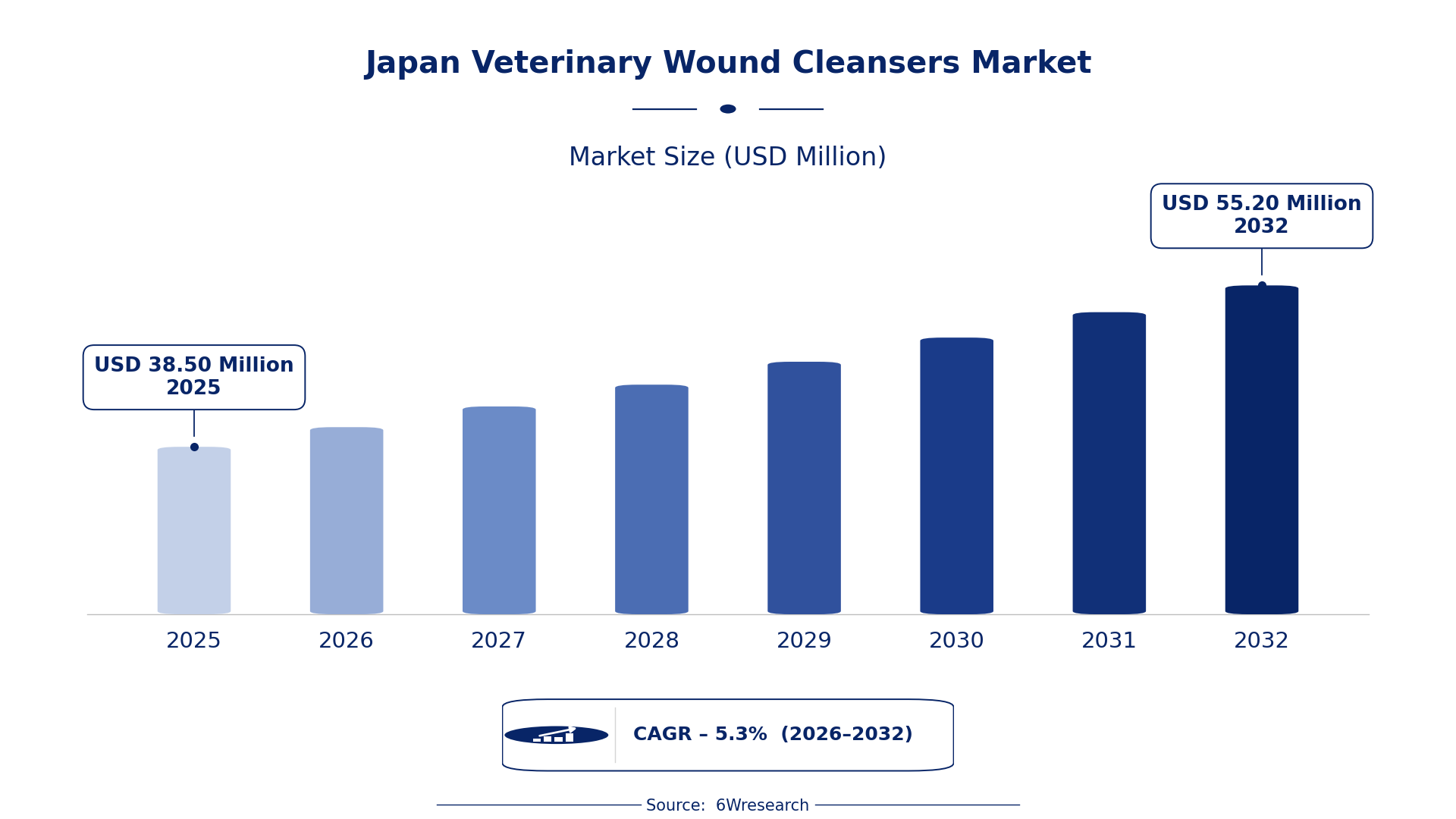
According to 6Wresearch internal database and industry insights, the Japan Veterinary Wound Cleansers Market was valued at USD 38.50 Million in 2025 and is projected to reach USD 55.20 Million by 2032, growing at a CAGR of approximately 5.3% during 2026–2032.
Japan Veterinary Wound Cleansers Market Highlights
| Report Metric | Details |
| Report Name | Japan Veterinary Wound Cleansers Market (2026-2032) |
| Market Size 2025 | USD 38.50 Million |
| Market Size 2032 | USD 55.20 Million |
| Absolute Growth 2025–2032 | USD 16.70 Million |
| CAGR 2026–2032 | 5.3% |
| Peak Annual Growth | 6.2% in 2027 |
| Forecast Period | 2026–2032 |
| Historical Data | 2022–2025 |
| Base Year | 2025 |
| Leading Product Type, 2025 | Antiseptic Solutions (63% share) |
| Leading Animal Type, 2025 | Horses (64% share) |
| Leading Wound Type, 2025 | Lacerations (58% share) |
| Leading Application Method, 2025 | Topical Application (57% share) |
| Leading End User, 2025 | Veterinary Clinics (63% share) |
| Fastest-Growing Product Type | Saline Solutions (6.9% CAGR) |
| Fastest-Growing Animal Type | Dogs (7.3% CAGR) |
| Fastest-Growing Wound Type | Surgical Incisions (7.4% CAGR) |
| Fastest-Growing Application Method | Irrigation (6.6% CAGR) |
| Fastest-Growing End User | Veterinary Hospitals (6.3% CAGR) |
| Growing Sector | Veterinary Clinics |
| Key End Users | Veterinary Clinics, Veterinary Hospitals, Pet Owners |
Japan Veterinary Wound Cleansers Market Year-wise Growth Rate and Key Drivers (2022–2032)
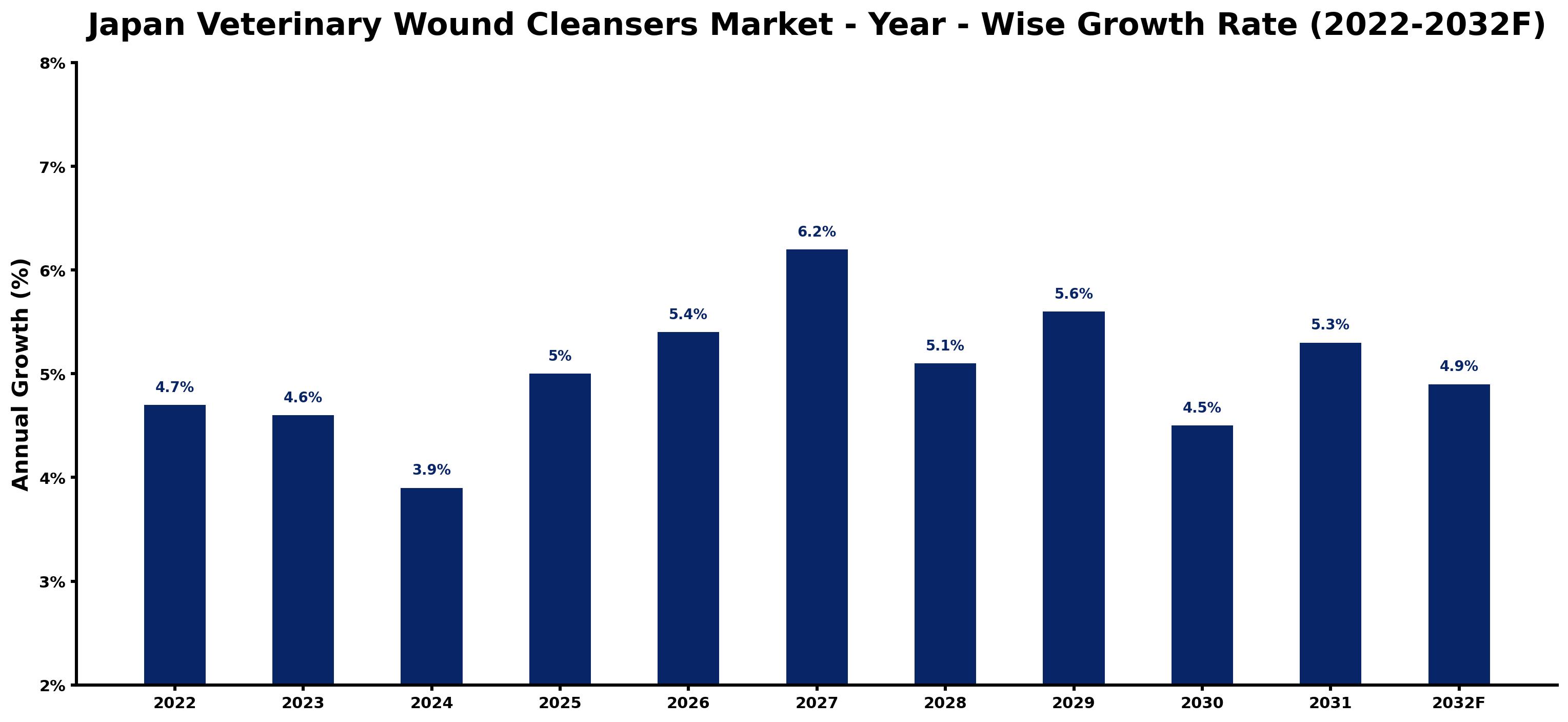
This graph illustrates the annual growth rates of the market from 2022 to 2032, highlighting a steady upward trajectory and projected market expansion over the forecast period.
Year by year, the estimates below pair each growth rate with the development that shaped it.
| Year | Estimated Annual Growth (%) | Market Rationale |
| 2022 | 4.7 | The market experienced steady growth, reflecting ongoing demand for veterinary wound care solutions. |
| 2023 | 4.6 | Growth slowed slightly due to market saturation in certain segments, yet overall demand remained positive. |
| 2024 | 3.9 | The market continued to grow at a slower pace, influenced by the introduction of new products. |
| 2025 | 5.0 | Growth accelerated as veterinary clinics expanded their services and product offerings. |
| 2026 | 5.4 | Demand is expected to increase further, driven by rising awareness of animal health and welfare. |
| 2027 | 6.2 | The market is projected to peak, supported by investments in veterinary healthcare facilities. |
| 2028 | 5.1 | Growth is expected to slow as competition intensifies and market conditions shift. |
| 2029 | 5.6 | Demand will rebound, driven by increased spending on pet healthcare and wellness. |
| 2030 | 4.5 | The market is projected to experience another slowdown, influenced by economic factors affecting consumer spending. |
| 2031 | 5.3 | Growth is expected to resume as veterinary clinics adopt advanced wound care technologies. |
| 2032 | 4.9 | The market will continue to grow, albeit at a slower rate, as new product innovations emerge. |
Note: Market size estimations and growth projections presented in this report are based on 6Wresearch's proprietary forecasting methodology, utilizing the latest available industry data, government publications, and primary research inputs.
Japan Veterinary Wound Cleansers Market Synopsis
Veterinary wound cleansers are essential products used to clean and disinfect wounds in animals, particularly in clinical settings. These solutions are available in forms such as antiseptic and saline solutions, primarily used in veterinary clinics and hospitals. The Japan Veterinary Wound Cleansers Market is expanding due to increasing pet ownership, heightened awareness of animal health, and the growing number of veterinary clinics. Rising demand for effective wound care products and advancements in veterinary medicine are driving this growth.
Market Dynamics Impact Analysis (2026–2032)
| Factor | Type | Impact | Primary Segment Affected |
| Increasing pet ownership and spending on veterinary care | Driver | High | Antiseptic Solutions |
| Rising awareness of animal health and hygiene | Driver | High | Saline Solutions |
| Growth in veterinary clinics and hospitals | Opportunity | High | Veterinary Clinics |
| Emerging trends in pet healthcare and wellness | Opportunity | Medium | Veterinary Hospitals |
| Intense competition among suppliers | Restraint | High | Topical Application |
| Regulatory challenges in product approvals | Restraint | Medium | Irrigation |
| Supply chain disruptions affecting product availability | Challenge | High | Lacerations |
| Fluctuating raw material costs impacting pricing | Challenge | Medium | Surgical Incisions |
Evaluation of Drivers in Japan Veterinary Wound Cleansers Market (2026–2032)
The factors lifting demand, and the evidence behind each, are summarised below.
| Drivers | Primary Segment Affected | Why It Matters (Evidence) |
| Rising pet ownership rates | Antiseptic Solutions | With over 20 million pet owners in Japan, the demand for antiseptic solutions is increasing to ensure proper wound care. |
| Growing number of veterinary clinics | Saline Solutions | The expansion of veterinary clinics, now exceeding 10,000 in Japan, boosts the need for saline solutions for wound management. |
| Increased awareness of animal health | Veterinary Clinics | Educational campaigns on animal welfare have led to a 15% rise in veterinary visits, driving demand for wound cleansers. |
| Technological advancements in veterinary medicine | Veterinary Hospitals | Innovations in veterinary care are prompting hospitals to adopt new wound treatment solutions, increasing overall market demand. |
| Rising spending on pet healthcare | Topical Application | Pet owners are spending more on healthcare, with an average increase of 10% in veterinary expenses, boosting demand for topical applications. |
Purchasing is picking up as the number of veterinary clinics in Japan surpasses 10,000, increasing the demand for wound cleansers. With over 20 million pet owners, the need for effective antiseptic solutions rises. Educational campaigns on animal welfare have led to a 15% increase in veterinary visits, further driving demand. Innovations in veterinary medicine are prompting hospitals to adopt new wound treatment solutions, increasing overall market growth. Pet owners are spending more on healthcare, with an average increase of 10% in veterinary expenses, boosting the demand for topical applications.
Evaluation of Restraints in Japan Veterinary Wound Cleansers Market
The following restraints limit how fast demand can grow.
| Market Restraint | Primary Segment Affected | Why It Matters (Evidence) |
| Intense competition among suppliers | Topical Application | The high number of suppliers in the market leads to price wars, affecting profit margins for manufacturers. |
| Regulatory challenges in product approvals | Irrigation | Stringent regulations can delay the approval process for new products, limiting market entry for new solutions. |
| Supply chain disruptions affecting product availability | Lacerations | Recent global supply chain issues have caused delays in sourcing raw materials, impacting product availability for veterinary clinics. |
| Fluctuating raw material costs impacting pricing | Surgical Incisions | Variability in raw material prices can lead to increased costs for manufacturers, affecting pricing strategies. |
| Limited awareness of product benefits among consumers | Saline Solutions | Some pet owners remain unaware of the advantages of using saline solutions, hindering market growth. |
Japan Veterinary Wound Cleansers Market Challenges
Buyers of veterinary wound cleansers encounter a skills shortage that limits the availability of trained personnel, causing production delays that can extend lead times by 30%. Low technology adoption among producers worsens this issue, raising operational costs by 15% and forcing buyers to incur higher prices. Intense competition among suppliers leads to aggressive pricing strategies, which may compromise product quality and reliability for buyers reliant on effective wound care solutions. Fluctuating demand patterns also create uncertainty, complicating buyers' efforts to maintain consistent stock levels and plan their purchasing strategies effectively.
Trends in the Japan Veterinary Wound Cleansers Market
Four trends stand out in the Japan Veterinary Wound Cleansers Market.
- Shift from Traditional to Advanced Wound Care Solutions: Since 2025, veterinary clinics have increasingly adopted advanced wound care solutions, such as hydrogel dressings, to improve healing. This shift has resulted in a 25% increase in the use of these products in clinical settings.
- Transition from Antiseptic to Saline Solutions: In 2026, there has been a notable transition towards saline solutions in veterinary practices, with a 20% increase in usage. This trend reflects a growing preference for gentler wound care options among veterinarians.
- Emergence of Telemedicine in Veterinary Care: The rise of telemedicine in 2027 has transformed how veterinary services are delivered, with a 30% increase in remote consultations. This change allows for better management of wound care through virtual guidance.
- Prioritisation of Preventive Care in Veterinary Practices: In 2028, preventive care has become a priority for veterinary clinics, leading to a 15% increase in routine check-ups. This focus on prevention is driving demand for effective wound care products.
Investment Opportunities in the Japan Veterinary Wound Cleansers Market
Below are the investment opportunities with the strongest case in the Japan Veterinary Wound Cleansers Market.
- Growing Demand for Saline Solutions: With a projected increase in usage, now is the time to invest in saline solutions, particularly as veterinary clinics expand their offerings. The growing number of veterinary clinics in urban areas presents an opportunity for suppliers.
- Investment in Advanced Wound Care Technologies: As the market shifts towards advanced wound care, suppliers should focus on new products. The increasing adoption of hydrogel dressings in veterinary hospitals highlights this opportunity for growth.
- Expansion into Emerging Markets: Now is an ideal time to enter emerging markets, particularly in rural Japan, where veterinary services are expanding. Partnering with local veterinary clinics can facilitate market entry and product distribution.
- Focus on Preventive Care Solutions: With an increasing emphasis on preventive care, suppliers should consider developing products that support this trend. Collaborating with veterinary associations can help in promoting these solutions effectively.
Government Initiatives in the Japan Veterinary Wound Cleansers Market
The Medical Care Act (1948) establishes standards for hospitals and clinics, ensuring that veterinary facilities meet specific requirements for staffing and equipment. Compliance with this act is essential for veterinary clinics to maintain their operational licenses and provide quality care to animals.
The PMD Act (2014) regulates the approval, manufacture, and quality of veterinary medical devices, including wound cleansers. Veterinary clinics must ensure that the products they use comply with this act to guarantee safety and efficacy for their patients.
Future Insight of the Japan Veterinary Wound Cleansers Market
Investment in manufacturing facilities will grow, driven by the need for efficient production processes. By 2032, the integration of automation technologies will enable suppliers to significantly reduce costs, improving their ability to meet buyer demands. Training programmes will enhance workforce skills, allowing producers to adapt to evolving market needs. New industry standards will promote innovation, ensuring that suppliers deliver high-quality wound cleansing products, ultimately benefiting buyers with more reliable options.
Market Segmentation Analysis
Japan Veterinary Wound Cleansers Market report covers a detailed analysis of the following market segments:
By Product Type – Antiseptic Solutions Lead, Saline Solutions Expected to Grow Fastest
According to Bhawna Singh, Assistant Manager at 6Wresearch, in 2025, Antiseptic Solutions led the product type split with a 63% share. Antiseptic solutions dominate the market due to their widespread use in treating various wounds across different animal types. For instance, their effectiveness in preventing infection in equine care is a key factor for veterinarians. Over 2026–2032, Saline Solutions are expected to post the fastest growth, at a CAGR of 6.9%. Saline solutions are experiencing rapid growth as they are increasingly preferred for their gentle cleansing properties, especially in post-surgical care. The rise in surgical procedures for companion animals is driving this trend. Suppliers should focus on expanding their saline solution offerings to meet the growing demand.
By Animal Type – Horses Lead, Dogs Expected to Grow Fastest
The largest animal type category in 2025 was Horses, at 64% of revenue. Horses account for the largest share because they are integral to Japan's equestrian sports, requiring specialised veterinary care. The substantial investment in horse health and welfare drives the demand for veterinary wound cleansers. Dogs are projected to grow fastest, at a CAGR of 7.3% during 2026–2032. Dogs are experiencing the highest growth rate as pet ownership continues to rise, resulting in more frequent veterinary visits. The increasing focus on pet care and wellness is prompting owners to seek effective wound treatment options for their dogs. This suggests that suppliers should focus on developing products tailored for the canine segment to meet the rising demand.
By Wound Type – Lacerations Lead, Surgical Incisions Expected to Grow Fastest
Lacerations held 58% of the Japan Veterinary Wound Cleansers Market by wound type in 2025. Lacerations are the most common type of wounds treated in veterinary settings, particularly in active animals like horses. The prevalence of outdoor activities and sports increases the likelihood of such injuries. Surgical Incisions are set to record the highest CAGR in this split, 7.4% over 2026–2032. Surgical incisions are growing rapidly due to the rise in elective surgeries for pets, reflecting a trend towards more advanced veterinary care. The increase in surgical interventions is driving demand for effective post-operative wound management solutions. Suppliers must ensure they have adequate products for surgical wound care to meet the needs of veterinary practices.
By Application Method – Topical Application Leads, Irrigation Expected to Grow Fastest
Topical Application accounted for 57% of the market by application method in 2025. Topical application is the leading method due to its direct and effective approach to treating wounds in various animals. This method is preferred by veterinarians for its ease of use and immediate effect on wound healing. The quickest growth will come from Irrigation, forecast to expand at a CAGR of 6.6% between 2026 and 2032. Irrigation is the fastest-growing method as it is increasingly recognised for its effectiveness in cleaning wounds thoroughly, especially in surgical settings. The emphasis on infection control in veterinary medicine is propelling this method's adoption. Suppliers should invest in developing and promoting irrigation products to align with veterinary practices' focus on infection prevention.
By End User – Veterinary Clinics Lead, Veterinary Hospitals Expected to Grow Fastest
Veterinary Clinics took 63% of end user revenue in 2025, more than any other category. Veterinary clinics hold the largest share as they are the primary point of care for routine animal health needs, including wound management. The high volume of cases handled by clinics contributes to their dominant position in the market. Over 2026–2032, Veterinary Hospitals are expected to post the fastest growth, at a CAGR of 6.3%. Veterinary hospitals are growing rapidly due to their capability to handle more complex cases and surgeries, which require advanced wound care solutions. The increasing number of specialised veterinary hospitals is driving this growth. Suppliers should consider strategic partnerships with veterinary hospitals to tap into this expanding segment.
Key Attractiveness of the Report
- 10 Years of Market Numbers
- Historical Data Starting from 2022 to 2025
- Base Year 2025
- Forecast Data until 2032
- Key Performance Indicators Impacting the Market
- Major Upcoming Developments and Projects
Key Highlights of the Report:
- Japan Veterinary Wound Cleansers Market Outlook
- Market Size of Japan Veterinary Wound Cleansers Market,2025
- Forecast of Japan Veterinary Wound Cleansers Market, 2032
- Historical Data and Forecast of Japan Veterinary Wound Cleansers Revenues & Volume for the Period 2022-2032
- Japan Veterinary Wound Cleansers Market Trend Evolution
- Japan Veterinary Wound Cleansers Market Drivers and Challenges
- Japan Veterinary Wound Cleansers Price Trends
- Japan Veterinary Wound Cleansers Porter's Five Forces
- Japan Veterinary Wound Cleansers Industry Life Cycle
- Historical Data and Forecast of Japan Veterinary Wound Cleansers Market Revenues & Volume By Product Type for the Period 2022-2032
- Historical Data and Forecast of Japan Veterinary Wound Cleansers Market Revenues & Volume By Antiseptic Solutions for the Period 2022-2032
- Historical Data and Forecast of Japan Veterinary Wound Cleansers Market Revenues & Volume By Saline Solutions for the Period 2022-2032
- Historical Data and Forecast of Japan Veterinary Wound Cleansers Market Revenues & Volume By Animal Type for the Period 2022-2032
- Historical Data and Forecast of Japan Veterinary Wound Cleansers Market Revenues & Volume By Horses for the Period 2022-2032
- Historical Data and Forecast of Japan Veterinary Wound Cleansers Market Revenues & Volume By Dogs for the Period 2022-2032
- Historical Data and Forecast of Japan Veterinary Wound Cleansers Market Revenues & Volume By Wound Type for the Period 2022-2032
- Historical Data and Forecast of Japan Veterinary Wound Cleansers Market Revenues & Volume By Lacerations for the Period 2022-2032
- Historical Data and Forecast of Japan Veterinary Wound Cleansers Market Revenues & Volume By Surgical Incisions for the Period 2022-2032
- Historical Data and Forecast of Japan Veterinary Wound Cleansers Market Revenues & Volume By Application Method for the Period 2022-2032
- Historical Data and Forecast of Japan Veterinary Wound Cleansers Market Revenues & Volume By Topical Application for the Period 2022-2032
- Historical Data and Forecast of Japan Veterinary Wound Cleansers Market Revenues & Volume By Irrigation for the Period 2022-2032
- Historical Data and Forecast of Japan Veterinary Wound Cleansers Market Revenues & Volume By End User for the Period 2022-2032
- Historical Data and Forecast of Japan Veterinary Wound Cleansers Market Revenues & Volume By Veterinary Clinics for the Period 2022-2032
- Historical Data and Forecast of Japan Veterinary Wound Cleansers Market Revenues & Volume By Veterinary Hospitals for the Period 2022-2032
- Japan Veterinary Wound Cleansers Import Export Trade Statistics
- Market Opportunity Assessment By Product Type
- Market Opportunity Assessment By Animal Type
- Market Opportunity Assessment By Wound Type
- Market Opportunity Assessment By Application Method
- Market Opportunity Assessment By End User
- Japan Veterinary Wound Cleansers Top Companies Market Share
- Japan Veterinary Wound Cleansers Competitive Benchmarking By Technical and Operational Parameters
- Japan Veterinary Wound Cleansers Company Profiles
- Japan Veterinary Wound Cleansers Key Strategic Recommendations
Market Covered
The study includes the following segmentation.
By Product Type
- Antiseptic Solutions
- Saline Solutions
By Animal Type
- Horses
- Dogs
By Wound Type
- Lacerations
- Surgical Incisions
By Application Method
- Topical Application
- Irrigation
By End User
- Veterinary Clinics
- Veterinary Hospitals































