Japan Virtual Reality Medical Simulation Market Size & Growth Rate
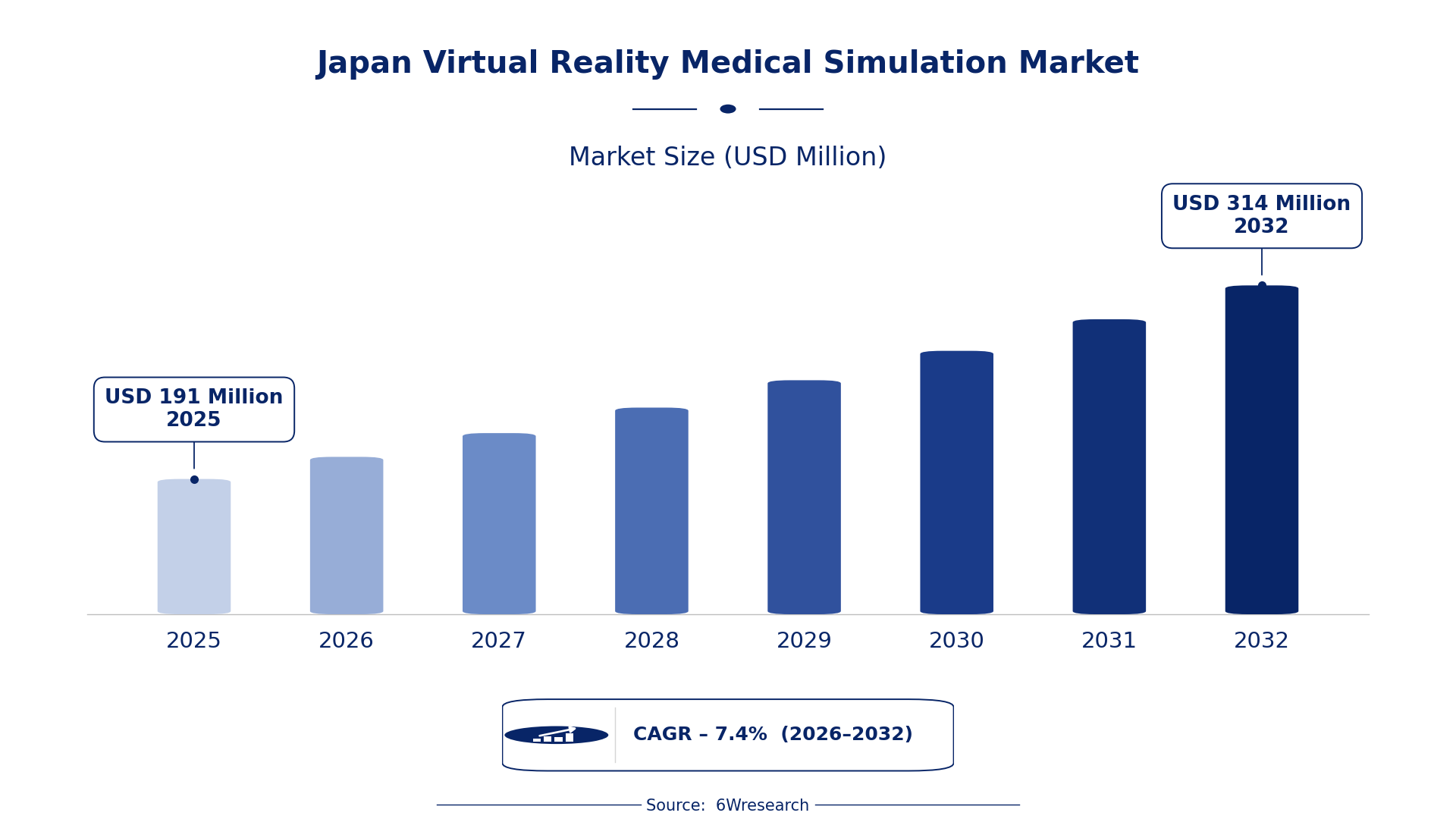
According to 6Wresearch internal database and industry insights, the Japan Virtual Reality Medical Simulation Market was valued at USD 191 Million in 2025 and is projected to reach USD 314 Million by 2032, growing at a CAGR of approximately 7.4% during 2026–2032.
Japan Virtual Reality Medical Simulation Market Highlights
| Report Metric | Details |
| Report Name | Japan Virtual Reality Medical Simulation Market (2026-2032) |
| Market Size 2025 | USD 191 Million |
| Market Size 2032 | USD 314 Million |
| Absolute Growth 2025–2032 | USD 123 Million |
| CAGR 2026–2032 | 7.4% |
| Peak Annual Growth | 8.3% in 2026 |
| Forecast Period | 2026–2032 |
| Historical Data | 2022–2025 |
| Base Year | 2025 |
| Leading Type, 2025 | Surgical Simulator (54% share) |
| Leading Application, 2025 | Hospital (46% share) |
| Fastest-Growing Type | Patient Simulator (9.9% CAGR) |
| Fastest-Growing Application | Clinic (9.4% CAGR) |
| Growing Sector | medical training |
| Key End Users | hospitals, medical schools, research institutions, dental schools |
Japan Virtual Reality Medical Simulation Market Year-wise Growth Rate and Key Drivers (2022–2032)
This graph illustrates the annual growth rates of the market from 2022 to 2032, highlighting a steady upward trajectory and projected market expansion over the forecast period.
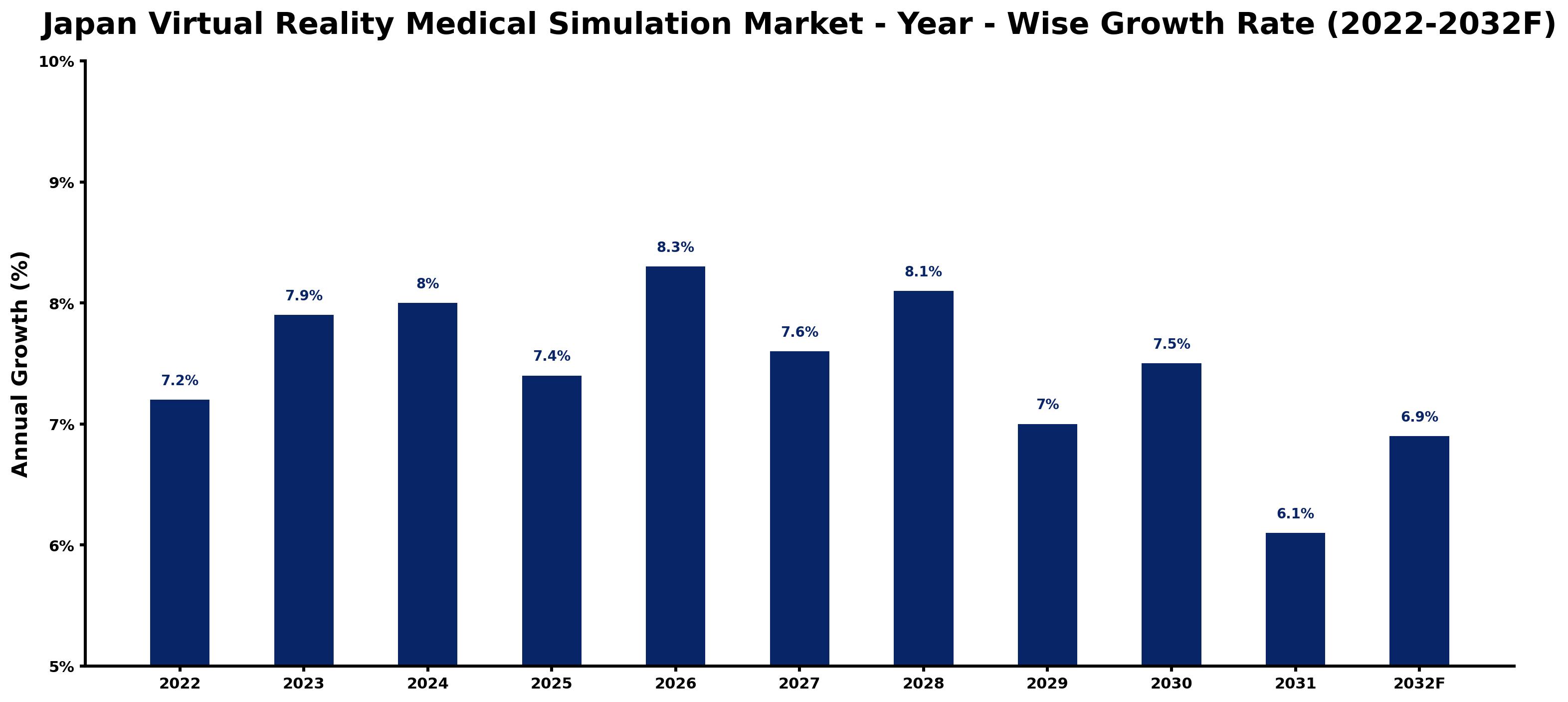
Year by year, the estimates below pair each growth rate with the development that shaped it.
| Year | Estimated Annual Growth (%) | Market Rationale |
| 2022 | 7.2 | The market exhibited steady growth due to increased adoption of simulation technologies in medical training. |
| 2023 | 7.9 | Demand accelerated as more healthcare institutions integrated virtual reality into their training programs. |
| 2024 | 8.0 | Growth continued to rise, driven by advancements in VR technology and user engagement. |
| 2025 | 7.4 | The market experienced a slowdown, influenced by market saturation in certain segments. |
| 2026 | 8.3 | Demand surged as hospitals expanded their training capabilities with new VR applications. |
| 2027 | 7.6 | Growth slowed slightly due to the maturation of existing technologies and market competition. |
| 2028 | 8.1 | The market rebounded with increased investment in advanced simulation technologies. |
| 2029 | 7.0 | Growth decelerated as the market began to stabilise after rapid expansion. |
| 2030 | 7.5 | Demand increased again as healthcare facilities sought to improve training effectiveness. |
| 2031 | 6.1 | The market saw a slowdown as new entrants began to compete in established segments. |
| 2032 | 6.9 | Growth picked up due to renewed interest in training solutions. |
Note: Market size estimations and growth projections presented in this report are based on 6Wresearch's proprietary forecasting methodology, utilizing the latest available industry data, government publications, and primary research inputs.
Japan Virtual Reality Medical Simulation Market Synopsis
Virtual Reality Medical Simulation employs advanced VR technology to create immersive training environments for healthcare professionals. It is widely used for surgical training, patient care, and dental practices. The Japan Virtual Reality Medical Simulation Market is expanding, driven by the increasing adoption of VR training modules in medical schools, with 75% of institutions implementing these technologies by 2022. Key factors include a growing elderly population, rising healthcare expenditures, and a strong focus on improving training quality across healthcare institutions.
Market Dynamics Impact Analysis (2026–2032)
| Factor | Type | Impact | Primary Segment Affected |
| Increasing adoption of VR training in medical schools | Driver | High | Surgical Simulator |
| Growing demand for realistic patient interaction training | Driver | High | Patient Simulator |
| Expansion of dental training programs in educational institutions | Opportunity | Medium | Dental Simulator |
| Rising healthcare expenditure supporting technology investments | Opportunity | High | Hospital |
| High initial investment costs for VR equipment | Restraint | High | Surgical Simulator |
| Limited awareness among smaller clinics about VR benefits | Restraint | Medium | Clinic |
| Competition from traditional training methods | Challenge | High | Dental Simulator |
| Technological limitations in VR hardware affecting user experience | Challenge | Medium | Patient Simulator |
Evaluation of Drivers in Japan Virtual Reality Medical Simulation Market (2026–2032)
Demand rests on the following drivers, each shown with the segment it touches most.
| Drivers | Primary Segment Affected | Why It Matters (Evidence) |
| 75% of medical schools adopting VR training modules | Surgical Simulator | This shift improves the training quality for future surgeons, resulting in higher demand for simulators. |
| Aging population increasing healthcare needs | Patient Simulator | With 29.3% of the population aged 65 or older, healthcare institutions require better training tools. |
| Government support for healthcare technology innovation | Hospital | A ¥1 billion allocation in 2023 encourages hospitals to invest in advanced training solutions. |
| Focus on patient safety and quality of care | Dental Simulator | As dental schools adopt VR, demand for simulators rises to ensure effective training. |
| Research institutions developing advanced VR technologies | Research Institute | These advancements create more sophisticated simulation tools, driving demand in healthcare. |
Buyers are expanding capacity as 75% of medical schools in Japan embraced VR training modules in 2022, elevating the quality of surgical training. The elderly population, comprising 29.3% aged 65 or older, heightens the demand for skilled healthcare professionals, driving interest in patient simulators. A ¥1 billion allocation for healthcare technology innovation in 2023 motivates hospitals to invest in advanced training solutions. Developments in VR technologies are improving the effectiveness of medical training tools, resulting in increased purchases throughout the sector.
Evaluation of Restraints in Japan Virtual Reality Medical Simulation Market
The following restraints limit how fast demand can grow.
| Market Restraint | Primary Segment Affected | Why It Matters (Evidence) |
| High initial investment costs for VR equipment | Surgical Simulator | Many hospitals find the upfront costs prohibitive, which limits their ability to upgrade training facilities. |
| Limited awareness among smaller clinics about VR benefits | Clinic | Smaller healthcare providers may not understand the advantages of VR, resulting in lower adoption rates. |
| Technological limitations in VR hardware affecting user experience | Patient Simulator | Current VR technology may not fully replicate real-life scenarios, causing hesitance in adoption. |
| Competition from traditional training methods | Dental Simulator | Established training techniques remain popular, making it challenging for VR solutions to gain traction. |
| Regulatory hurdles for new medical technologies | Hospital | Stringent approval processes can delay the introduction of new VR training systems. |
Japan Virtual Reality Medical Simulation Market Challenges
Intense competition among medical simulation providers restricts market entry for new suppliers, leading to fewer choices for healthcare institutions. The expense of advanced VR technology poses a considerable challenge, as hospitals may need to allocate up to 30% of their budgets for training, potentially delaying skill development. Rapid technological advancements create a burden for buyers who must frequently upgrade their systems, resulting in higher operational costs and possible disruptions in training. Many healthcare buyers find it difficult to justify investments in VR modules, particularly given that 29.3% of Japan's population is aged 65 or older, complicating budget allocations for education.
Trends in the Japan Virtual Reality Medical Simulation Market
The following changes are redrawing the Japan Virtual Reality Medical Simulation Market.
- Shift Towards Advanced Training Methods in Tokyo: Tokyo is experiencing a notable shift towards advanced training methods, with over 1,200 hospitals adopting VR technologies. This trend is evident as training effectiveness improves, contributing to better patient outcomes.
- Increase in Dental Simulator Usage: In 2023, over 300 dental schools in Japan began using dental simulators, reflecting a 20% increase from previous years. This growing trend highlights the need for effective training tools in dental education.
- Advocacy for Simulation Training Standards: The Japan Society for Simulation in Healthcare has been promoting simulation training, leading to a rise in standards across medical institutions. This initiative aims to improve training quality and patient safety.
- Growing Investment in VR Technology Development: Research institutions are focusing on developing advanced VR technologies for healthcare, with funding increasing by 15% in 2023. This investment is essential for improving the capabilities of medical simulations.
Investment Opportunities in the Japan Virtual Reality Medical Simulation Market
Several openings in the Japan Virtual Reality Medical Simulation Market merit attention from investors.
- Gap in Advanced Training Solutions: With Japan's national medical care expenditure at about JPY 46.7 trillion, there is a pressing need for advanced training solutions. Hospitals can invest in VR technologies to elevate training quality.
- Timing for New Simulation Technologies: Now presents an ideal opportunity for suppliers to enter the market, as 75% of medical schools have adopted VR modules. Collaborating with educational institutions can ease market entry.
- Supply of Patient Simulation Equipment: The demand for patient simulation equipment is increasing, particularly in hospitals. Suppliers can focus on this segment by providing tailored solutions that address specific training needs.
- Investment in Dental Training Programs: With over 300 dental schools adopting VR simulators, there is a clear opportunity for investment in dental training programs. Partnering with educational institutions can strengthen market presence.
Government Initiatives in the Japan Virtual Reality Medical Simulation Market
The Medical Care Act of 1948 established standards for hospitals and clinics, including staffing and facilities, ensuring quality in healthcare delivery. This law has paved the way for the integration of advanced training technologies, such as VR simulations, into medical education. The Next-Generation Medical Infrastructure Act of 2017 allows certified bodies to anonymise medical data for research and product development, further supporting the use of VR in medical training environments.
The Pharmaceuticals and Medical Devices Agency (PMDA) reviews and monitors medical devices, ensuring safety and efficacy. This agency plays a critical role in approving VR medical simulation technologies, facilitating their adoption in healthcare settings. The Japan Agency for Medical Research and Development (AMED) funds medical research and development, promoting the advancement of VR technologies in the medical field.
Future Insight of the Japan Virtual Reality Medical Simulation Market
Emerging VR technologies will reshape demand for realistic medical simulations by 2032, particularly in surgical and patient care training. Government support, highlighted by a recent program allocating ¥1 billion for healthcare technology innovation, will facilitate the integration of VR into educational frameworks. With over 1,200 hospitals already employing medical simulation technologies, the trend towards immersive training will likely accelerate. The Japan Society for Simulation in Healthcare is expected to advocate for broader adoption of VR training across educational and research institutions.
Market Segmentation Analysis
Japan Virtual Reality Medical Simulation Market report covers a detailed analysis of the following market segments:
By Type – Surgical Simulator Leads, Patient Simulator Expected to Grow Fastest
According to Vasudha, AM at 6Wresearch, the largest type category in 2025 was Surgical Simulator, at 54% of revenue. The Surgical Simulator segment holds the largest share as it is crucial for training healthcare professionals in surgical procedures. With over 500 surgical simulators reported in Japan, hospitals rely on this technology to ensure patient safety and improve skill proficiency. Patient Simulator is projected to grow fastest, at a CAGR of 9.9% during 2026–2032. The Patient Simulator segment is experiencing rapid growth due to its provision of realistic training for patient interactions, which is increasingly recognised as essential in medical education. The adoption of VR training modules by 75% of medical schools signifies strong momentum for this segment. Suppliers must focus on developing patient simulation technologies to address the increasing demand.
By Application – Hospital Leads, Clinic Expected to Grow Fastest
With 46% of application revenue in 2025, Hospital was the largest category. Hospitals lead the application segment as they are integral for surgical training and emergency response preparation. With approximately 8,100 hospitals in Japan, the dependence on advanced training technologies is vital for enhancing healthcare outcomes. Clinic is set to record the highest CAGR in this split, 9.4% over 2026–2032. Clinics are the fastest-growing application area as they adopt simulation technologies for training healthcare staff in clinical settings. The rising number of clinics implementing these technologies indicates a shift towards more effective training methodologies. Buyers in the clinic sector should invest in simulation technologies to elevate training standards.
Key Attractiveness of the Report
- 10 Years of Market Numbers
- Historical Data Starting from 2022 to 2025
- Base Year 2025
- Forecast Data until 2032
- Key Performance Indicators Impacting the Market
- Major Upcoming Developments and Projects
Key Highlights of the Report:
- Japan Virtual Reality Medical Simulation Market Outlook
- Market Size of Japan Virtual Reality Medical Simulation Market, 2025
- Forecast of Japan Virtual Reality Medical Simulation Market, 2032
- Historical Data and Forecast of Japan Virtual Reality Medical Simulation Revenues & Volume for the Period 2022-2032
- Japan Virtual Reality Medical Simulation Market Trend Evolution
- Japan Virtual Reality Medical Simulation Market Drivers and Challenges
- Japan Virtual Reality Medical Simulation Price Trends
- Japan Virtual Reality Medical Simulation Porter's Five Forces
- Japan Virtual Reality Medical Simulation Industry Life Cycle
- Historical Data and Forecast of Japan Virtual Reality Medical Simulation Market Revenues & Volume By Type for the Period 2022-2032
- Historical Data and Forecast of Japan Virtual Reality Medical Simulation Market Revenues & Volume By Patient Simulator for the Period 2022-2032
- Historical Data and Forecast of Japan Virtual Reality Medical Simulation Market Revenues & Volume By Dental Simulator for the Period 2022-2032
- Historical Data and Forecast of Japan Virtual Reality Medical Simulation Market Revenues & Volume By Surgical Simulator for the Period 2022-2032
- Historical Data and Forecast of Japan Virtual Reality Medical Simulation Market Revenues & Volume By Application for the Period 2022-2032
- Historical Data and Forecast of Japan Virtual Reality Medical Simulation Market Revenues & Volume By Clinic for the Period 2022-2032
- Historical Data and Forecast of Japan Virtual Reality Medical Simulation Market Revenues & Volume By Hospital for the Period 2022-2032
- Historical Data and Forecast of Japan Virtual Reality Medical Simulation Market Revenues & Volume By Research Institute for the Period 2022-2032
- Japan Virtual Reality Medical Simulation Import Export Trade Statistics
- Market Opportunity Assessment By Type
- Market Opportunity Assessment By Application
- Japan Virtual Reality Medical Simulation Top Companies Market Share
- Japan Virtual Reality Medical Simulation Competitive Benchmarking By Technical and Operational Parameters
- Japan Virtual Reality Medical Simulation Company Profiles
- Japan Virtual Reality Medical Simulation Key Strategic Recommendations
Market Covered
The study includes the following segmentation.
By Type
- Patient Simulator
- Dental Simulator
- Surgical Simulator
By Application
- Clinic
- Hospital
- Research Institute































