Japan Vitrification Market Size & Growth Rate
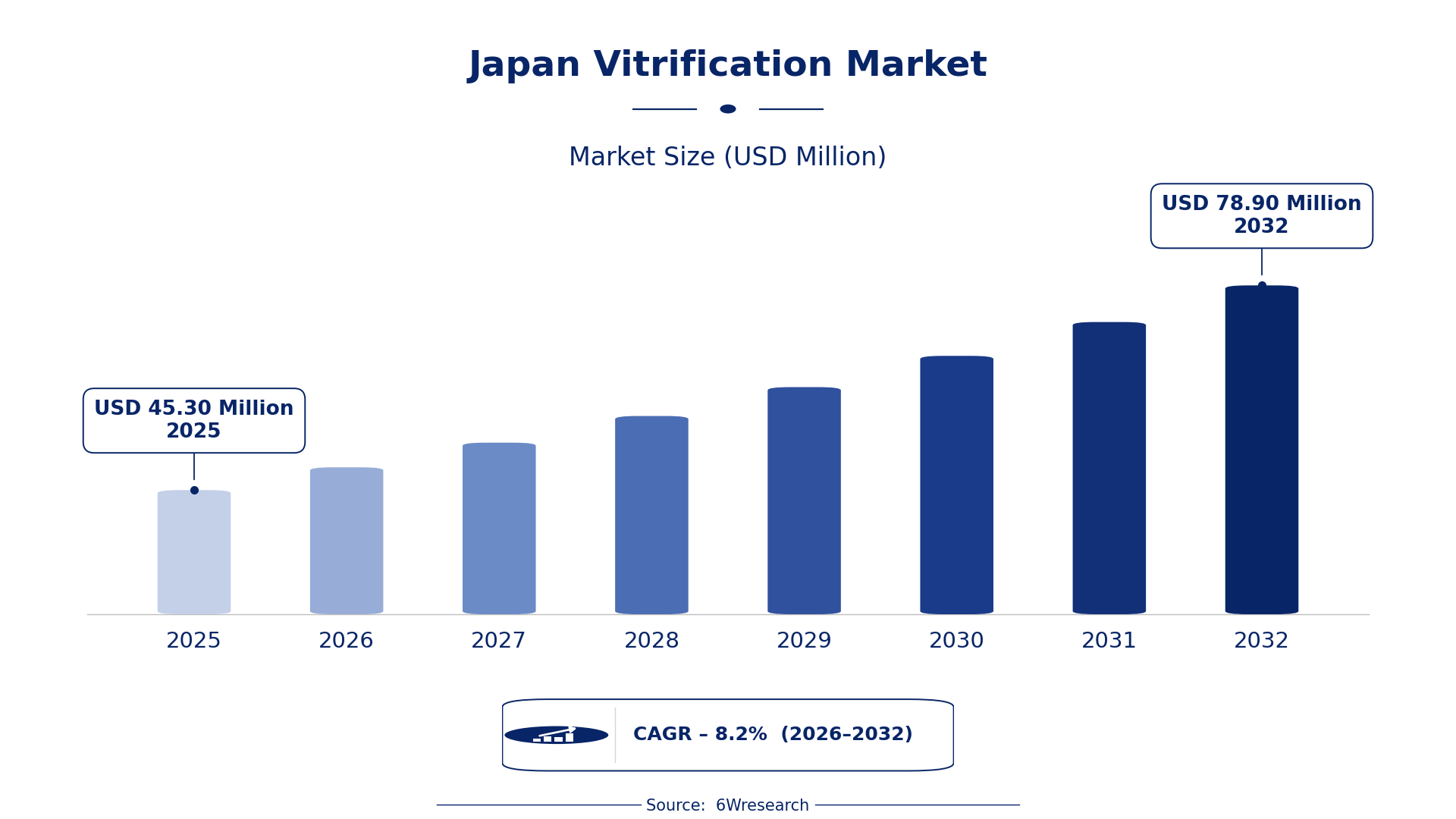
According to 6Wresearch internal database and industry insights, the Japan Vitrification Market was valued at USD 45.30 Million in 2025 and is projected to reach USD 78.90 Million by 2032, growing at a CAGR of approximately 8.2% during 2026–2032.
Japan Vitrification Market Highlights
| Report Metric | Details |
| Report Name | Japan Vitrification Market (2026-2032) |
| Market Size 2025 | USD 45.30 Million |
| Market Size 2032 | USD 78.90 Million |
| Absolute Growth 2025–2032 | USD 33.60 Million |
| CAGR 2026–2032 | 8.2% |
| Peak Annual Growth | 9.2% in 2028 |
| Forecast Period | 2026–2032 |
| Historical Data | 2022–2025 |
| Base Year | 2025 |
| Leading Specimen, 2025 | Oocytes (52% share) |
| Leading End User, 2025 | IVF Clinics (55% share) |
| Fastest-Growing Specimen | Embryo (10.3% CAGR) |
| Fastest-Growing End User | Biobanks (10.6% CAGR) |
| Growing Sector | IVF Clinics |
| Key End Users | IVF Clinics, Biobanks, Fertility Specialists |
Japan Vitrification Market Year-wise Growth Rate and Key Drivers (2022–2032)
This graph illustrates the annual growth rates of the market from 2022 to 2032, highlighting a steady upward trajectory and projected market expansion over the forecast period.
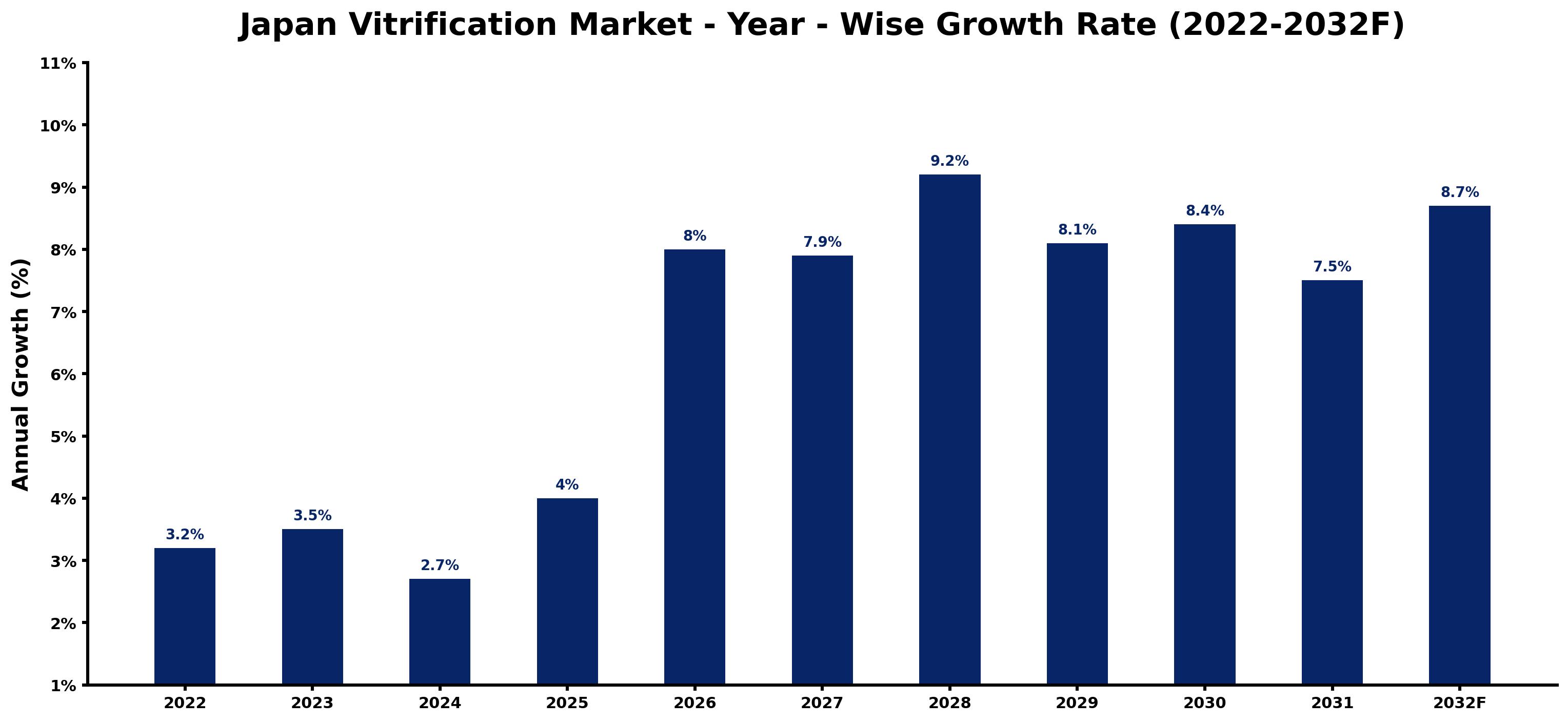
The yearly estimates that follow link every growth rate to its principal driver, so readers can see why the pace changed in each period.
| Year | Estimated Annual Growth (%) | Market Rationale |
| 2022 | 3.2 | The market showed steady growth due to increasing IVF cycles performed across Japan. |
| 2023 | 3.5 | Demand rose as more couples sought fertility treatments amid rising awareness of reproductive health. |
| 2024 | 2.7 | Growth slowed as the market adjusted to previous high demand levels and resource allocation. |
| 2025 | 4.0 | The market experienced a surge as new IVF clinics opened in major urban centres. |
| 2026 | 8.0 | Increased investment in reproductive health technologies boosted demand for vitrification services. |
| 2027 | 7.9 | Growth slowed slightly as the market stabilised after a period of rapid expansion. |
| 2028 | 9.2 | The market peaked with heightened demand driven by advancements in IVF techniques. |
| 2029 | 8.1 | Growth slowed as the market began to normalise following peak demand levels. |
| 2030 | 8.4 | Demand increased again as new biobanks expanded their services for reproductive cell storage. |
| 2031 | 7.5 | The market experienced a slight slowdown as competition intensified among service providers. |
| 2032 | 8.7 | Growth accelerated with new technologies enhancing vitrification processes and outcomes. |
Note: Market size estimations and growth projections presented in this report are based on 6Wresearch's proprietary forecasting methodology, utilizing the latest available industry data, government publications, and primary research inputs.
Japan Vitrification Market Synopsis
Vitrification is a cryopreservation technology used to preserve biological samples like oocytes and embryos, primarily in assisted reproductive technologies. In Japan, the IVF sector is flourishing, with over 300 IVF clinics and around 200,000 cycles performed each year. The growing demand for fertility treatments, bolstered by government initiatives and advancements in reproductive health technologies, is propelling market growth. The allocation of ¥2 billion for reproductive health initiatives in 2023 demonstrates the government's commitment to improving reproductive services and biobanks, which are crucial for long-term storage solutions.
Market Dynamics Impact Analysis (2026–2032)
| Factor | Type | Impact | Primary Segment Affected |
| Increasing IVF cycles performed annually | Driver | High | IVF Clinics |
| Rising number of biobanks for reproductive cell storage | Driver | High | Biobanks |
| Growing awareness of reproductive health among couples | Opportunity | High | IVF Clinics |
| Expansion of IVF clinics in urban areas | Opportunity | High | IVF Clinics |
| High costs associated with fertility treatments | Restraint | Medium | IVF Clinics |
| Limited public awareness regarding vitrification benefits | Restraint | Medium | Biobanks |
| Competition among IVF clinics for patient acquisition | Challenge | High | IVF Clinics |
| Regulatory hurdles in biobank operations | Challenge | Medium | Biobanks |
Evaluation of Drivers in Japan Vitrification Market (2026–2032)
Demand rests on the following drivers, each shown with the segment it touches most.
| Drivers | Primary Segment Affected | Why It Matters (Evidence) |
| Increased IVF cycles | IVF Clinics | In 2021, approximately 200,000 IVF cycles were performed, driving demand for vitrification. |
| Expansion of biobanks | Biobanks | The number of biobanks has increased by 15% since 2019, improving storage capacity. |
| Government subsidies for fertility treatments | IVF Clinics | In 2022, the government launched a program to subsidise fertility treatments, boosting demand. |
| Technological advancements in IVF | IVF Clinics | New techniques in IVF are increasing the success rates of treatments, leading to more cycles. |
| Rising average age of women undergoing IVF | IVF Clinics | The average age of women undergoing IVF is 35 years, increasing the need for vitrification. |
What keeps demand rising is the increasing number of IVF cycles performed, with approximately 200,000 cycles recorded in 2021. This surge drives clinics to adopt vitrification technology to improve success rates. The average age of women seeking IVF is 35 years, pushing clinics to offer advanced preservation methods. The expansion of biobanks by 15% since 2019 has improved long-term storage options, attracting more patients.
Evaluation of Restraints in Japan Vitrification Market
These restraints slow adoption and weigh on supplier margins.
| Market Restraint | Primary Segment Affected | Why It Matters (Evidence) |
| High costs associated with fertility treatments | IVF Clinics | The average cost of IVF treatments can be prohibitive, limiting access for many couples. |
| Limited public awareness regarding vitrification benefits | Biobanks | Many potential users remain unaware of the advantages of vitrification for reproductive health. |
| Regulatory hurdles in biobank operations | Biobanks | Strict regulations under the Act on the Protection of Personal Information can delay biobank operations. |
| Competition among IVF clinics for patient acquisition | IVF Clinics | Intense competition can lead to price wars, affecting profitability for clinics. |
| Dependence on technological advancements | IVF Clinics | Clinics must continually invest in new technologies to stay competitive, increasing operational costs. |
Japan Vitrification Market Challenges
In 2021, approximately 200,000 IVF cycles were performed in Japan, yet outdated technology hampers the vitrification process, delaying sample preservation for clinics. Many IVF facilities face supply chain challenges due to dependence on a limited number of suppliers for cryopreservation materials, leading to increased costs that clinics must transfer to patients. Rising operational expenses from adhering to standards like ISO 13485 strain clinics, forcing them to elevate prices for patients. Competition among over 300 IVF facilities escalates, compelling providers to lower prices, which can diminish service quality for patients.
Trends in the Japan Vitrification Market
Buyers and suppliers in the Japan Vitrification Market are adjusting to the following trends.
- Shift from Traditional to Advanced Vitrification Techniques: Since 2022, IVF clinics have increasingly adopted advanced vitrification techniques to improve success rates. Approximately 70% of clinics in Tokyo now utilise these methods, reflecting a notable shift in practice.
- Increase in Biobank Services: In 2023, the number of biobanks in Japan rose by 15%, reflecting a growing demand for long-term storage solutions. This trend indicates a shift towards improved reproductive health services.
- Focus on Government Subsidies for Fertility Treatments: The 2022 government initiative to subsidise fertility treatments has led to a 20% increase in IVF cycle applications. This support is vital for making treatments more accessible to couples.
- Emergence of New IVF Clinics in Urban Areas: The number of IVF clinics in Osaka has increased significantly, with over 50 new facilities opening since 2021. This growth is driven by rising demand for fertility services.
Investment Opportunities in the Japan Vitrification Market
Below are the investment opportunities with the strongest case in the Japan Vitrification Market.
- Timing is Right for Investment in IVF Clinics: With over 300 IVF clinics in Japan, the current demand for services is high, particularly in urban areas. Investing in new clinics can capture this market, especially in Tokyo.
- Biobanks Seeking Advanced Storage Solutions: The increase in biobanks presents an opportunity for suppliers of advanced vitrification technologies. Collaborating with biobanks can improve service offerings and patient outcomes.
- Government Funding for Reproductive Health Initiatives: The ¥2 billion allocated in 2023 for reproductive health initiatives highlights a strong investment opportunity. Suppliers can partner with IVF clinics to develop effective solutions.
- Growing Demand from IVF Clinics: The rising number of IVF cycles performed indicates a robust demand for vitrification technology. Establishing partnerships with IVF clinics can facilitate market entry and growth.
Government Initiatives in the Japan Vitrification Market
The Next-Generation Medical Infrastructure Act, enacted in 2017, enables certified bodies to anonymise medical data for research, supporting the development of reproductive health technologies. This law builds on the Clinical Trials Act of 2017, which established rules for clinical research, ensuring that advancements in vitrification practices are based on reliable data.
The Ministry of Health, Labour and Welfare oversees reproductive health policies, including funding for fertility treatments. In 2022, this included a program that subsidises IVF procedures, making them more accessible to couples seeking assistance.
Future Insight of the Japan Vitrification Market
Advancements in technology will transform demand for vitrification by 2032, improving the efficiency and reliability of IVF procedures. The government's ¥2 billion investment in reproductive health initiatives will support the development of state-of-the-art facilities, enhancing patient access. Increased emphasis on research, driven by the Japanese Association of Medical Sciences, will lead to notable innovations in reproductive technologies. As collaboration between clinics and biobanks strengthens, effective sample management will improve outcomes for patients seeking treatments and create new opportunities for suppliers.
Market Segmentation Analysis
Japan Vitrification Market report covers a detailed analysis of the following market segments:
By Specimen – Oocytes Lead, Embryo Expected to Grow Fastest
According to Vasudha, AM at 6Wresearch, Oocytes accounted for 52% of the market by specimen in 2025. Oocytes hold the largest share as they are crucial for IVF procedures, with around 200,000 cycles conducted yearly in Japan. The high concentration of IVF clinics in urban centres like Tokyo and Osaka increases the demand for oocyte preservation. The quickest growth will come from Embryo, forecast to expand at a CAGR of 10.3% between 2026 and 2032. The embryo segment is witnessing rapid growth due to advancements in preservation techniques that improve IVF success rates. The 15% increase in biobanks since 2019 indicates a heightened need for effective embryo storage solutions. Suppliers should focus on enhancing embryo preservation technologies to meet the growing requirements of the IVF sector.
By End User – IVF Clinics Lead, Biobanks Expected to Grow Fastest
IVF Clinics took 55% of end user revenue in 2025, more than any other category. IVF clinics dominate the market as the primary users of vitrification technology, with more than 300 clinics operating across Japan. Their established infrastructure and steady demand for fertility treatments solidify their leading position. Biobanks are projected to grow fastest, at a CAGR of 10.6% during 2026–2032. Biobanks are growing quickly due to their essential role in the long-term storage of reproductive cells, which is increasingly critical as IVF cycles rise. The government's ¥2 billion allocation for reproductive health initiatives supports this growth. Buyers should consider partnerships with biobanks to secure reliable storage solutions for reproductive materials.
Key Attractiveness of the Report
- 10 Years of Market Numbers
- Historical Data Starting from 2022 to 2025
- Base Year 2025
- Forecast Data until 2032
- Key Performance Indicators Impacting the Market
- Major Upcoming Developments and Projects
Key Highlights of the Report:
- Japan Vitrification Market Outlook
- Market Size of Japan Vitrification Market, 2025
- Forecast of Japan Vitrification Market, 2032
- Historical Data and Forecast of Japan Vitrification Revenues & Volume for the Period 2022-2032
- Japan Vitrification Market Trend Evolution
- Japan Vitrification Market Drivers and Challenges
- Japan Vitrification Price Trends
- Japan Vitrification Porter's Five Forces
- Japan Vitrification Industry Life Cycle
- Historical Data and Forecast of Japan Vitrification Market Revenues & Volume By Specimen for the Period 2022-2032
- Historical Data and Forecast of Japan Vitrification Market Revenues & Volume By Oocytes for the Period 2022-2032
- Historical Data and Forecast of Japan Vitrification Market Revenues & Volume By Embryo for the Period 2022-2032
- Historical Data and Forecast of Japan Vitrification Market Revenues & Volume By Sperm for the Period 2022-2032
- Historical Data and Forecast of Japan Vitrification Market Revenues & Volume By End User for the Period 2022-2032
- Historical Data and Forecast of Japan Vitrification Market Revenues & Volume By IVF Clinics for the Period 2022-2032
- Historical Data and Forecast of Japan Vitrification Market Revenues & Volume By Biobanks for the Period 2022-2032
- Japan Vitrification Import Export Trade Statistics
- Market Opportunity Assessment By Specimen
- Market Opportunity Assessment By End User
- Japan Vitrification Top Companies Market Share
- Japan Vitrification Competitive Benchmarking By Technical and Operational Parameters
- Japan Vitrification Company Profiles
- Japan Vitrification Key Strategic Recommendations
Market Covered
Coverage by segment is as follows.
By Specimen
- Oocytes
- Embryo
- Sperm
By End User
- IVF Clinics
- Biobanks































