Japan Warehouse Racking Market Size & Growth Rate
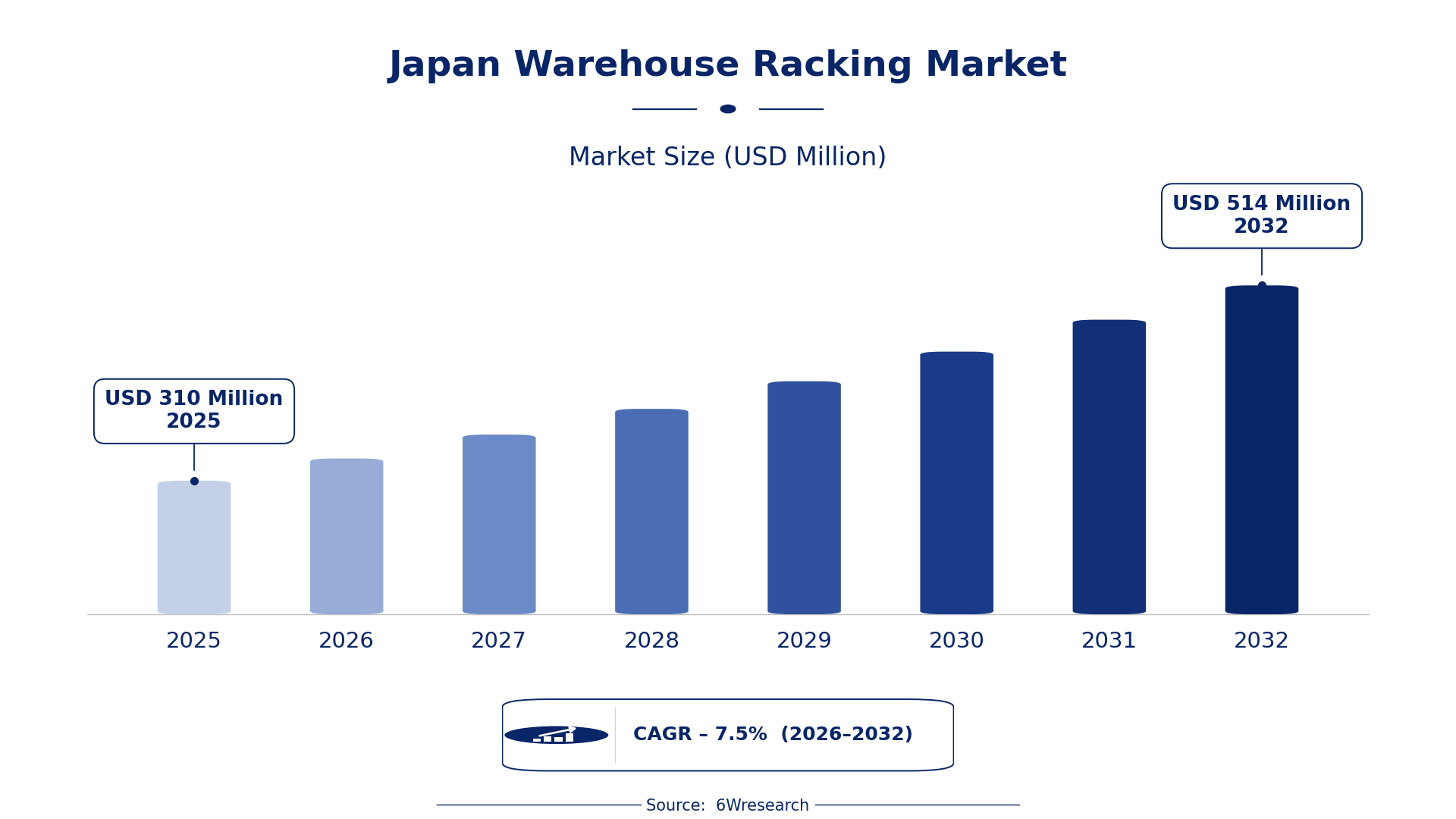
According to 6Wresearch internal database and industry insights, the Japan Warehouse Racking Market was valued at USD 310 Million in 2025 and is projected to reach USD 514 Million by 2032, growing at a CAGR of approximately 7.5% during 2026–2032.
Japan Warehouse Racking Market Highlights
| Report Metric | Details |
| Report Name | Japan Warehouse Racking Market (2026-2032) |
| Market Size 2025 | USD 310 Million |
| Market Size 2032 | USD 514 Million |
| Absolute Growth 2025–2032 | USD 204 Million |
| CAGR 2026–2032 | 7.5% |
| Peak Annual Growth | 8.3% in 2028 |
| Forecast Period | 2026–2032 |
| Historical Data | 2022–2025 |
| Base Year | 2025 |
| Leading Product, 2025 | Selective Pallets (40% share) |
| Leading Application, 2025 | Automotive (40% share) |
| Fastest-Growing Product | Drive-in (10.5% CAGR) |
| Fastest-Growing Application | Food & Beverage (10.2% CAGR) |
| Growing Sector | Logistics |
| Key End Users | Logistics companies, manufacturing firms, food and beverage producers, retail businesses |
Japan Warehouse Racking Market Year-wise Growth Rate and Key Drivers (2022–2032)
This graph illustrates the annual growth rates of the market from 2022 to 2032, highlighting a steady upward trajectory and projected market expansion over the forecast period.
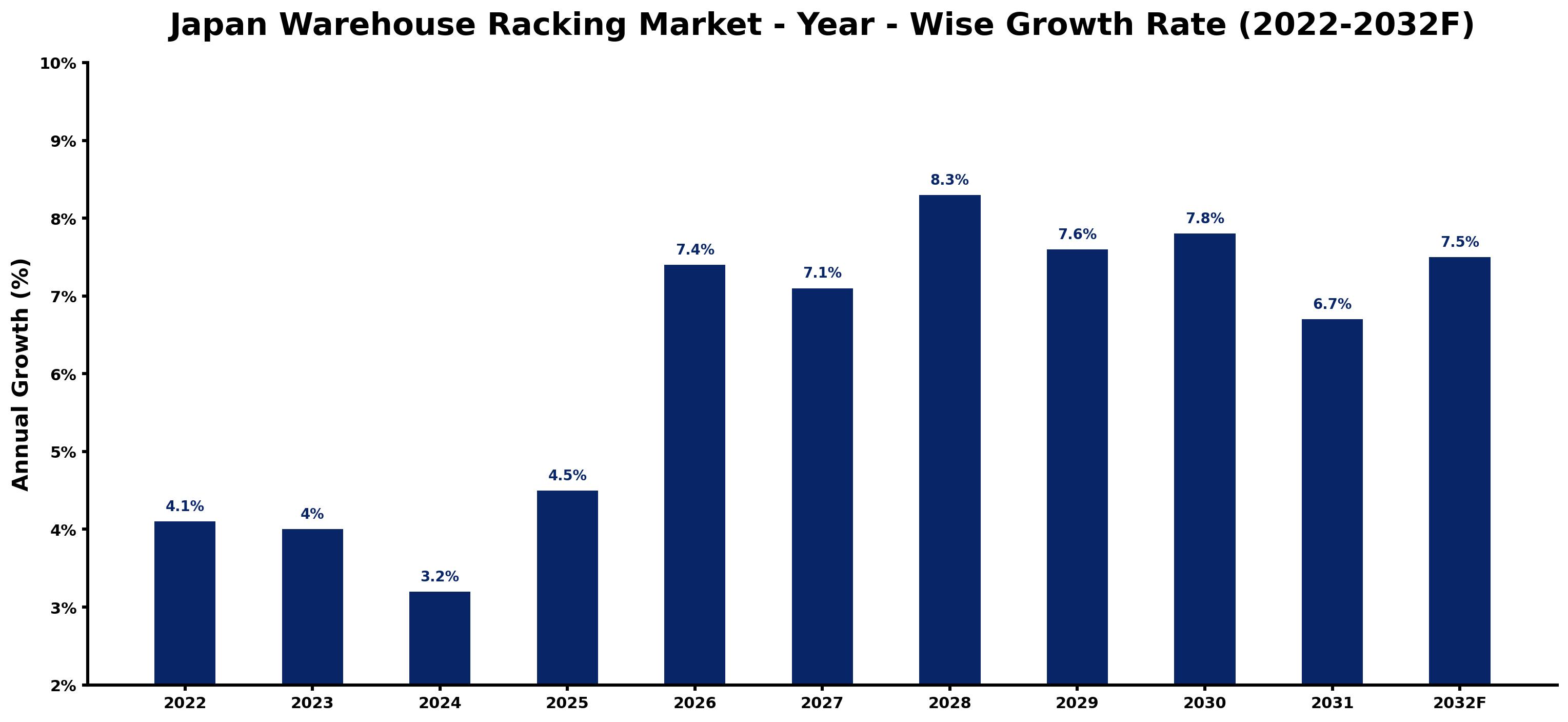
For each year, the table pairs the estimated growth rate with the leading influence on demand, showing how the drivers changed across the period.
| Year | Estimated Annual Growth (%) | Market Rationale |
| 2022 | 4.1 | The market experienced steady growth due to consistent demand from logistics and manufacturing sectors. |
| 2023 | 4.0 | Growth slowed slightly as the logistics industry adjusted to recent automation investments. |
| 2024 | 3.2 | A further slowdown occurred as companies focused on optimising existing storage solutions. |
| 2025 | 4.5 | Increased demand from the logistics sector led to a faster growth rate compared to the previous year. |
| 2026 | 7.4 | The market will surge as logistics companies invest heavily in modern storage solutions. |
| 2027 | 7.1 | Growth is projected to slow as the market stabilises following the rapid investments of the prior year. |
| 2028 | 8.3 | A peak in growth will be driven by heightened demand for efficient storage in cold storage facilities. |
| 2029 | 7.6 | The market will continue to grow, albeit at a slower pace as companies consolidate their investments. |
| 2030 | 7.8 | A renewed interest in warehouse efficiency will lead to a faster growth rate compared to the previous year. |
| 2031 | 6.7 | Growth is expected to slow as the market adjusts to the saturation of new installations in key regions. |
| 2032 | 7.5 | The market is projected to grow steadily as demand for efficient storage solutions remains strong. |
Note: Market size estimations and growth projections presented in this report are based on 6Wresearch's proprietary forecasting methodology, utilizing the latest available industry data, government publications, and primary research inputs.
Japan Warehouse Racking Market Synopsis
Warehouse racking systems are crucial storage solutions designed to optimise space in warehouses and distribution centres. The Japan Warehouse Racking Market is growing due to investments in logistics and manufacturing sectors, especially in regions like Tokyo and Osaka. The logistics industry is set to invest heavily in automation by 2025, further driving the demand for efficient racking systems. Compliance with JIS standards ensures safety and quality, supporting market growth and improving operational practices.
Market Dynamics Impact Analysis (2026–2032)
| Factor | Type | Impact | Primary Segment Affected |
| Increased investments in logistics automation | Driver | High | Selective Pallets |
| Growing demand for efficient cold storage solutions | Driver | High | Drive-in |
| Expansion of the food and beverage sector | Opportunity | High | Pallet Flow |
| Rising e-commerce activities driving storage needs | Opportunity | Medium | Push Back |
| High initial costs for advanced racking systems | Restraint | High | Cantilever |
| Limited awareness of racking safety standards | Restraint | Medium | Others |
| Challenges in adapting to rapid technological changes | Challenge | High | Drive-in |
| Supply chain disruptions affecting material availability | Challenge | Medium | Selective Pallets |
Evaluation of Drivers in Japan Warehouse Racking Market (2026–2032)
The table below links each growth driver to the segment it affects and the evidence for it.
| Drivers | Primary Segment Affected | Why It Matters (Evidence) |
| Increased logistics automation | Selective Pallets | The logistics industry in Japan is projected to invest heavily in automation by 2025, boosting demand for efficient storage solutions. |
| Demand for cold storage | Drive-in | Drive-in racks are prevalent in cold storage facilities in Hokkaido, responding to the need for high-density storage solutions. |
| Retail sector growth | Push Back | Push back racking systems are increasingly adopted in Osaka's retail sector, improving inventory management capabilities. |
| FIFO inventory management | Pallet Flow | Pallet flow systems are critical in the food industry, especially in Kyushu, ensuring efficient inventory turnover. |
| Manufacturing sector expansion | Cantilever | Cantilever racks are common in manufacturing plants across Aichi Prefecture, facilitating the storage of long and bulky items. |
Several shifts outside the market lift sales. The logistics industry in Japan is projected to invest heavily in automation by 2025, leading to a rise in demand for efficient storage solutions. Selective pallet racks are widely used in Tokyo's logistics centres, which enhances operational practices. Demand for cold storage solutions is increasing in Hokkaido, where drive-in racks cater to high-density storage needs. The retail sector's growth in Osaka has driven the adoption of push back racking systems, improving inventory management. In the food industry, pallet flow systems are critical for ensuring efficient inventory turnover, particularly in Kyushu, while cantilever racks are commonly found in manufacturing plants across Aichi Prefecture, enabling the storage of long and bulky items.
Evaluation of Restraints in Japan Warehouse Racking Market
The main factors holding the market back are set out below.
| Market Restraint | Primary Segment Affected | Why It Matters (Evidence) |
| High initial costs for advanced racking systems | Cantilever | The high costs associated with advanced racking systems deter some buyers, particularly smaller businesses. |
| Limited awareness of racking safety standards | Others | Many buyers lack awareness of JIS standards, which can lead to unsafe racking practices. |
| Supply chain disruptions affecting material availability | Selective Pallets | Material shortages have delayed racking system installations, impacting overall market growth. |
| Challenges in adapting to rapid technological changes | Drive-in | Suppliers face difficulties in keeping up with technological advancements, affecting product offerings. |
| Regulatory compliance costs | Push Back | Compliance with safety regulations increases operational costs for buyers, limiting their investment capacity. |
Japan Warehouse Racking Market Challenges
Outdated technology hampers efficiency in Japan's warehouse racking market, as many facilities still rely on manual processes, delaying order fulfilment by 20% for logistics providers. Buyers face rising costs due to limited domestic production capabilities, forcing them to seek imports for advanced systems, which can increase expenses by 15%. Competition from international suppliers pressures local manufacturers, resulting in price wars that erode profit margins for domestic producers. Compliance with JIS standards complicates operations, necessitating additional investments that can extend project timelines for warehouse operators by several months.
Trends in the Japan Warehouse Racking Market
The trends below show where the Japan Warehouse Racking Market is heading.
- Shift from Traditional to Automated Racking: Since 2025, the logistics sector has increasingly embraced automated racking systems to improve efficiency. For instance, Tokyo's logistics centres are implementing advanced automated solutions to streamline operations, reflecting a growing trend towards automation.
- Emergence of Cold Storage Solutions: In 2023, the demand for cold storage solutions surged, particularly in Hokkaido, as businesses adapted to changing consumer preferences. This shift has led to increased investments in drive-in racking systems, highlighting the need for efficient cold storage.
- Growth in FIFO Inventory Management: Beginning in 2026, FIFO inventory management practices gained traction in the food and beverage sector, especially in Kyushu. This trend has driven the adoption of pallet flow systems, ensuring efficient inventory turnover.
- Increased Focus on Safety Standards: In 2022, the Japan Warehousing Association emphasised the importance of safety standards in racking systems. This focus has led to greater compliance with JIS standards, ensuring safer storage practices across the industry.
Investment Opportunities in the Japan Warehouse Racking Market
The following areas offer the clearest openings for investors and suppliers in the Japan Warehouse Racking Market.
- Partnerships for Local Manufacturing: By 2025, the logistics sector's investment in automation creates opportunities for local partnerships in manufacturing racking systems. Collaborating with regional manufacturers in Osaka can help meet rising demand for efficient solutions.
- Investment in Cold Storage Facilities: With the projected growth of the cold storage market, now is the ideal time to invest in drive-in racking systems. The food and beverage sector in Hokkaido presents a notable opportunity for suppliers.
- Expansion of E-commerce Storage Solutions: The rise of e-commerce has created a gap in efficient storage solutions, particularly in urban areas. Suppliers should focus on push back racking systems to cater to the growing retail sector in Tokyo.
- Improving Compliance with JIS Standards: As awareness of safety standards rises, investing in compliance solutions can be profitable. Collaborating with the Japan Warehousing Association can facilitate access to guidelines and certifications.
Government Initiatives in the Japan Warehouse Racking Market
The Food Recycling Law (2000) requires food businesses to reduce waste and recycle it into feed, fertiliser, and energy. This law influences producers of racking systems by necessitating designs that support efficient storage and handling of recyclable materials. Compliance with these regulations ensures that racking solutions align with industry standards, improving marketability.
The Ministry of Land, Infrastructure, Transport and Tourism promotes efficient logistics practices through funding and guidelines. This support aids logistics companies in implementing advanced racking systems, ensuring compliance with safety and efficiency standards. The Japan Warehousing Association also provides necessary guidelines for racking safety and efficiency.
Future Insight of the Japan Warehouse Racking Market
Investment in automation will reshape warehouse racking systems by 2032, creating robust demand for advanced solutions. As logistics facilities adopt automated systems, the need for efficient storage will grow, particularly in Tokyo and Osaka. The Ministry of Land, Infrastructure, Transport and Tourism's initiatives will streamline logistics practices, enhancing operational efficiency across sectors. Projections indicate a 20% increase in racking system adoption in cold storage facilities, compelling suppliers to adjust their offerings to meet specific industry requirements.
Market Segmentation Analysis
Japan Warehouse Racking Market report covers a detailed analysis of the following market segments:
By Product – Selective Pallets Lead, Drive-in Expected to Grow Fastest
According to Vasudha, AM at 6Wresearch, Selective Pallets held 40% of the Japan Warehouse Racking Market by product in 2025. Selective pallet racks dominate the market as they are extensively utilised in logistics centres across Tokyo, where the need for efficient storage and retrieval is paramount. Their design optimally utilises space, making them essential for urban warehouses facing high-density storage requirements. Drive-in is set to record the highest CAGR in this split, 10.5% over 2026–2032. Drive-in racks are experiencing swift growth due to their suitability for high-density storage, particularly in cold storage facilities in Hokkaido. The rising demand for efficient cold storage solutions in this area is driving the expansion of this segment. Suppliers must focus on developing drive-in racks to cater to the increasing need for efficient cold storage solutions.
By Application – Automotive Leads, Food & Beverage Expected to Grow Fastest
Automotive accounted for 40% of the market by application in 2025. The automotive sector holds the largest market share, requiring robust storage solutions for parts and components in regions with high logistics activity. This sector's reliance on efficient storage systems reinforces its dominance in the warehouse racking market. Food & Beverage is projected to grow fastest, at a CAGR of 10.2% during 2026–2032. The food and beverage sector is the fastest-growing application, spurred by its significant need for effective racking systems to manage perishable goods. The emphasis on optimising storage solutions in this sector is propelling its growth rate. Buyers in the food and beverage sector should invest in advanced racking systems to improve their storage efficiency.
Key Attractiveness of the Report
- 10 Years of Market Numbers
- Historical Data Starting from 2022 to 2025
- Base Year 2025
- Forecast Data until 2032
- Key Performance Indicators Impacting the Market
- Major Upcoming Developments and Projects
Key Highlights of the Report:
- Japan Warehouse Racking Market Outlook
- Market Size of Japan Warehouse Racking Market, 2025
- Forecast of Japan Warehouse Racking Market, 2032
- Historical Data and Forecast of Japan Warehouse Racking Revenues & Volume for the Period 2022-2032
- Japan Warehouse Racking Market Trend Evolution
- Japan Warehouse Racking Market Drivers and Challenges
- Japan Warehouse Racking Price Trends
- Japan Warehouse Racking Porter's Five Forces
- Japan Warehouse Racking Industry Life Cycle
- Historical Data and Forecast of Japan Warehouse Racking Market Revenues & Volume By Product for the Period 2022-2032
- Historical Data and Forecast of Japan Warehouse Racking Market Revenues & Volume By Selective Pallets for the Period 2022-2032
- Historical Data and Forecast of Japan Warehouse Racking Market Revenues & Volume By Drive-in for the Period 2022-2032
- Historical Data and Forecast of Japan Warehouse Racking Market Revenues & Volume By Push Back for the Period 2022-2032
- Historical Data and Forecast of Japan Warehouse Racking Market Revenues & Volume By Pallet Flow for the Period 2022-2032
- Historical Data and Forecast of Japan Warehouse Racking Market Revenues & Volume By Cantilever for the Period 2022-2032
- Historical Data and Forecast of Japan Warehouse Racking Market Revenues & Volume By Others for the Period 2022-2032
- Historical Data and Forecast of Japan Warehouse Racking Market Revenues & Volume By Application for the Period 2022-2032
- Historical Data and Forecast of Japan Warehouse Racking Market Revenues & Volume By Automotive for the Period 2022-2032
- Historical Data and Forecast of Japan Warehouse Racking Market Revenues & Volume By Food & Beverage for the Period 2022-2032
- Historical Data and Forecast of Japan Warehouse Racking Market Revenues & Volume By Retail for the Period 2022-2032
- Historical Data and Forecast of Japan Warehouse Racking Market Revenues & Volume By Packaging for the Period 2022-2032
- Historical Data and Forecast of Japan Warehouse Racking Market Revenues & Volume By Manufacturing for the Period 2022-2032
- Historical Data and Forecast of Japan Warehouse Racking Market Revenues & Volume By Others for the Period 2022-2032
- Japan Warehouse Racking Import Export Trade Statistics
- Market Opportunity Assessment By Product
- Market Opportunity Assessment By Application
- Japan Warehouse Racking Top Companies Market Share
- Japan Warehouse Racking Competitive Benchmarking By Technical and Operational Parameters
- Japan Warehouse Racking Company Profiles
- Japan Warehouse Racking Key Strategic Recommendations
Market Covered
Coverage by segment is as follows.
By Product
- Selective Pallets
- Drive-in
- Push Back
- Pallet Flow
- Cantilever
- Others
By Application
- Automotive
- Food & Beverage
- Retail
- Packaging
- Manufacturing
- Others































