Japan Warfarin Sensitivity Test Market Size & Growth Rate
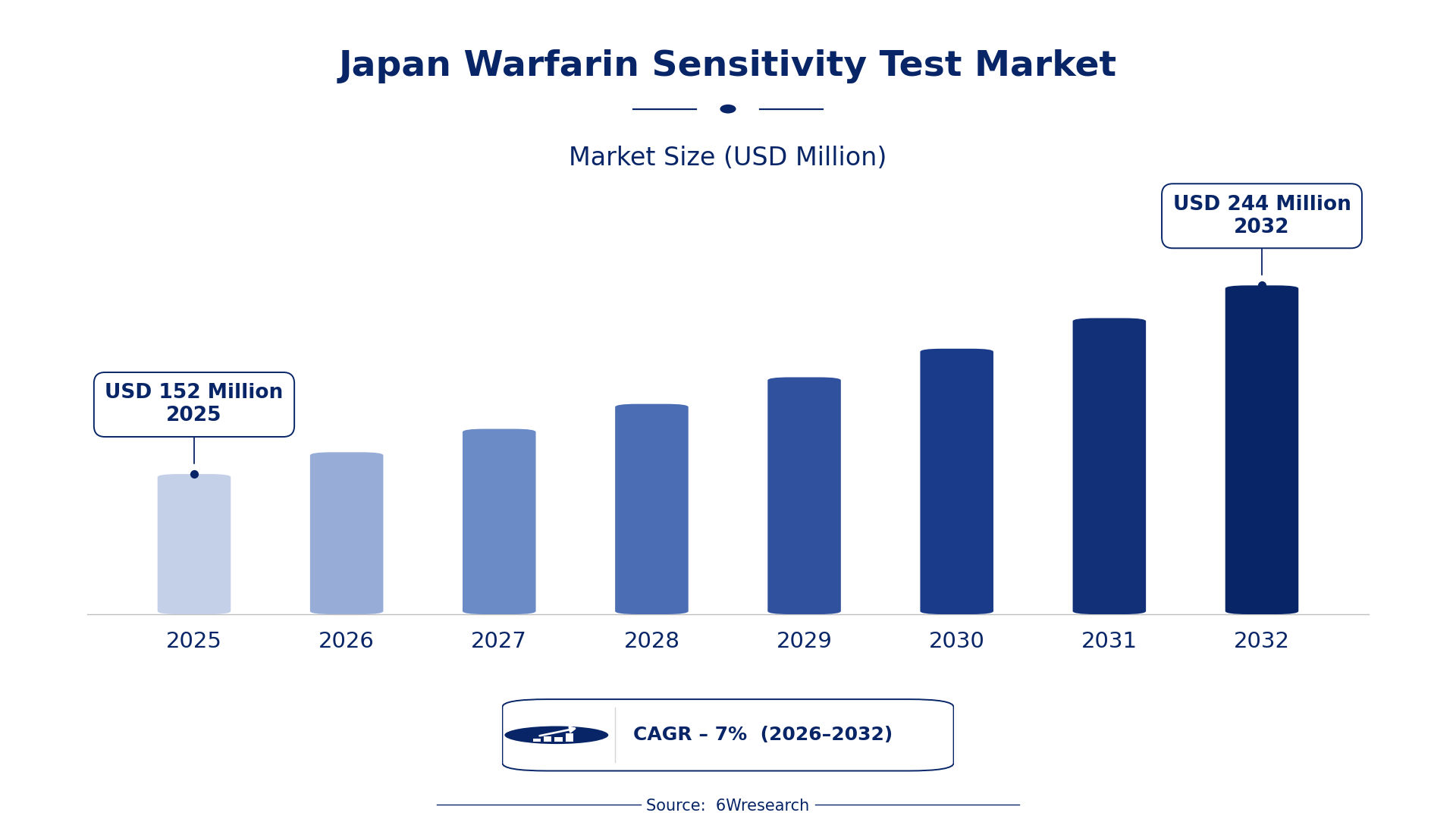
According to 6Wresearch internal database and industry insights, the Japan Warfarin Sensitivity Test Market was valued at USD 152 Million in 2025 and is projected to reach USD 244 Million by 2032, growing at a CAGR of approximately 7% during 2026–2032.
Japan Warfarin Sensitivity Test Market Highlights
| Report Metric | Details |
| Report Name | Japan Warfarin Sensitivity Test Market (2026-2032) |
| Market Size 2025 | USD 152 Million |
| Market Size 2032 | USD 244 Million |
| Absolute Growth 2025–2032 | USD 92 Million |
| CAGR 2026–2032 | 7% |
| Peak Annual Growth | 7.7% in 2026 |
| Forecast Period | 2026–2032 |
| Historical Data | 2022–2025 |
| Base Year | 2025 |
| Leading Test Type, 2025 | Laboratory-based (33% share) |
| Leading Technology Used, 2025 | PCR-based (42% share) |
| Leading End User, 2025 | Hospitals (40% share) |
| Leading Application, 2025 | Drug Response Monitoring (45% share) |
| Leading End Use, 2025 | Professional Tattooing (64% share) |
| Fastest-Growing Test Type | Point-of-Care (9.9% CAGR) |
| Fastest-Growing Technology Used | NGS (9.8% CAGR) |
| Fastest-Growing End User | Clinics (9.0% CAGR) |
| Fastest-Growing Application | Pharmacogenomics (9.4% CAGR) |
| Growing Sector | personalized medicine |
| Key End Users | hospitals, clinics, research institutions |
Japan Warfarin Sensitivity Test Market Year-wise Growth Rate and Key Drivers (2022–2032)
This graph illustrates the annual growth rates of the market from 2022 to 2032, highlighting a steady upward trajectory and projected market expansion over the forecast period.
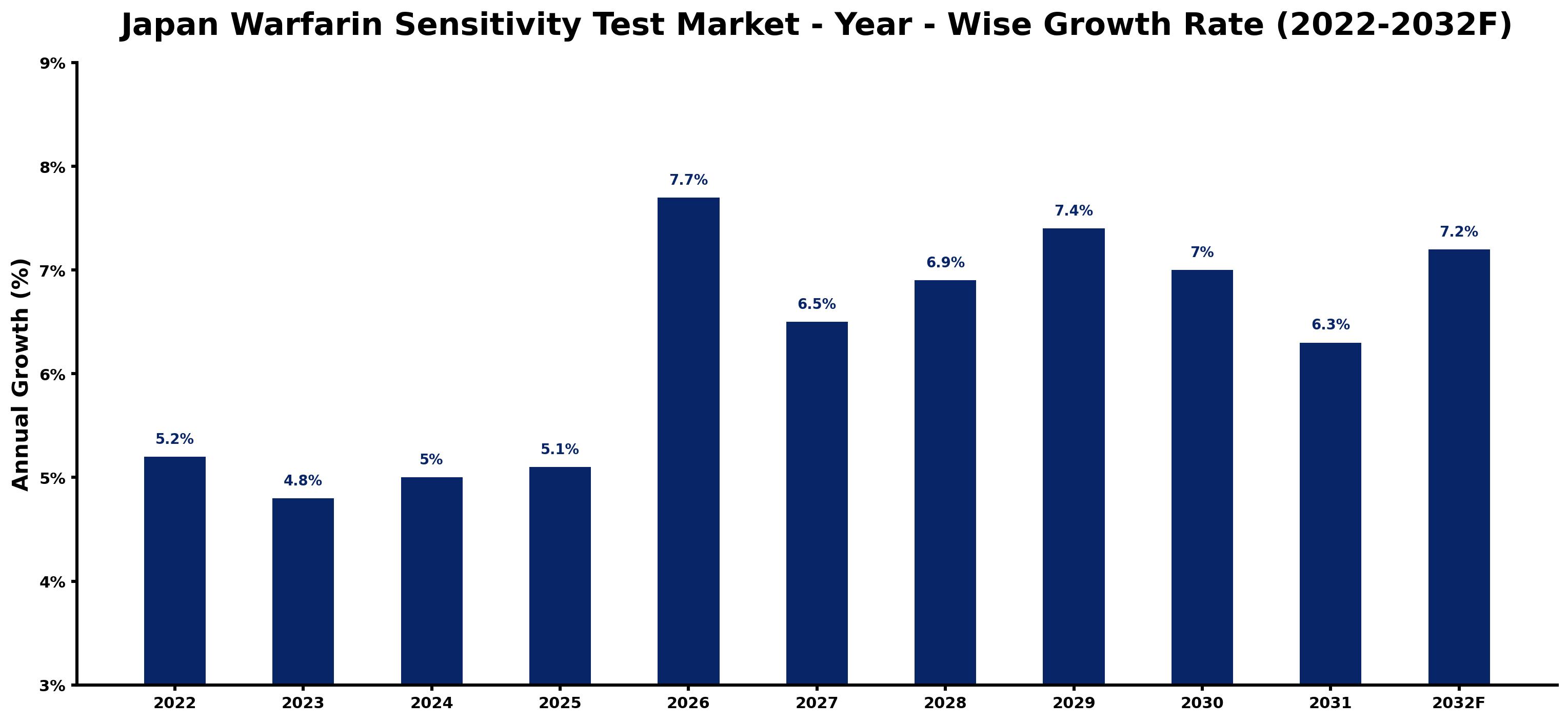
The yearly estimates that follow link every growth rate to its principal driver, so readers can see why the pace changed in each period.
| Year | Estimated Annual Growth (%) | Market Rationale |
| 2022 | 5.2 | The market experienced steady growth due to increasing awareness of personalized medicine. |
| 2023 | 4.8 | Growth slowed slightly as hospitals adjusted to new testing protocols and guidelines. |
| 2024 | 5.0 | Demand increased as more clinics adopted Warfarin sensitivity testing for patient management. |
| 2025 | 5.1 | Hospitals expanded their testing capabilities, leading to faster growth than the previous year. |
| 2026 | 7.7 | The introduction of new pharmacogenomics initiatives is expected to boost market demand. |
| 2027 | 6.5 | Growth is projected to slow as the market begins to stabilise after rapid expansion in previous years. |
| 2028 | 6.9 | Increased focus on anticoagulation management will lead to a rise in testing demand. |
| 2029 | 7.4 | Demand is expected to surge as more healthcare providers recognise the importance of genetic testing. |
| 2030 | 7.0 | Growth is projected to slow as market saturation begins to affect new patient enrolments. |
| 2031 | 6.3 | The market will continue to grow, albeit at a slower pace as competition intensifies. |
| 2032 | 7.2 | Demand is expected to increase as new technologies and guidelines emerge in personalized medicine. |
Note: Market size estimations and growth projections presented in this report are based on 6Wresearch's proprietary forecasting methodology, utilizing the latest available industry data, government publications, and primary research inputs.
Japan Warfarin Sensitivity Test Market Synopsis
The Japan Warfarin Sensitivity Test Market focuses on genetic and biochemical analyses to determine individual responses to Warfarin, optimising dosing to prevent adverse reactions. Demand is driven by an ageing population, with over 65 years as the average age of patients requiring therapy. Hospitals and clinics are the primary buyers, supported by government initiatives for pharmacogenomics and the National Health Insurance system covering genetic testing. The emphasis on personalised medicine is driving further demand, with Tokyo and Osaka as key regions for anticoagulation services.
Market Dynamics Impact Analysis (2026–2032)
| Factor | Type | Impact | Primary Segment Affected |
| Increasing patient population over 65 years driving demand for anticoagulation management. | Driver | High | Hospitals |
| Growing adoption of pharmacogenomics in clinical settings. | Driver | High | Clinics |
| Expansion of anticoagulation services in major urban areas. | Opportunity | High | Laboratories |
| Investment in personalized medicine technologies by research institutions. | Opportunity | High | Research Institutes |
| Limited awareness among healthcare providers about the benefits of testing. | Restraint | Medium | Clinics |
| High costs associated with implementing new testing technologies. | Restraint | Medium | Laboratories |
| Regulatory compliance challenges in testing procedures. | Challenge | High | Hospitals |
| Capacity constraints in laboratories due to increased testing volume. | Challenge | High | Laboratories |
Evaluation of Drivers in Japan Warfarin Sensitivity Test Market (2026–2032)
Demand rests on the following drivers, each shown with the segment it touches most.
| Drivers | Primary Segment Affected | Why It Matters (Evidence) |
| Growing ageing population requiring anticoagulation therapy. | Hospitals | With approximately 126 million residents, the demand for Warfarin sensitivity testing is high among older patients. |
| Increased focus on pharmacogenomics in clinical practice. | Clinics | Government support for pharmacogenomics initiatives is improving patient outcomes and driving demand for testing. |
| Expansion of anticoagulation management guidelines by professional societies. | Laboratories | Professional societies promote guidelines for anticoagulation management, encouraging testing in laboratories. |
| Investment in personalized medicine technologies by research institutions. | Research Institutes | Government funding for personalized medicine technologies is improving testing capabilities. |
| Routine testing recommendations for patients starting Warfarin therapy. | Clinics | Clinical guidelines recommend routine testing to optimise patient management and reduce adverse drug reactions. |
Behind the steady rise in orders sits a growing ageing population, with over 65 years being the average age of patients requiring Warfarin therapy. The substantial patient base in Japan creates a strong demand for sensitivity testing. A heightened emphasis on pharmacogenomics drives demand in clinical settings, as hospitals and clinics adopt these practices. Clinical guidelines recommend routine testing for patients starting Warfarin therapy, further solidifying the need for these tests in managing anticoagulation therapy.
Evaluation of Restraints in Japan Warfarin Sensitivity Test Market
The main factors holding the market back are set out below.
| Market Restraint | Primary Segment Affected | Why It Matters (Evidence) |
| Limited awareness among healthcare providers about the benefits of testing. | Clinics | Many clinics are still unfamiliar with the advantages of Warfarin sensitivity testing, hindering adoption. |
| High costs associated with implementing new testing technologies. | Laboratories | The financial burden of advanced testing technologies can deter laboratories from expanding their services. |
| Regulatory compliance challenges in testing procedures. | Hospitals | Hospitals face difficulties in meeting stringent regulatory requirements for testing, delaying implementation. |
| Capacity constraints in laboratories due to increased testing volume. | Laboratories | As demand rises, laboratories struggle to keep up with the volume of tests, affecting turnaround times. |
| Limited reimbursement options for genetic testing under insurance plans. | Clinics | Some clinics find it challenging to cover costs due to restrictive insurance policies on genetic testing. |
Japan Warfarin Sensitivity Test Market Challenges
Clinics face high costs due to a limited supply of Warfarin sensitivity tests, with some patients waiting over three months for results, which can lead to increased adverse drug reactions. Laboratories struggle with intense competition, as many seek ISO 9001 certification, a process that can take more than a year, delaying their market entry and impacting test availability. Hospitals encounter skills shortages in pharmacogenomics, resulting in longer turnaround times for test results and affecting patient care. Patients experience insurance coverage challenges, as the National Health Insurance system only covers genetic testing under specific conditions, leading to potential out-of-pocket expenses of up to 30% for some individuals.
Trends in the Japan Warfarin Sensitivity Test Market
These developments are changing demand patterns in the Japan Warfarin Sensitivity Test Market.
- Shift towards Improved Anticoagulation Management: Tokyo is experiencing a shift towards better anticoagulation management practices, with annual conferences focusing on advancements in testing and treatment. In 2022, over 1,000 healthcare professionals attended these conferences, highlighting the growing interest in optimising patient care.
- Transition from Laboratory to Point-of-Care Testing: The introduction of Point-of-Care testing in Japan is changing how Warfarin sensitivity is assessed. With a projected CAGR of 9.9% from 2026 to 2032, this shift allows for quicker patient management and reduces the need for laboratory confirmations.
- Emergence of Pharmacogenomics as a Key Focus: Pharmacogenomics is becoming a central aspect of anticoagulation therapy in Japan. Research institutions published over 50 studies annually on this topic, indicating a growing commitment to personalised medicine.
- Increased Investment in Personalized Medicine Technologies: The Japanese government allocated USD 50 million in 2023 for the development of personalized medicine technologies, improving the capabilities of healthcare providers. This investment is projected to stimulate innovation in testing methods.
Investment Opportunities in the Japan Warfarin Sensitivity Test Market
The following opportunities in the Japan Warfarin Sensitivity Test Market pair current demand with a clear way in.
- Collaborate with Research Institutions: Research institutions are increasingly focusing on pharmacogenomics, presenting an opportunity for collaboration. With over 50 studies published annually, investing in joint research can lead to new testing solutions.
- Expand Services in Urban Areas: Clinics in Tokyo and Osaka are expanding anticoagulation services, creating demand for Warfarin sensitivity testing. Investing in these regions can capture a growing patient base, supported by local healthcare initiatives.
- Supply Advanced Testing Technologies: There is a pressing need for advanced testing technologies in laboratories. With the average age of patients over 65 years, supplying new solutions can improve testing accuracy and efficiency.
- Utilise Government Funding for Development: The 2023 government funding for personalized medicine technologies presents an opportunity to develop new testing methods. Engaging with government initiatives can facilitate entry into the market.
Government Initiatives in the Japan Warfarin Sensitivity Test Market
The NHI drug price standard, revised regularly, sets reimbursement prices for genetic testing, ensuring that hospitals and clinics can recover costs associated with Warfarin sensitivity tests. This measure complements the Medical Care Act of 1948, which establishes standards for testing facilities and staffing, improving overall service quality.
Hospitals leverage the NHI drug price standard to ensure that genetic testing for Warfarin sensitivity is financially viable. The Ministry of Health, Labour and Welfare oversees this process, ensuring that healthcare providers can access necessary funding for implementing these tests.
Future Insight of the Japan Warfarin Sensitivity Test Market
New pharmacogenomics research facilities will enhance testing capabilities by 2032, enabling quicker and more accurate results for patients. Increased government funding for personalized medicine initiatives will drive advancements in testing methodologies, improving patient outcomes. Clinical guidelines will increasingly recommend routine genetic assessments, expanding access to tailored Warfarin therapy. As the Japanese government allocates resources for personalized medicine technologies, suppliers will need to innovate and broaden their offerings to accommodate the growing demand from an ageing population.
Market Segmentation Analysis
Japan Warfarin Sensitivity Test Market report covers a detailed analysis of the following market segments:
By Test Type – Laboratory-based Leads, Point-of-Care Expected to Grow Fastest
According to Bhawna Singh, Assistant Manager at 6Wresearch, Laboratory-based held 33% of the Japan Warfarin Sensitivity Test Market by test type in 2025. Laboratory-based testing holds the largest share due to its accuracy and reliability, making it the preferred choice for hospitals and clinics. For instance, the Japanese Society of Thrombosis and Hemostasis endorses laboratory testing for its adherence to clinical guidelines. Over 2026–2032, Point-of-Care is expected to post the fastest growth, at a CAGR of 9.9%. Point-of-Care testing is experiencing rapid growth as it offers immediate results, appealing to clinics seeking efficiency in patient management. The increasing focus on timely anticoagulation adjustments is driving this trend. Suppliers should consider investing in Point-of-Care technologies to meet the growing demand for rapid testing solutions.
By Technology Used – PCR-based Leads, NGS Expected to Grow Fastest
With 42% of technology used revenue in 2025, PCR-based was the largest category. PCR-based technology holds the largest share due to its reliability and established use in Warfarin sensitivity testing. Its integration into hospitals and clinics across Japan ensures a steady demand, particularly in regions like Tokyo and Osaka. NGS is set to record the highest CAGR in this split, 9.8% over 2026–2032. NGS is experiencing rapid growth as it provides advanced genetic analysis, which aligns with the increasing emphasis on personalised medicine. The government's allocation of funds for pharmacogenomics initiatives is likely to further enhance its adoption in clinical settings. Suppliers should consider expanding their offerings to include NGS technologies to cater to the market's shift towards advanced genetic testing.
By End User – Hospitals Lead, Clinics Expected to Grow Fastest
The largest end user category in 2025 was Hospitals, at 40% of revenue. Hospitals dominate the end user segment as they extensively utilise Warfarin sensitivity tests for managing patient care. The high patient volume, especially among the elderly population, drives the consistent need for these tests in hospital environments. The quickest growth will come from Clinics, forecast to expand at a CAGR of 9.0% between 2026 and 2032. Clinics are witnessing the fastest growth in this segment as they increasingly adopt Warfarin sensitivity testing to improve outpatient care. The clinical guidelines advocating for routine testing are encouraging clinics to integrate these tests into their services more regularly. Suppliers should focus their marketing efforts on clinics, capitalising on the rising trend of outpatient testing for Warfarin sensitivity.
By Application – Drug Response Monitoring Leads, Pharmacogenomics Expected to Grow Fastest
Drug Response Monitoring accounted for 45% of the market by application in 2025. Drug Response Monitoring is the leading application, essential for effectively managing anticoagulation therapy. The emphasis on routine testing in clinical guidelines highlights its critical role in ensuring patient safety and optimal treatment outcomes. Pharmacogenomics are projected to grow fastest, at a CAGR of 9.4% during 2026–2032. Pharmacogenomics is the fastest-growing application, reflecting the increasing incorporation of genetic testing into treatment protocols. This growth aligns with national initiatives aimed at promoting personalised medicine within the healthcare system. Suppliers should invest in developing solutions that enhance pharmacogenomics capabilities, aligning with the future direction of healthcare.
By End Use – Professional Tattooing Leads and Records the Fastest Growth
Professional Tattooing took 64% of end use revenue in 2025, more than any other category. Professional Tattooing is the leading end use, though its relevance to Warfarin testing is minimal. The segment's presence is largely due to niche applications rather than significant clinical relevance in anticoagulation management. The same category is also set to grow fastest, at a CAGR of 8.6% during 2026–2032. Professional Tattooing is also the fastest-growing end use, but this growth is marginal and does not indicate substantial market impact. Its limited application in Warfarin testing suggests a need for suppliers to prioritise more relevant end uses. Suppliers should reconsider their strategies regarding this end use, as it does not align with the primary objectives of Warfarin sensitivity testing.
Key Attractiveness of the Report
- 10 Years of Market Numbers
- Historical Data Starting from 2022 to 2025
- Base Year 2025
- Forecast Data until 2032
- Key Performance Indicators Impacting the Market
- Major Upcoming Developments and Projects
Key Highlights of the Report:
- Japan Warfarin Sensitivity Test Market Outlook
- Market Size of Japan Warfarin Sensitivity Test Market,2025
- Forecast of Japan Warfarin Sensitivity Test Market, 2032
- Historical Data and Forecast of Japan Warfarin Sensitivity Test Revenues & Volume for the Period 2022-2032
- Japan Warfarin Sensitivity Test Market Trend Evolution
- Japan Warfarin Sensitivity Test Market Drivers and Challenges
- Japan Warfarin Sensitivity Test Price Trends
- Japan Warfarin Sensitivity Test Porter's Five Forces
- Japan Warfarin Sensitivity Test Industry Life Cycle
- Historical Data and Forecast of Japan Warfarin Sensitivity Test Market Revenues & Volume By Test Type for the Period 2022-2032
- Historical Data and Forecast of Japan Warfarin Sensitivity Test Market Revenues & Volume By Genetic for the Period 2022-2032
- Historical Data and Forecast of Japan Warfarin Sensitivity Test Market Revenues & Volume By Blood for the Period 2022-2032
- Historical Data and Forecast of Japan Warfarin Sensitivity Test Market Revenues & Volume By Point-of-Care for the Period 2022-2032
- Historical Data and Forecast of Japan Warfarin Sensitivity Test Market Revenues & Volume By Laboratory-based for the Period 2022-2032
- Historical Data and Forecast of Japan Warfarin Sensitivity Test Market Revenues & Volume By Home-based for the Period 2022-2032
- Historical Data and Forecast of Japan Warfarin Sensitivity Test Market Revenues & Volume By Technology Used for the Period 2022-2032
- Historical Data and Forecast of Japan Warfarin Sensitivity Test Market Revenues & Volume By PCR-based for the Period 2022-2032
- Historical Data and Forecast of Japan Warfarin Sensitivity Test Market Revenues & Volume By Microarray for the Period 2022-2032
- Historical Data and Forecast of Japan Warfarin Sensitivity Test Market Revenues & Volume By NGS for the Period 2022-2032
- Historical Data and Forecast of Japan Warfarin Sensitivity Test Market Revenues & Volume By RT-PCR for the Period 2022-2032
- Historical Data and Forecast of Japan Warfarin Sensitivity Test Market Revenues & Volume By ELISA for the Period 2022-2032
- Historical Data and Forecast of Japan Warfarin Sensitivity Test Market Revenues & Volume By End User for the Period 2022-2032
- Historical Data and Forecast of Japan Warfarin Sensitivity Test Market Revenues & Volume By Hospitals for the Period 2022-2032
- Historical Data and Forecast of Japan Warfarin Sensitivity Test Market Revenues & Volume By Clinics for the Period 2022-2032
- Historical Data and Forecast of Japan Warfarin Sensitivity Test Market Revenues & Volume By Laboratories for the Period 2022-2032
- Historical Data and Forecast of Japan Warfarin Sensitivity Test Market Revenues & Volume By Research Institutes for the Period 2022-2032
- Historical Data and Forecast of Japan Warfarin Sensitivity Test Market Revenues & Volume By Home Users for the Period 2022-2032
- Historical Data and Forecast of Japan Warfarin Sensitivity Test Market Revenues & Volume By Application for the Period 2022-2032
- Historical Data and Forecast of Japan Warfarin Sensitivity Test Market Revenues & Volume By Drug Response Monitoring for the Period 2022-2032
- Historical Data and Forecast of Japan Warfarin Sensitivity Test Market Revenues & Volume By Coagulation Testing for the Period 2022-2032
- Historical Data and Forecast of Japan Warfarin Sensitivity Test Market Revenues & Volume By Personalized Medicine for the Period 2022-2032
- Historical Data and Forecast of Japan Warfarin Sensitivity Test Market Revenues & Volume By Pharmacogenomics for the Period 2022-2032
- Historical Data and Forecast of Japan Warfarin Sensitivity Test Market Revenues & Volume By Self-monitoring for the Period 2022-2032
- Historical Data and Forecast of Japan Warfarin Sensitivity Test Market Revenues & Volume By End Use for the Period 2022-2032
- Historical Data and Forecast of Japan Warfarin Sensitivity Test Market Revenues & Volume By Professional Tattooing for the Period 2022-2032
- Historical Data and Forecast of Japan Warfarin Sensitivity Test Market Revenues & Volume By Tattoo Studios for the Period 2022-2032
- Japan Warfarin Sensitivity Test Import Export Trade Statistics
- Market Opportunity Assessment By Test Type
- Market Opportunity Assessment By Technology Used
- Market Opportunity Assessment By End User
- Market Opportunity Assessment By Application
- Market Opportunity Assessment By End Use
- Japan Warfarin Sensitivity Test Top Companies Market Share
- Japan Warfarin Sensitivity Test Competitive Benchmarking By Technical and Operational Parameters
- Japan Warfarin Sensitivity Test Company Profiles
- Japan Warfarin Sensitivity Test Key Strategic Recommendations
Market Covered
The following segment groups are covered in the report.
By Test Type
- Genetic
- Blood
- Point-of-Care
- Laboratory-based
- Home-based
By Technology Used
- PCR-based
- Microarray
- NGS
- RT-PCR
- ELISA
By End User
- Hospitals
- Clinics
- Laboratories
- Research Institutes
- Home Users
By Application
- Drug Response Monitoring
- Coagulation Testing
- Personalized Medicine
- Pharmacogenomics
- Self-monitoring
By End Use
- Professional Tattooing
- Tattoo Studios































