Japan Wearable Adhesive Market Size & Growth Rate
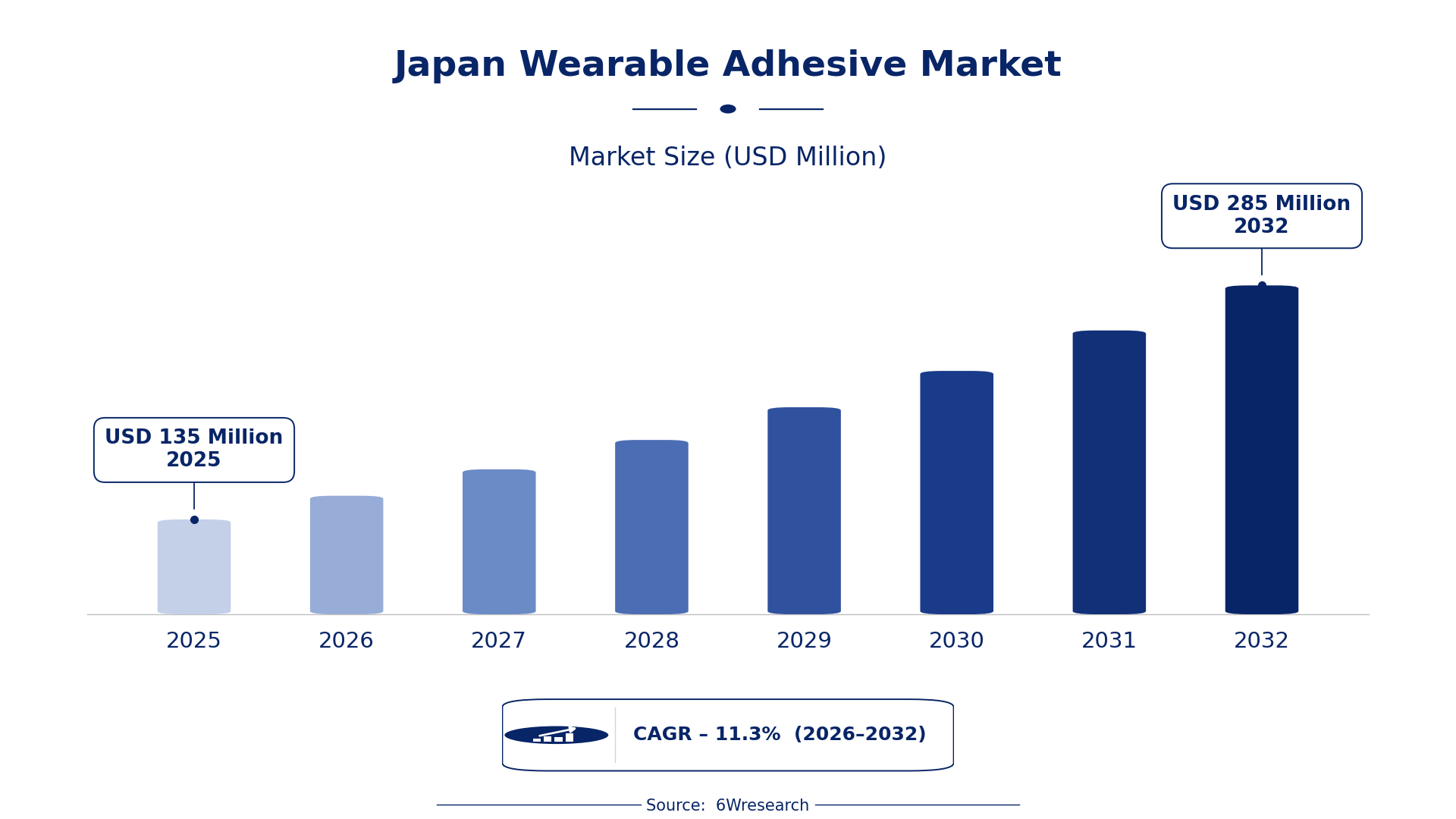
According to 6Wresearch internal database and industry insights, the Japan Wearable Adhesive Market was valued at USD 135 Million in 2025 and is projected to reach USD 285 Million by 2032, growing at a CAGR of approximately 11.3% during 2026–2032.
Japan Wearable Adhesive Market Highlights
| Report Metric | Details |
| Report Name | Japan Wearable Adhesive Market (2026-2032) |
| Market Size 2025 | USD 135 Million |
| Market Size 2032 | USD 285 Million |
| Absolute Growth 2025–2032 | USD 150 Million |
| CAGR 2026–2032 | 11.3% |
| Peak Annual Growth | 12.0% in 2030 |
| Forecast Period | 2026–2032 |
| Historical Data | 2022–2025 |
| Base Year | 2025 |
| Leading Type, 2025 | Medical-Grade Adhesives (38% share) |
| Leading Material, 2025 | Silicone (43% share) |
| Leading Application, 2025 | Wound Care (41% share) |
| Leading End Use, 2025 | Hospitals (50% share) |
| Fastest-Growing Type | Skin-Friendly Tapes (15.7% CAGR) |
| Fastest-Growing Material | Hydrocolloid (16.5% CAGR) |
| Fastest-Growing Application | Wearable Sensors (16.3% CAGR) |
| Fastest-Growing End Use | Homecare (14.7% CAGR) |
| Growing Sector | Homecare |
| Key End Users | Hospitals, Clinics, Medical Device Companies, Dermatology Centers |
Japan Wearable Adhesive Market Year-wise Growth Rate and Key Drivers (2022–2032)
This graph illustrates the annual growth rates of the market from 2022 to 2032, highlighting a steady upward trajectory and projected market expansion over the forecast period.
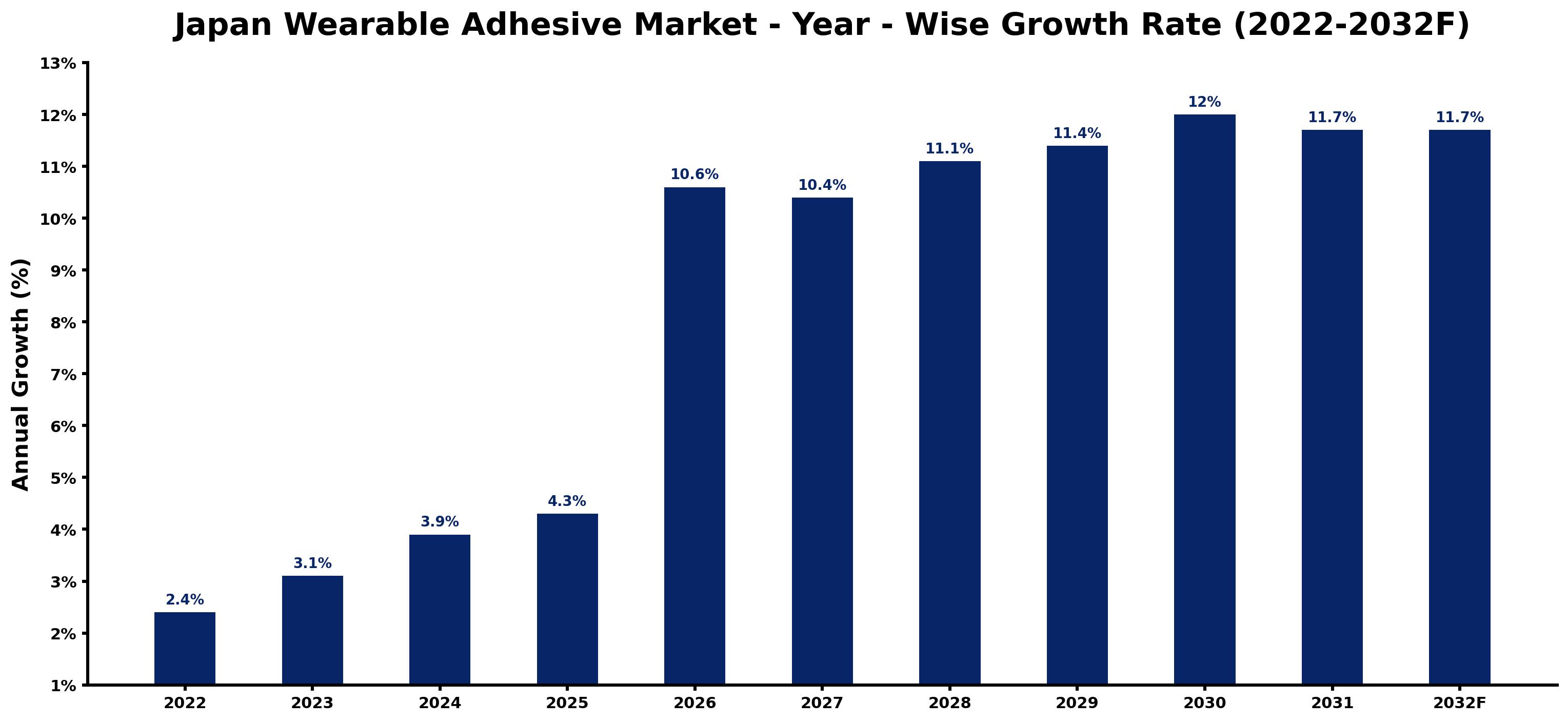
The yearly estimates that follow link every growth rate to its principal driver, so readers can see why the pace changed in each period.
| Year | Estimated Annual Growth (%) | Market Rationale |
| 2022 | 2.4 | The market showed steady growth due to consistent demand from hospitals and clinics. |
| 2023 | 3.1 | Growth accelerated as healthcare expenditure increased, reflecting higher investments in medical technologies. |
| 2024 | 3.9 | Demand continued to rise, driven by the growing prevalence of chronic diseases in the population. |
| 2025 | 4.3 | The market peaked historically as hospitals expanded their use of advanced medical adhesives. |
| 2026 | 10.6 | Growth is expected to surge as the demand for wearable sensors increases across healthcare. |
| 2027 | 10.4 | Growth is projected to slow slightly as the market adjusts to higher production capacities and supply levels. |
| 2028 | 11.1 | Demand is expected to rise again, supported by innovations in adhesive technologies and applications. |
| 2029 | 11.4 | The market is projected to continue growing as more healthcare facilities adopt wearable adhesives. |
| 2030 | 12.0 | The peak annual growth is expected to be reached, driven by heightened healthcare needs and innovations. |
| 2031 | 11.7 | Growth is expected to slow as the market stabilises following the peak demand year. |
| 2032 | 11.7 | The market is projected to maintain its growth rate as the aging population continues to drive healthcare needs. |
Note: Market size estimations and growth projections presented in this report are based on 6Wresearch's proprietary forecasting methodology, utilizing the latest available industry data, government publications, and primary research inputs.
Japan Wearable Adhesive Market Synopsis
Wearable adhesives are medical-grade adhesives designed for skin application, primarily used in wound care, securing sensors, and drug delivery systems. The Japan Wearable Adhesive Market is expanding due to rising healthcare expenditure, which reached 42 trillion JPY in 2023, and an increasing number of hospital admissions exceeding 8 million annually. The demand for wearable sensors is growing alongside the prevalence of chronic diseases, further propelling market growth.
Market Dynamics Impact Analysis (2026–2032)
| Factor | Type | Impact | Primary Segment Affected |
| Growing healthcare expenditure | Driver | High | Medical-Grade Adhesives |
| Increase in hospital admissions | Driver | High | Wound Care |
| Investment in home healthcare services | Opportunity | High | Skin-Friendly Tapes |
| Rising demand for wearable sensors | Opportunity | Medium | Wearable Sensors |
| Regulatory compliance costs | Restraint | High | Medical-Grade Adhesives |
| Competition from alternative materials | Restraint | Medium | Conductive Adhesives |
| Challenges in supply chain resilience | Challenge | High | Waterproof Adhesives |
| Need for continuous innovation | Challenge | Medium | Skin-Friendly Tapes |
Evaluation of Drivers in Japan Wearable Adhesive Market (2026–2032)
The main growth drivers and the segments they affect most are set out below.
| Drivers | Primary Segment Affected | Why It Matters (Evidence) |
| Increased healthcare expenditure | Medical-Grade Adhesives | Japan's healthcare expenditure reached 42 trillion JPY in 2023, leading to higher demand for medical-grade products. |
| Rising hospital admissions | Wound Care | With over 8 million hospital admissions annually, hospitals are increasingly utilizing advanced wound care solutions. |
| Growing prevalence of chronic diseases | Wearable Sensors | The demand for wearable sensors is increasing as chronic diseases become more prevalent, prompting healthcare facilities to invest. |
| Expansion of home healthcare services | Skin-Friendly Tapes | Japan's recent programme to improve home healthcare services is driving demand for skin-friendly adhesive solutions. |
| Technological advancements in adhesives | Hydrocolloid | Innovations in hydrocolloid materials are improving their effectiveness in wound care, attracting more buyers. |
Behind the steady rise in orders sits a marked increase in healthcare expenditure, which reached 42 trillion JPY in 2023, prompting hospitals to invest more in medical-grade adhesives. Over 8 million hospital admissions annually lead to heightened demand for wound care solutions, as healthcare facilities seek effective products. The prevalence of chronic diseases is rising, driving the need for wearable sensors that require reliable adhesives.
Evaluation of Restraints in Japan Wearable Adhesive Market
The table below lists the restraints and the evidence behind each.
| Market Restraint | Primary Segment Affected | Why It Matters (Evidence) |
| High costs of regulatory compliance | Medical-Grade Adhesives | Producers face substantial costs to meet JIS standards, impacting pricing and market entry. |
| Competition from alternative materials | Conductive Adhesives | The presence of alternative materials in the market can limit growth opportunities for conductive adhesives. |
| Supply chain vulnerabilities | Waterproof Adhesives | Challenges in supply chain resilience can delay product availability and increase costs for buyers. |
| Need for continuous innovation | Skin-Friendly Tapes | The market demands ongoing innovation, requiring investment and resources from producers. |
| Limited awareness of product benefits | Medical-Grade Adhesives | Some healthcare providers may not fully understand the advantages of advanced adhesive technologies. |
Japan Wearable Adhesive Market Challenges
Producers face a shortage of skilled labour, hampering their ability to develop new wearable adhesives. This skills gap can delay product innovation by up to six months, affecting hospitals that rely on timely access to advanced medical solutions. Importers must navigate stringent regulatory requirements under JIS standards, complicating the approval process for new products. This can increase costs and lead to delays of approximately 20% in market entry, impacting clinics that need these products for patient care. Buyers are encountering supply chain disruptions, resulting in stock shortages that force dermatology clinics to postpone treatments, negatively affecting patient outcomes.
Trends in the Japan Wearable Adhesive Market
Buyers and suppliers in the Japan Wearable Adhesive Market are adjusting to the following trends.
- Shift Towards Home Healthcare: In 2023, Japan launched a programme to improve home healthcare services, increasing the demand for wearable adhesives. This shift is expected to grow the market as patients prefer at-home treatment options.
- Increase in Chronic Disease Monitoring: The rise in chronic diseases has led to a notable increase in the demand for wearable sensors in Japan. This trend is driving the need for reliable adhesive solutions in healthcare.
- Growing Adoption of Biocompatible Materials: Since 2022, there has been a shift towards biocompatible materials in medical adhesives, with an increase in usage among hospitals. This trend supports patient safety and comfort.
- Expansion of Pediatric Care Applications: The use of skin-friendly tapes in pediatric care has surged, with a reported increase in dermatology clinics. This trend highlights the growing focus on sensitive skin applications.
Investment Opportunities in the Japan Wearable Adhesive Market
The following areas offer the clearest openings for investors and suppliers in the Japan Wearable Adhesive Market.
- Invest in Medical-Grade Adhesives: With Japan's healthcare expenditure at 42 trillion JPY, there is a strong opportunity to supply medical-grade adhesives. Targeting hospitals and clinics can lead to successful market entry.
- Supply Skin-Friendly Tapes: The growing demand for pediatric care presents an opportunity to supply skin-friendly tapes. Collaborating with dermatology centres can facilitate market entry and growth.
- Focus on Wearable Sensors: The increasing prevalence of chronic diseases offers a chance to invest in adhesives for wearable sensors. Engaging with medical device companies can enhance market penetration.
- Develop Hydrocolloid Products: The demand for effective wound care solutions is growing, creating opportunities for hydrocolloid products. Establishing partnerships with hospitals can drive sales.
Government Initiatives in the Japan Wearable Adhesive Market
The Chemical Substances Control Law (1973) requires producers to evaluate and control chemical substances in manufacturing, ensuring safety in medical adhesives. This law impacts how manufacturers develop and market their products, ensuring compliance with health standards. Additionally, the Economic Security Promotion Act (2022) supports supply-chain resilience for critical products, benefiting the production and distribution of medical adhesives.
The Long-Term Care Insurance Act (1997) funds nursing care and support services, benefiting the production and use of medical adhesives in home healthcare. Furthermore, the Semiconductor and Digital Industry Strategy (2021) promotes innovation in medical technologies, improving product offerings.
Future Insight of the Japan Wearable Adhesive Market
The investment pipeline for home healthcare services will drive demand for wearable adhesives by 2032, creating new opportunities for suppliers. Government initiatives will promote advancements in medical technologies, leading to improved product offerings. As Japan's population ages, the demand for innovative wound care solutions will rise, with healthcare expenditure reaching 42 trillion JPY in 2023 highlighting this trend. Adoption of ISO 13485 standards will strengthen quality management practices, benefiting both buyers and suppliers in the evolving market.
Market Segmentation Analysis
Japan Wearable Adhesive Market report covers a detailed analysis of the following market segments:
By Type – Medical-Grade Adhesives Lead, Skin-Friendly Tapes Expected to Grow Fastest
According to Bhawna Singh, Assistant Manager at 6Wresearch, Medical-Grade Adhesives took 38% of type revenue in 2025, more than any other category. Medical-grade adhesives hold the largest market share due to their critical role in wound care and securing wearable sensors. Their widespread use in hospitals and clinics across Japan is supported by compliance with JIS standards, ensuring reliability and safety. Over 2026–2032, Skin-Friendly Tapes are expected to post the fastest growth, at a CAGR of 15.7%. Skin-friendly tapes are experiencing rapid growth as they address the needs of sensitive skin, particularly in paediatric applications. The increasing emphasis on home healthcare services is driving their adoption, indicating a shift in consumer preferences. Suppliers must consider diversifying their offerings to include skin-friendly tapes to align with changing consumer demands.
By Material – Silicone Leads, Hydrocolloid Expected to Grow Fastest
With 43% of material revenue in 2025, Silicone was the largest category. Silicone holds the largest market share because of its flexibility and durability, making it ideal for various medical applications. Its widespread use in hospitals for adhesive products ensures a strong installed base. Hydrocolloid is set to record the highest CAGR in this split, 16.5% over 2026–2032. Hydrocolloid is experiencing rapid growth as it is widely used in wound dressings, which are in high demand due to an ageing population. This trend is likely to continue as healthcare needs increase. Buyers may benefit from sourcing more hydrocolloid products to address the growing needs in wound care.
By Application – Wound Care Leads, Wearable Sensors Expected to Grow Fastest
Wound Care held 41% of the Japan Wearable Adhesive Market by application in 2025. Wound care holds the largest share due to the high volume of hospital admissions, necessitating effective wound management solutions. The robust healthcare infrastructure in Japan ensures a consistent demand for these medical-grade adhesives. Wearable Sensors are projected to grow fastest, at a CAGR of 16.3% during 2026–2032. Wearable sensors are experiencing the highest growth as the demand for health monitoring devices increases with rising chronic disease rates. This trend is further fuelled by the government's focus on enhancing telemedicine services. Suppliers must focus on developing adhesives specifically for wearable sensors to capitalise on this growing market.
By End Use – Hospitals Lead, Homecare Expected to Grow Fastest
In 2025, Hospitals led the end use split with a 50% share. Hospitals represent the largest end-use segment, utilising wearable adhesives extensively for patient care and treatment. The considerable number of annual hospital admissions underscores the ongoing requirement for these products in medical settings. The quickest growth will come from Homecare, forecast to expand at a CAGR of 14.7% between 2026 and 2032. Homecare is the fastest-growing end-use segment, driven by a shift towards personal health management solutions. Government initiatives aimed at improving home healthcare services are accelerating this growth. Suppliers should explore partnerships with homecare providers to tap into this rapidly expanding market.
Key Attractiveness of the Report
- 10 Years of Market Numbers
- Historical Data Starting from 2022 to 2025
- Base Year 2025
- Forecast Data until 2032
- Key Performance Indicators Impacting the Market
- Major Upcoming Developments and Projects
Key Highlights of the Report:
- Japan Wearable Adhesive Market Outlook
- Market Size of Japan Wearable Adhesive Market,2025
- Forecast of Japan Wearable Adhesive Market, 2032
- Historical Data and Forecast of Japan Wearable Adhesive Revenues & Volume for the Period 2022-2032
- Japan Wearable Adhesive Market Trend Evolution
- Japan Wearable Adhesive Market Drivers and Challenges
- Japan Wearable Adhesive Price Trends
- Japan Wearable Adhesive Porter's Five Forces
- Japan Wearable Adhesive Industry Life Cycle
- Historical Data and Forecast of Japan Wearable Adhesive Market Revenues & Volume By Type for the Period 2022-2032
- Historical Data and Forecast of Japan Wearable Adhesive Market Revenues & Volume By Medical-Grade Adhesives for the Period 2022-2032
- Historical Data and Forecast of Japan Wearable Adhesive Market Revenues & Volume By Skin-Friendly Tapes for the Period 2022-2032
- Historical Data and Forecast of Japan Wearable Adhesive Market Revenues & Volume By Conductive Adhesives for the Period 2022-2032
- Historical Data and Forecast of Japan Wearable Adhesive Market Revenues & Volume By Waterproof Adhesives for the Period 2022-2032
- Historical Data and Forecast of Japan Wearable Adhesive Market Revenues & Volume By Others for the Period 2022-2032
- Historical Data and Forecast of Japan Wearable Adhesive Market Revenues & Volume By Material for the Period 2022-2032
- Historical Data and Forecast of Japan Wearable Adhesive Market Revenues & Volume By Silicone for the Period 2022-2032
- Historical Data and Forecast of Japan Wearable Adhesive Market Revenues & Volume By Hydrocolloid for the Period 2022-2032
- Historical Data and Forecast of Japan Wearable Adhesive Market Revenues & Volume By Acrylic for the Period 2022-2032
- Historical Data and Forecast of Japan Wearable Adhesive Market Revenues & Volume By Biocompatible Polymers for the Period 2022-2032
- Historical Data and Forecast of Japan Wearable Adhesive Market Revenues & Volume By Custom Formulations for the Period 2022-2032
- Historical Data and Forecast of Japan Wearable Adhesive Market Revenues & Volume By Application for the Period 2022-2032
- Historical Data and Forecast of Japan Wearable Adhesive Market Revenues & Volume By Wound Care for the Period 2022-2032
- Historical Data and Forecast of Japan Wearable Adhesive Market Revenues & Volume By Wearable Sensors for the Period 2022-2032
- Historical Data and Forecast of Japan Wearable Adhesive Market Revenues & Volume By ECG Monitoring for the Period 2022-2032
- Historical Data and Forecast of Japan Wearable Adhesive Market Revenues & Volume By Drug Delivery for the Period 2022-2032
- Historical Data and Forecast of Japan Wearable Adhesive Market Revenues & Volume By Skin Protection for the Period 2022-2032
- Historical Data and Forecast of Japan Wearable Adhesive Market Revenues & Volume By End Use for the Period 2022-2032
- Historical Data and Forecast of Japan Wearable Adhesive Market Revenues & Volume By Hospitals for the Period 2022-2032
- Historical Data and Forecast of Japan Wearable Adhesive Market Revenues & Volume By Homecare for the Period 2022-2032
- Historical Data and Forecast of Japan Wearable Adhesive Market Revenues & Volume By Clinics for the Period 2022-2032
- Historical Data and Forecast of Japan Wearable Adhesive Market Revenues & Volume By Medical Device Companies for the Period 2022-2032
- Historical Data and Forecast of Japan Wearable Adhesive Market Revenues & Volume By Dermatology Centers for the Period 2022-2032
- Historical Data and Forecast of Japan Wearable Adhesive Market Revenues & Volume By End Use for the Period 2022-2032
- Historical Data and Forecast of Japan Wearable Adhesive Market Revenues & Volume By Professional Tattooing for the Period 2022-2032
- Historical Data and Forecast of Japan Wearable Adhesive Market Revenues & Volume By Tattoo Studios for the Period 2022-2032
- Japan Wearable Adhesive Import Export Trade Statistics
- Market Opportunity Assessment By Type
- Market Opportunity Assessment By Material
- Market Opportunity Assessment By Application
- Market Opportunity Assessment By End Use
- Market Opportunity Assessment By End Use
- Japan Wearable Adhesive Top Companies Market Share
- Japan Wearable Adhesive Competitive Benchmarking By Technical and Operational Parameters
- Japan Wearable Adhesive Company Profiles
- Japan Wearable Adhesive Key Strategic Recommendations
Market Covered
The study includes the following segmentation.
By Type
- Medical-Grade Adhesives
- Skin-Friendly Tapes
- Conductive Adhesives
- Waterproof Adhesives
- Others
By Material
- Silicone
- Hydrocolloid
- Acrylic
- Biocompatible Polymers
- Custom Formulations
By Application
- Wound Care
- Wearable Sensors
- ECG Monitoring
- Drug Delivery
- Skin Protection
By End Use
- Hospitals
- Homecare
- Clinics
- Medical Device Companies
- Dermatology Centers































