Japan Wheat Seed Market Size & Growth Rate
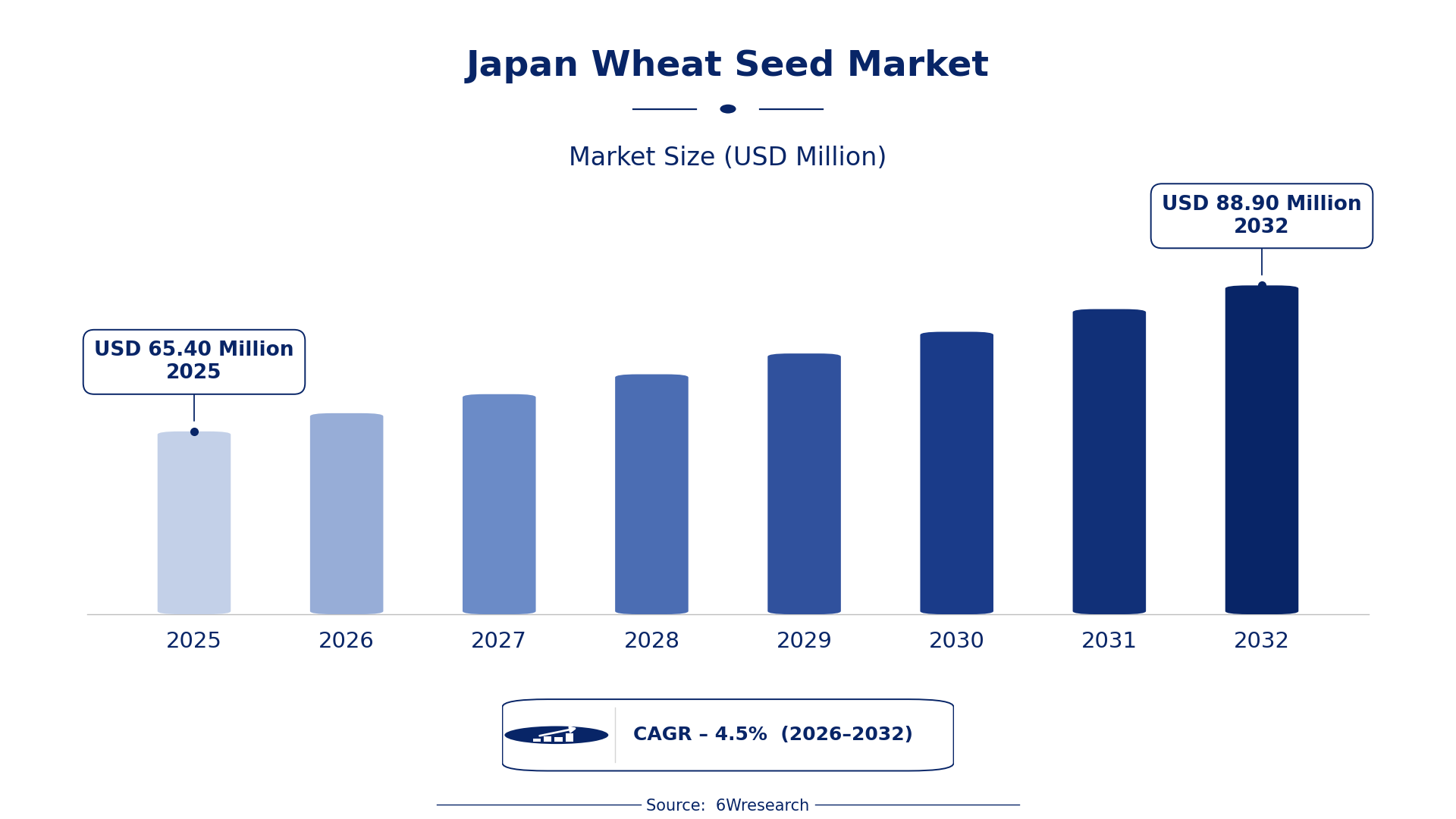
According to 6Wresearch internal database and industry insights, the Japan Wheat Seed Market was valued at USD 65.40 Million in 2025 and is projected to reach USD 88.90 Million by 2032, growing at a CAGR of approximately 4.5% during 2026–2032.
Japan Wheat Seed Market Highlights
| Report Metric | Details |
| Report Name | Japan Wheat Seed Market (2026-2032) |
| Market Size 2025 | USD 65.40 Million |
| Market Size 2032 | USD 88.90 Million |
| Absolute Growth 2025–2032 | USD 23.50 Million |
| CAGR 2026–2032 | 4.5% |
| Peak Annual Growth | 5.2% in 2032 |
| Forecast Period | 2026–2032 |
| Historical Data | 2022–2025 |
| Base Year | 2025 |
| Leading Product Type, 2025 | Hybrid Wheat (42% share) |
| Leading Packaging Type, 2025 | Bagged (50% share) |
| Leading Distribution Channel, 2025 | Agricultural Co-ops (45% share) |
| Leading End User, 2025 | Farmers (49% share) |
| Leading End Use, 2025 | Professional Tattooing (57% share) |
| Fastest-Growing Product Type | Organic Wheat (6.4% CAGR) |
| Fastest-Growing Packaging Type | Bulk (6.2% CAGR) |
| Fastest-Growing Distribution Channel | Seed Retailers (5.9% CAGR) |
| Fastest-Growing End User | Agriculture Industry (5.7% CAGR) |
| Fastest-Growing End Use | Tattoo Studios (5.6% CAGR) |
| Growing Sector | Agriculture Industry |
| Key End Users | Farmers, Agricultural Cooperatives, Food Industry |
Japan Wheat Seed Market Year-wise Growth Rate and Key Drivers (2022–2032)
This graph illustrates the annual growth rates of the market from 2022 to 2032, highlighting a steady upward trajectory and projected market expansion over the forecast period.
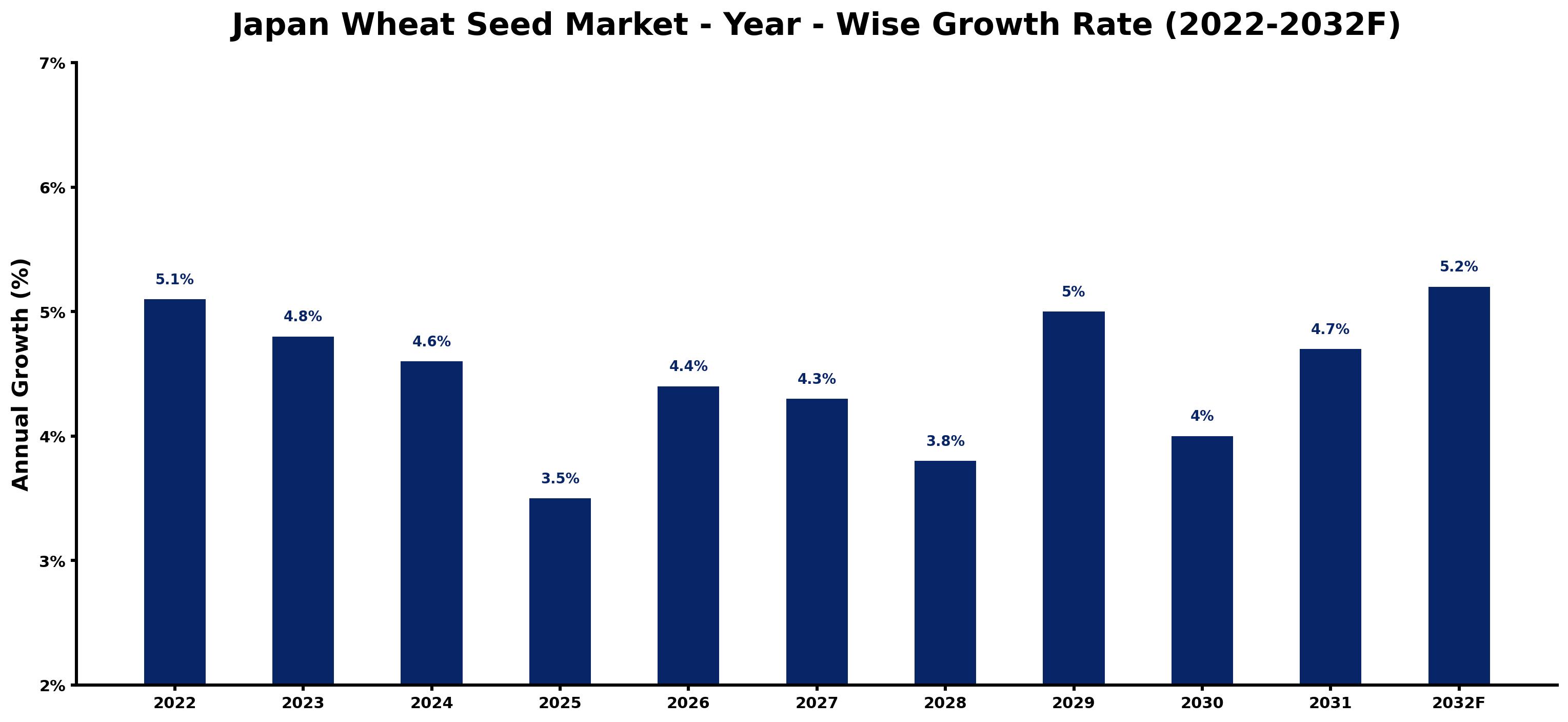
Each row of the following table gives one year's estimated growth and the event or demand shift that explains it.
| Year | Estimated Annual Growth (%) | Market Rationale |
| 2022 | 5.1 | The market showed strong demand from domestic farmers and cooperatives. |
| 2023 | 4.8 | Growth slowed due to a slight decrease in wheat production area. |
| 2024 | 4.6 | Demand continued to rise, but at a slower pace than previous years. |
| 2025 | 3.5 | The market experienced a further slowdown as farmers adjusted planting strategies. |
| 2026 | 4.4 | Growth is expected to accelerate as organic farming gains popularity among consumers. |
| 2027 | 4.3 | A slight slowdown is projected as the market stabilises after previous gains. |
| 2028 | 3.8 | Demand growth is expected to slow again as farmers face environmental challenges. |
| 2029 | 5.0 | The market is projected to rebound with increased interest in high-yield varieties. |
| 2030 | 4.0 | Growth is expected to decelerate slightly as supply chain issues emerge. |
| 2031 | 4.7 | Demand will increase again as farmers adopt new agricultural technologies. |
| 2032 | 5.2 | The market is projected to peak as consumer preferences shift towards organic wheat. |
Note: Market size estimations and growth projections presented in this report are based on 6Wresearch's proprietary forecasting methodology, utilizing the latest available industry data, government publications, and primary research inputs.
Japan Wheat Seed Market Synopsis
Wheat seed is essential for planting wheat crops, produced through selective breeding to improve yield and disease resistance. The Japan Wheat Seed Market is driven by domestic farmers and agricultural cooperatives, which are key buyer groups. The market is growing due to rising consumer interest in organic wheat, increasing production efficiency, and government support for sustainable practices, including the Food Recycling Law.
Market Dynamics Impact Analysis (2026–2032)
| Factor | Type | Impact | Primary Segment Affected |
| Rising consumer demand for organic wheat | Driver | High | Organic Wheat |
| Increased adoption of high-yield varieties | Driver | High | Hybrid Wheat |
| Growing interest in sustainable agriculture practices | Opportunity | High | Organic Wheat |
| Expansion of agricultural cooperatives supporting farmers | Opportunity | Medium | Agricultural Co-ops |
| Limited availability of arable land for wheat cultivation | Restraint | High | Conventional Wheat |
| Environmental challenges affecting crop yields | Restraint | Medium | Hybrid Wheat |
| Supply chain disruptions impacting seed distribution | Challenge | High | Seed Retailers |
| Rising production costs for wheat seeds | Challenge | Medium | Farmers |
Evaluation of Drivers in Japan Wheat Seed Market (2026–2032)
The main growth drivers and the segments they affect most are set out below.
| Drivers | Primary Segment Affected | Why It Matters (Evidence) |
| Increased consumer preference for organic products | Organic Wheat | This trend prompts farmers to invest more in organic wheat production, with organic farming increasing by 15% from 2021 to 2022. |
| Government support for sustainable agriculture | Hybrid Wheat | The Food Recycling Law encourages farmers to adopt high-yield varieties, improving overall production efficiency. |
| Growing demand from agricultural cooperatives | Agricultural Co-ops | These cooperatives provide resources and training, leading to increased seed purchases for wheat cultivation. |
| Technological advancements in seed breeding | Conventional Wheat | Improved breeding techniques have resulted in higher yields, prompting farmers to purchase more conventional wheat seeds. |
| Rising food production needs due to population growth | Hybrid Wheat | As Japan's population grows, the demand for wheat increases, driving farmers to seek high-yield seed varieties. |
Orders keep climbing as consumer interest in organic wheat rises, prompting farmers to invest in organic seed production. In 2022, organic farming increased by 15%, leading to higher demand for organic wheat seeds. Hokkaido, the leading prefecture for wheat cultivation, is seeing farmers adopting advanced breeding techniques, resulting in improved yields. The average wheat yield in Japan is around 6 tons per hectare, encouraging farmers to purchase more seeds. Support for sustainable practices drives demand for high-yield varieties among agricultural cooperatives.
Evaluation of Restraints in Japan Wheat Seed Market
These are the pressures that could keep growth below its potential.
| Market Restraint | Primary Segment Affected | Why It Matters (Evidence) |
| Limited arable land for wheat cultivation | Conventional Wheat | With only about 200,000 hectares planted, the availability of land constrains growth potential for wheat production. |
| Environmental challenges affecting yields | Hybrid Wheat | Factors such as climate change and soil degradation are impacting crop yields, reducing seed availability. |
| Supply chain disruptions in seed distribution | Seed Retailers | Logistical issues hinder timely delivery of seeds, affecting farmers' planting schedules and overall market performance. |
| Rising production costs for wheat seeds | Farmers | Increased costs for seed production and agricultural inputs are limiting farmers' purchasing power for new seed varieties. |
| Regulatory hurdles for organic certification | Organic Wheat | Farmers face challenges in meeting organic certification standards, which can slow the adoption of organic wheat farming. |
Japan Wheat Seed Market Challenges
Producers face high operational costs due to stringent seed quality regulations enforced by the Ministry of Agriculture, Forestry and Fisheries, consuming up to 20% of their budgets. Importers encounter rising expenses from international suppliers, potentially inflating prices for buyers by 15% during peak seasons. Domestic producers contend with competition from cheaper imported wheat seeds, compelling them to lower prices and risking profit margins by 10%. Supply chain disruptions, particularly in logistics, can delay seed deliveries, altering planting schedules and impacting yields for farmers by as much as 25%.
Trends in the Japan Wheat Seed Market
Several trends are reshaping the Japan Wheat Seed Market; the most important are set out below.
- Shift towards Organic Wheat Production: Japan is experiencing a notable shift towards organic wheat production, reflecting consumer demand for healthier food options. In 2022, organic wheat farming increased by 15%, indicating a growing market for organic seeds.
- Rise of Agricultural Cooperatives: Agricultural cooperatives are becoming more prominent in Japan, providing essential support to farmers. With over 1,000 cooperatives, they play a key role in seed distribution and farmer education.
- Increased Adoption of High-Yield Varieties: The year 2023 marked a notable increase in the adoption of high-yield wheat varieties among farmers. This shift is projected to improve overall production efficiency and meet rising food demands.
- Focus on Sustainable Agricultural Practices: The Food Recycling Law promotes sustainable agricultural practices. This initiative is expected to improve seed quality and increase organic farming adoption.
Investment Opportunities in the Japan Wheat Seed Market
The following opportunities in the Japan Wheat Seed Market pair current demand with a clear way in.
- Organic Wheat Seed Supply: The demand for organic wheat seeds is rising, especially with a 15% increase in organic farming. Farmers in Hokkaido are looking for suppliers to meet this growing need.
- Investment in High-Yield Seed Production: Now is the time to invest in high-yield seed production as farmers seek to improve yields. Agricultural cooperatives are potential partners for distribution.
- Expansion of Seed Retailing Channels: With the growth of online shopping, investing in e-commerce platforms for seed sales is timely. Seed retailers are increasingly looking to enhance their online presence.
- Support for Sustainable Practices: Investing in sustainable farming solutions aligns with government initiatives. The budget of ¥5 billion for organic farmers in 2023 presents a significant opportunity.
Government Initiatives in the Japan Wheat Seed Market
The Food Sanitation Act amendment of 2018 introduced a positive list system for synthetic resins used in food utensils, containers and packaging, which is enforced by the Ministry of Health, Labour and Welfare. This law ensures that wheat seed producers adhere to strict hygiene standards, thus enhancing the overall quality of seeds. Additionally, the Food Recycling Law established in 2000 mandates food businesses to reduce waste, promoting the recycling of by-products into feed and fertiliser, which indirectly supports the wheat seed market by ensuring sustainable practices are followed.
The Ministry of Agriculture, Forestry and Fisheries oversees the implementation of various agricultural subsidies, including a new program launched in 2023 with a budget of ¥5 billion aimed at supporting organic farmers. This agency also approves seed quality regulations, ensuring that wheat seeds meet industry standards set by the Japanese Seed Association. Such measures encourage farmers to adopt higher quality seeds, ultimately benefiting the wheat seed market by increasing demand for certified products.
Future Insight of the Japan Wheat Seed Market
By 2032, buyers will benefit from the growing adoption of organic farming practices among agricultural cooperatives, driven by a new subsidy program for organic farmers with a budget of ¥5 billion. Advancements in seed breeding techniques discussed at the International Wheat Conference will lead to improved varieties, boosting yields. The application of ISO 9001 standards will ensure higher seed quality, benefiting suppliers and providing better products for buyers. Enhanced collaboration among cooperatives will streamline distribution, making quality seeds more accessible.
Market Segmentation Analysis
Japan Wheat Seed Market report covers a detailed analysis of the following market segments:
By Product Type – Hybrid Wheat Leads, Organic Wheat Expected to Grow Fastest
According to Bhawna Singh, Assistant Manager at 6Wresearch, the largest product type category in 2025 was Hybrid Wheat, at 42% of revenue. Hybrid wheat dominates the market due to its high yield potential, essential for Japan's food security. Farmers in Hokkaido, the leading prefecture for wheat cultivation, prefer these varieties to maximise production efficiency. Organic Wheat is set to record the highest CAGR in this split, 6.4% over 2026–2032. Organic wheat is growing rapidly, with a notable 15% increase in organic farming from 2021 to 2022. This surge is driven by rising consumer preference for sustainably produced food, indicating a shift in agricultural practices. Suppliers should prioritise the development of hybrid and organic wheat varieties to meet evolving consumer preferences.
By Packaging Type – Bagged Leads, Bulk Expected to Grow Fastest
Bagged accounted for 50% of the market by packaging type in 2025. Bagged wheat seed is the leading packaging type as it is the most common format for retail distribution, making it accessible for small-scale farmers. This packaging method is widely used across various agricultural cooperatives in Japan. The quickest growth will come from Bulk, forecast to expand at a CAGR of 6.2% between 2026 and 2032. Bulk packaging is growing quickly due to its cost-effectiveness for large orders, appealing to larger agricultural operations. This shift indicates a trend towards efficiency in seed procurement for the agriculture sector. Suppliers may need to diversify packaging options to cater to both small and large-scale buyers.
By Distribution Channel – Agricultural Co-ops Lead, Seed Retailers Expected to Grow Fastest
In 2025, Agricultural Co-ops led the distribution channel split with a 45% share. Agricultural cooperatives dominate the distribution channel due to their extensive network and support for local farmers. With over 1,000 cooperatives in Japan, they play a crucial role in ensuring farmers have access to quality wheat seeds and resources for optimal crop production. Seed Retailers are projected to grow fastest, at a CAGR of 5.9% during 2026–2032. Seed retailers are experiencing rapid growth as they cater to farmers' immediate needs for wheat seeds. This shift towards direct purchasing reflects a changing preference among farmers for convenience and accessibility in obtaining agricultural inputs. Suppliers should focus on building strong relationships with seed retailers to enhance market reach and meet the evolving demands of farmers.
By End User – Farmers Lead, Agriculture Industry Expected to Grow Fastest
With 49% of end user revenue in 2025, Farmers was the largest category. Farmers are the largest end-user group, as they are the primary consumers of wheat seeds for crop production. Their dependence on wheat for both food and feed highlights their critical role in the agricultural sector. Over 2026–2032, Agriculture Industry is expected to post the fastest growth, at a CAGR of 5.7%. The agriculture industry is the fastest-growing end-user segment, reflecting its substantial consumption of seeds for diverse agricultural practices. This growth underscores the increasing importance of quality seed supply in the industry. Suppliers should tailor their products to address the specific requirements of farmers and the broader agriculture sector.
By End Use – Professional Tattooing Leads, Tattoo Studios Expected to Grow Fastest
Professional Tattooing took 57% of end use revenue in 2025, more than any other category. Professional tattooing is not applicable to the wheat seed market, as this segment does not pertain to agricultural uses. The primary focus remains on agricultural applications, which are essential for food production and related activities. Tattoo Studios are set to record the highest CAGR in this split, 5.6% over 2026–2032. Tattoo studios do not relate to the wheat seed market, as their operations do not involve agricultural seeds. The market's emphasis is strictly on agricultural applications, which are vital for sustaining food supply chains. This highlights the necessity for suppliers to concentrate exclusively on agricultural applications and avoid diversifying into unrelated industries.
Key Attractiveness of the Report
- 10 Years of Market Numbers
- Historical Data Starting from 2022 to 2025
- Base Year 2025
- Forecast Data until 2032
- Key Performance Indicators Impacting the Market
- Major Upcoming Developments and Projects
Key Highlights of the Report:
- Japan Wheat Seed Market Outlook
- Market Size of Japan Wheat Seed Market,2025
- Forecast of Japan Wheat Seed Market, 2032
- Historical Data and Forecast of Japan Wheat Seed Revenues & Volume for the Period 2022-2032
- Japan Wheat Seed Market Trend Evolution
- Japan Wheat Seed Market Drivers and Challenges
- Japan Wheat Seed Price Trends
- Japan Wheat Seed Porter's Five Forces
- Japan Wheat Seed Industry Life Cycle
- Historical Data and Forecast of Japan Wheat Seed Market Revenues & Volume By Product Type for the Period 2022-2032
- Historical Data and Forecast of Japan Wheat Seed Market Revenues & Volume By Hybrid Wheat for the Period 2022-2032
- Historical Data and Forecast of Japan Wheat Seed Market Revenues & Volume By Organic Wheat for the Period 2022-2032
- Historical Data and Forecast of Japan Wheat Seed Market Revenues & Volume By Conventional Wheat for the Period 2022-2032
- Historical Data and Forecast of Japan Wheat Seed Market Revenues & Volume By Packaging Type for the Period 2022-2032
- Historical Data and Forecast of Japan Wheat Seed Market Revenues & Volume By Bagged for the Period 2022-2032
- Historical Data and Forecast of Japan Wheat Seed Market Revenues & Volume By Bulk for the Period 2022-2032
- Historical Data and Forecast of Japan Wheat Seed Market Revenues & Volume By Sacks for the Period 2022-2032
- Historical Data and Forecast of Japan Wheat Seed Market Revenues & Volume By Distribution Channel for the Period 2022-2032
- Historical Data and Forecast of Japan Wheat Seed Market Revenues & Volume By Agricultural Co-ops for the Period 2022-2032
- Historical Data and Forecast of Japan Wheat Seed Market Revenues & Volume By Seed Retailers for the Period 2022-2032
- Historical Data and Forecast of Japan Wheat Seed Market Revenues & Volume By Online Stores for the Period 2022-2032
- Historical Data and Forecast of Japan Wheat Seed Market Revenues & Volume By End User for the Period 2022-2032
- Historical Data and Forecast of Japan Wheat Seed Market Revenues & Volume By Farmers for the Period 2022-2032
- Historical Data and Forecast of Japan Wheat Seed Market Revenues & Volume By Agriculture Industry for the Period 2022-2032
- Historical Data and Forecast of Japan Wheat Seed Market Revenues & Volume By Food Industry for the Period 2022-2032
- Historical Data and Forecast of Japan Wheat Seed Market Revenues & Volume By End Use for the Period 2022-2032
- Historical Data and Forecast of Japan Wheat Seed Market Revenues & Volume By Professional Tattooing for the Period 2022-2032
- Historical Data and Forecast of Japan Wheat Seed Market Revenues & Volume By Tattoo Studios for the Period 2022-2032
- Japan Wheat Seed Import Export Trade Statistics
- Market Opportunity Assessment By Product Type
- Market Opportunity Assessment By Packaging Type
- Market Opportunity Assessment By Distribution Channel
- Market Opportunity Assessment By End User
- Market Opportunity Assessment By End Use
- Japan Wheat Seed Top Companies Market Share
- Japan Wheat Seed Competitive Benchmarking By Technical and Operational Parameters
- Japan Wheat Seed Company Profiles
- Japan Wheat Seed Key Strategic Recommendations
Market Covered
The study includes the following segmentation.
By Product Type
- Hybrid Wheat
- Organic Wheat
- Conventional Wheat
By Packaging Type
- Bagged
- Bulk
- Sacks
By Distribution Channel
- Agricultural Co-ops
- Seed Retailers
- Online Stores
By End User
- Farmers
- Agriculture Industry
- Food Industry
By End Use
- Professional Tattooing
- Tattoo Studios































