Japan White Spirit Market Size & Growth Rate
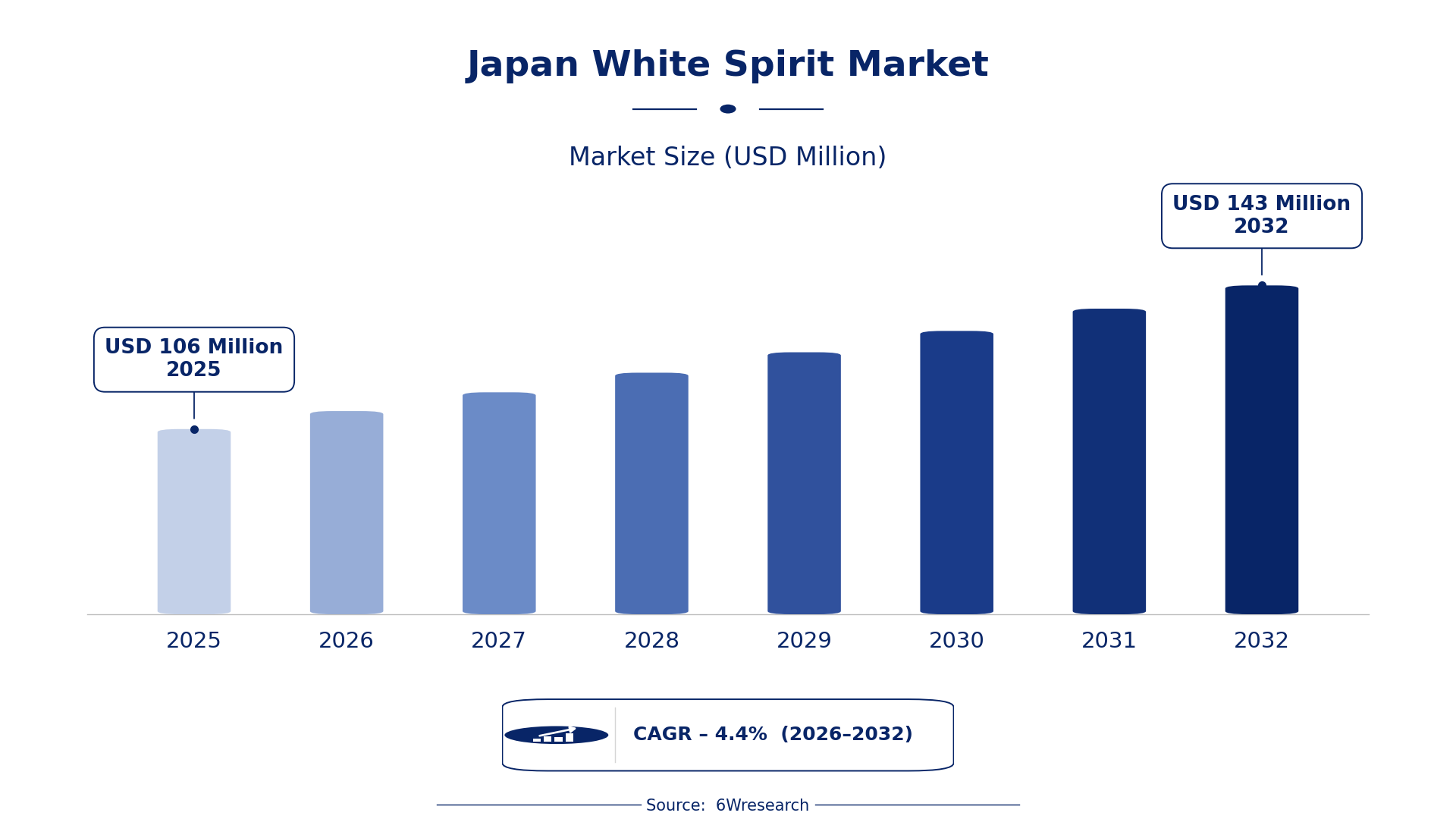
According to 6Wresearch internal database and industry insights, the Japan White Spirit Market was valued at USD 106 Million in 2025 and is projected to reach USD 143 Million by 2032, growing at a CAGR of approximately 4.4% during 2026–2032.
Japan White Spirit Market Highlights
| Report Metric | Details |
| Report Name | Japan White Spirit Market (2026-2032) |
| Market Size 2025 | USD 106 Million |
| Market Size 2032 | USD 143 Million |
| Absolute Growth 2025–2032 | USD 37 Million |
| CAGR 2026–2032 | 4.4% |
| Peak Annual Growth | 5.1% in 2029 |
| Forecast Period | 2026–2032 |
| Historical Data | 2022–2025 |
| Base Year | 2025 |
| Leading Product Type, 2025 | Type 1 (Low Aromatic) (49% share) |
| Leading Packaging Type, 2025 | Drums (56% share) |
| Leading Distribution Channel, 2025 | Direct Sales (55% share) |
| Leading End User, 2025 | Paint Industry (40% share) |
| Leading End Use, 2025 | Professional Tattooing (67% share) |
| Fastest-Growing Product Type | Type 2 (High Aromatic) (6.0% CAGR) |
| Fastest-Growing Packaging Type | Cans (6.1% CAGR) |
| Fastest-Growing Distribution Channel | Specialty Stores (5.7% CAGR) |
| Fastest-Growing End User | Automotive Industry (5.6% CAGR) |
| Fastest-Growing End Use | Tattoo Studios (5.5% CAGR) |
| Growing Sector | Automotive Industry |
| Key End Users | Paint Industry, Automotive Industry, Chemical Industry |
Japan White Spirit Market Year-wise Growth Rate and Key Drivers (2022–2032)
This graph illustrates the annual growth rates of the market from 2022 to 2032, highlighting a steady upward trajectory and projected market expansion over the forecast period.
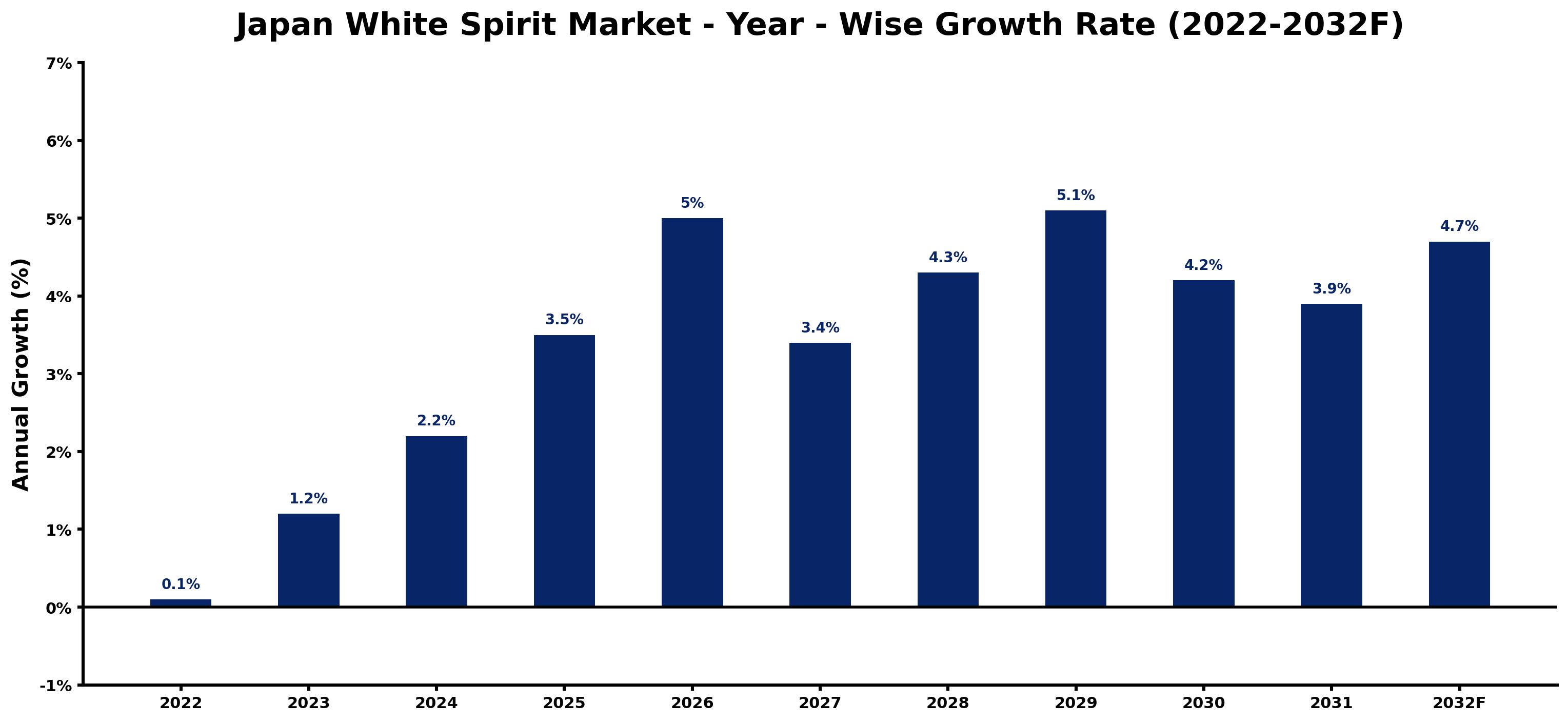
Below, each year's estimated growth is shown next to the factor that most influenced it.
| Year | Estimated Annual Growth (%) | Market Rationale |
| 2022 | 0.1 | The market experienced steady demand from the paint industry, reflecting ongoing industrial activities. |
| 2023 | 1.2 | Growth accelerated as domestic paint consumption increased, reflecting market recovery. |
| 2024 | 2.2 | Demand continued to rise due to expanding automotive maintenance activities. |
| 2025 | 3.5 | The market peaked with consumption driven by the paint sector's needs. |
| 2026 | 5.0 | Growth surged as manufacturers adopted safer, low-aromatic products to meet regulations. |
| 2027 | 3.4 | Growth slowed slightly as the market adjusted to new product standards and preferences. |
| 2028 | 4.3 | Demand rebounded as industrial applications expanded, particularly in automotive cleaning. |
| 2029 | 5.1 | The market peaked again with heightened demand for low-aromatic white spirit alternatives. |
| 2030 | 4.2 | Growth slowed as the market stabilised following previous peaks in consumption. |
| 2031 | 3.9 | A further slowdown occurred as buyers adjusted to market conditions and regulations. |
| 2032 | 4.7 | Growth resumed as new applications for white spirit emerged in various industries. |
Note: Market size estimations and growth projections presented in this report are based on 6Wresearch's proprietary forecasting methodology, utilizing the latest available industry data, government publications, and primary research inputs.
Japan White Spirit Market Synopsis
White spirit is a petroleum-derived solvent primarily used in the paint and coatings industry, produced through crude oil distillation. It serves important functions such as thinning paints and cleaning tools. The Japan White Spirit Market is expanding due to increased consumption in the paint industry, which used approximately 1.2 million litres in 2022, alongside the automotive sector's growing demand for cleaning applications. Government initiatives promoting safer alternatives are influencing product preferences and driving further growth.
Market Dynamics Impact Analysis (2026–2032)
| Factor | Type | Impact | Primary Segment Affected |
| Increased demand for low-aromatic white spirit due to health regulations. | Driver | High | Type 1 (Low Aromatic) |
| The expansion of the automotive sector requiring cleaning and maintenance solvents. | Driver | High | Automotive Industry |
| Growing interest in sustainable paint products among consumers and manufacturers. | Opportunity | High | Paint Industry |
| The rise in DIY projects among consumers seeking white spirit for hobbyist use. | Opportunity | Medium | Specialty Stores |
| Strict regulations on aromatic content limiting product availability. | Restraint | High | Type 2 (High Aromatic) |
| Health concerns surrounding solvent exposure affecting market preferences. | Restraint | Medium | Type 3 (De-aromatized) |
| Challenges in sourcing compliant raw materials due to regulatory changes. | Challenge | High | Paint Industry |
| Competition from greener alternatives impacting traditional solvent usage. | Challenge | Medium | Chemical Industry |
Evaluation of Drivers in Japan White Spirit Market (2026–2032)
The following drivers explain most of the expected growth.
| Drivers | Primary Segment Affected | Why It Matters (Evidence) |
| Increased adoption of low-aromatic white spirit for health compliance. | Type 1 (Low Aromatic) | The paint industry is shifting towards safer products, with approximately 1.2 million liters consumed in 2022. |
| Growing automotive sector requiring cleaning solvents for maintenance. | Automotive Industry | The automotive sector's demand for cleaning parts drives white spirit purchases, with significant usage reported. |
| Rising consumer interest in sustainable paint products. | Paint Industry | The Japan Paint Manufacturers Association launched a campaign for sustainable products, influencing purchasing decisions. |
| Increased DIY projects leading to higher retail demand. | Specialty Stores | Hobbyists are increasingly purchasing white spirit for various projects, contributing to a notable sales increase. |
| Expansion of industrial applications requiring large volumes of white spirit. | Bulk | Bulk purchases are preferred for large-scale industrial applications, reflecting growing demand. |
Several shifts outside the market are boosting sales. The automotive sector's demand for cleaning solvents has risen, driven by maintenance needs. The increase in DIY projects among consumers has led to heightened retail demand for white spirit, particularly in specialty stores, which reported a 20% rise in sales. Industrial applications are expanding, underscoring the evolving market environment.
Evaluation of Restraints in Japan White Spirit Market
The following restraints limit how fast demand can grow.
| Market Restraint | Primary Segment Affected | Why It Matters (Evidence) |
| Regulatory restrictions on aromatic content limiting product options. | Type 2 (High Aromatic) | Japan's strict regulations impact the availability of high-aromatic products. |
| Health concerns surrounding solvent exposure affecting consumer choices. | Type 3 (De-aromatized) | Growing awareness of health risks leads to a preference for low-toxicity options. |
| Challenges in sourcing compliant raw materials due to regulations. | Paint Industry | Manufacturers face difficulties in obtaining compliant materials that meet new standards. |
| Limited market for high-aromatic white spirit due to health regulations. | Type 2 (High Aromatic) | The market for high-aromatic products is shrinking as consumers prefer safer alternatives. |
| Competition from greener alternatives reducing traditional solvent usage. | Chemical Industry | The chemical industry is exploring eco-friendly options, impacting white spirit demand. |
Japan White Spirit Market Challenges
Producers face strict regulations on aromatic content, limiting the types of white spirit they can manufacture. These regulations are enforced to protect public health, causing delays for producers who must adapt their processes, extending production times by up to three weeks. Buyers encounter rising costs as they are compelled to source compliant alternatives, resulting in a 15% increase in procurement expenses. Competition intensifies as producers invest heavily in meeting these regulations, diverting resources from research and development, which ultimately hampers their ability to innovate and compete effectively in the market.
Trends in the Japan White Spirit Market
Several trends are reshaping the Japan White Spirit Market; the most important are set out below.
- Shift from High Aromatic to Low Aromatic Solvents: The Tokyo region is increasingly adopting low-aromatic white spirit due to health regulations. In 2023, a government initiative promoted safer alternatives, reshaping consumer preferences.
- Transition to Sustainable Paint Products: In 2023, the Japan Paint Manufacturers Association launched a campaign for sustainable paint products. This initiative aims to reduce environmental impact and is expected to influence purchasing decisions in the paint industry.
- Growing DIY Culture in Urban Areas: The rise in DIY projects among urban consumers is driving demand for white spirit. Specialty stores are reporting a 20% increase in sales as hobbyists seek quality solvents for their projects.
- Emergence of Online Sales Channels: The online sales channel for white spirit is expanding, with a 15% growth reported in 2023. This trend allows consumers to access products more conveniently, increasing overall market reach.
Investment Opportunities in the Japan White Spirit Market
The following areas offer the clearest openings for investors and suppliers in the Japan White Spirit Market.
- Timing for Low-Aromatic Products: With increasing health awareness, there is a growing demand for low-aromatic white spirit. The paint industry, a major consumer, is shifting towards safer alternatives, creating a market gap for suppliers to fill.
- Investing in Specialty Stores: Specialty stores are seeing a rise in DIY projects, leading to increased white spirit sales. Suppliers can tap into this trend by partnering with local stores to improve distribution.
- Bulk Supply for Industrial Applications: The industrial sector is expanding, requiring larger volumes of white spirit. Suppliers can focus on bulk packaging solutions to meet this demand and streamline their operations.
- Online Sales Expansion: The online sales channel for white spirit is growing rapidly. Suppliers should invest in e-commerce platforms to reach a broader consumer base and improve accessibility.
Government Initiatives in the Japan White Spirit Market
The PRTR Law mandates producers to disclose the use of chemical substances, ensuring transparency in the use of solvents like white spirit. This measure requires compliance to avoid penalties, impacting how producers operate and report their activities. Additionally, the Chemical Substances Control Law necessitates evaluation and control of chemical substances, affecting the manufacturing and import processes for white spirit, promoting safer alternatives.
In 2023, the Ministry of Health, Labour and Welfare launched a campaign promoting safer alternatives to high-aromatic solvents, aiming to reduce health risks associated with solvent exposure. This initiative supports buyers seeking compliant products and encourages manufacturers to innovate, with funding allocated to projects that enhance safety and sustainability in the industry.
Future Insight of the Japan White Spirit Market
Advancements in solvent production technology will reshape white spirit demand by 2032, particularly with the rise of low aromatic variants. A government initiative promoting safer alternatives will encourage buyers to shift towards greener solvents, altering procurement practices. By 2025, approximately 30% of the market is expected to transition to these alternatives, indicating a notable shift in industry standards. The campaign for sustainable paint products will drive suppliers to innovate, ensuring they adapt to changing market expectations and maintain their competitive edge.
Market Segmentation Analysis
Japan White Spirit Market report covers a detailed analysis of the following market segments:
By Product Type – Type 1 (Low Aromatic) Leads, Type 2 (High Aromatic) Expected to Grow Fastest
According to Bhawna Singh, Assistant Manager at 6Wresearch, the largest product type category in 2025 was Type 1 (Low Aromatic), at 49% of revenue. Type 1 (Low Aromatic) white spirit holds the largest share due to its widespread use in the paint industry, where it is preferred for low-odor applications. For instance, the Japanese paint industry consumed approximately 1.2 million litres of this type in 2022. Over 2026–2032, Type 2 (High Aromatic) is expected to post the fastest growth, at a CAGR of 6.0%. The growth of Type 2 (High Aromatic) white spirit is driven by its use in specialized applications, despite health concerns limiting its appeal. The ongoing exploration of greener alternatives in the chemical industry also contributes to its increasing interest. Suppliers should focus on promoting Type 1 (Low Aromatic) products to align with industry preferences and regulations.
By Packaging Type – Drums Lead, Cans Expected to Grow Fastest
Drums held 56% of the Japan White Spirit Market by packaging type in 2025. Drums hold the largest share in the packaging segment due to their suitability for industrial applications, facilitating the storage and transport of larger quantities. This is particularly true in regions like Tokyo, where demand for efficient packaging solutions is high. The quickest growth will come from Cans, forecast to expand at a CAGR of 6.1% between 2026 and 2032. Cans are seeing rapid growth as they are preferred for retail and smaller applications, appealing to hobbyists and DIY enthusiasts. The increasing trend towards convenience in packaging is propelling this segment forward. Suppliers should focus on expanding their product lines to include cans to meet the rising demand in the retail market.
By Distribution Channel – Direct Sales Leads, Specialty Stores Expected to Grow Fastest
Direct Sales took 55% of distribution channel revenue in 2025, more than any other category. Direct Sales is the leading distribution channel, primarily utilised for industrial transactions where bulk purchases are common. This method ensures efficiency and reliability for large-scale users in the paint and automotive sectors. Specialty Stores are projected to grow fastest, at a CAGR of 5.7% during 2026–2032. Specialty Stores are growing rapidly as they cater to hobbyists and DIY enthusiasts seeking smaller quantities of white spirit. This channel's rise reflects a shift in consumer preferences towards more accessible retail options. Suppliers should explore partnerships with specialty stores to reach a broader audience.
By End User – Paint Industry Leads, Automotive Industry Expected to Grow Fastest
With 40% of end user revenue in 2025, Paint Industry was the largest category. The Paint Industry stands as the largest consumer of white spirit, leveraging it for essential tasks such as paint formulation and thinning. This sector's extensive usage underscores the importance of white spirit in maintaining robust production capabilities. Automotive Industry is set to record the highest CAGR in this split, 5.6% over 2026–2032. The Automotive Industry is witnessing rapid growth as it increasingly incorporates white spirit for cleaning and maintenance activities. This trend indicates a rising reliance on effective solvents within the sector's operational framework. Suppliers must consider strategies that address the growing needs of the automotive sector alongside the established paint industry.
By End Use – Professional Tattooing Leads, Tattoo Studios Expected to Grow Fastest
In 2025, Professional Tattooing led the end use split with a 67% share. Professional Tattooing is the leading end use for white spirit, primarily for cleaning and preparation processes in the tattooing procedure. This niche market demonstrates the versatility of white spirit beyond traditional applications. Over 2026–2032, Tattoo Studios are expected to post the fastest growth, at a CAGR of 5.5%. Tattoo Studios are emerging as the fastest-growing end use, as they incorporate white spirit for cleaning purposes during tattooing sessions. This growth reflects the increasing popularity of tattooing as an art form. Suppliers may benefit from developing targeted marketing campaigns for the tattoo studio segment.
Key Attractiveness of the Report
- 10 Years of Market Numbers
- Historical Data Starting from 2022 to 2025
- Base Year 2025
- Forecast Data until 2032
- Key Performance Indicators Impacting the Market
- Major Upcoming Developments and Projects
Key Highlights of the Report:
- Japan White Spirit Market Outlook
- Market Size of Japan White Spirit Market,2025
- Forecast of Japan White Spirit Market, 2032
- Historical Data and Forecast of Japan White Spirit Revenues & Volume for the Period 2022-2032
- Japan White Spirit Market Trend Evolution
- Japan White Spirit Market Drivers and Challenges
- Japan White Spirit Price Trends
- Japan White Spirit Porter's Five Forces
- Japan White Spirit Industry Life Cycle
- Historical Data and Forecast of Japan White Spirit Market Revenues & Volume By Product Type for the Period 2022-2032
- Historical Data and Forecast of Japan White Spirit Market Revenues & Volume By Type 1 (Low Aromatic) for the Period 2022-2032
- Historical Data and Forecast of Japan White Spirit Market Revenues & Volume By Type 2 (High Aromatic) for the Period 2022-2032
- Historical Data and Forecast of Japan White Spirit Market Revenues & Volume By Type 3 (De-aromatized) for the Period 2022-2032
- Historical Data and Forecast of Japan White Spirit Market Revenues & Volume By Packaging Type for the Period 2022-2032
- Historical Data and Forecast of Japan White Spirit Market Revenues & Volume By Drums for the Period 2022-2032
- Historical Data and Forecast of Japan White Spirit Market Revenues & Volume By Cans for the Period 2022-2032
- Historical Data and Forecast of Japan White Spirit Market Revenues & Volume By Bulk for the Period 2022-2032
- Historical Data and Forecast of Japan White Spirit Market Revenues & Volume By Distribution Channel for the Period 2022-2032
- Historical Data and Forecast of Japan White Spirit Market Revenues & Volume By Direct Sales for the Period 2022-2032
- Historical Data and Forecast of Japan White Spirit Market Revenues & Volume By Specialty Stores for the Period 2022-2032
- Historical Data and Forecast of Japan White Spirit Market Revenues & Volume By Online Stores for the Period 2022-2032
- Historical Data and Forecast of Japan White Spirit Market Revenues & Volume By End User for the Period 2022-2032
- Historical Data and Forecast of Japan White Spirit Market Revenues & Volume By Paint Industry for the Period 2022-2032
- Historical Data and Forecast of Japan White Spirit Market Revenues & Volume By Automotive Industry for the Period 2022-2032
- Historical Data and Forecast of Japan White Spirit Market Revenues & Volume By Chemical Industry for the Period 2022-2032
- Historical Data and Forecast of Japan White Spirit Market Revenues & Volume By End Use for the Period 2022-2032
- Historical Data and Forecast of Japan White Spirit Market Revenues & Volume By Professional Tattooing for the Period 2022-2032
- Historical Data and Forecast of Japan White Spirit Market Revenues & Volume By Tattoo Studios for the Period 2022-2032
- Japan White Spirit Import Export Trade Statistics
- Market Opportunity Assessment By Product Type
- Market Opportunity Assessment By Packaging Type
- Market Opportunity Assessment By Distribution Channel
- Market Opportunity Assessment By End User
- Market Opportunity Assessment By End Use
- Japan White Spirit Top Companies Market Share
- Japan White Spirit Competitive Benchmarking By Technical and Operational Parameters
- Japan White Spirit Company Profiles
- Japan White Spirit Key Strategic Recommendations
Market Covered
Segments analysed in this report are listed below.
By Product Type
- Type 1 (Low Aromatic)
- Type 2 (High Aromatic)
- Type 3 (De-aromatized)
By Packaging Type
- Drums
- Cans
- Bulk
By Distribution Channel
- Direct Sales
- Specialty Stores
- Online Stores
By End User
- Paint Industry
- Automotive Industry
- Chemical Industry
By End Use
- Professional Tattooing
- Tattoo Studios































