Japan Wireless Medical Technologies Market Size & Growth Rate
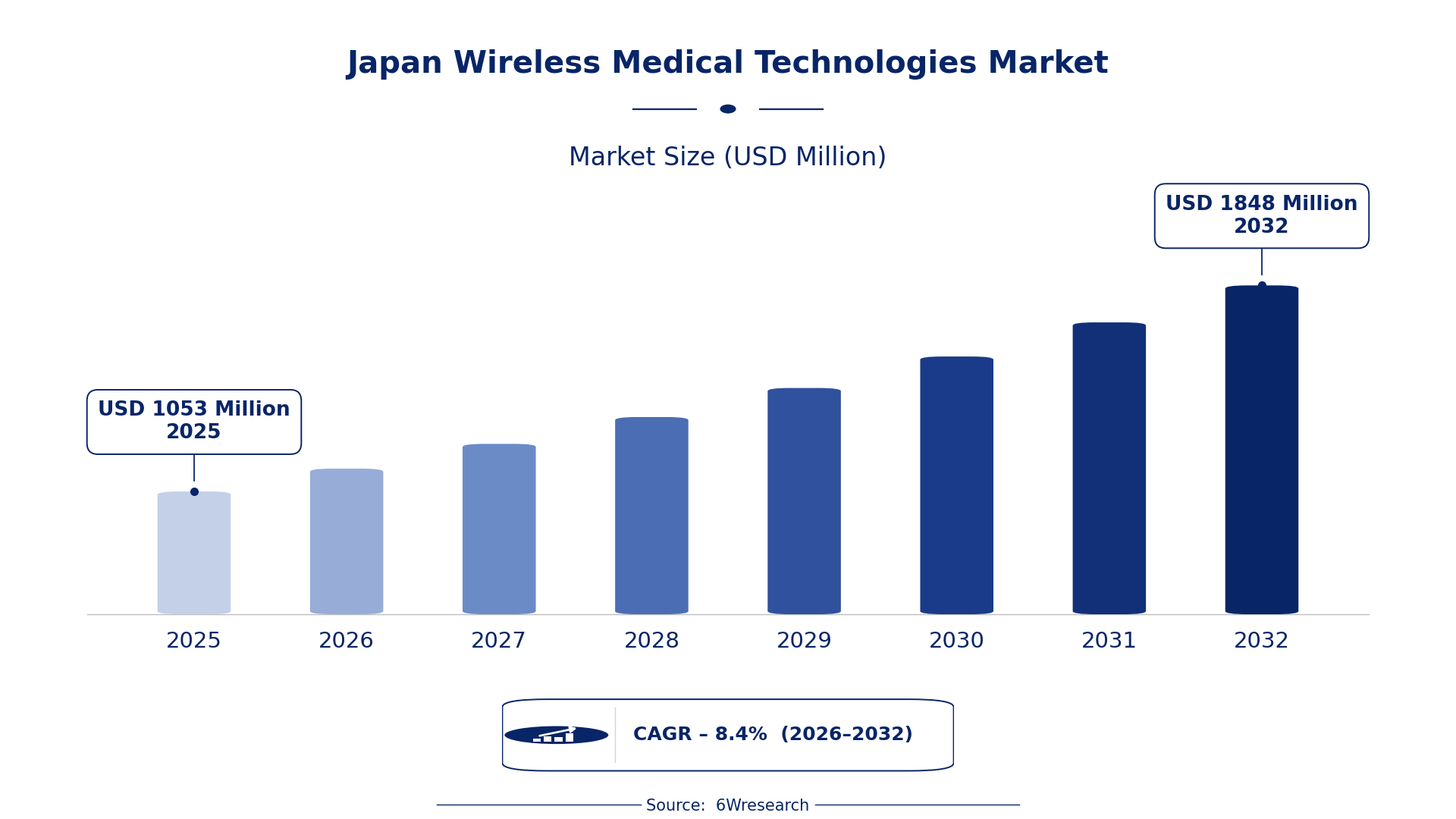
According to 6Wresearch internal database and industry insights, the Japan Wireless Medical Technologies Market was valued at USD 1,053 Million in 2025 and is projected to reach USD 1,848 Million by 2032, growing at a CAGR of approximately 8.4% during 2026–2032.
Japan Wireless Medical Technologies Market Highlights
| Report Metric | Details |
| Report Name | Japan Wireless Medical Technologies Market (2026-2032) |
| Market Size 2025 | USD 1,053 Million |
| Market Size 2032 | USD 1,848 Million |
| Absolute Growth 2025–2032 | USD 795 Million |
| CAGR 2026–2032 | 8.4% |
| Peak Annual Growth | 9.1% in 2028 |
| Forecast Period | 2026–2032 |
| Historical Data | 2022–2025 |
| Base Year | 2025 |
| Leading Technology, 2025 | Wi-Fi (46% share) |
| Leading End User, 2025 | Hospitals (40% share) |
| Fastest-Growing Technology | Bluetooth (11.4% CAGR) |
| Fastest-Growing End User | Home Care Settings (10.5% CAGR) |
| Growing Sector | Home Care Settings |
| Key End Users | Hospitals, Clinics, Home Care Providers |
Japan Wireless Medical Technologies Market Year-wise Growth Rate and Key Drivers (2022–2032)
This graph illustrates the annual growth rates of the market from 2022 to 2032, highlighting a steady upward trajectory and projected market expansion over the forecast period.
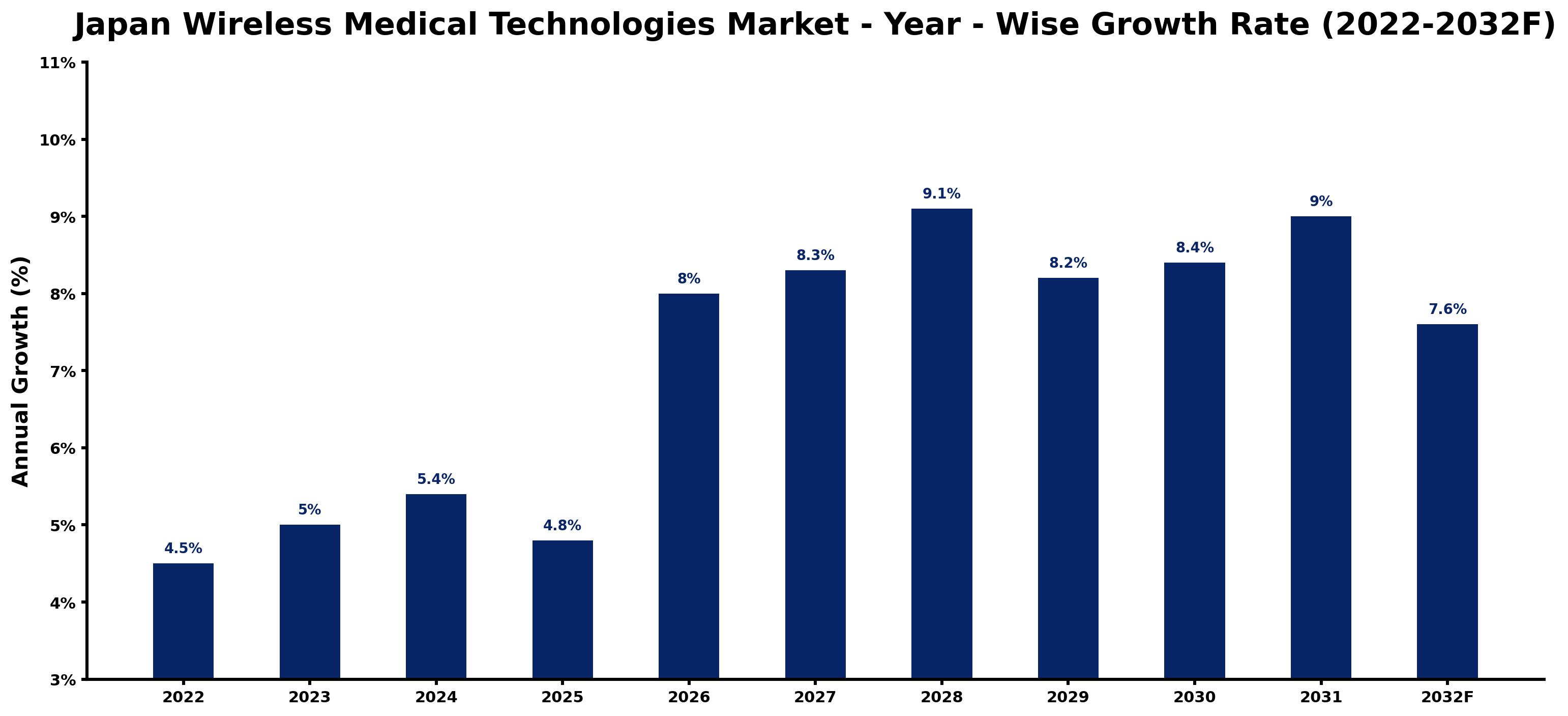
The following figures match every annual growth estimate with the main market development of that year, giving the reasoning behind each rise or slowdown.
| Year | Estimated Annual Growth (%) | Market Rationale |
| 2022 | 4.5 | The market experienced steady demand from healthcare providers and institutions. |
| 2023 | 5.0 | Growth accelerated as hospitals adopted wireless technologies for patient monitoring. |
| 2024 | 5.4 | Demand rose further with the integration of telemedicine services across various healthcare settings. |
| 2025 | 4.8 | Growth slowed slightly due to market saturation in some urban areas. |
| 2026 | 8.0 | The expansion of home care services is expected to drive a resurgence in demand for wireless technologies. |
| 2027 | 8.3 | Adoption of Bluetooth technologies is projected to surge, improving connectivity in patient monitoring. |
| 2028 | 9.1 | The peak growth year will see investments in digital health infrastructure. |
| 2029 | 8.2 | Growth is expected to decelerate as the market stabilises after rapid expansion. |
| 2030 | 8.4 | Demand will increase again with new innovations in wireless medical devices. |
| 2031 | 9.0 | The market is projected to continue growing as healthcare providers seek improved patient outcomes. |
| 2032 | 7.6 | Growth is expected to slow as the market matures, focusing on optimising existing technologies. |
Note: Market size estimations and growth projections presented in this report are based on 6Wresearch's proprietary forecasting methodology, utilizing the latest available industry data, government publications, and primary research inputs.
Japan Wireless Medical Technologies Market Synopsis
Wireless Medical Technologies encompass devices that utilise wireless communication to transmit medical data, facilitating remote patient monitoring, telemedicine, and optimising hospital workflows. The Japan Wireless Medical Technologies Market is growing due to an ageing population, with 29.3% aged 65 or older, and more than 80% of hospitals adopting these technologies for patient care. Government initiatives aimed at enhancing digital health services further drive demand, creating opportunities for innovation and investment in this sector.
Market Dynamics Impact Analysis (2026–2032)
| Factor | Type | Impact | Primary Segment Affected |
| Aging population driving demand for remote patient monitoring solutions. | Driver | High | Home Care Settings |
| Increased investment in digital health technologies by healthcare providers. | Driver | High | Hospitals |
| Growing demand for telemedicine solutions in rural areas. | Opportunity | High | Clinics |
| Expansion of home care services requiring advanced monitoring solutions. | Opportunity | High | Home Care Settings |
| High costs associated with implementing wireless technologies in healthcare facilities. | Restraint | Medium | Hospitals |
| Limited awareness of wireless technologies among smaller clinics. | Restraint | Medium | Clinics |
| Challenges in integrating new technologies with existing systems. | Challenge | High | Hospitals |
| Regulatory hurdles in the approval of new wireless medical devices. | Challenge | Medium | Home Care Settings |
Evaluation of Drivers in Japan Wireless Medical Technologies Market (2026–2032)
These are the developments adding the most demand over the forecast period.
| Drivers | Primary Segment Affected | Why It Matters (Evidence) |
| Growing elderly population requiring continuous health monitoring. | Home Care Settings | Approximately 29.3% of Japan's population was aged 65 or older, increasing demand for remote monitoring solutions. |
| Increased adoption of telemedicine services by healthcare providers. | Hospitals | Telemedicine initiatives lead to higher investments in wireless technologies, improving patient care. |
| Technological advancements in wireless communication improving device functionality. | Clinics | Over 80% of hospitals have adopted wireless technologies, enhancing patient management capabilities. |
| Expansion of healthcare infrastructure in rural areas. | Home Care Settings | In 2023, a program was launched to enhance digital health services across rural regions. |
| Rising healthcare expenditure supporting technology investments. | Hospitals | Japan's national medical care expenditure was about JPY 46.7 trillion in fiscal 2022, boosting technology adoption. |
The primary driver of demand is the increasing elderly population, with a considerable segment aged 65 or older, which intensifies the need for continuous health monitoring in home care environments. The rise of telemedicine services has prompted greater investment in wireless technologies, facilitating improved patient management. Advances in wireless communication technology have enhanced device functionality, enabling healthcare facilities to deliver more effective care. Rising healthcare expenditure, estimated at approximately JPY 46.7 trillion in fiscal 2022, supports investments in new medical technologies throughout the sector.
Evaluation of Restraints in Japan Wireless Medical Technologies Market
Several factors work against faster growth; the main ones are summarised below.
| Market Restraint | Primary Segment Affected | Why It Matters (Evidence) |
| High costs associated with implementing wireless technologies in healthcare facilities. | Hospitals | Implementing wireless systems can require substantial financial investment, limiting adoption in some hospitals. |
| Limited awareness of wireless technologies among smaller clinics. | Clinics | Many smaller clinics lack knowledge about the benefits of wireless technologies, hindering their adoption. |
| Challenges in integrating new technologies with existing systems. | Hospitals | Healthcare facilities face difficulties ensuring compatibility between new wireless devices and current systems. |
| Regulatory hurdles in the approval of new wireless medical devices. | Home Care Settings | Strict regulations can delay the introduction of new technologies, affecting market growth. |
| Concerns over data security and patient privacy. | Clinics | Healthcare providers worry about potential breaches, which can deter investment in wireless solutions. |
Japan Wireless Medical Technologies Market Challenges
Producers encounter delays in product approvals due to stringent regulations from the Pharmaceuticals and Medical Devices Agency, which can prolong timelines by up to six months. Integration challenges arise as many hospitals continue to rely on outdated systems, increasing operational costs for producers who must ensure compatibility with modern devices. Supply chain disruptions occur due to limited domestic manufacturing of advanced components, compelling producers to depend on imports and extending lead times for buyers by an average of 30%. Escalating costs impact buyers as Japan's national medical care expenditure reached JPY 46.7 trillion, straining budgets and restricting investment in new technologies.
Trends in the Japan Wireless Medical Technologies Market
Below are the shifts with the largest effect on the Japan Wireless Medical Technologies Market.
- Shift to Remote Patient Monitoring: The Tokyo Metropolitan area is experiencing a shift towards remote patient monitoring as hospitals adopt wireless technologies. Over 80% of hospitals have integrated these systems, improving patient care and management.
- Promotion of Telemedicine Standards: The Ministry of Health, Labour and Welfare is promoting telemedicine standards, improving the integration of wireless technologies in healthcare. This initiative supports the growing demand for remote consultations, particularly in rural areas.
- Emergence of Bluetooth Technologies: Bluetooth technologies are becoming a preferred choice for short-range medical device communication. This trend is evident as Bluetooth adoption is projected to grow at a CAGR of 11.4% from 2026 to 2032.
- Increased Focus on Digital Health Innovation: Healthcare providers are prioritising digital health innovation, particularly in home care settings. The government allocated 5 billion yen in 2023 for projects aimed at improving digital health services.
Investment Opportunities in the Japan Wireless Medical Technologies Market
Several openings in the Japan Wireless Medical Technologies Market merit attention from investors.
- Wireless Patient Monitoring Devices: The demand for wireless patient monitoring devices is increasing, particularly in home care settings. With a significant portion of the population aged 65 or older, there is an opportunity to supply these technologies.
- Telemedicine Solutions: Now is an ideal time to invest in telemedicine solutions, as government support promotes their adoption. Clinics are actively seeking innovative technologies to improve patient management.
- Digital Health Services in Rural Areas: Healthcare providers in rural areas need advanced digital health services. The 2023 government program aimed at improving these services presents an investment opportunity.
- Integration of Wireless Technologies: The integration of wireless technologies in hospitals is essential for improving patient care. With over 80% of hospitals adopting these technologies, suppliers can enter the market through partnerships with healthcare providers.
Government Initiatives in the Japan Wireless Medical Technologies Market
The Electrical Appliance and Material Safety Act governs the safety of electrical appliances, ensuring that wireless medical devices comply with safety standards. This legislation, along with the Medical Care Act, establishes a framework for the safe and effective implementation of healthcare technology, benefiting both producers and buyers in the wireless medical technologies sector.
The Pharmaceuticals and Medical Devices Agency (PMDA) manages the approval of medical devices, ensuring adherence to safety standards. This agency is responsible for funding and approving projects that support the integration of wireless technologies in healthcare.
Future Insight of the Japan Wireless Medical Technologies Market
The investment pipeline for digital health innovation projects will expand by 2032, driving demand for wireless medical technologies in healthcare. The government’s allocation of 5 billion yen for digital health initiatives will stimulate advancements in remote patient monitoring. New standards like ISO 13485 will improve quality management processes, benefiting both buyers and suppliers. As wireless technologies become more prevalent, particularly in rural areas, healthcare delivery will become more efficient, improving patient care.
Market Segmentation Analysis
Japan Wireless Medical Technologies Market report covers a detailed analysis of the following market segments:
By Technology – Wi-Fi Leads, Bluetooth Expected to Grow Fastest
According to Bhawna Singh, Assistant Manager at 6Wresearch, in 2025, Wi-Fi led the technology split with a 46% share. Wi-Fi commands the largest share as it is essential for data transfer in hospitals and clinics, where over 80% have integrated wireless technologies. This widespread adoption highlights Wi-Fi's fundamental role in the medical data communication framework within Japan's healthcare sector. Over 2026–2032, Bluetooth is expected to post the fastest growth, at a CAGR of 11.4%. Bluetooth is rapidly gaining traction for short-range medical device communication, particularly in home care settings. This growth is fuelled by the increasing demand for remote patient monitoring solutions, which are vital for managing chronic conditions effectively. Suppliers must prioritise the development of Bluetooth technologies to cater to the rising demand in home care environments.
By End User – Hospitals Lead, Home Care Settings Expected to Grow Fastest
The largest end user category in 2025 was Hospitals, at 40% of revenue. Hospitals lead the market as the primary consumers of wireless medical technologies, employing these systems extensively for patient care across around 8,100 facilities in Japan. The high concentration of hospitals in regions such as the Tokyo Metropolitan area reinforces their dominant position. Home Care Settings are set to record the highest CAGR in this split, 10.5% over 2026–2032. Home care settings are experiencing the fastest growth due to the rising adoption of remote monitoring and telehealth services, spurred by government initiatives aimed at improving digital health in rural areas. This trend indicates a shift towards more patient care occurring outside traditional hospital settings. Buyers in home care should anticipate an influx of wireless technology solutions designed for remote patient management.
Key Attractiveness of the Report
- 10 Years of Market Numbers
- Historical Data Starting from 2022 to 2025
- Base Year 2025
- Forecast Data until 2032
- Key Performance Indicators Impacting the Market
- Major Upcoming Developments and Projects
Key Highlights of the Report:
- Japan Wireless Medical Technologies Market Outlook
- Market Size of Japan Wireless Medical Technologies Market,2025
- Forecast of Japan Wireless Medical Technologies Market, 2032
- Historical Data and Forecast of Japan Wireless Medical Technologies Revenues & Volume for the Period 2022-2032
- Japan Wireless Medical Technologies Market Trend Evolution
- Japan Wireless Medical Technologies Market Drivers and Challenges
- Japan Wireless Medical Technologies Price Trends
- Japan Wireless Medical Technologies Porter's Five Forces
- Japan Wireless Medical Technologies Industry Life Cycle
- Historical Data and Forecast of Japan Wireless Medical Technologies Market Revenues & Volume By Technology for the Period 2022-2032
- Historical Data and Forecast of Japan Wireless Medical Technologies Market Revenues & Volume By Bluetooth for the Period 2022-2032
- Historical Data and Forecast of Japan Wireless Medical Technologies Market Revenues & Volume By Wi-Fi for the Period 2022-2032
- Historical Data and Forecast of Japan Wireless Medical Technologies Market Revenues & Volume By Zigbee for the Period 2022-2032
- Historical Data and Forecast of Japan Wireless Medical Technologies Market Revenues & Volume By Others for the Period 2022-2032
- Historical Data and Forecast of Japan Wireless Medical Technologies Market Revenues & Volume By End User for the Period 2022-2032
- Historical Data and Forecast of Japan Wireless Medical Technologies Market Revenues & Volume By Hospitals for the Period 2022-2032
- Historical Data and Forecast of Japan Wireless Medical Technologies Market Revenues & Volume By Clinics for the Period 2022-2032
- Historical Data and Forecast of Japan Wireless Medical Technologies Market Revenues & Volume By Home Care Settings for the Period 2022-2032
- Historical Data and Forecast of Japan Wireless Medical Technologies Market Revenues & Volume By Others for the Period 2022-2032
- Japan Wireless Medical Technologies Import Export Trade Statistics
- Market Opportunity Assessment By Technology
- Market Opportunity Assessment By End User
- Japan Wireless Medical Technologies Top Companies Market Share
- Japan Wireless Medical Technologies Competitive Benchmarking By Technical and Operational Parameters
- Japan Wireless Medical Technologies Company Profiles
- Japan Wireless Medical Technologies Key Strategic Recommendations
Market Covered
The following segment groups are covered in the report.
By Technology
- Bluetooth
- Wi-Fi
- Zigbee
- Others
By End User
- Hospitals
- Clinics
- Home Care Settings
- Others































