Kuwait Digital Lending Market Size & Growth Rate (2026-2032)
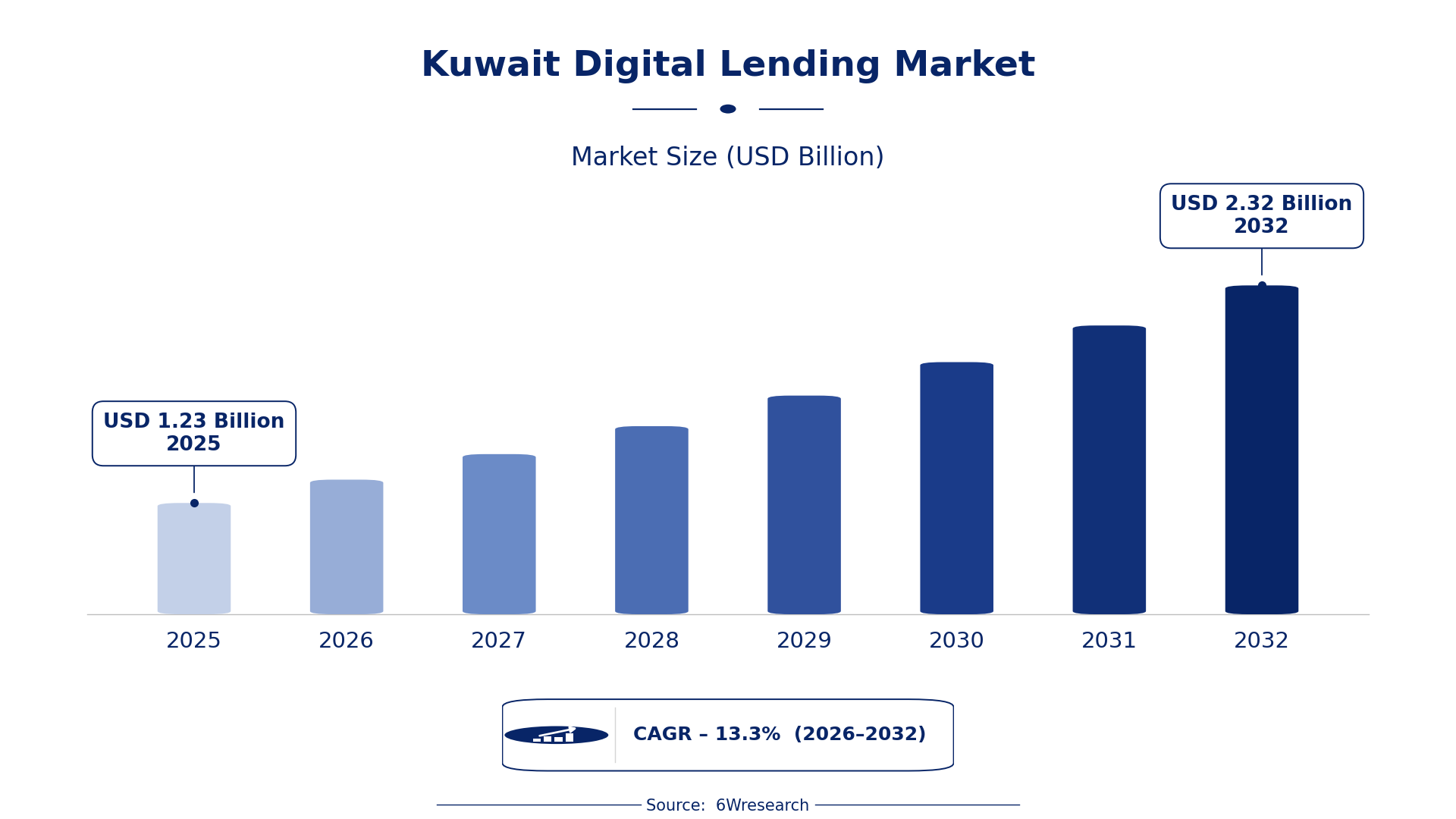
The Kuwait Digital Lending Market was estimated at USD 1233 Million in 2025 and is projected to reach USD 2318 Million by 2032, growing at a CAGR of 13.3% from 2026 to 2032.
Kuwait Digital Lending Market Synopsis
The surge in smartphone adoption is currently the most influential force shaping the Kuwait Digital Lending Market. With increasing numbers of consumers relying on mobile technology for their financial needs, digital lending platforms are rapidly gaining traction, offering convenient and user-friendly services.
As more Kuwaitis seek quick financial solutions, the demand for online lending options is intensifying. This shift is further supported by fintech innovations, which are streamlining processes and enhancing customer experiences across various lending services.
Kuwait Digital Lending Market Year-wise Growth Rate and Key Drivers
This graph illustrates the annual growth rates of the Kuwait Digital Lending Market from 2021 to 2032, highlighting a steady upward trajectory and projected expansion over the forecast period.
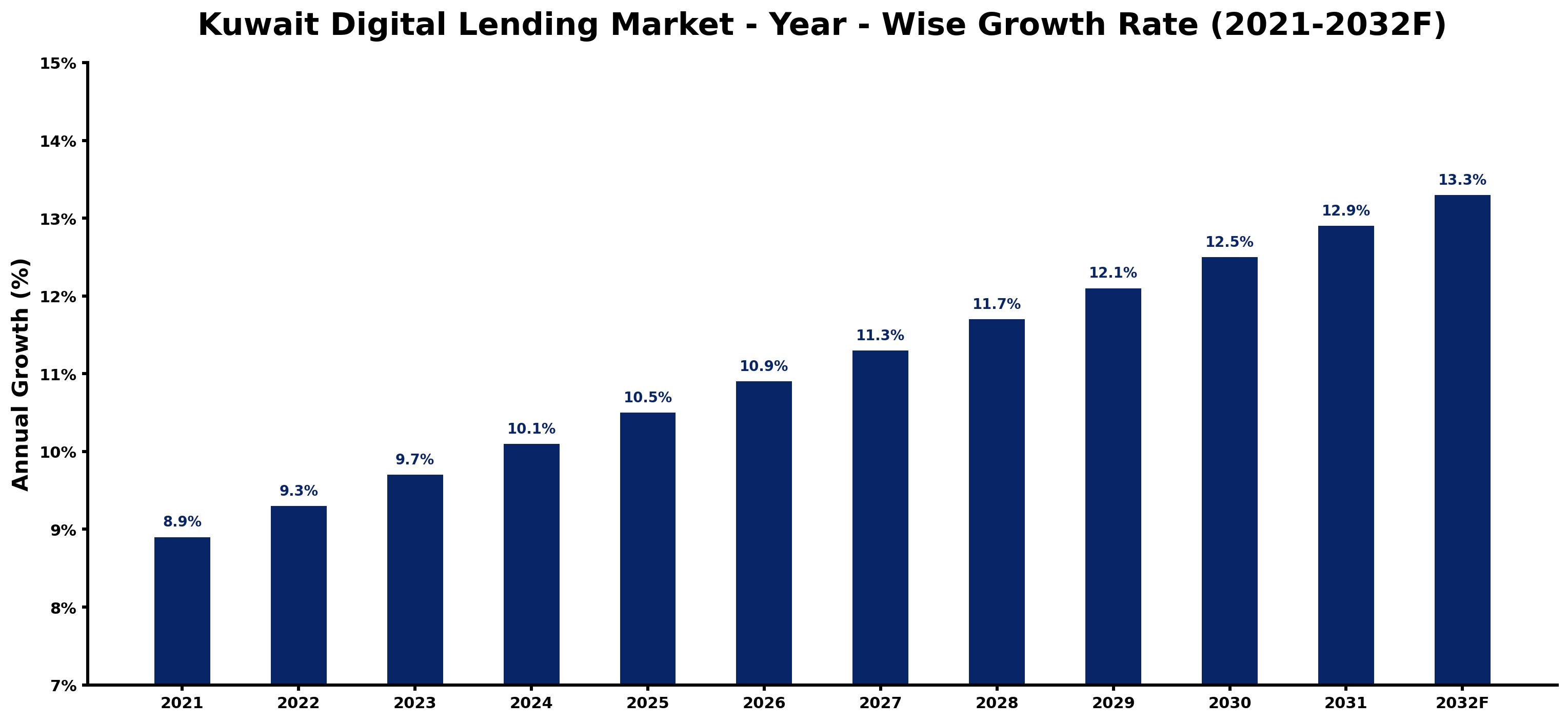
The table below presents the year‑wise growth rates along with the key drivers influencing the market
| Year | Growth Rate | Major Drivers |
| 2021 | 8.9% | Regulatory support from Central Bank of Kuwait initiatives |
| 2022 | 9.3% | Rising smartphone adoption boosting online lending platforms |
| 2023 | 9.7% | Increased demand for quick credit solutions among youth |
| 2024 | 10.1% | Government initiatives promoting fintech innovation and investment |
| 2025 | 10.5% | Rising e-commerce driving digital transaction growth |
| 2026 | 10.9% | Expanding fintech ecosystem attracting foreign investments |
| 2027 | 11.3% | Higher financial literacy increasing digital loan uptake |
| 2028 | 11.7% | Supportive legal framework for digital lending services |
| 2029 | 12.1% | Growing reliance on digital finance post-COVID-19 pandemic |
| 2030 | 12.5% | Emergence of local peer-to-peer lending platforms |
| 2031 | 12.9% | Institutional partnerships enhancing tech adoption in lending |
| 2032 | 13.3% | Increased customer trust in online financial services |
Note: Market size estimations and growth projections presented in this report are based on 6Wresearch's proprietary forecasting methodology, utilizing the latest available industry data, government publications, and primary research inputs.
Kuwait Digital Lending Market Key Takeaways
Below are some of the specific key takeaways from the market, including:
- Rapid growth driven by increased internet and smartphone penetration.
- Fintech startups are transforming the lending landscape with innovative solutions.
- Regulatory frameworks are evolving to support digital lending while ensuring consumer protection.
- Opportunities exist in underserved segments, particularly small businesses and individuals.
- Consumer preferences are shifting towards online platforms for borrowing needs.
Evaluation of Restraints in Kuwait Digital Lending Market
Despite its growth, the Kuwait Digital Lending Market faces considerable restraints. A primary concern is the lack of consumer awareness and trust regarding online lending platforms. Many potential borrowers remain hesitant, conditioned by long-standing relationships with traditional banks. Additionally, regulatory challenges can complicate entry for new players, as compliance with evolving laws requires significant resources. Limited credit information further hinders accurate risk assessments, making it difficult for lenders to extend credit to a broader audience.
Kuwait Digital Lending Market Trends
Several trends are currently shaping the Kuwait Digital Lending Market. The emergence of digital-only lenders is notable, providing faster loan approval processes that appeal to tech-savvy consumers. The integration of artificial intelligence in credit scoring is enhancing risk assessment capabilities, allowing lenders to make more informed decisions. on top of that, peer-to-peer lending platforms are gaining popularity, offering alternative funding sources for individuals and small businesses. These trends reflect a broader shift towards digitization in financial services.
Kuwait Digital Lending Market Opportunities
Opportunities for growth in the Kuwait Digital Lending Market are plentiful. One key area is the potential to serve underserved demographics, particularly small businesses and individuals with limited access to traditional banking services. Additionally, personalized loan products tailored to consumer needs can attract a wider customer base. Utilizing data analytics to improve customer experience and reduce default rates is also a promising avenue for lenders, as it allows for more precise targeting and service customization.
Government Initiatives in the Kuwait Digital Lending Market
The Kuwaiti government is actively shaping the Digital Lending Market through various regulatory and policy initiatives. By focusing on financial inclusion and consumer protection, authorities are creating a balanced environment for digital lenders to thrive. The government's commitment to digital transformation in the financial sector is crucial, as it encourages innovation while maintaining oversight to protect consumers.
- A regulatory framework established in 2025 mandates transparency in lending practices, enhancing consumer trust.
- Currently ongoing is a national initiative aimed at improving digital infrastructure, expected to facilitate better access to financial services.
- A planned public-private partnership is set to be introduced by 2027, aimed at expanding digital lending services to rural areas.
- The Central Bank of Kuwait has initiated a series of workshops to educate consumers about digital lending platforms, enhancing awareness and confidence.
- In 2026, a licensing program will launch to standardize operations among digital lenders, ensuring compliance with consumer protection laws.
Future Insights of the Kuwait Digital Lending Market
Looking ahead to 2026-2032, the Kuwait Digital Lending Market is set for remarkable expansion. The convergence of increasing internet access, a young tech-savvy population, and government support for digital financial services will drive growth. As consumer demand for efficient, accessible lending solutions rises, digital platforms will likely innovate further, enhancing their offerings. However, market participants must remain vigilant regarding regulatory changes and cybersecurity threats as they scale their operations.
Kuwait Digital Lending Market Latest Developments
Recent activity in the Kuwait Digital Lending Market reflects a dynamic shift towards more innovative solutions. Over the last year, numerous fintech firms have entered the market, introducing new products designed to meet the diverse needs of consumers. As digital adoption accelerates, these changes are indicative of a rapidly evolving financial ecosystem.
- A new mobile app was launched in early 2025, offering users streamlined access to personal loans with enhanced security features.
- In Q1 2026, a major technology vendor announced an ongoing partnership with local banks to integrate AI-based lending solutions.
- A service upgrade is currently underway, expected to enhance user experience by mid-2026, focusing on faster loan processing times.
- Planned for late 2026 is the rollout of a peer-to-peer lending platform, aimed at connecting individual investors with borrowers directly.
- A recent initiative began in early 2025 to educate small business owners about digital financing options, increasing awareness and usage.
Kuwait Digital Lending Market - Key Attractiveness of the Report
- 10 Years of Market Numbers
- Historical Data Starting from 2022 to 2025
- Base Year: 2025
- Forecast Data until 2032
- Key Performance Indicators Impacting the Market
- Major Upcoming Developments and Projects
Key Highlights of the Report:
- Kuwait Digital Lending Market Outlook
- Market Size of Kuwait Digital Lending Market, 2025
- Forecast of Kuwait Digital Lending Market, 2032
- Historical Data and Forecast of Kuwait Digital Lending Revenues & Volume for the Period 2022-2032F
- Kuwait Digital Lending Market Trend Evolution
- Kuwait Digital Lending Market Drivers and Challenges
- Kuwait Digital Lending Price Trends
- Kuwait Digital Lending Porter's Five Forces
- Kuwait Digital Lending Industry Life Cycle
- Historical Data and Forecast of Kuwait Digital Lending Market Revenues & Volume By Offering for the Period 2022-2032F
- Historical Data and Forecast of Kuwait Digital Lending Market Revenues & Volume By Solutions for the Period 2022-2032F
- Historical Data and Forecast of Kuwait Digital Lending Market Revenues & Volume By Services for the Period 2022-2032F
- Historical Data and Forecast of Kuwait Digital Lending Market Revenues & Volume By Deployment Mode for the Period 2022-2032F
- Historical Data and Forecast of Kuwait Digital Lending Market Revenues & Volume By Cloud for the Period 2022-2032F
- Historical Data and Forecast of Kuwait Digital Lending Market Revenues & Volume By On-premises for the Period 2022-2032F
- Historical Data and Forecast of Kuwait Digital Lending Market Revenues & Volume By End User for the Period 2022-2032F
- Historical Data and Forecast of Kuwait Digital Lending Market Revenues & Volume By Banks for the Period 2022-2032F
- Historical Data and Forecast of Kuwait Digital Lending Market Revenues & Volume By Credit Unions for the Period 2022-2032F
- Historical Data and Forecast of Kuwait Digital Lending Market Revenues & Volume By NBFCs for the Period 2022-2032F
- Kuwait Digital Lending Import Export Trade Statistics
- Market Opportunity Assessment By Offering
- Market Opportunity Assessment By Deployment Mode
- Market Opportunity Assessment By End User
- Kuwait Digital Lending Top Companies Market Share
- Kuwait Digital Lending Competitive Benchmarking By Technical and Operational Parameters
- Kuwait Digital Lending Company Profiles
- Kuwait Digital Lending Key Strategic Recommendations






































