Kuwait Whiskey Market Size, Share & Growth Rate
The Kuwait Whiskey Market was estimated at USD 1245 Million in 2025 and is projected to reach USD 2241 Million by 2032, growing at a CAGR of 8.8% from 2026 to 2032. This growth trajectory is primarily fueled by the burgeoning interest in premium whiskey brands among affluent consumers, alongside a gradual relaxation of traditional attitudes towards alcohol consumption. The black market has become a crucial component of the supply chain, catering to both expatriates and a select local demographic, indicating a latent demand that presents significant potential for stakeholders.
Kuwait Whiskey Market Year-wise Growth Rate and Key Drivers
This graph highlights how the Kuwait Whiskey Market has steadily grown over the years, supported by major growth factors.
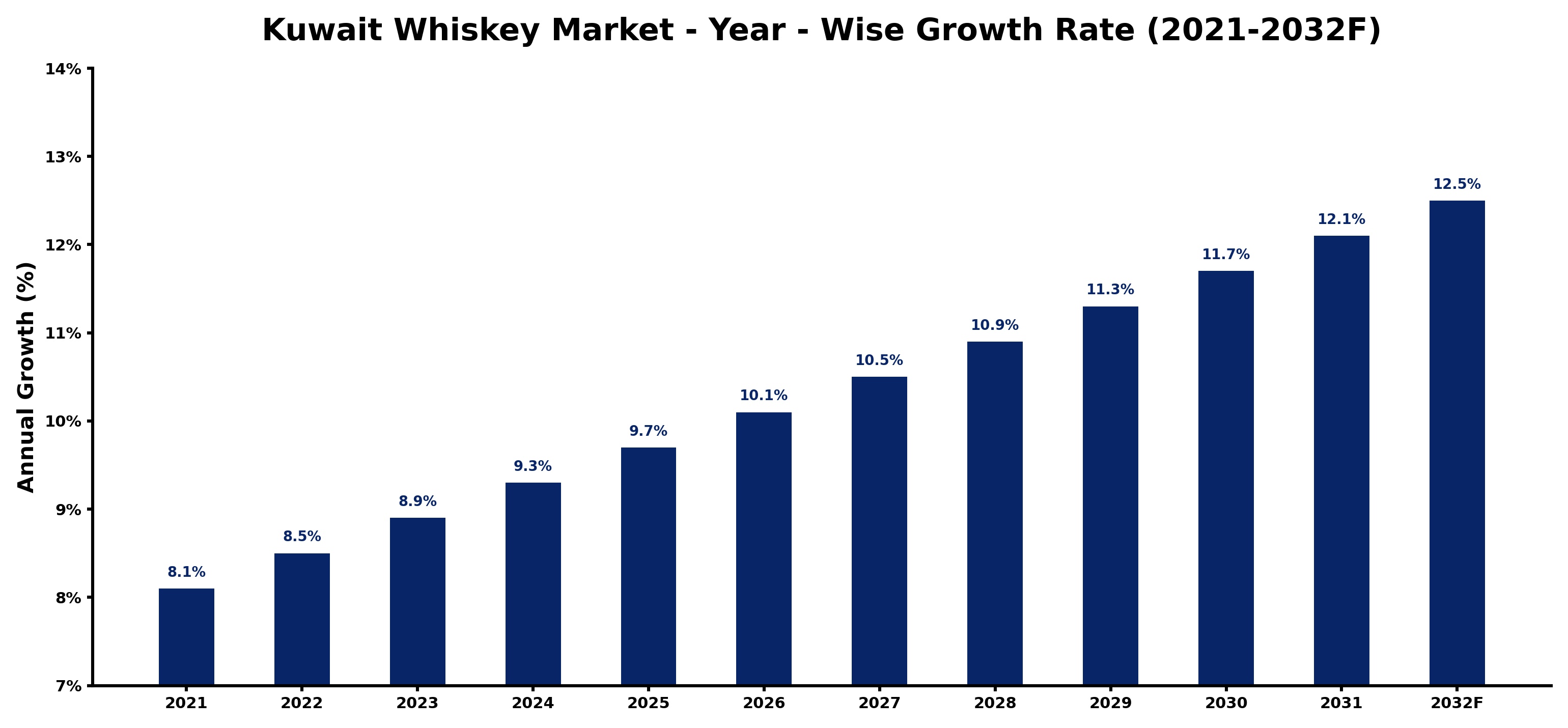
The table below presents the year‑wise growth rates along with the key drivers influencing the market
| Year | Growth Rate | Major Drivers |
| 2021 | 8.1% | Increased demand for premium whiskey |
| 2022 | 8.5% | Growing interest in whiskey cocktails |
| 2023 | 8.9% | Rise in whiskey tasting events |
| 2024 | 9.3% | Expansion of whiskey brands available |
| 2025 | 9.7% | Increased tourism driving whiskey sales |
| 2026 | 10.1% | Social media marketing effectiveness improved |
| 2027 | 10.5% | Whiskey education programs gaining popularity |
| 2028 | 10.9% | Craft whiskey distilleries emerging rapidly |
| 2029 | 11.3% | Online sales channels expanding significantly |
| 2030 | 11.7% | Whiskey festivals attracting larger crowds |
| 2031 | 12.1% | Collaborations with local bars increasing |
| 2032 | 12.5% | Innovative whiskey flavors capturing interest |
Note - Market size estimations and growth projections presented in this report are based on 6Wresearch’s advanced forecasting approach, validated with industry datasets as of June 2026.
Kuwait Whiskey Market Synopsis
Despite the stringent Islamic laws governing alcohol consumption, the Kuwait whiskey market has carved out a niche, largely driven by cultural shifts among its affluent class. With premium whiskey increasingly perceived as a symbol of status and sophistication, demand continues to grow, albeit within a challenging regulatory landscape.
The market is characterized by a dynamic interplay between established norms and evolving consumer behaviors. As expatriates and some locals seek premium whiskey options, suppliers find themselves navigating a complex web of legal restrictions and market opportunities, establishing a clandestine yet thriving scene that reflects broader global trends in alcohol consumption.
Kuwait Whiskey Market Key Takeaways
- The black market for whiskey represents a substantial opportunity, driven by high demand among expatriates and wealthy locals.
- Changing consumer tastes are shifting towards premium and high-end whiskey brands, enhancing market dynamism.
- Regulatory constraints impose challenges, yet they simultaneously shape the unique landscape of the whiskey market in Kuwait.
- As cultural attitudes evolve, the market is anticipated to see sustained growth, primarily among younger demographics.
- Whiskey is increasingly viewed as a status symbol, further propelling demand in affluent circles.
Evaluation of Restraints in Kuwait Whiskey Market
The main restraint impacting the Kuwait whiskey market is the strict legal framework surrounding alcohol sales. These regulations restrict availability, limiting distribution to licensed venues and creating an intricate web of compliance for suppliers. Furthermore, societal norms remain deeply rooted in Islamic principles, constraining the visibility and marketing of whiskey products. This environment fosters a reliance on the black market, which, while lucrative, brings inherent risks, including legal penalties and fluctuating prices that can deter potential investors.
Kuwait Whiskey Market Trends
A significant trend in the Kuwait whiskey market is the increasing acceptance of premium spirits among the younger affluent demographic, who are actively seeking brands that resonate with a modern, sophisticated lifestyle. Additionally, social gatherings and private events are gradually becoming venues for whiskey tasting, further embedding the drink into social rituals. Online platforms, although limited, are also beginning to serve as informal channels for distribution, indicating a potential shift in how whiskey is sourced and consumed within the confines of the law.
Kuwait Whiskey Market Opportunities
There is a distinct opportunity for whiskey brands to position themselves strategically within the expatriate community, which continues to grow in Kuwait. Establishing exclusive partnerships with licensed venues and leveraging social events can enhance visibility while adhering to regulations. Furthermore, as perceptions of whiskey evolve, brands that can articulate their identity as luxurious and sophisticated stand to gain substantial market share. Moreover, investments in discreet distribution channels could tap into the existing demand without attracting undue scrutiny.
Government Initiatives in the Kuwait Whiskey Market
The Kuwaiti government maintains a stringent stance on the sale and consumption of alcohol, including whiskey, with a focus on enforcing compliance with Islamic values. While public initiatives primarily emphasize cultural preservation, the government does recognize licensed establishments as essential for certain demographics, creating avenues for controlled sales. However, any significant relaxation of these policies remains unlikely given the strong cultural and religious opposition to alcohol consumption.
Future Insights of the Kuwait Whiskey Market
Looking ahead to 2026-2032, the Kuwait whiskey market is poised for gradual expansion driven by evolving cultural attitudes and a growing willingness among younger consumers to embrace premium brands. However, regulatory challenges will persist, necessitating strategic navigation of the legal landscape. As demand for sophisticated spirits continues to rise, the black market will likely adapt and innovate to meet consumer expectations, presenting both risks and opportunities for market players.
Kuwait Whiskey Market Latest Developments (May 2025 - June 2026)
Recent industry movements indicate a cautious but steady increase in the visibility of whiskey events, particularly among expatriate communities. Informal gatherings focusing on whiskey tasting and appreciation are becoming more prevalent, serving as both social outlets and niche market catalysts. Furthermore, there are ongoing discussions among stakeholders regarding the potential for more structured distribution frameworks that could enhance market accessibility without significantly altering current regulations.
Kuwait Whiskey Market - Key Attractiveness of the Report
- 10 Years of Market Numbers
- Historical Data Starting from 2022 to 2025
- Base Year: 2025
- Forecast Data until 2032
- Key Performance Indicators Impacting the Market
- Major Upcoming Developments and Projects
Key Highlights of the Report:
- Kuwait Whiskey Market Outlook
- Market Size of Kuwait Whiskey Market, 2025
- Forecast of Kuwait Whiskey Market, 2032
- Historical Data and Forecast of Kuwait Whiskey Revenues & Volume for the Period 2022-2032F
- Kuwait Whiskey Market Trend Evolution
- Kuwait Whiskey Market Drivers and Challenges
- Kuwait Whiskey Price Trends
- Kuwait Whiskey Porter's Five Forces
- Kuwait Whiskey Industry Life Cycle
- Historical Data and Forecast of Kuwait Whiskey Market Revenues & Volume By Product Type for the Period 2022-2032F
- Historical Data and Forecast of Kuwait Whiskey Market Revenues & Volume By American Whisky for the Period 2022-2032F
- Historical Data and Forecast of Kuwait Whiskey Market Revenues & Volume By Irish Whisky for the Period 2022-2032F
- Historical Data and Forecast of Kuwait Whiskey Market Revenues & Volume By Scotch Whisky for the Period 2022-2032F
- Historical Data and Forecast of Kuwait Whiskey Market Revenues & Volume By Canadian Whisky for the Period 2022-2032F
- Historical Data and Forecast of Kuwait Whiskey Market Revenues & Volume By Others for the Period 2022-2032F
- Historical Data and Forecast of Kuwait Whiskey Market Revenues & Volume By Distribution Channel for the Period 2022-2032F
- Historical Data and Forecast of Kuwait Whiskey Market Revenues & Volume By On-trade for the Period 2022-2032F
- Historical Data and Forecast of Kuwait Whiskey Market Revenues & Volume By Off-trade for the Period 2022-2032F
- Kuwait Whiskey Import Export Trade Statistics
- Market Opportunity Assessment By Product Type
- Market Opportunity Assessment By Distribution Channel
- Kuwait Whiskey Top Companies Market Share
- Kuwait Whiskey Competitive Benchmarking By Technical and Operational Parameters
- Kuwait Whiskey Company Profiles
- Kuwait Whiskey Key Strategic Recommendations






































