Malaysia Conductive Yarn Market Size, Share & Growth Rate
The Malaysia Conductive Yarn Market was estimated at USD 238 Million in 2025 and is projected to reach USD 310 Million by 2032, growing at a CAGR of 3.8% from 2026 to 2032. This growth trajectory is propelled by the rising demand for smart textiles and the integration of electronic components into everyday fabrics. As Malaysia strengthens its electronics industry, the convergence of technology and textiles is set to redefine the market landscape, opening new avenues for innovation and investment.
Malaysia Conductive Yarn Market Year-wise Growth Rate and Key Drivers
This graph highlights how the Malaysia Conductive Yarn Market has steadily grown over the years, supported by major growth factors.
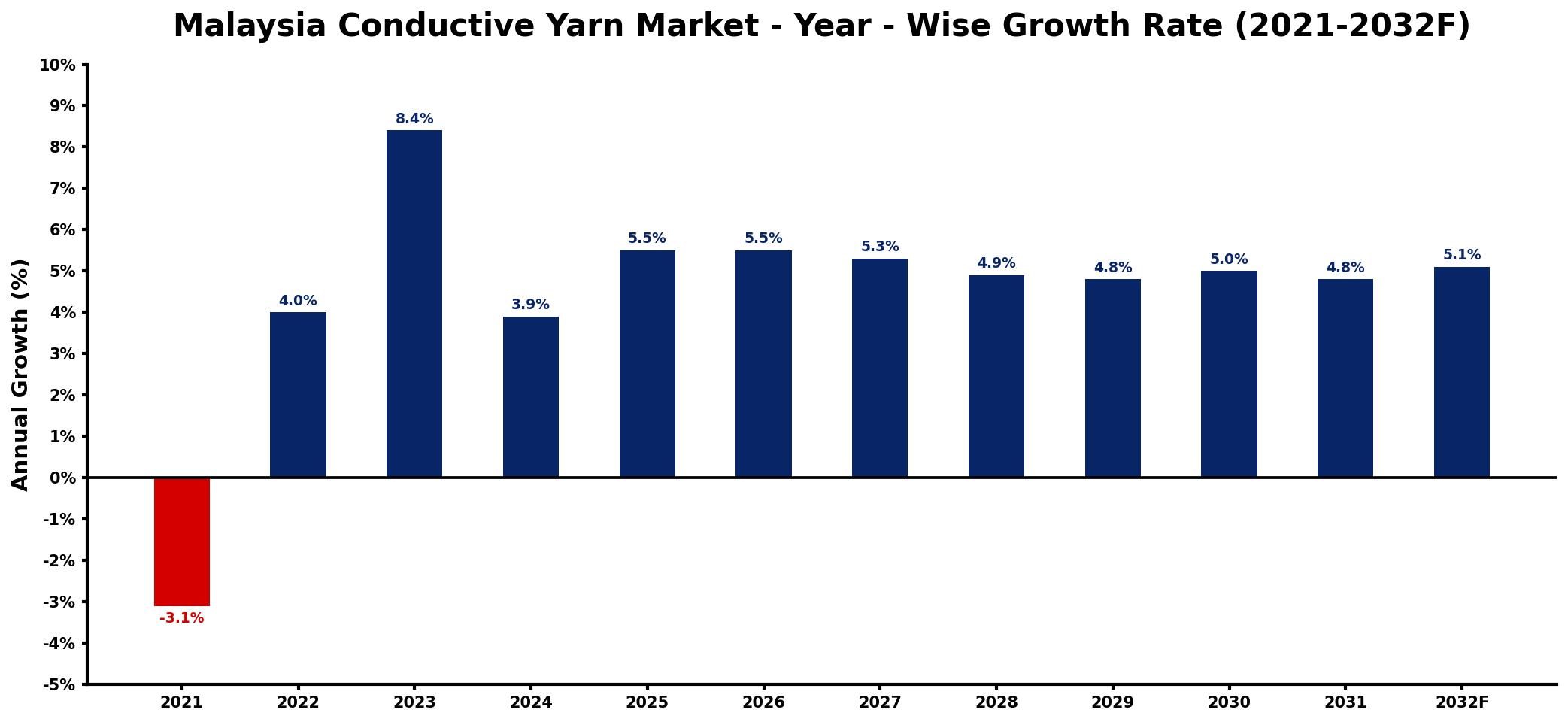
The table below presents the year‑wise growth rates along with the key drivers influencing the market
| Year | Growth Rate | Major Drivers |
| 2021 | -3.1% | decreased demand from textile sector |
| 2022 | 4.0% | increased investment in smart textiles |
| 2023 | 8.4% | growing interest in wearable technology |
| 2024 | 3.9% | expansion in electronic apparel market |
| 2025 | 5.5% | rising applications in healthcare textiles |
| 2026 | 5.5% | enhanced focus on sustainability practices |
| 2027 | 5.3% | growing collaborations with fashion brands |
| 2028 | 4.9% | increased consumer awareness on technology |
| 2029 | 4.8% | expansion of e-commerce platforms |
| 2030 | 5.0% | growing demand in automotive applications |
| 2031 | 4.8% | increased adoption in sportswear industry |
| 2032 | 5.1% | rising trends in fitness apparel |
Note: Market size estimations and growth projections presented in this report are based on 6Wresearch's proprietary forecasting methodology, utilizing the latest available industry data, government publications, and primary research inputs.
Malaysia Conductive Yarn Market Synopsis
In recent years, the Malaysia Conductive Yarn Market has gained significant traction, fueled by advancements in technology and the increasing demand for e-textiles across various industries. This momentum presents exciting opportunities, yet the market is on the cusp of a broader transformation as more sectors recognize the potential of conductive yarn in enhancing functionality.
Looking ahead, the market is expected to leverage Malaysias position as an emerging hub for innovative textile solutions. The versatility of conductive yarns offers immense potential in healthcare, sportswear, and fashion, suggesting that the market is not just poised for growth but is also evolving into a vital component of the smart textile ecosystem.
Malaysia Conductive Yarn Market Key Takeaways
- Strong growth potential as Malaysia integrates technology into textiles.
- Key applications span diverse sectors, from healthcare to fashion.
- Research and development are critical for improving yarn durability and conductivity.
- Leading companies in the market are focusing on innovative solutions and sustainable practices.
- The ongoing trend towards smart textiles indicates a promising outlook for the market.
Evaluation of Restraints in Malaysia Conductive Yarn Market
Despite the positive outlook, the Malaysia Conductive Yarn Market faces several restraints that could hinder its growth. One primary limitation is the ongoing need for extensive research and development, particularly in enhancing the durability and conductivity of yarns. Manufacturers are challenged to balance performance with affordability, which can slow down innovation. Furthermore, the initial investment for developing high-quality conductive textiles may deter smaller players from entering the market, leading to a concentration of advancements among a few established entities.
Malaysia Conductive Yarn Market Trends
Several current and emerging trends are shaping the demand for conductive yarns in Malaysia. The rise of wearable technology, especially in health monitoring devices, continues to drive innovation in e-textiles. Additionally, sustainability has become a key focus, with manufacturers exploring eco-friendly materials and production processes. The fashion industry is also embracing smart textiles, with designers increasingly incorporating conductive yarns to create interactive clothing. These trends underscore the dynamic nature of the market as it adapts to meet evolving consumer needs.
Malaysia Conductive Yarn Market Opportunities
The market presents numerous opportunities for growth and investment, particularly in niche applications within healthcare and fitness. The burgeoning interest in smart textiles opens doors for collaborations between technology developers and textile manufacturers. Additionally, as the global demand for sustainable products rises, companies that prioritize eco-friendly conductive yarn solutions may find themselves at a competitive advantage. The continuous advancement in wearable technology will further amplify the need for high-quality conductive yarns, making it a lucrative sector for innovation.
Government Initiatives in the Malaysia Conductive Yarn Market
The Malaysian government has recognized the importance of fostering growth in the textiles and technology sectors, initiating several policies aimed at promoting innovation. Public funding for research and development in smart textiles has increased, with an emphasis on integrating technology into traditional industries. Incentives for companies investing in sustainable practices are also part of the broader governmental strategy to position Malaysia as a leader in high-tech textiles.
Future Insights of the Malaysia Conductive Yarn Market
From 2026 to 2032, the Malaysia Conductive Yarn Market is expected to evolve significantly as advancements in technology continue to reshape the textiles landscape. The convergence of fashion, healthcare, and technology will drive new product innovations, while consumer demand for multi-functional textiles will accelerate the adoption of conductive yarns. As Malaysia solidifies its status as an innovation hub, ongoing investments in research and collaboration are likely to create a robust market environment ripe for growth.
Malaysia Conductive Yarn Market Latest Developments (2025 - 2026)
Recent industry developments suggest a strong push towards integrating advanced technologies within conductive yarn production. Companies are increasingly adopting smart manufacturing techniques and exploring partnerships to enhance their product offerings. The emphasis on sustainability remains a core focus, as manufacturers aim to balance performance with environmental responsibility. Furthermore, collaborations with tech firms are gaining momentum, setting the stage for innovative applications in healthcare and sportswear.
Malaysia Conductive Yarn Market - Key Attractiveness of the Report
- 10 Years of Market Numbers
- Historical Data Starting from 2022 to 2025
- Base Year: 2025
- Forecast Data until 2032
- Key Performance Indicators Impacting the Market
- Major Upcoming Developments and Projects
Key Highlights of the Report:
- Malaysia Conductive Yarn Market Outlook
- Market Size of Malaysia Conductive Yarn Market, 2025
- Forecast of Malaysia Conductive Yarn Market, 2032
- Historical Data and Forecast of Malaysia Conductive Yarn Revenues & Volume for the Period 2022-2032F
- Malaysia Conductive Yarn Market Trend Evolution
- Malaysia Conductive Yarn Market Drivers and Challenges
- Malaysia Conductive Yarn Price Trends
- Malaysia Conductive Yarn Porter's Five Forces
- Malaysia Conductive Yarn Industry Life Cycle
- Historical Data and Forecast of Malaysia Conductive Yarn Market Revenues & Volume By ProductType for the Period 2022-2032F
- Historical Data and Forecast of Malaysia Conductive Yarn Market Revenues & Volume By Metallic Type for the Period 2022-2032F
- Historical Data and Forecast of Malaysia Conductive Yarn Market Revenues & Volume By Carbon-Based Type for the Period 2022-2032F
- Historical Data and Forecast of Malaysia Conductive Yarn Market Revenues & Volume By Metal Compound Type for the Period 2022-2032F
- Historical Data and Forecast of Malaysia Conductive Yarn Market Revenues & Volume By Application for the Period 2022-2032F
- Historical Data and Forecast of Malaysia Conductive Yarn Market Revenues & Volume By Anti-Static Fabric for the Period 2022-2032F
- Historical Data and Forecast of Malaysia Conductive Yarn Market Revenues & Volume By Signal Transmission for the Period 2022-2032F
- Historical Data and Forecast of Malaysia Conductive Yarn Market Revenues & Volume By Cellphone Protective Cover for the Period 2022-2032F
- Malaysia Conductive Yarn Import Export Trade Statistics
- Market Opportunity Assessment By ProductType
- Market Opportunity Assessment By Application
- Malaysia Conductive Yarn Top Companies Market Share
- Malaysia Conductive Yarn Competitive Benchmarking By Technical and Operational Parameters
- Malaysia Conductive Yarn Company Profiles
- Malaysia Conductive Yarn Key Strategic Recommendations






































