Mexico Asphalt Market Summary
The mexico asphalt market was estimated at USD 146 Million in 2025 and is projected to reach USD 168 Million by 2032, growing at a CAGR of 0.9% from 2026 to 2032.
Mexico Asphalt Market Year-wise Growth Rate and Key Drivers
This graph highlights how the Mexico Asphalt Market has steadily grown over the past five years, supported by major growth factors.
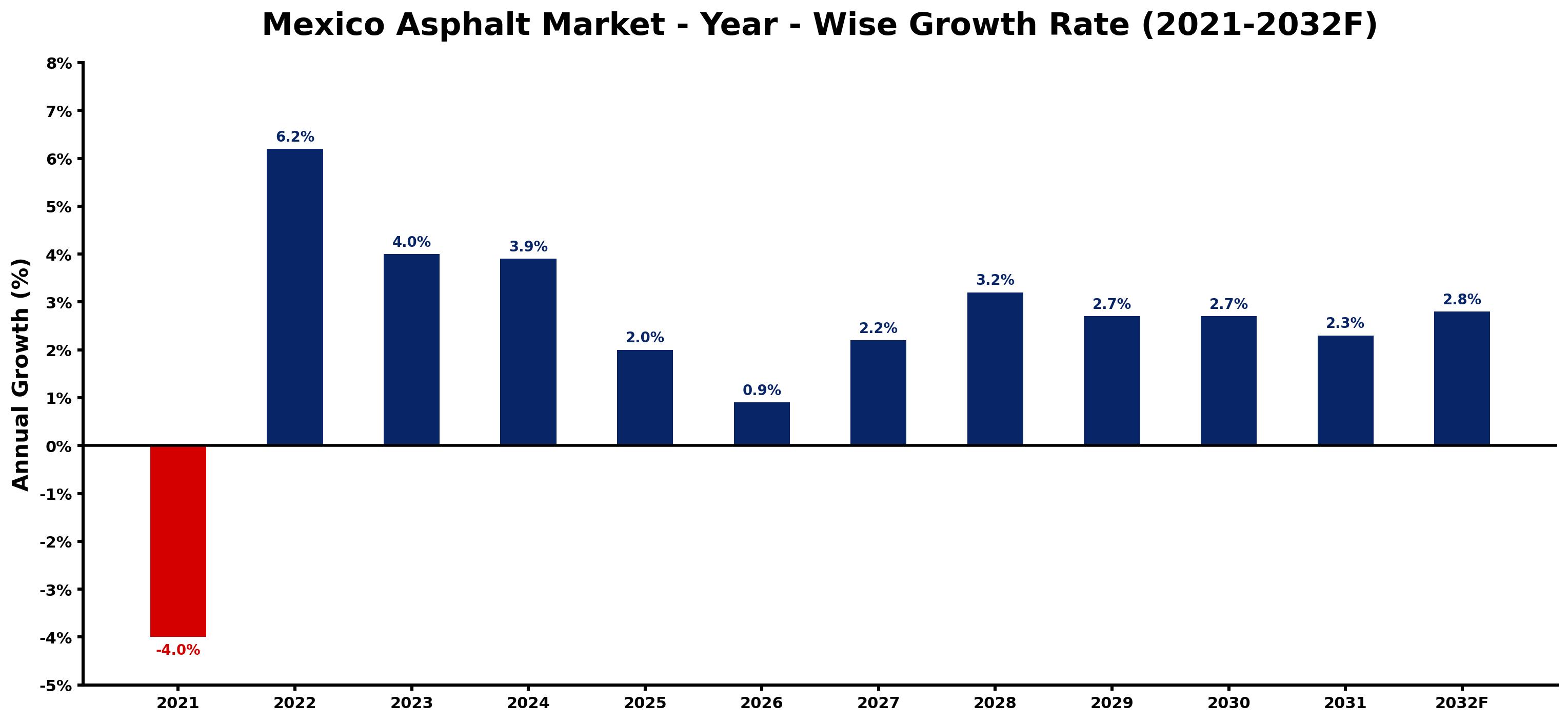
The table below presents the year wise growth rates along with the key drivers influencing the market
| Year | Growth Rate | Major Drivers |
| 2021 | -4.0% | Increased competition from alternative paving solutions diminished demand for traditional asphalt products in key infrastructure projects. |
| 2022 | 6.2% | Increased private investments in road construction enhance demand for high-quality asphalt solutions. |
| 2023 | 4.0% | A heightened emphasis on sustainable materials shapes asphalt production techniques in Mexico. |
| 2024 | 3.9% | The construction boom in tourism hotspots requires innovative asphalt applications for durability. |
| 2025 | 2.0% | Technological improvements in asphalt recycling methods support eco-friendly construction practices. |
| 2026 | 0.9% | Regional sourcing of raw materials leads to cost-effective asphalt production and supply chains. |
| 2027 | 2.2% | Expansion of logistics networks enhances the distribution efficiency of asphalt products nationwide. |
| 2028 | 3.2% | Emerging smart city projects necessitate advanced asphalt formulations for urban resilience. |
| 2029 | 2.7% | Collaboration between public and private sectors accelerates infrastructure investments in rural areas. |
| 2030 | 2.7% | Diverse climate conditions prompt tailored asphalt solutions for enhanced performance and longevity. |
| 2031 | 2.3% | Continued urbanization trends create sustained demand for asphalt in both residential and commercial projects. |
| 2032 | 2.8% | Growing focus on sustainability influences asphalt market dynamics towards environmental compliance standards. |
Note - Market size estimations and growth projections presented in this report are based on 6Wresearch's advanced forecasting approach, validated with industry datasets as of June 2026.
Mexico Asphalt Market Synopsis
The Mexico Asphalt Market is projected to reach 0.9% and witness significant growth during the forecast period (2026-2032). This growth is underpinned by the escalating demand for asphalt in the construction and maintenance of transportation infrastructure across the nation. The importance of asphalt as a fundamental material in road construction and highway development underscores its pivotal role in supporting Mexico's extensive infrastructure initiatives.
Mexico Asphalt Market Growth Drivers
A myriad of factors is driving the growth of the Mexico Asphalt Market. Primarily, the burgeoning construction industry plays a crucial role in amplifying the demand for asphalt products. As the country actively invests in enhancing its infrastructure, the following elements contribute to the accelerating market dynamics:
- The continuous expansion of road networks and highways necessitates the use of asphalt, ensuring safe and efficient transportation routes.
- Public and private construction projects increasingly require high-quality asphalt for durability and longevity in pavement solutions.
- The ongoing urbanization trends are prompting an increased need for road construction, thereby further amplifying the asphalt demand.
- Government initiatives focused on infrastructure upgrades are translating into more contracts for asphalt suppliers and contractors, driving market growth.
- Innovations in asphalt production techniques and materials are enhancing product quality and performance, making asphalt a preferred choice in construction projects.
Mexico Asphalt Market Challenges and Restraints
Despite the optimistic growth outlook, the Mexico Asphalt Market encounters several challenges that could hinder its advancement. One major issue is the volatility of crude oil prices. As asphalt is a byproduct derived from refining crude oil, fluctuations in oil prices can lead to unpredictable production costs, potentially disrupting market pricing and profitability. Additionally, environmental concerns are gaining prominence:
- Asphalt manufacturing poses significant environmental challenges, raising questions about the sustainability of using non-renewable resources.
- Increasing regulatory scrutiny around environmentally friendly practices demands adaptability in production processes within the asphalt industry.
- Public opposition to environmentally detrimental practices may lead to increased costs associated with compliance and adaptation to greener alternatives.
- The industry must innovate to mitigate the environmental impact of asphalt use, necessitating investment in research and development.
- Effectively addressing these sustainability concerns is critical for long-term growth and acceptance in the marketplace.
Mexico Asphalt Market Government Investment and Initiatives
The Mexican government plays a crucial role in fostering the development of the asphalt market through various investment initiatives and policy frameworks. Recognizing the essential nature of robust infrastructure for economic growth, the government has implemented policies that focus on:
- Stimulating public spending on infrastructure projects, thereby directly increasing demand for asphalt.
- Setting regulatory standards that ensure the quality of asphalt used in government-funded road construction projects, enhancing overall safety and durability.
- Encouraging sustainable construction practices, including the use of recycled materials in asphalt production, aligning with broader environmental goals.
- Facilitating partnerships between private enterprises and government agencies to attract investments in infrastructure development.
- Implementing strategic development plans that prioritize the upgrade and maintenance of aging road networks, further amplifying market potential.
Mexico Asphalt Market Latest Developments (May 2025 - June 2026)
Recent developments within the Mexico Asphalt Market between May 2025 and June 2026 indicate a transformative phase. Key observations during this period include:
- Increased collaboration between government entities and construction firms has fostered innovation in asphalt applications and formulations.
- Emerging technologies in asphalt recycling and environmentally friendly production methods have gained traction, responding to growing sustainability concerns.
- Market players have begun to adapt to regulatory changes aimed at lowering the environmental footprint of asphalt production processes.
- Investment in infrastructure has surged, with significant projects on highways and urban roads underway, driving asphalt demand significantly.
- Stakeholders across the supply chain are focusing on enhancing the supply chain resilience in light of global economic fluctuations affecting material costs.
Mexico Asphalt Market - Key Attractiveness of the Report
- 10 Years of Market Numbers
- Historical Data Starting from 2022 to 2025
- Base Year: 2025
- Forecast Data until 2032
- Key Performance Indicators Impacting the Market
- Major Upcoming Developments and Projects
Key Highlights of the Report:
- Mexico Asphalt Market Outlook
- Market Size of Mexico Asphalt Market, 2025
- Forecast of Mexico Asphalt Market, 2032
- Historical Data and Forecast of Mexico Asphalt Revenues & Volume for the Period 2022-2032F
- Mexico Asphalt Market Trend Evolution
- Mexico Asphalt Market Drivers and Challenges
- Mexico Asphalt Price Trends
- Mexico Asphalt Porter's Five Forces
- Mexico Asphalt Industry Life Cycle
- Historical Data and Forecast of Mexico Asphalt Market Revenues & Volume By Type for the Period 2022-2032F
- Historical Data and Forecast of Mexico Asphalt Market Revenues & Volume By Paving Petroleum Asphalt for the Period 2022-2032F
- Historical Data and Forecast of Mexico Asphalt Market Revenues & Volume By Industrial Petroleum Asphalt for the Period 2022-2032F
- Historical Data and Forecast of Mexico Asphalt Market Revenues & Volume By Others for the Period 2022-2032F
- Historical Data and Forecast of Mexico Asphalt Market Revenues & Volume By Application for the Period 2022-2032F
- Historical Data and Forecast of Mexico Asphalt Market Revenues & Volume By Paving for the Period 2022-2032F
- Historical Data and Forecast of Mexico Asphalt Market Revenues & Volume By Roofing for the Period 2022-2032F
- Historical Data and Forecast of Mexico Asphalt Market Revenues & Volume By Others for the Period 2022-2032F
- Mexico Asphalt Import Export Trade Statistics
- Market Opportunity Assessment By Type
- Market Opportunity Assessment By Application
- Mexico Asphalt Top Companies Market Share
- Mexico Asphalt Competitive Benchmarking By Technical and Operational Parameters
- Mexico Asphalt Company Profiles
- Mexico Asphalt Key Strategic Recommendations






































