Mexico Mass Spectrometry Market Size, Share & Growth Rate
The Mexico Mass Spectrometry Market was estimated at USD 129 Million in 2025 and is projected to reach USD 149 Million by 2032, growing at a CAGR of 2.1% from 2026 to 2032. This growth is fueled by a surge in applications across pharmaceuticals, biotechnology, and environmental testing, where precision and reliability are paramount. Additionally, supportive government initiatives aimed at bolstering healthcare infrastructure are creating a more conducive environment for market expansion.
Mexico Mass Spectrometry Market Year-wise Growth Rate and Key Drivers
This graph highlights how the Mexico Mass Spectrometry Market has steadily grown over the years, supported by major growth factors.
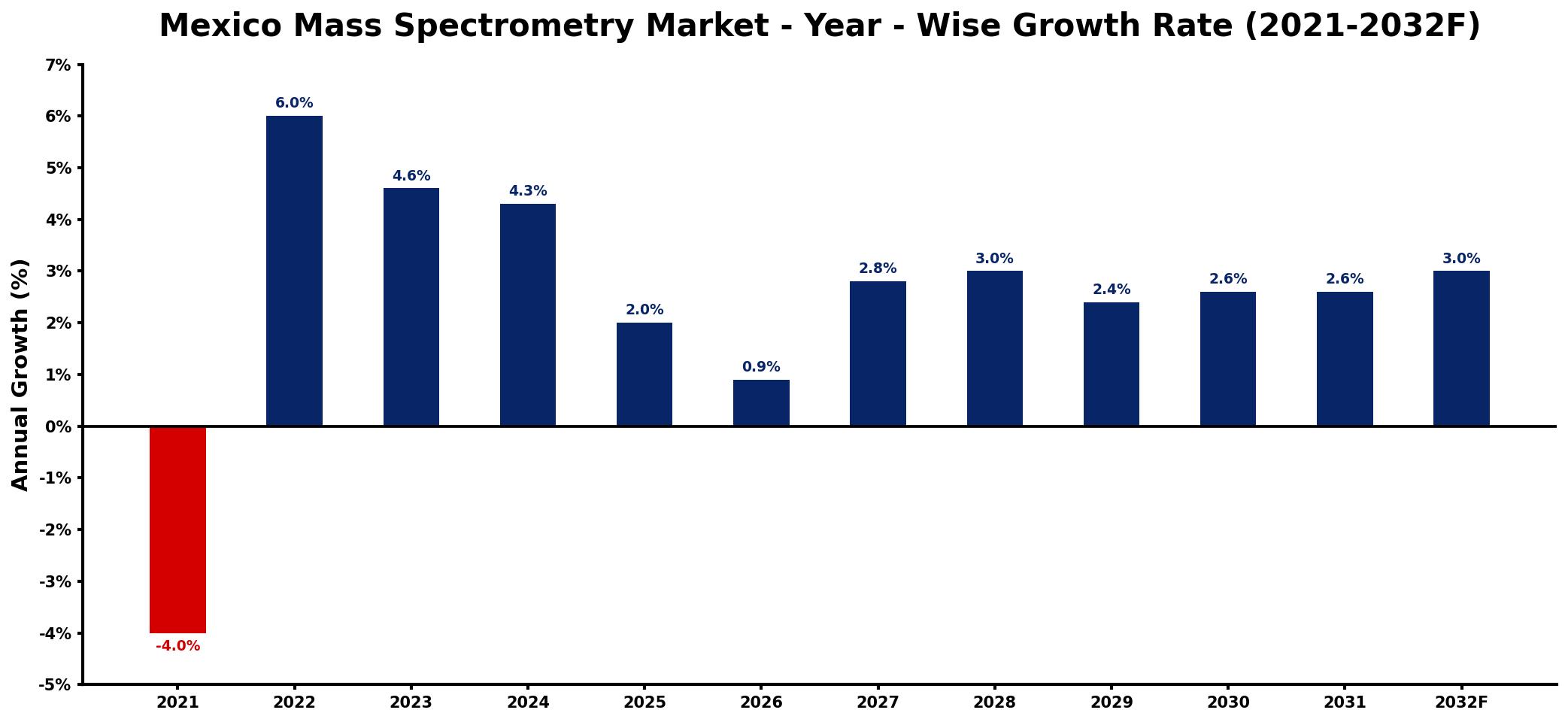
The table below presents the year‑wise growth rates along with the key drivers influencing the market
| Year | Growth Rate | Major Drivers |
| 2021 | -4.0% | decreased research funding availability |
| 2022 | 6.0% | increased pharmaceutical research investments |
| 2023 | 4.6% | growing environmental monitoring requirements |
| 2024 | 4.3% | expansion in clinical diagnostics sector |
| 2025 | 2.0% | rising demand from food safety |
| 2026 | 0.9% | enhanced biotechnology applications growth |
| 2027 | 2.8% | developing academic research initiatives |
| 2028 | 3.0% | surge in agricultural testing needs |
| 2029 | 2.4% | growing interest in personalized medicine |
| 2030 | 2.6% | advancements in analytical techniques adoption |
| 2031 | 2.6% | increased focus on regulatory compliance |
| 2032 | 3.0% | expansion of industrial quality control |
Note: Market size estimations and growth projections presented in this report are based on 6Wresearch's proprietary forecasting methodology, utilizing the latest available industry data, government publications, and primary research inputs.
Mexico Mass Spectrometry Market Synopsis
Recent momentum in the Mexico Mass Spectrometry Market has been notable, reflecting an increasing integration of advanced analytical techniques in various sectors. As we look ahead, the market is poised for sustained growth driven by technological innovations and a rising need for high-throughput analysis.
The pharmaceutical industry stands out as a key catalyst, emphasizing drug development and stringent quality control. Coupled with advancements in mass spectrometry technologies, the outlook remains optimistic, suggesting that the market will continue to evolve to meet the complex demands of various end-users.
Mexico Mass Spectrometry Market Key Takeaways
- The Mexico Mass Spectrometry Market is projected to grow steadily due to increasing adoption across multiple industries.
- Innovative technology advancements are driving demand for higher sensitivity, accuracy, and efficiency.
- Strategic collaborations between industry and academia are fostering research and development in this field.
- Investment in training and technical support services is essential to bridge the skills gap in mass spectrometry.
- Government policies are increasingly supporting market growth through regulatory frameworks and funding for research initiatives.
Evaluation of Restraints in Mexico Mass Spectrometry Market
Despite the growth trajectory, the Mexico Mass Spectrometry Market faces several constraints. A significant barrier is the high initial investment required for advanced mass spectrometry equipment, limiting access for smaller entities and academic institutions. Furthermore, the skill gap in the workforce, particularly concerning the operation and interpretation of mass spectrometry data, presents a challenge. The availability of technical support and maintenance services is also inadequate, potentially hindering equipment efficiency and impacting user confidence in adopting these technologies. Addressing these issues is vital for unlocking the full potential of the market.
Mexico Mass Spectrometry Market Trends
Several trends are currently shaping the Mexico Mass Spectrometry Market. Notably, there is an increasing shift towards automation and miniaturization of mass spectrometry systems, which allows for higher throughput and better efficiency. Additionally, advancements in instrument design, such as improvements in sensitivity and resolution, are gaining traction. The growing emphasis on environmental testing and food safety also drives the demand for sophisticated analytical tools, highlighting a broader application landscape beyond traditional pharmaceutical uses.
Mexico Mass Spectrometry Market Opportunities
Investment opportunities abound in the Mexico Mass Spectrometry Market, particularly given the expanding application range in sectors such as pharmaceuticals and environmental monitoring. Companies can capitalize on this growth by diversifying their product portfolios to meet varying industry needs. Forming strategic partnerships with research institutions and government agencies can also facilitate the development of innovative solutions tailored for drug discovery and clinical diagnostics. Furthermore, enhanced training programs and customer support services represent additional avenues for fostering loyalty and market penetration.
Government Initiatives in the Mexico Mass Spectrometry Market
The Mexican government plays a pivotal role in the growth of the Mass Spectrometry Market through various regulatory and support initiatives. Policies aimed at ensuring compliance with safety and quality standards for mass spectrometry equipment are in place. Additionally, the government promotes research and development through funding and grants to encourage innovation in analytical techniques. Import regulations are also strategically implemented to prevent counterfeiting and ensure that only reliable products enter the market, further enhancing consumer protection.
Future Insights of the Mexico Mass Spectrometry Market
Looking ahead to 2026-2032, the Mexico Mass Spectrometry Market is set to witness significant advancements. As the demand for personalized medicine increases, the necessity for precise analytical tools will become more pronounced, thereby driving market growth. Technological innovations are anticipated to enhance instrument performance in terms of speed, accuracy, and sensitivity. With the continued strengthening of Mexico's position in the Latin American analytical instrumentation landscape, the market is expected to embrace new developments and applications, paving the way for a bright future.
Mexico Mass Spectrometry Market Latest Developments (2025 - 2026)
In recent months, the Mexico Mass Spectrometry Market has seen noteworthy advancements, particularly in automation and integration with digital platforms. Research collaborations are on the rise, focusing on enhancing analytical techniques and their applications. Additionally, several initiatives aimed at improving technical training for professionals in the field are being implemented to address the skills gap and ensure a steady pipeline of talent for the future.
Mexico Mass Spectrometry Market - Key Attractiveness of the Report
- 10 Years of Market Numbers
- Historical Data Starting from 2022 to 2025
- Base Year: 2025
- Forecast Data until 2032
- Key Performance Indicators Impacting the Market
- Major Upcoming Developments and Projects
Key Highlights of the Report:
- Mexico Mass Spectrometry Market Outlook
- Market Size of Mexico Mass Spectrometry Market, 2025
- Forecast of Mexico Mass Spectrometry Market, 2032
- Historical Data and Forecast of Mexico Mass Spectrometry Revenues & Volume for the Period 2022-2032F
- Mexico Mass Spectrometry Market Trend Evolution
- Mexico Mass Spectrometry Market Drivers and Challenges
- Mexico Mass Spectrometry Price Trends
- Mexico Mass Spectrometry Porter's Five Forces
- Mexico Mass Spectrometry Industry Life Cycle
- Historical Data and Forecast of Mexico Mass Spectrometry Market Revenues & Volume By Technology for the Period 2022-2032F
- Historical Data and Forecast of Mexico Mass Spectrometry Market Revenues & Volume By Hybrid Mass Spectrometry for the Period 2022-2032F
- Historical Data and Forecast of Mexico Mass Spectrometry Market Revenues & Volume By Single Mass Spectrometry for the Period 2022-2032F
- Historical Data and Forecast of Mexico Mass Spectrometry Market Revenues & Volume By Application for the Period 2022-2032F
- Historical Data and Forecast of Mexico Mass Spectrometry Market Revenues & Volume By Pharmaceutical for the Period 2022-2032F
- Historical Data and Forecast of Mexico Mass Spectrometry Market Revenues & Volume By Biotechnology for the Period 2022-2032F
- Historical Data and Forecast of Mexico Mass Spectrometry Market Revenues & Volume By Security for the Period 2022-2032F
- Historical Data and Forecast of Mexico Mass Spectrometry Market Revenues & Volume By Industrial chemistry for the Period 2022-2032F
- Historical Data and Forecast of Mexico Mass Spectrometry Market Revenues & Volume By Environmental testing for the Period 2022-2032F
- Historical Data and Forecast of Mexico Mass Spectrometry Market Revenues & Volume By Food & beverage testing for the Period 2022-2032F
- Historical Data and Forecast of Mexico Mass Spectrometry Market Revenues & Volume By Forensic for the Period 2022-2032F
- Historical Data and Forecast of Mexico Mass Spectrometry Market Revenues & Volume By Clinical for the Period 2022-2032F
- Mexico Mass Spectrometry Import Export Trade Statistics
- Market Opportunity Assessment By Technology
- Market Opportunity Assessment By Application
- Mexico Mass Spectrometry Top Companies Market Share
- Mexico Mass Spectrometry Competitive Benchmarking By Technical and Operational Parameters
- Mexico Mass Spectrometry Company Profiles
- Mexico Mass Spectrometry Key Strategic Recommendations






































