Morocco Facade Market Size, Share & Growth Rate
The Morocco Facade Market was estimated at USD 231 Million in 2025 and is projected to reach USD 319 Million by 2032, growing at a CAGR of 4.7% from 2026 to 2032. This growth trajectory is underpinned by an upsurge in construction activities across diverse sectors, particularly commercial and residential, driven by urbanization and infrastructural development. The increasing demand for aesthetically appealing and energy-efficient solutions further propels the adoption of advanced facade systems in Morocco.
Morocco Facade Market Year-wise Growth Rate and Key Drivers
This graph highlights how the Morocco Facade Market has steadily grown over the years, supported by major growth factors.
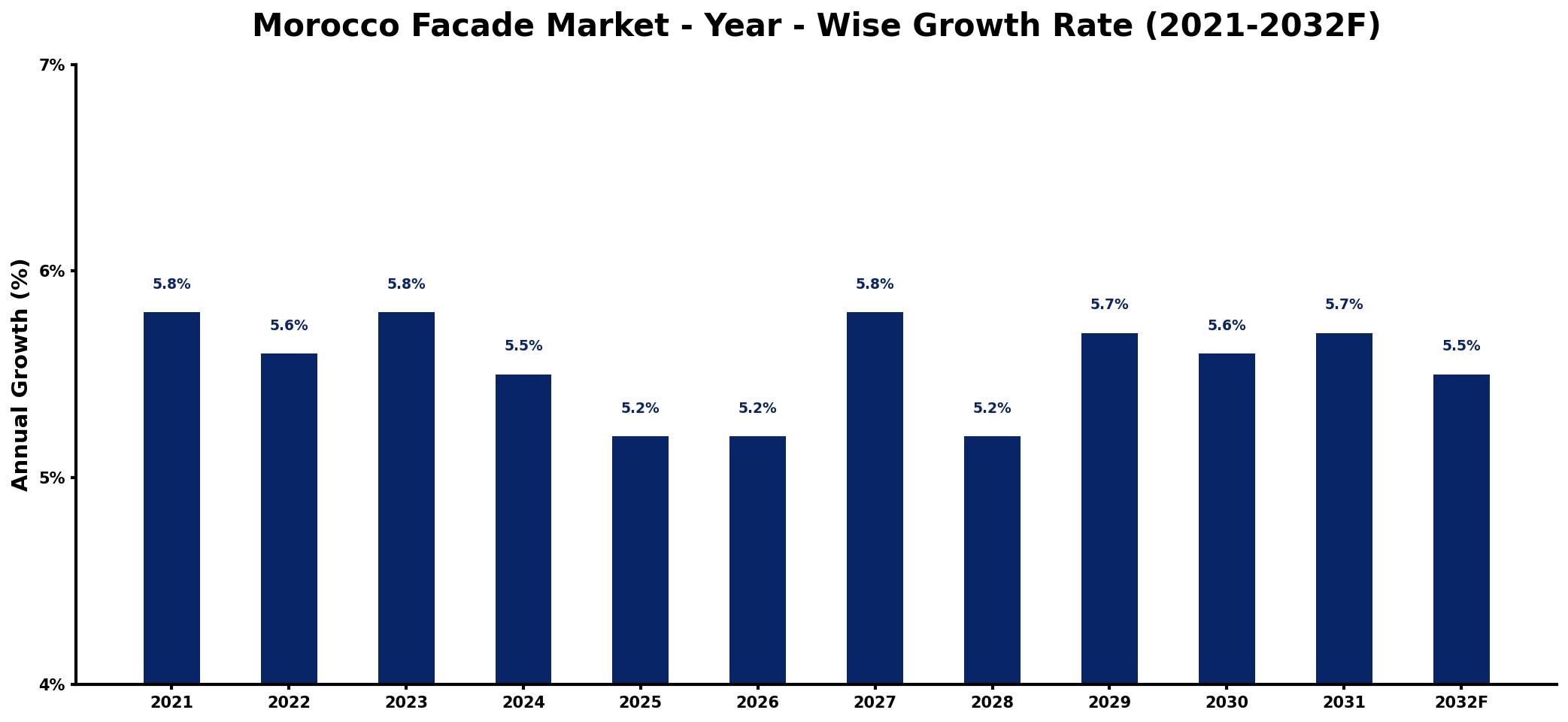
The table below presents the year‑wise growth rates along with the key drivers influencing the market
| Year | Growth Rate | Major Drivers |
| 2021 | 5.8% | Rising urban construction activities |
| 2022 | 5.6% | Increased demand for aesthetics |
| 2023 | 5.8% | Growing focus on sustainability |
| 2024 | 5.5% | Expansion of commercial projects |
| 2025 | 5.2% | Higher investment in infrastructure |
| 2026 | 5.2% | Development of green buildings |
| 2027 | 5.8% | Surge in residential projects |
| 2028 | 5.2% | Advancements in building technology |
| 2029 | 5.7% | Boost in renovation activities |
| 2030 | 5.6% | Growing awareness of energy efficiency |
| 2031 | 5.7% | Increased government construction initiatives |
| 2032 | 5.5% | rising export shipment volumes |
Note: Market size estimations and growth projections presented in this report are based on 6Wresearch's proprietary forecasting methodology, utilizing the latest available industry data, government publications, and primary research inputs.
Morocco Facade Market Synopsis
The Morocco facade market is currently witnessing a positive momentum, characterized by a shift toward sustainable and technologically advanced materials. This transition comes in response to the rising emphasis on energy efficiency and modern design aesthetics, aligning with global architectural trends.
As the market evolves, innovative facade solutions incorporating materials like glass, aluminum, and composite panels are gaining traction. Government policies promoting sustainable construction practices further cement the foundation for the market's growth, paving the way for new opportunities and advancements.
Morocco Facade Market Key Takeaways
- The market is projected to experience steady growth driven by increased urbanization and infrastructural development.
- There is a significant focus on energy-efficient and sustainable facade solutions, reflecting broader global trends.
- Innovative facade systems that combine functionality with aesthetics are becoming increasingly popular.
- Government initiatives supporting green construction practices are fostering market opportunities.
- The competitive landscape is intensifying, emphasizing the need for differentiation through technological advancements.
Evaluation of Restraints in Morocco Facade Market
Despite its promising trajectory, the Morocco facade market is facing several limitations. The absence of standardized regulations for facade construction often results in variability in quality and safety across different projects. Additionally, the market is grappling with a shortage of skilled labor and specialized professionals, which can hinder timely project completion and compromise overall quality. Furthermore, the presence of numerous local and international players intensifies competition, leading to pricing pressures that challenge profitability. Economic fluctuations and regional political instability also pose potential risks to sustained market growth.
Morocco Facade Market Trends
The prevailing trends in the Morocco facade market are indicative of a broader shift toward sustainable building practices. A growing preference for energy-efficient facades is driving demand for eco-friendly materials and innovative designs. Smart technologies, such as dynamic shading systems and smart glass, are also gaining popularity as they enhance energy efficiency and comfort in living spaces.
Additionally, prefabricated facade systems are becoming favored for their ability to reduce construction times and maintain high quality standards. This convergence of sustainability, aesthetics, and technology is reshaping the landscape of facade solutions in Morocco.
Morocco Facade Market Opportunities
Investment opportunities within the Morocco facade market are abundant, particularly due to the government's increasing focus on urban development and infrastructure projects. As the construction sector expands, there is a growing demand for modern and energy-efficient building solutions, creating a lucrative environment for investors looking to enter the facade materials market. Opportunities also exist in collaborating with local developers to leverage their knowledge and networks, thereby enhancing market penetration.
Government Initiatives in the Morocco Facade Market
Government policies in Morocco are strategically aligned with promoting sustainable and energy-efficient construction practices. Regulations mandate that new projects adhere to strict environmental standards, encouraging the use of eco-friendly materials and technologies. Furthermore, incentives such as tax breaks and subsidies are provided to developers integrating sustainable facades into their projects. Collaborative efforts with industry stakeholders are also underway to foster research and development of innovative facade solutions, aligning market growth with the countrys sustainability goals.
Future Insights of the Morocco Facade Market
Looking ahead to 2026-2032, the future of the Morocco facade market appears robust, driven by continued urbanization and infrastructure investment. The ongoing demand for advanced facade solutions is expected to amplify as the construction industry modernizes and incorporates innovative materials and technologies. Furthermore, government initiatives advocating for green building practices and renewable energy integration are anticipated to further accelerate market growth. With increasing attention to aesthetic appeal, functionality, and sustainability, the Morocco facade market is well-positioned for significant expansion.
Morocco Facade Market Latest Developments (2025 - 2026)
In recent months, the Morocco facade market has experienced notable developments focusing on sustainability and innovation. Industry stakeholders are actively exploring collaborations to enhance research and development of advanced facade solutions. Additionally, there is an uptick in projects emphasizing eco-friendly materials and energy-efficient technologies, responding to both market demand and regulatory requirements. The focus on integrating smart technology into facades is also gaining momentum, indicating a shift toward more technologically advanced construction practices.
Morocco Facade Market - Key Attractiveness of the Report
- 10 Years of Market Numbers
- Historical Data Starting from 2022 to 2025
- Base Year: 2025
- Forecast Data until 2032
- Key Performance Indicators Impacting the Market
- Major Upcoming Developments and Projects
Key Highlights of the Report:
- Morocco Facade Market Outlook
- Market Size of Morocco Facade Market, 2025
- Forecast of Morocco Facade Market, 2032
- Historical Data and Forecast of Morocco Facade Revenues & Volume for the Period 2022-2032F
- Morocco Facade Market Trend Evolution
- Morocco Facade Market Drivers and Challenges
- Morocco Facade Price Trends
- Morocco Facade Porter's Five Forces
- Morocco Facade Industry Life Cycle
- Historical Data and Forecast of Morocco Facade Market Revenues & Volume By Product for the Period 2022-2032F
- Historical Data and Forecast of Morocco Facade Market Revenues & Volume By Ventilated Facades for the Period 2022-2032F
- Historical Data and Forecast of Morocco Facade Market Revenues & Volume By Non-ventilated Facades for the Period 2022-2032F
- Historical Data and Forecast of Morocco Facade Market Revenues & Volume By Others for the Period 2022-2032F
- Historical Data and Forecast of Morocco Facade Market Revenues & Volume By End-use for the Period 2022-2032F
- Historical Data and Forecast of Morocco Facade Market Revenues & Volume By Commercial for the Period 2022-2032F
- Historical Data and Forecast of Morocco Facade Market Revenues & Volume By Residential for the Period 2022-2032F
- Historical Data and Forecast of Morocco Facade Market Revenues & Volume By Industrial for the Period 2022-2032F
- Morocco Facade Import Export Trade Statistics
- Market Opportunity Assessment By Product
- Market Opportunity Assessment By End-use
- Morocco Facade Top Companies Market Share
- Morocco Facade Competitive Benchmarking By Technical and Operational Parameters
- Morocco Facade Company Profiles
- Morocco Facade Key Strategic Recommendations






































