Nepal Telecom Services Market Size, Share & Growth Rate
The Nepal Telecom Services Market was estimated at USD 313 Million in 2025 and is projected to reach USD 430 Million by 2032, growing at a CAGR of 4.6% from 2026 to 2032. This growth is primarily driven by an increasing mobile penetration rate and a significant rise in demand for high-speed data services as the population becomes more digitally connected. Moreover, government initiatives aimed at improving infrastructure, particularly in rural areas, are playing a crucial role in propelling market expansion.
Nepal Telecom Services Market Year-wise Growth Rate and Key Drivers
This graph highlights how the Nepal Telecom Services Market has steadily grown over the years, supported by major growth factors.
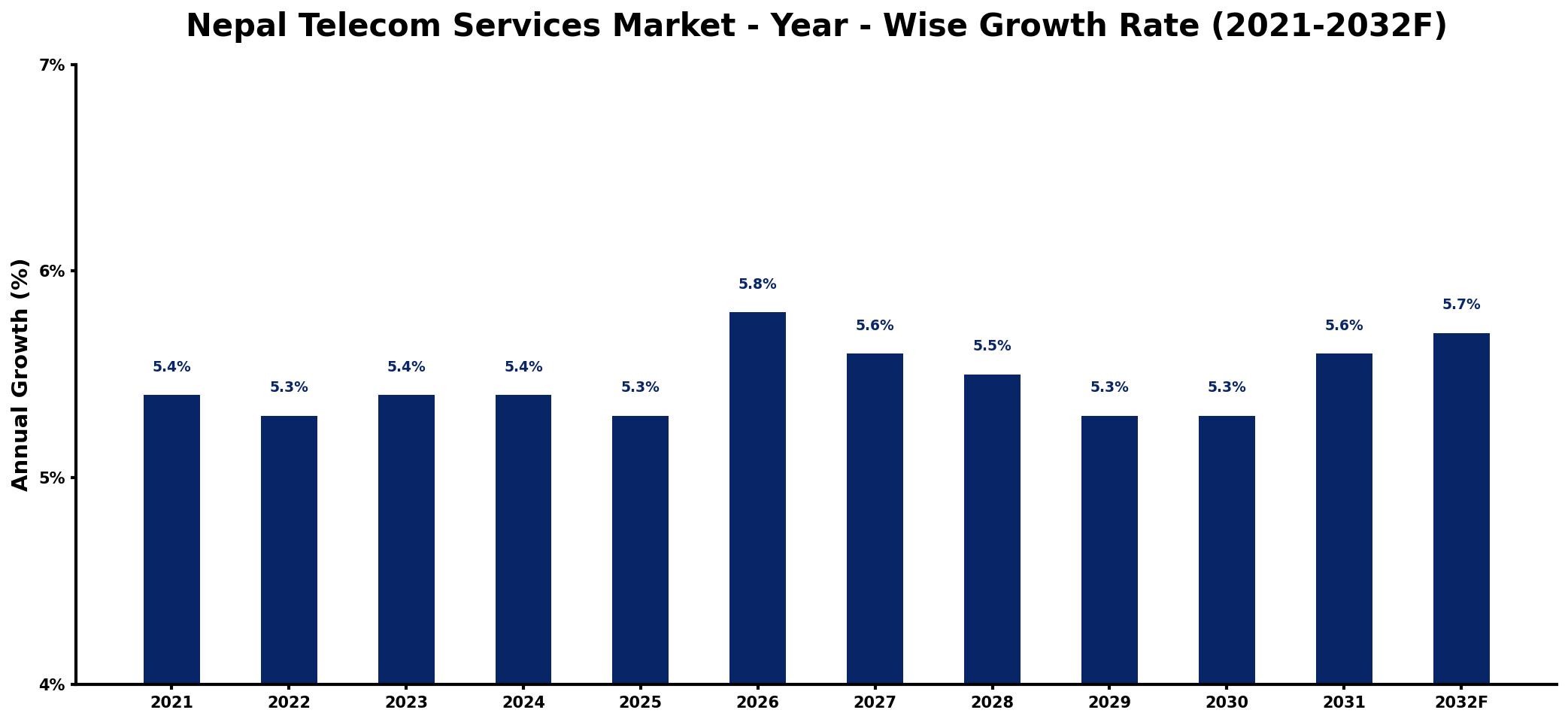
The table below presents the year‑wise growth rates along with the key drivers influencing the market
| Year | Growth Rate | Major Drivers |
| 2021 | 5.4% | increased smartphone penetration rates |
| 2022 | 5.3% | rising end-use demand growth |
| 2023 | 5.4% | expansion of mobile infrastructure |
| 2024 | 5.4% | rising urban population connectivity |
| 2025 | 5.3% | increased digital payment adoption |
| 2026 | 5.8% | growth in IoT applications |
| 2027 | 5.6% | strengthening international trade flows |
| 2028 | 5.5% | increased investment in technology |
| 2029 | 5.3% | growing interest in remote work |
| 2030 | 5.3% | rise of e-commerce platforms |
| 2031 | 5.6% | increased focus on cybersecurity |
| 2032 | 5.7% | growing demand for streaming content |
Note: Market size estimations and growth projections presented in this report are based on 6Wresearch's proprietary forecasting methodology, utilizing the latest available industry data, government publications, and primary research inputs.
Nepal Telecom Services Market Synopsis
Recent momentum in the Nepal Telecom Services Market indicates a surge in mobile and internet service demand, with consumers increasingly relying on digital platforms for communication and entertainment. However, the market is expected to shift towards higher competition and innovation as private players enter the space, prompting established operators to enhance their service offerings.
As telecom services evolve, operators must adapt to emerging consumer preferences, particularly in the areas of affordability and high-speed connectivity. This adaptation is vital for maintaining relevance in an increasingly competitive landscape, suggesting a transformative phase ahead for the Nepal Telecom Services Market.
Nepal Telecom Services Market Key Takeaways
- The Nepal Telecom Services Market is projected to grow significantly, driven by a rising demand for mobile and internet services.
- Government initiatives to improve broadband access are vital for fostering market expansion, especially in rural regions.
- Competition from private telecom operators is intensifying, leading to better pricing and service options for consumers.
- Technological advancements such as the rollout of 4G and upcoming 5G networks are expected to transform service delivery.
- Investment opportunities are emerging in areas like digital payments and IoT solutions, catering to a growing digital economy.
Evaluation of Restraints in Nepal Telecom Services Market
Despite its promising growth trajectory, the Nepal Telecom Services Market grapples with several constraints. A significant challenge is the limited infrastructure development, particularly in rural regions where geographic and topographic complexities hinder network expansion. Additionally, high service costs and variable internet speeds often deter potential customers from fully embracing telecom offerings. To overcome these limitations, substantial investment in infrastructure and regulatory reforms are essential for fostering a more robust and competitive market environment.
Nepal Telecom Services Market Trends
Current trends in the Nepal Telecom Services Market indicate a pronounced shift towards high-speed internet services, reflecting the growing adoption of smartphones and digital platforms. Additionally, there is a rising consumer preference for affordable pricing plans as competition intensifies among service providers. Furthermore, the integration of advanced technologies, such as 5G and IoT, is reshaping the market landscape, enhancing connectivity and fostering a more digitally oriented consumer base.
Nepal Telecom Services Market Opportunities
The evolving landscape of the Nepal Telecom Services Market offers ample opportunities for growth and investment. As the demand for internet and mobile services escalates, expanding broadband infrastructure presents a lucrative avenue for potential investors. Additionally, there is significant scope for value-added services, including digital payments and cloud computing solutions, which can meet the diverse needs of both consumers and businesses. Tapping into underserved rural markets through enhanced network coverage can also unveil new customer segments, paving the way for further development.
Government Initiatives in the Nepal Telecom Services Market
The Nepal government, through the Nepal Telecommunications Authority (NTA), actively regulates the telecom sector to ensure competitive practices and consumer protection. Various policies have been implemented to encourage competition, facilitate infrastructure development, and promote innovation across the industry. These initiatives include licensing multiple operators, regulating tariffs, and providing incentives aimed at expanding service access, especially in rural areas. Such measures are crucial for enhancing the overall service quality and reliability within the market.
Future Insights of the Nepal Telecom Services Market
Looking ahead to 2026-2032, the Nepal Telecom Services Market is set for considerable growth driven by increasing smartphone adoption and rising demand for digital services. The government's commitment to improving broadband infrastructure and its focus on promoting digitalization will encourage telecom operators to invest heavily in their networks. This will not only elevate service quality but also stimulate innovation as emerging technologies like 5G gain traction, positioning Nepal as a competitive player in the telecom landscape.
Nepal Telecom Services Market Latest Developments (2025 - 2026)
The Nepal Telecom Services Market has witnessed several strategic developments aimed at enhancing connectivity and expanding service offerings. Operators are increasingly focusing on upgrading existing infrastructures to accommodate growing consumer demands for high-speed internet. Additionally, there are ongoing discussions surrounding partnerships with technology firms to leverage innovative solutions in the market, further signaling a shift towards a more digital-centric telecom environment. These developments are pivotal in shaping the future of Nepal's telecom landscape.
Nepal Telecom Services Market - Key Attractiveness of the Report
- 10 Years of Market Numbers
- Historical Data Starting from 2022 to 2025
- Base Year: 2025
- Forecast Data until 2032
- Key Performance Indicators Impacting the Market
- Major Upcoming Developments and Projects
Key Highlights of the Report:
- Nepal Telecom Services Market Outlook
- Market Size of Nepal Telecom Services Market, 2025
- Forecast of Nepal Telecom Services Market, 2032
- Historical Data and Forecast of Nepal Telecom Services Revenues & Volume for the Period 2022-2032F
- Nepal Telecom Services Market Trend Evolution
- Nepal Telecom Services Market Drivers and Challenges
- Nepal Telecom Services Price Trends
- Nepal Telecom Services Porter's Five Forces
- Nepal Telecom Services Industry Life Cycle
- Historical Data and Forecast of Nepal Telecom Services Market Revenues & Volume By Service Type for the Period 2022-2032F
- Historical Data and Forecast of Nepal Telecom Services Market Revenues & Volume By Fixed Voice Services for the Period 2022-2032F
- Historical Data and Forecast of Nepal Telecom Services Market Revenues & Volume By Fixed Internet Access Services for the Period 2022-2032F
- Historical Data and Forecast of Nepal Telecom Services Market Revenues & Volume By Mobile Voice Services for the Period 2022-2032F
- Historical Data and Forecast of Nepal Telecom Services Market Revenues & Volume By Mobile Data Services for the Period 2022-2032F
- Historical Data and Forecast of Nepal Telecom Services Market Revenues & Volume By Pay-TV Services for the Period 2022-2032F
- Historical Data and Forecast of Nepal Telecom Services Market Revenues & Volume By Machine-to-Machine (Mobile IoT) Services for the Period 2022-2032F
- Historical Data and Forecast of Nepal Telecom Services Market Revenues & Volume By Transmission for the Period 2022-2032F
- Historical Data and Forecast of Nepal Telecom Services Market Revenues & Volume By Wireline for the Period 2022-2032F
- Historical Data and Forecast of Nepal Telecom Services Market Revenues & Volume By Wireless for the Period 2022-2032F
- Historical Data and Forecast of Nepal Telecom Services Market Revenues & Volume By End-use for the Period 2022-2032F
- Historical Data and Forecast of Nepal Telecom Services Market Revenues & Volume By Consumer/Residential for the Period 2022-2032F
- Historical Data and Forecast of Nepal Telecom Services Market Revenues & Volume By Business for the Period 2022-2032F
- Nepal Telecom Services Import Export Trade Statistics
- Market Opportunity Assessment By Service Type
- Market Opportunity Assessment By Transmission
- Market Opportunity Assessment By End-use
- Nepal Telecom Services Top Companies Market Share
- Nepal Telecom Services Competitive Benchmarking By Technical and Operational Parameters
- Nepal Telecom Services Company Profiles
- Nepal Telecom Services Key Strategic Recommendations






































