Nigeria Critical Infrastructure Protection Market Size & Growth Rate (2026-2032)
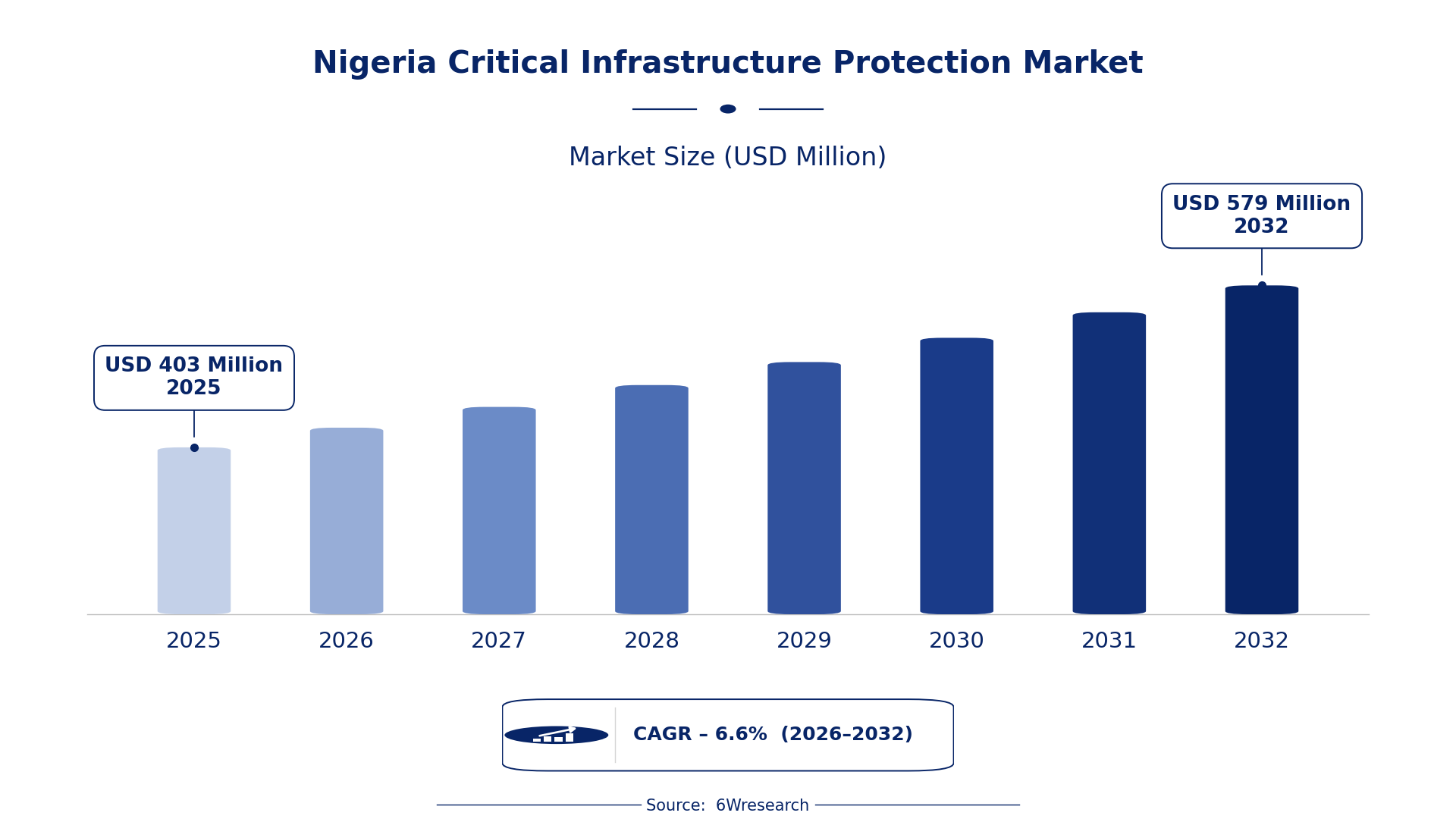
The Nigeria Critical Infrastructure Protection Market was estimated at USD 403 Million in 2025 and is projected to reach USD 579 Million by 2032, growing at a CAGR of 6.6% from 2026 to 2032.
Nigeria Critical Infrastructure Protection Market Synopsis
In Nigeria, the urgency to safeguard critical infrastructure is becoming apparent as threats from cyberattacks, physical violence, and natural disasters rise. With the economy increasingly reliant on technology, securing vital assets in sectors like energy, telecommunications, and transportation is no longer an option; it's a necessity.
This market is witnessing a collaborative approach between public and private sectors to enhance security measures. As infrastructure modernization accelerates, investments in advanced cybersecurity solutions, surveillance systems, and physical barriers are surging, reflecting a growing commitment to protecting Nigeria’s essential services and facilities.
Nigeria Critical Infrastructure Protection Market Year-wise Growth Rate and Key Drivers
This graph illustrates the annual growth rates of the Nigeria Critical Infrastructure Protection Market from 2021 to 2032, highlighting a steady upward trajectory and projected expansion over the forecast period.
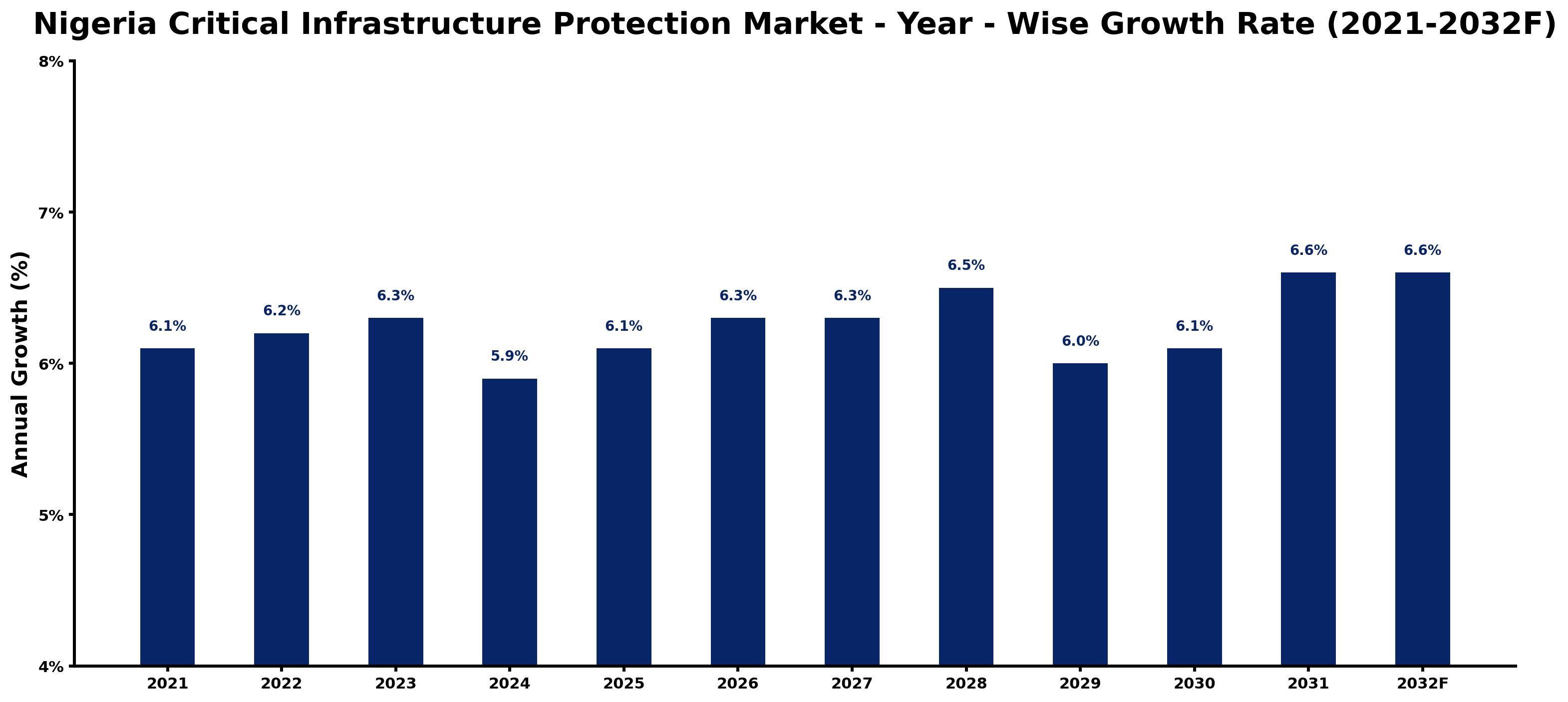
The table below presents the year‑wise growth rates along with the key drivers influencing the market
| Year | Growth Rate | Major Drivers |
| 2021 | 6.1% | Increased focus on cybersecurity by Nigerian government |
| 2022 | 6.2% | Implementation of National Cybersecurity Policy by NITDA |
| 2023 | 6.3% | Growing investments in public sector resilience initiatives |
| 2024 | 5.9% | Heightened security concerns from regional insurgency threats |
| 2025 | 6.1% | Enhanced collaboration with international security agencies |
| 2026 | 6.3% | Regulatory emphasis on safeguarding critical digital infrastructure |
| 2027 | 6.3% | Rising digital transformation in critical sectors driving demand |
| 2028 | 6.5% | Local adoption of advanced surveillance technologies for security |
| 2029 | 6.0% | Increasing awareness of infrastructure vulnerabilities among businesses |
| 2030 | 6.1% | Expanding training programs for cybersecurity professionals |
| 2031 | 6.6% | Strengthened legal frameworks for critical infrastructure protection |
| 2032 | 6.6% | Increased public-private partnerships in security technology deployment |
Note: Market size estimations and growth projections presented in this report are based on 6Wresearch's proprietary forecasting methodology, utilizing the latest available industry data, government publications, and primary research inputs.
Nigeria Critical Infrastructure Protection Market Key Takeaways
Below are some of the specific key takeaways from the market, including:
- Increasing threats are pushing organizations to adopt comprehensive security strategies.
- Investment in cybersecurity and physical security measures is on the rise across multiple sectors.
- Government policies are increasingly focused on enhancing the resilience of critical infrastructure.
- Adoption of advanced technologies like AI and biometrics is transforming threat detection capabilities.
- Partnerships between public and private entities are expected to strengthen security frameworks.
Evaluation of Restraints in Nigeria Critical Infrastructure Protection Market
Despite the evident growth potential, several restraints are hindering the progress of the Nigeria Critical Infrastructure Protection Market. Insufficient funding for modernizing existing infrastructure often leads to vulnerabilities. The acute shortage of skilled cybersecurity professionals exacerbates the problem, limiting the capability to address sophisticated cyber threats effectively. on top of that, regulatory frameworks are often inadequate, leaving gaps in enforcement and compliance, which could lead to increased risks. These challenges require targeted investments and strategic initiatives to build robust security systems.
Nigeria Critical Infrastructure Protection Market Trends
A noticeable trend in the Nigeria Critical Infrastructure Protection Market is the shift towards integrated security solutions that combine physical and cyber defenses. As organizations recognize the interconnectedness of threats, the deployment of converged security platforms is becoming more common. The use of AI-driven analytics, biometrics, and real-time monitoring systems is also gaining traction. This evolution allows for enhanced threat detection and quicker response times, aligning with the growing demand for sophisticated protection measures.
Nigeria Critical Infrastructure Protection Market Opportunities
There are compelling investment opportunities arising within this market, particularly in cybersecurity, physical security technologies, and emergency management services. The increasing demand for tailored security solutions opens avenues for innovative firms to provide comprehensive offerings designed specifically for Nigeria’s unique challenges. Collaborations with government agencies aiming to strengthen critical infrastructure present an additional layer of opportunity for savvy investors.
Government Initiatives in the Nigeria Critical Infrastructure Protection Market
Government initiatives are crucial for shaping the Nigeria Critical Infrastructure Protection Market. With a growing recognition of the threats posed to essential services, the Nigerian government has enacted several policies aimed at bolstering security. These efforts focus on enhancing resilience across critical sectors, fostering public-private partnerships, and ensuring compliance with evolving regulatory standards.
- A National Security Strategy (NSS) has been implemented to identify and address security threats to critical infrastructure.
- The National Critical Information Infrastructure Protection (NCIIP) framework is currently guiding efforts to secure key information systems.
- The Nigerian Cybercrime Act was established to combat cyber threats targeting critical assets and enforces penalties for offenders.
- Current initiatives include enhanced surveillance and access control measures being rolled out in major urban centers.
- A planned public-private initiative is expected to begin in late 2025, aiming to upgrade security across telecommunications infrastructures.
Future Insights of the Nigeria Critical Infrastructure Protection Market
Looking ahead to 2026-2032, the Nigeria Critical Infrastructure Protection Market is set for considerable expansion. Heightened concerns over cybersecurity and the increasing sophistication of threats will necessitate further investments in advanced protective measures. The government’s commitment to upgrading essential services aligns with the urgent need for comprehensive security solutions, suggesting a fertile ground for innovations that can address both existing and emerging threats.
Nigeria Critical Infrastructure Protection Market Latest Developments
In the past year, the Nigeria Critical Infrastructure Protection Market has seen a flurry of activity as organizations respond to escalating threats. Both public and private sectors are increasingly focused on fortifying their defenses, leading to a series of strategic initiatives and collaborations aimed at enhancing security protocols.
- A major technology vendor launched an advanced surveillance solution in Q2 2025, enhancing threat monitoring capabilities across urban infrastructures.
- A regional operator is currently underway with the deployment of a nationwide cybersecurity training program initiated in early 2025, addressing the skills gap in the market.
- A government-backed initiative aimed at increasing resilience in the energy sector is expected to begin in mid-2026, focusing on integrated security systems.
- A private firm recently completed a project to upgrade physical barriers at critical communication sites, enhancing their defenses against potential attacks.
- An upcoming regulatory framework set to be introduced in late 2026 will mandate stricter compliance measures for cybersecurity protocols in key sectors.
Nigeria Critical Infrastructure Protection Market - Key Attractiveness of the Report
- 10 Years of Market Numbers
- Historical Data Starting from 2022 to 2025
- Base Year: 2025
- Forecast Data until 2032
- Key Performance Indicators Impacting the Market
- Major Upcoming Developments and Projects
Opportunities exist in sectors such as cybersecurity, physical security technologies, and emergency management services, particularly tailored to Nigeria’s challenges.
Key Highlights of the Report:
- Nigeria Critical Infrastructure Protection Market Outlook
- Market Size of Nigeria Critical Infrastructure Protection Market, 2025
- Forecast of Nigeria Critical Infrastructure Protection Market, 2032
- Historical Data and Forecast of Nigeria Critical Infrastructure Protection Revenues & Volume for the Period 2022-2032F
- Nigeria Critical Infrastructure Protection Market Trend Evolution
- Nigeria Critical Infrastructure Protection Market Drivers and Challenges
- Nigeria Critical Infrastructure Protection Price Trends
- Nigeria Critical Infrastructure Protection Porter's Five Forces
- Nigeria Critical Infrastructure Protection Industry Life Cycle
- Historical Data and Forecast of Nigeria Critical Infrastructure Protection Market Revenues & Volume By Solution for the Period 2022-2032F
- Historical Data and Forecast of Nigeria Critical Infrastructure Protection Market Revenues & Volume By Physical Safety for the Period 2022-2032F
- Historical Data and Forecast of Nigeria Critical Infrastructure Protection Market Revenues & Volume By Security Video Surveillance Systems for the Period 2022-2032F
- Historical Data and Forecast of Nigeria Critical Infrastructure Protection Market Revenues & Volume By Screening for the Period 2022-2032F
- Historical Data and Forecast of Nigeria Critical Infrastructure Protection Market Revenues & Volume By Scanning for the Period 2022-2032F
- Historical Data and Forecast of Nigeria Critical Infrastructure Protection Market Revenues & Volume By Cybersecurity for the Period 2022-2032F
- Historical Data and Forecast of Nigeria Critical Infrastructure Protection Market Revenues & Volume By Encryption for the Period 2022-2032F
- Historical Data and Forecast of Nigeria Critical Infrastructure Protection Market Revenues & Volume By Threat Intelligence for the Period 2022-2032F
- Historical Data and Forecast of Nigeria Critical Infrastructure Protection Market Revenues & Volume By Component for the Period 2022-2032F
- Historical Data and Forecast of Nigeria Critical Infrastructure Protection Market Revenues & Volume By Solution for the Period 2022-2032F
- Historical Data and Forecast of Nigeria Critical Infrastructure Protection Market Revenues & Volume By Services for the Period 2022-2032F
- Historical Data and Forecast of Nigeria Critical Infrastructure Protection Market Revenues & Volume By Vertical for the Period 2022-2032F
- Historical Data and Forecast of Nigeria Critical Infrastructure Protection Market Revenues & Volume By Financial Institutions for the Period 2022-2032F
- Historical Data and Forecast of Nigeria Critical Infrastructure Protection Market Revenues & Volume By Government for the Period 2022-2032F
- Historical Data and Forecast of Nigeria Critical Infrastructure Protection Market Revenues & Volume By Defense for the Period 2022-2032F
- Historical Data and Forecast of Nigeria Critical Infrastructure Protection Market Revenues & Volume By Transport and Logistics for the Period 2022-2032F
- Historical Data and Forecast of Nigeria Critical Infrastructure Protection Market Revenues & Volume By Energy and Power for the Period 2022-2032F
- Historical Data and Forecast of Nigeria Critical Infrastructure Protection Market Revenues & Volume By Commercial Sector for the Period 2022-2032F
- Historical Data and Forecast of Nigeria Critical Infrastructure Protection Market Revenues & Volume By Telecom for the Period 2022-2032F
- Historical Data and Forecast of Nigeria Critical Infrastructure Protection Market Revenues & Volume By Chemicals and Manufacturing for the Period 2022-2032F
- Nigeria Critical Infrastructure Protection Import Export Trade Statistics
- Market Opportunity Assessment By Solution
- Market Opportunity Assessment By Cybersecurity
- Market Opportunity Assessment By Component
- Market Opportunity Assessment By Vertical
- Nigeria Critical Infrastructure Protection Top Companies Market Share
- Nigeria Critical Infrastructure Protection Competitive Benchmarking By Technical and Operational Parameters
- Nigeria Critical Infrastructure Protection Company Profiles
- Nigeria Critical Infrastructure Protection Key Strategic Recommendations






































