Nigeria Industrial Machinery Market Size, Share & Growth Rate
The Nigeria Industrial Machinery Market was estimated at USD 146 Million in 2025 and is projected to reach USD 160 Million by 2032, growing at a CAGR of 1.3% from 2026 to 2032. This growth trajectory is largely propelled by Nigeria's increasing investments in key industrial sectors, particularly agriculture, manufacturing, and construction. The push for modernization and efficiency in production processes is driving demand for advanced machinery, particularly as industries adopt automation and smart technologies.
Nigeria Industrial Machinery Market Year-wise Growth Rate and Key Drivers
This graph highlights how the Nigeria Industrial Machinery Market has steadily grown over the years, supported by major growth factors.
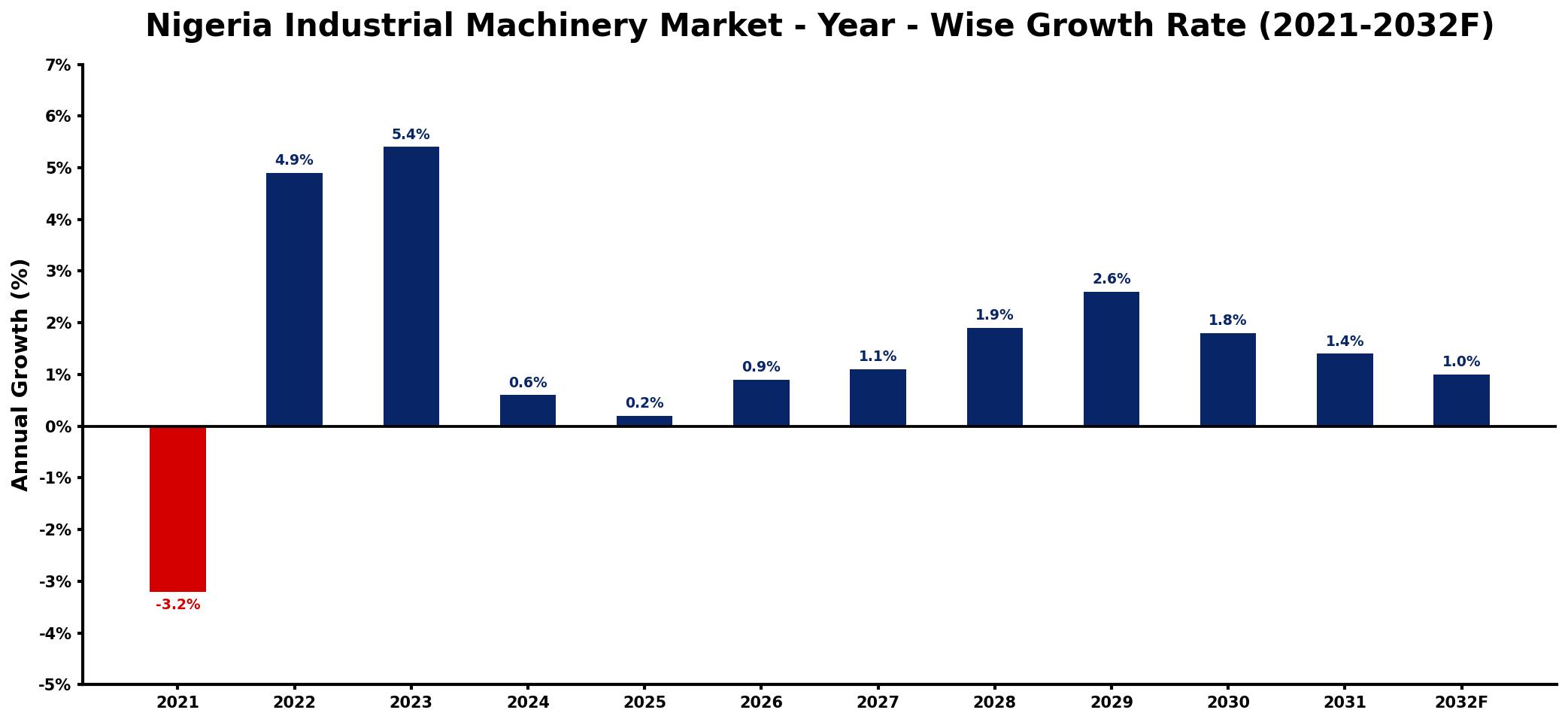
The table below presents the year‑wise growth rates along with the key drivers influencing the market
| Year | Growth Rate | Major Drivers |
| 2021 | -3.2% | decrease in construction projects |
| 2022 | 4.9% | growth in manufacturing capacity |
| 2023 | 5.4% | expansion of energy sector |
| 2024 | 0.6% | rise in agricultural investments |
| 2025 | 0.2% | increased infrastructure development plans |
| 2026 | 0.9% | boost in foreign investments |
| 2027 | 1.1% | enhancement of logistics networks |
| 2028 | 1.9% | surge in technology adoption |
| 2029 | 2.6% | stronger distribution network expansion |
| 2030 | 1.8% | development of renewable energy |
| 2031 | 1.4% | rising infrastructure development spending |
| 2032 | 1.0% | increase in skilled workforce availability |
Note: Market size estimations and growth projections presented in this report are based on 6Wresearch's proprietary forecasting methodology, utilizing the latest available industry data, government publications, and primary research inputs.
Nigeria Industrial Machinery Market Synopsis
As Nigeria continues to develop its industrial landscape, the demand for industrial machinery is becoming increasingly pronounced. The market is responding to a clear shift toward productivity enhancements and cost-efficiency through technological advancements, including automation and smart solutions. This transition is reshaping operational practices across various industries.
However, the sector faces certain headwinds, notably regarding financing and operational costs. Despite these challenges, the general outlook remains optimistic, with significant opportunities arising from government policies aimed at promoting local production and assembly of machinery.
Nigeria Industrial Machinery Market Key Takeaways
- The market is on a steady growth path driven by investments in industrial facilities and technological advancements.
- Government incentives are fostering local production, which is anticipated to enhance the overall competitiveness of the market.
- Automated machinery is increasingly being adopted to improve production efficiency and reduce costs.
- Challenges related to financing and high import duties continue to impact the market dynamics.
- The growth in key sectors like agriculture and manufacturing further supports the expansion of the machinery market.
Evaluation of Restraints in Nigeria Industrial Machinery Market
Despite the promising growth prospects, the Nigeria Industrial Machinery Market grapples with several restraints. Chief among these are the inadequate financing options available to businesses aiming to upgrade their machinery. This lack of access to capital limits the ability of industrialists to invest in modern equipment, hindering overall market growth. Additionally, the high import duties imposed on machinery and delays in customs clearance further inflate operational costs, making it challenging for companies to remain competitive in an evolving market landscape.
Nigeria Industrial Machinery Market Trends
Current trends in the Nigeria Industrial Machinery Market indicate a significant shift towards automation. Many companies are actively seeking to leverage smart technologies to enhance efficiency and productivity. There is also a growing focus on the local assembly of machinery, spurred by government incentives aimed at boosting the manufacturing sector. Furthermore, sustainability practices are gaining traction, with industries exploring energy-efficient machinery and practices as part of their operational strategies.
Nigeria Industrial Machinery Market Opportunities
Opportunities abound in the Nigeria Industrial Machinery Market, particularly in sectors that require modernization and increased efficiency. As Nigeria's manufacturing and agricultural sectors continue to expand, there is a burgeoning demand for advanced machinery that can facilitate production goals. The ongoing government initiatives to support local assembly and manufacturing of machinery provide fertile ground for investment. Companies that can navigate the challenges of financing and operational costs stand to gain significantly in this evolving landscape.
Government Initiatives in the Nigeria Industrial Machinery Market
The Nigerian government is actively promoting policies designed to bolster the industrial machinery market. These include tax incentives for local production and assembly, aimed at reducing reliance on imports and fostering homegrown manufacturing capabilities. Additionally, the government is working towards establishing standards and certification requirements to ensure the quality and safety of industrial machinery, which is crucial for building investor confidence and enhancing overall market integrity.
Future Insights of the Nigeria Industrial Machinery Market
Looking ahead to 2026-2032, the Nigeria Industrial Machinery Market is expected to experience gradual but steady growth. As technological advancements continue to penetrate various sectors, the adoption of automated and smart machinery will become increasingly prevalent. The emphasis on local manufacturing, supported by government initiatives, will likely catalyze market expansion, while strategic investments in infrastructure will bolster overall industrial output. Companies that align their strategies with these trends are poised to thrive in the burgeoning landscape.
Nigeria Industrial Machinery Market Latest Developments (2025 - 2026)
Recent developments in the Nigeria Industrial Machinery Market indicate a heightened focus on local manufacturing capabilities. Various industries are exploring partnerships to enhance their machinery assembly processes, reflecting a commitment to reducing import reliance. Moreover, technological innovation is being prioritized, with an emphasis on integrating smart solutions into existing production lines. These movements signal a robust adaptation to the changing dynamics of global supply chains and operational efficiency.
Nigeria Industrial Machinery Market - Key Attractiveness of the Report
- 10 Years of Market Numbers
- Historical Data Starting from 2022 to 2025
- Base Year: 2025
- Forecast Data until 2032
- Key Performance Indicators Impacting the Market
- Major Upcoming Developments and Projects
Key Highlights of the Report:
- Nigeria Industrial Machinery Market Outlook
- Market Size of Nigeria Industrial Machinery Market, 2025
- Forecast of Nigeria Industrial Machinery Market, 2032
- Historical Data and Forecast of Nigeria Industrial Machinery Revenues & Volume for the Period 2022-2032F
- Nigeria Industrial Machinery Market Trend Evolution
- Nigeria Industrial Machinery Market Drivers and Challenges
- Nigeria Industrial Machinery Price Trends
- Nigeria Industrial Machinery Porter's Five Forces
- Nigeria Industrial Machinery Industry Life Cycle
- Historical Data and Forecast of Nigeria Industrial Machinery Market Revenues & Volume By Application for the Period 2022-2032F
- Historical Data and Forecast of Nigeria Industrial Machinery Market Revenues & Volume By Agriculture for the Period 2022-2032F
- Historical Data and Forecast of Nigeria Industrial Machinery Market Revenues & Volume By Construction for the Period 2022-2032F
- Historical Data and Forecast of Nigeria Industrial Machinery Market Revenues & Volume By Packaging for the Period 2022-2032F
- Historical Data and Forecast of Nigeria Industrial Machinery Market Revenues & Volume By Food Processing for the Period 2022-2032F
- Historical Data and Forecast of Nigeria Industrial Machinery Market Revenues & Volume By Mining for the Period 2022-2032F
- Historical Data and Forecast of Nigeria Industrial Machinery Market Revenues & Volume By Semiconductor Manufacturing for the Period 2022-2032F
- Nigeria Industrial Machinery Import Export Trade Statistics
- Market Opportunity Assessment By Application
- Nigeria Industrial Machinery Top Companies Market Share
- Nigeria Industrial Machinery Competitive Benchmarking By Technical and Operational Parameters
- Nigeria Industrial Machinery Company Profiles
- Nigeria Industrial Machinery Key Strategic Recommendations






































