Oman Infrared Imaging Market Size, Share & Growth Rate
The Oman Infrared Imaging Market was estimated at USD 361 Million in 2025 and is projected to reach USD 514 Million by 2032, growing at a CAGR of 5.2% from 2026 to 2032. This growth trajectory is underpinned by a surge in demand for non-invasive imaging solutions across various sectors, including healthcare, defense, and industrial applications. Technological advancements in infrared imaging systems are further propelling market expansion, as organizations increasingly recognize the importance of thermal analysis and diagnostics for enhanced operational efficiency.
Oman Infrared Imaging Market Year-wise Growth Rate and Key Drivers
This graph highlights how the Oman Infrared Imaging Market has steadily grown over the years, supported by major growth factors.
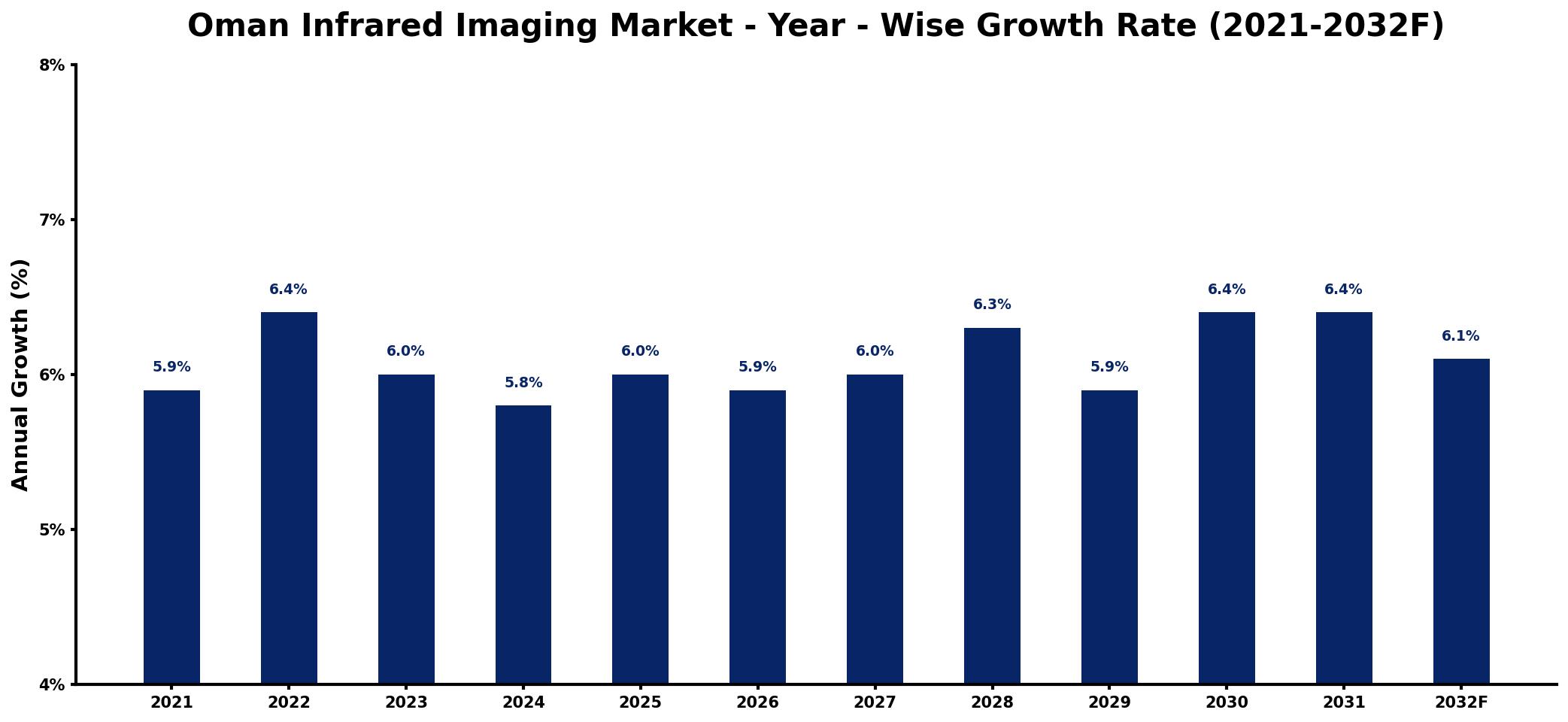
The table below presents the year‑wise growth rates along with the key drivers influencing the market
| Year | Growth Rate | Major Drivers |
| 2021 | 5.9% | Rising demand in healthcare sector |
| 2022 | 6.4% | Increased investments in technology |
| 2023 | 6.0% | Growing applications in security |
| 2024 | 5.8% | Expansion in industrial automation |
| 2025 | 6.0% | Advancements in research applications |
| 2026 | 5.9% | Surge in renewable energy projects |
| 2027 | 6.0% | Growth in construction monitoring |
| 2028 | 6.3% | Enhanced agricultural productivity needs |
| 2029 | 5.9% | Rising interest in environmental studies |
| 2030 | 6.4% | Boost in military applications demand |
| 2031 | 6.4% | Increased focus on safety regulations |
| 2032 | 6.1% | Expansion of smart city initiatives |
Note: Market size estimations and growth projections presented in this report are based on 6Wresearch's proprietary forecasting methodology, utilizing the latest available industry data, government publications, and primary research inputs.
Oman Infrared Imaging Market Synopsis
In recent years, the Oman infrared imaging market has experienced significant momentum, spurred by an expanding awareness of the benefits of infrared technology. However, as the market matures, a diverse range of applications is emerging, particularly within healthcare and industrial inspection, where precise thermal data can lead to improved outcomes.
Looking ahead, the market is poised for continued growth driven by government support and increasing investment in cutting-edge technologies. As businesses adopt advanced infrared solutions, the potential for innovation and enhanced performance in sectors like automotive and security will become increasingly apparent.
Oman Infrared Imaging Market Key Takeaways
- The market is estimated at USD 361 Million in 2025, expected to grow to USD 514 Million by 2032.
- There is a rising demand for non-invasive imaging solutions across multiple sectors.
- Technological advancements are pivotal in shaping market growth and adoption rates.
- Government policies are facilitating the uptake of infrared imaging technologies.
- Omans industrial and healthcare sectors are key drivers of market expansion.
Evaluation of Restraints in Oman Infrared Imaging Market
Despite the favorable growth landscape, the Oman infrared imaging market faces several challenges that may hinder its full potential. Ensuring the accuracy and reliability of imaging systems is a significant concern, as discrepancies can lead to improper diagnoses and safety risks. Additionally, the complexity of analyzing infrared data requires a skilled workforce, which may be in short supply. Thermal calibration is another critical aspect that can limit system performance, necessitating ongoing investment and resources to maintain optimal functionality.
Oman Infrared Imaging Market Trends
Several trends are shaping the demand for infrared imaging technology in Oman. Firstly, there is a noticeable shift towards smart technologies, integrating infrared imaging with artificial intelligence to enhance diagnostic accuracy and processing speed. Secondly, increased investment in healthcare infrastructure is propelling the adoption of infrared systems for various medical applications, from diagnostics to patient monitoring. Moreover, rising security concerns are driving the integration of infrared technology in surveillance systems, further broadening the market's application base.
Oman Infrared Imaging Market Opportunities
The Oman infrared imaging market presents numerous opportunities for growth and investment. With the government's push towards modernization in healthcare and industrial sectors, stakeholders can capitalize on funding and initiatives aimed at boosting the adoption of advanced imaging solutions. Additionally, as businesses seek to enhance operational efficiency and safety, there is a growing market for innovative applications that leverage infrared imaging technology. Collaborations between manufacturers and research institutions can pave the way for groundbreaking developments, solidifying Omans position as a regional leader in infrared technology.
Government Initiatives in the Oman Infrared Imaging Market
The Omani government is actively fostering the growth of the infrared imaging market through various supportive policies. Initiatives include providing financial incentives for manufacturers and channeling research funding into the development of innovative imaging technologies. Regulatory standards are being established to ensure product quality and performance, further boosting confidence in infrared solutions. Additionally, the government promotes the utilization of infrared imaging in sectors such as healthcare, security, and industrial inspection, enhancing not only operational efficiency but also safety across these crucial industries.
Future Insights of the Oman Infrared Imaging Market
Looking towards 2026-2032, the Oman infrared imaging market is expected to witness robust growth as the convergence of technology and market demand accelerates. The integration of advanced analytics and artificial intelligence will likely transform how infrared data is processed, leading to more actionable insights. Furthermore, ongoing government initiatives and industry collaborations will play a significant role in driving innovation and adoption rates. The market is poised for transformation, particularly within healthcare and industrial applications, setting the stage for a vibrant ecosystem of infrared imaging solutions.
Oman Infrared Imaging Market Latest Developments (2025 - 2026)
In the past year, the Oman infrared imaging market has seen a shift towards advanced thermal imaging technologies, with increased collaborations between local manufacturers and international tech firms. There has also been a notable increase in awareness about the capabilities of infrared systems, leading to higher adoption rates in healthcare and industrial sectors. Additionally, government-led initiatives aimed at enhancing infrastructure for diagnostics and surveillance have gained momentum, encouraging further investment in infrared technologies.
Oman Infrared Imaging Market - Key Attractiveness of the Report
- 10 Years of Market Numbers
- Historical Data Starting from 2022 to 2025
- Base Year: 2025
- Forecast Data until 2032
- Key Performance Indicators Impacting the Market
- Major Upcoming Developments and Projects
Key Highlights of the Report:
- Oman Infrared Imaging Market Outlook
- Market Size of Oman Infrared Imaging Market, 2025
- Forecast of Oman Infrared Imaging Market, 2032
- Historical Data and Forecast of Oman Infrared Imaging Revenues & Volume for the Period 2022-2032F
- Oman Infrared Imaging Market Trend Evolution
- Oman Infrared Imaging Market Drivers and Challenges
- Oman Infrared Imaging Price Trends
- Oman Infrared Imaging Porter's Five Forces
- Oman Infrared Imaging Industry Life Cycle
- Historical Data and Forecast of Oman Infrared Imaging Market Revenues & Volume By Technology for the Period 2022-2032F
- Historical Data and Forecast of Oman Infrared Imaging Market Revenues & Volume By Cooled Infrared Imaging for the Period 2022-2032F
- Historical Data and Forecast of Oman Infrared Imaging Market Revenues & Volume By Uncooled Infrared Imaging for the Period 2022-2032F
- Historical Data and Forecast of Oman Infrared Imaging Market Revenues & Volume By Wavelength for the Period 2022-2032F
- Historical Data and Forecast of Oman Infrared Imaging Market Revenues & Volume By Near Infrared for the Period 2022-2032F
- Historical Data and Forecast of Oman Infrared Imaging Market Revenues & Volume By Shortwave Infrared for the Period 2022-2032F
- Historical Data and Forecast of Oman Infrared Imaging Market Revenues & Volume By Mid-wave Infrared for the Period 2022-2032F
- Historical Data and Forecast of Oman Infrared Imaging Market Revenues & Volume By Long-wave Infrared for the Period 2022-2032F
- Historical Data and Forecast of Oman Infrared Imaging Market Revenues & Volume By Application for the Period 2022-2032F
- Historical Data and Forecast of Oman Infrared Imaging Market Revenues & Volume By Security & Surveillance for the Period 2022-2032F
- Historical Data and Forecast of Oman Infrared Imaging Market Revenues & Volume By Monitoring & Inspection for the Period 2022-2032F
- Historical Data and Forecast of Oman Infrared Imaging Market Revenues & Volume By Detection for the Period 2022-2032F
- Historical Data and Forecast of Oman Infrared Imaging Market Revenues & Volume By Vertical for the Period 2022-2032F
- Historical Data and Forecast of Oman Infrared Imaging Market Revenues & Volume By Industrial for the Period 2022-2032F
- Historical Data and Forecast of Oman Infrared Imaging Market Revenues & Volume By Nonindustrial for the Period 2022-2032F
- Oman Infrared Imaging Import Export Trade Statistics
- Market Opportunity Assessment By Technology
- Market Opportunity Assessment By Wavelength
- Market Opportunity Assessment By Application
- Market Opportunity Assessment By Vertical
- Oman Infrared Imaging Top Companies Market Share
- Oman Infrared Imaging Competitive Benchmarking By Technical and Operational Parameters
- Oman Infrared Imaging Company Profiles
- Oman Infrared Imaging Key Strategic Recommendations






































