Pakistan Digital Twin Market Size, Share & Growth Rate
The Pakistan Digital Twin Market was estimated at USD 1176 Million in 2025 and is projected to reach USD 1692 Million by 2032, growing at a CAGR of 5.3% from 2026 to 2032. This growth trajectory is propelled by the escalating need for real-time data insights across sectors such as manufacturing, construction, and healthcare. Coupled with advancements in IoT, artificial intelligence, and a government-backed drive for digital transformation, the market is rapidly evolving to meet the demands of a modernized economy.
Pakistan Digital Twin Market Year-wise Growth Rate and Key Drivers
This graph highlights how the Pakistan Digital Twin Market has steadily grown over the years, supported by major growth factors.
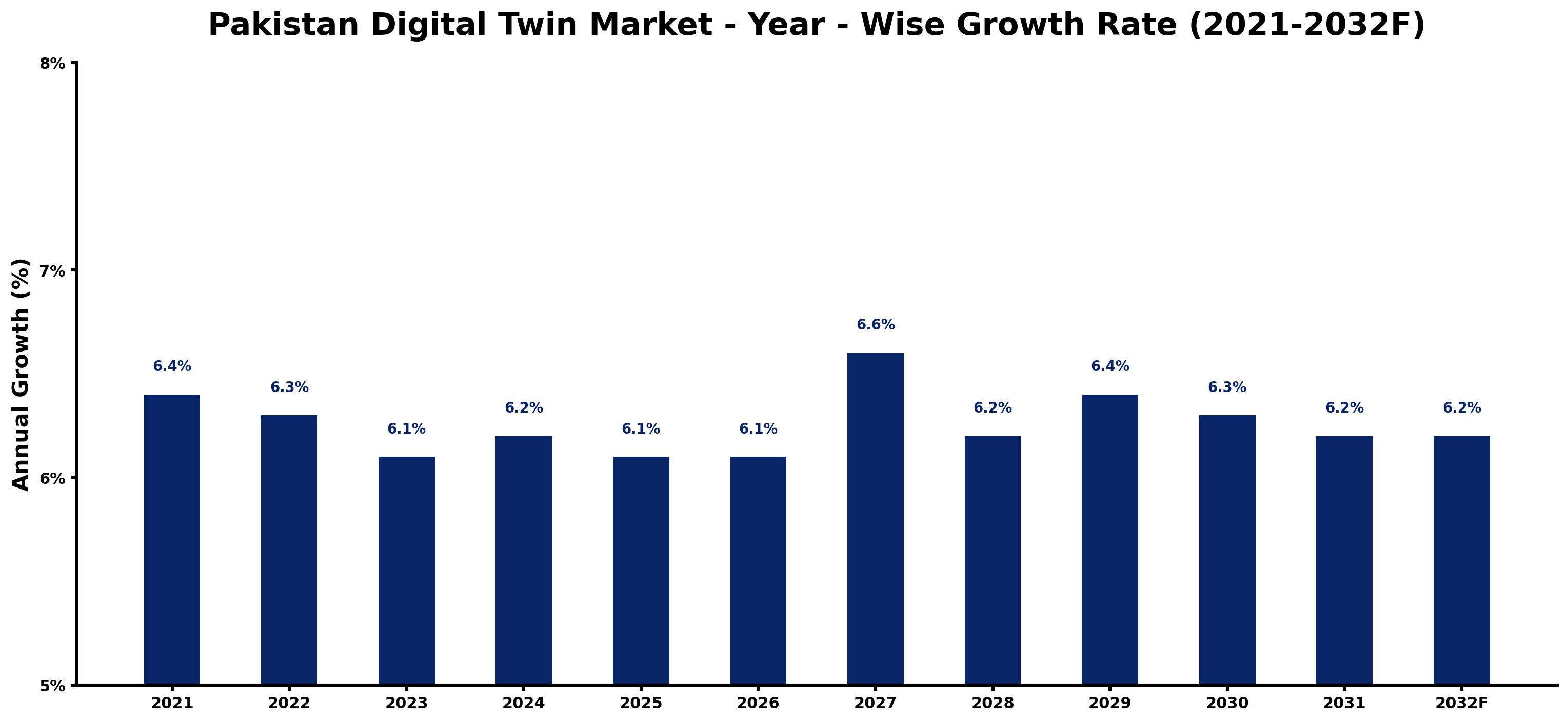
The table below presents the year‑wise growth rates along with the key drivers influencing the market
| Year | Growth Rate | Major Drivers |
| 2021 | 6.4% | Growing renewable energy integration projects |
| 2022 | 6.3% | Growing urbanization and commercial development |
| 2023 | 6.1% | Increasing adoption of advanced technologies |
| 2024 | 6.2% | Increasing adoption of advanced technologies |
| 2025 | 6.1% | Government infrastructure modernization initiatives |
| 2026 | 6.1% | Growing urbanization and commercial development |
| 2027 | 6.6% | Growing renewable energy integration projects |
| 2028 | 6.2% | Expansion of transportation and logistics networks |
| 2029 | 6.4% | Increasing smart city development projects |
| 2030 | 6.3% | Expansion of manufacturing activities |
| 2031 | 6.2% | Increasing industrial automation investments |
| 2032 | 6.2% | Growing urbanization and commercial development |
Note - Market size estimations and growth projections presented in this report are based on 6Wresearch’s advanced forecasting approach, validated with industry datasets as of June 2026.
Pakistan Digital Twin Market Synopsis
The demand for digital twin technology in Pakistan is rising as industries seek innovative ways to improve operational efficiency. Specifically, the manufacturing sector is leveraging these virtual replicas to optimize production processes and asset management, leading to substantial cost savings and enhanced performance.
On the supply side, technology providers are increasingly integrating advanced data analytics and IoT capabilities into their digital twin solutions. This integration is crucial for creating accurate digital representations that facilitate improved decision-making and predictive maintenance, fostering a more responsive industrial environment.
Pakistan Digital Twin Market Key Takeaways
- Rapid adoption across multiple industries, notably manufacturing, construction, and healthcare.
- Increasing integration of IoT devices and AI technologies enhancing predictive analytics.
- Growing focus on sustainability and energy efficiency through digital twin implementation.
- Investment opportunities in technology startups and tailored digital twin solutions.
- Supportive government policies promoting digital transformation and innovation.
Evaluation of Restraints in Pakistan Digital Twin Market
Despite its growth potential, the Pakistan Digital Twin Market faces notable restraints that could impede progress. Awareness of digital twin technology remains limited, particularly among small and medium enterprises, which often lack the resources to adopt such advanced solutions. Compounding this issue is the shortage of skilled professionals equipped to develop and implement these technologies effectively. Data privacy concerns also create hesitation among businesses contemplating adoption, while infrastructural inadequacies, such as unreliable internet connectivity and power supply, further complicate the effective implementation of digital twin solutions in the country.
Pakistan Digital Twin Market Trends
The current trends shaping the Pakistan Digital Twin Market highlight the increasing integration of IoT devices that facilitate real-time data collection. Businesses are leveraging artificial intelligence and machine learning for enhanced predictive analytics, creating smarter and more efficient operational frameworks. Additionally, the emphasis on sustainability is leading organizations to implement energy-efficient digital twins, showcasing a commitment to green practices. Furthermore, cloud-based solutions are gaining traction, allowing companies to monitor and collaborate on operations remotely, thus broadening the accessibility and usability of digital twin technologies.
Pakistan Digital Twin Market Opportunities
Investment opportunities in the Pakistan Digital Twin Market are abundant, particularly in sectors like manufacturing and infrastructure development. As the government actively pursues digital transformation initiatives, organizations are increasingly seeking customized digital twin solutions that cater to their specific operational needs. Investors can explore opportunities to develop innovative technologies or collaborate with local enterprises to adapt existing solutions for the Pakistani market. The burgeoning smart cities initiative also presents a lucrative avenue for integrating digital twin technologies to enhance urban planning and resource management.
Government Initiatives in the Pakistan Digital Twin Market
The government of Pakistan is actively fostering an environment conducive to digital innovation through its Digital Pakistan Policy. This initiative aims to enhance digital infrastructure and promote the widespread adoption of emerging technologies. While explicit policies targeting the digital twin market may not be in place, the overarching focus on e-governance, improved connectivity, and technology adoption creates a supportive framework for the growth of digital twin solutions. Collaborations between governmental bodies and private sector stakeholders are expected to catalyze further advancements in this space.
Future Insights of the Pakistan Digital Twin Market
Looking ahead to 2026-2032, the Pakistan Digital Twin Market is set for remarkable expansion as industries increasingly recognize the potential of digital twin technologies. The drive toward Industry 4.0 will continue to fuel demand, as businesses strive for enhanced efficiency and innovation. With advancements in AI, IoT, and big data analytics paving the way for smarter operational processes, the market is likely to attract significant investment. Enhanced collaborations among technology providers, research institutions, and industry players will be essential in advancing the capabilities and applications of digital twin technology across Pakistan.
Pakistan Digital Twin Market Latest Developments (May 2025 - June 2026)
The Pakistan Digital Twin Market is witnessing a flurry of activity as companies increasingly adopt digital twin technologies. Innovations in cloud-based solutions are becoming more commonplace, enabling organizations to collaborate effectively regardless of geographical barriers. Moreover, new partnerships are forming between technology providers and government entities to pilot projects aimed at enhancing public services through digital twin implementations. These developments signal a growing recognition of the value that digital twins bring to operational efficiency and decision-making processes.
Pakistan Digital Twin Market - Key Attractiveness of the Report
- 10 Years of Market Numbers
- Historical Data Starting from 2022 to 2025
- Base Year: 2025
- Forecast Data until 2032
- Key Performance Indicators Impacting the Market
- Major Upcoming Developments and Projects
Key Highlights of the Report:
- Pakistan Digital Twin Market Outlook
- Market Size of Pakistan Digital Twin Market, 2025
- Forecast of Pakistan Digital Twin Market, 2032
- Historical Data and Forecast of Pakistan Digital Twin Revenues & Volume for the Period 2022-2032F
- Pakistan Digital Twin Market Trend Evolution
- Pakistan Digital Twin Market Drivers and Challenges
- Pakistan Digital Twin Price Trends
- Pakistan Digital Twin Porter's Five Forces
- Pakistan Digital Twin Industry Life Cycle
- Historical Data and Forecast of Pakistan Digital Twin Market Revenues & Volume By End-users for the Period 2022-2032F
- Historical Data and Forecast of Pakistan Digital Twin Market Revenues & Volume By Automotive & Defense for the Period 2022-2032F
- Historical Data and Forecast of Pakistan Digital Twin Market Revenues & Volume By Home & Commercial for the Period 2022-2032F
- Historical Data and Forecast of Pakistan Digital Twin Market Revenues & Volume By Healthcare for the Period 2022-2032F
- Historical Data and Forecast of Pakistan Digital Twin Market Revenues & Volume By Energy & Utilities for the Period 2022-2032F
- Historical Data and Forecast of Pakistan Digital Twin Market Revenues & Volume By Electronics & Electrical Manufacturing for the Period 2022-2032F
- Historical Data and Forecast of Pakistan Digital Twin Market Revenues & Volume By Others for the Period 2022-2032F
- Historical Data and Forecast of Pakistan Digital Twin Market Revenues & Volume By Applications for the Period 2022-2032F
- Historical Data and Forecast of Pakistan Digital Twin Market Revenues & Volume By Product Design and Development for the Period 2022-2032F
- Historical Data and Forecast of Pakistan Digital Twin Market Revenues & Volume By Machine and Equipment Health Monitoring for the Period 2022-2032F
- Historical Data and Forecast of Pakistan Digital Twin Market Revenues & Volume By Predictive Maintenance for the Period 2022-2032F
- Historical Data and Forecast of Pakistan Digital Twin Market Revenues & Volume By Dynamic Optimization for the Period 2022-2032F
- Pakistan Digital Twin Import Export Trade Statistics
- Market Opportunity Assessment By End-users
- Market Opportunity Assessment By Applications
- Pakistan Digital Twin Top Companies Market Share
- Pakistan Digital Twin Competitive Benchmarking By Technical and Operational Parameters
- Pakistan Digital Twin Company Profiles
- Pakistan Digital Twin Key Strategic Recommendations






































